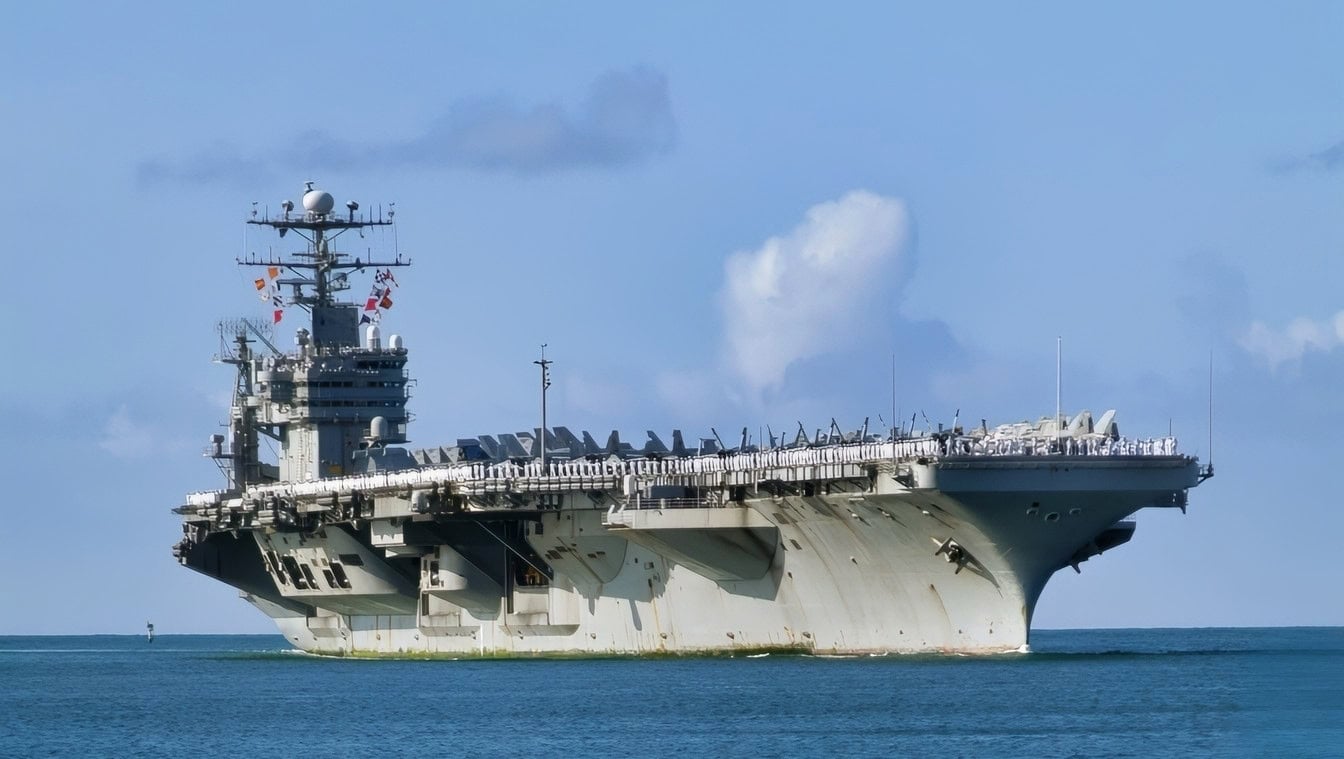
Summary and Key Points: In the summer of 2000, during the RIMPAC exercises around Hawaii, an Australian diesel-electric submarine that had been in commission for ten months went hunting. HMAS Waller displaced 3,400 tons submerged, measured 254 feet, and carried 58 people. Her targets belonged to a formation built around USS Abraham Lincoln — 1,092 feet long, up to 100,000 tons, two nuclear reactors, around 65 aircraft, and more than 5,000 sailors and aircrew, screened by surface warships and American nuclear attack submarines. Waller had spent the first part of the exercise inside that formation, the first Australian submarine ever integrated into a US carrier group. Then she changed sides. She killed two US Navy nuclear attack submarines, penetrated the surface screen, and simulated a torpedo attack on the carrier itself.
Australia’s Collins-Class Submarine vs. a US Navy Nimitz-Class Aircraft Carrier in a Drill
Warning signs about the vulnerability of American nuclear-powered aircraft carriers have been blaring for decades.
Whether it be Chinese diesel-electric submarines appearing within torpedo range of carriers, or Swedish and French submarines successfully sinking US carriers in exercises, or the ever-growing threat of missile and drone swarms to aircraft carriers, the warnings have never been clearer that the United States Navy is far too invested in these systems.
The Setting
An incredible encounter between a Nimitz-class aircraft carrier and an older Collins-class diesel-electric submarine of the Royal Australian Navy in 2000 highlights how vulnerable carriers have been to enemy fire (contrary to their consistently excellent image in the Western press).
The Nimitz-class aircraft carriers are 1,092 feet long and displace up to 100,000 tons. Two nuclear reactors power these ships, and they can carry around 65 aircraft and more than 5,000 sailors (and aircrew).
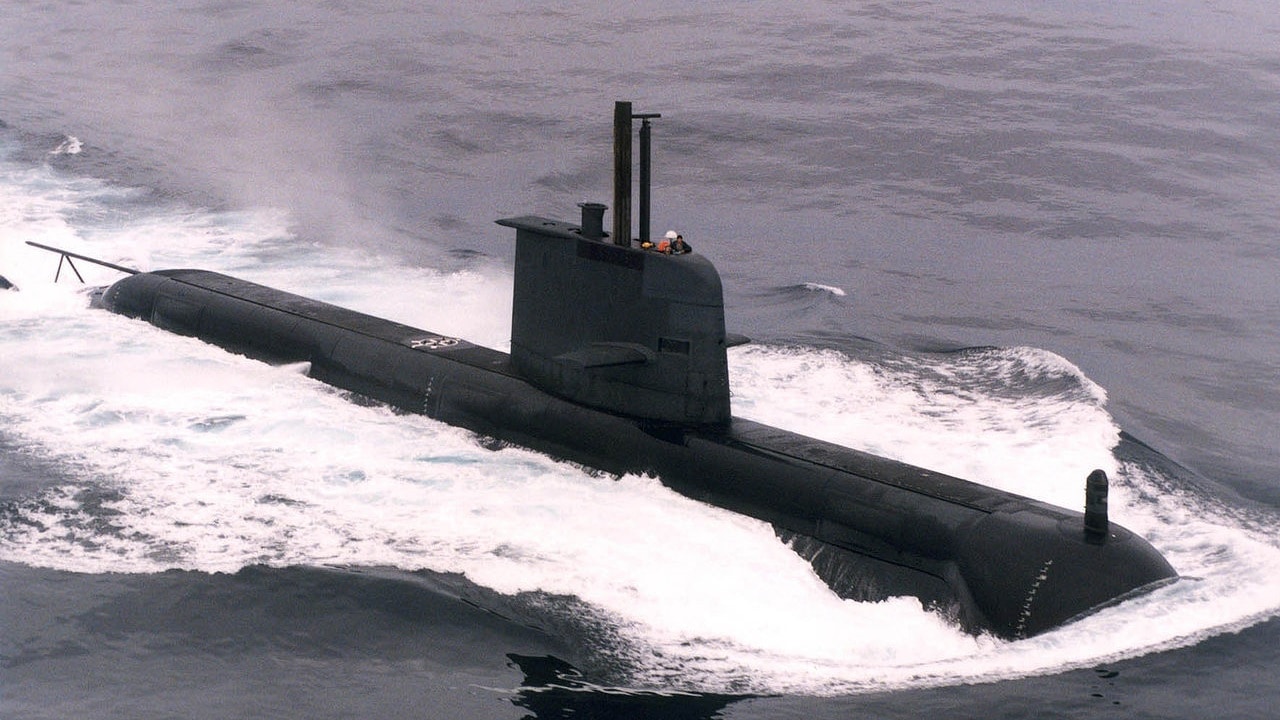
Collins-Class Submarine from Australia.
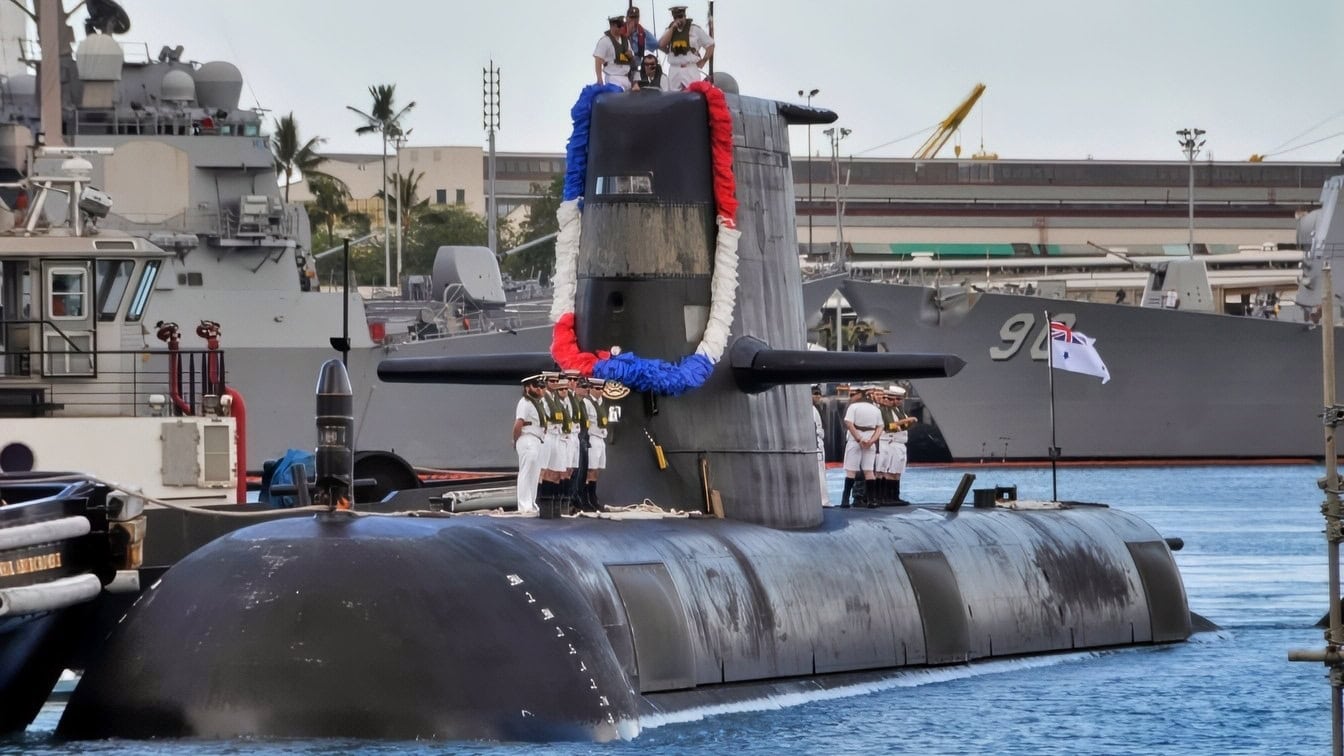
JOINT BASE PEARL HARBOR-HICKAM, Hawaii – (June 30, 2012) – Her Majesty’s Australian Ship, HMAS Farncomb (SSG 74), a Collins class submarine operated by the Royal Australian Navy, arrived at Joint Base Pearl Harbor-Hickam to participate in the Rim of the Pacific (RIMPAC) exercise, June 30. Twenty-two nations, more than 40 ships and submarines, more than 200 aircraft and 25,000 personnel will participate in the biennial RIMPAC exercise scheduled June 29 to Aug. 3, in and around the Hawaiian Islands. The world’s largest international maritime exercise, RIMPAC provides a unique training opportunity that helps participants foster and sustain the cooperative relationships that are critical to ensuring the safety of sea lanes and security on the world’s oceans. RIMPAC 2012 is the 23rd exercise in the series that began in 1971. (U.S. Navy photo by Mass Communication Specialist 1st Class Ronald Gutridge / Released)
The Navy puts an average cost of a Nimitz-class carrier at around $5.5 billion per ship.
During the Rim of the Pacific 2000 exercise (RIMPAC), one of these supercarriers was successfully hunted by an Australian diesel-electric submarine displacing just 3,400 tons (when submerged).
That submarine was the HMAS Waller, one of only six diesel-electric submarines in the Australian Navy at the time. Its target was the USS Abraham Lincoln (CVN-72). Waller got close enough to sink the Lincoln.
From May 30 to July 6, 2000, the RIMPAC 2000 multinational exercises occurred around the Hawaiian Islands. More than 22,000 personnel, 50 ships, and 200 aircraft partook in the event.
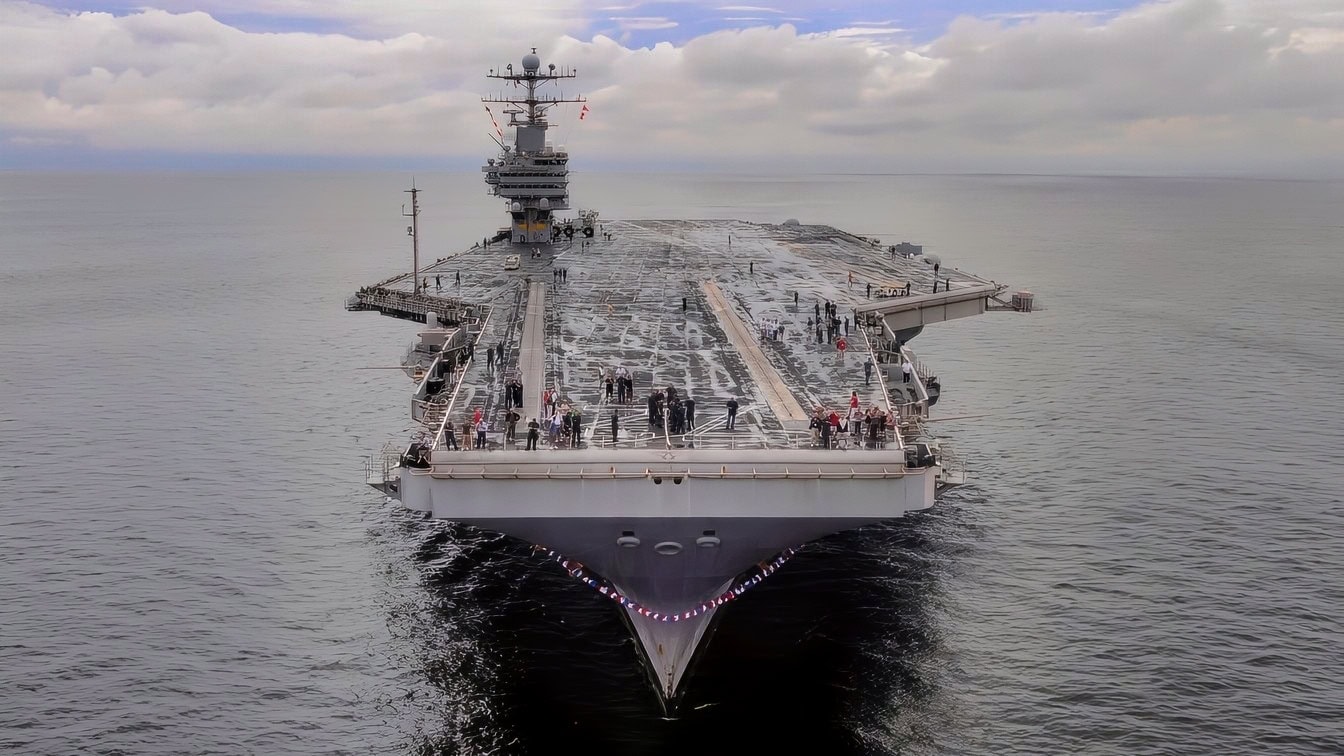
ATLANTIC OCEAN (Aug. 7, 2012) — The aircraft carrier USS Abraham Lincoln (CVN 72) arrives at it’s new homeport at Naval Station Norfolk. Lincoln deployed as part of Carrier Strike Group (CSG) 9 in support of maritime security operations (MSO) and theater security cooperation (TSC) efforts in the U.S. Navy’s 5th , 6th and 7th Fleet areas of responsibility. (U.S. Navy photo by Mass Communication Specialist Petty Officer 3rd Class (SW/AW) Desiree D. Green/Released)
Australia, Canada, Chile, South Korea, the United Kingdom, and, of course, the United States were all there.
Ten months after she was first commissioned by the Australian Navy (July 10, 1999), the HMAS Waller arrived at Pearl Harbor on May 28, 2000.
Waller had been laid down on March 19, 1992, and ultimately launched on March 14, 1997.
The “Attack”
Initially, HMAS Waller operated as part of the US carrier battle group, becoming the first Australian submarine integrated into a US carrier force.
Then the Australians changed sides for the duration of the RIMPAC 2000 exercise.
In its role as an attacker, the Waller successfully attacked not one but two US Navy nuclear-powered attack submarines before finally penetrating the surface screen provided by warships defending the Abraham Lincoln.
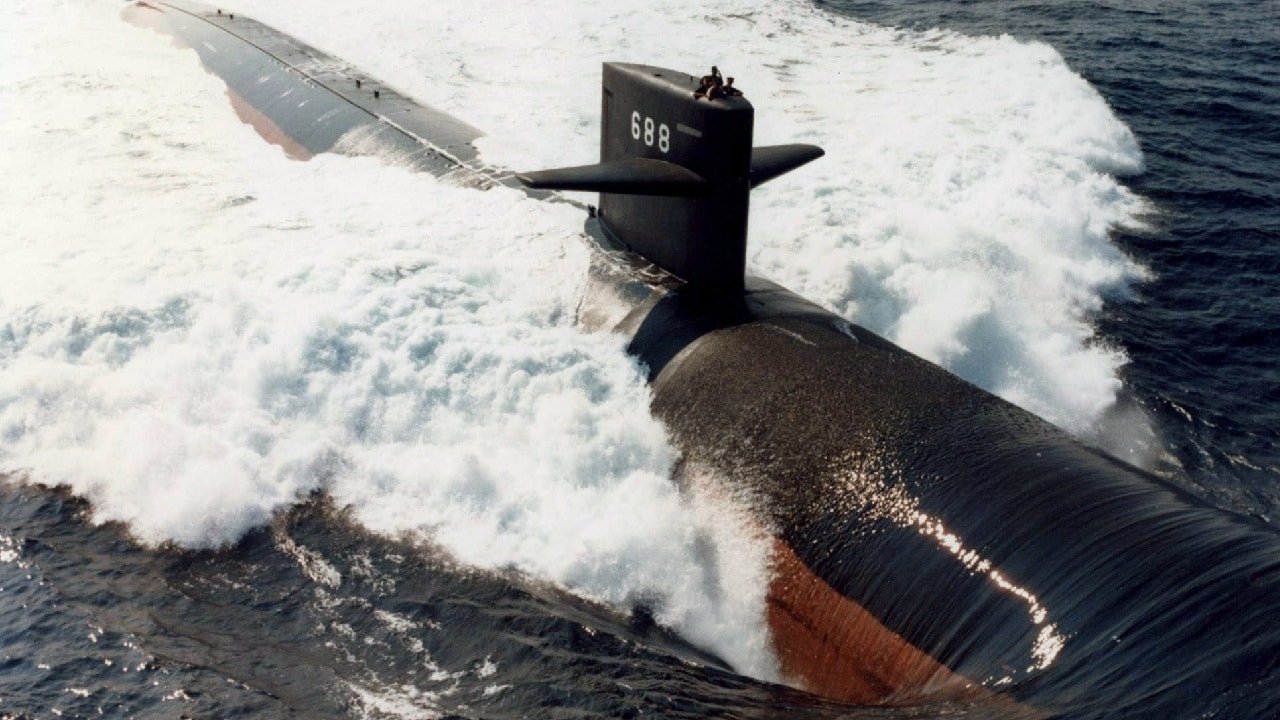
Los Angeles-class attack submarine. Image Credit: Creative Commons.
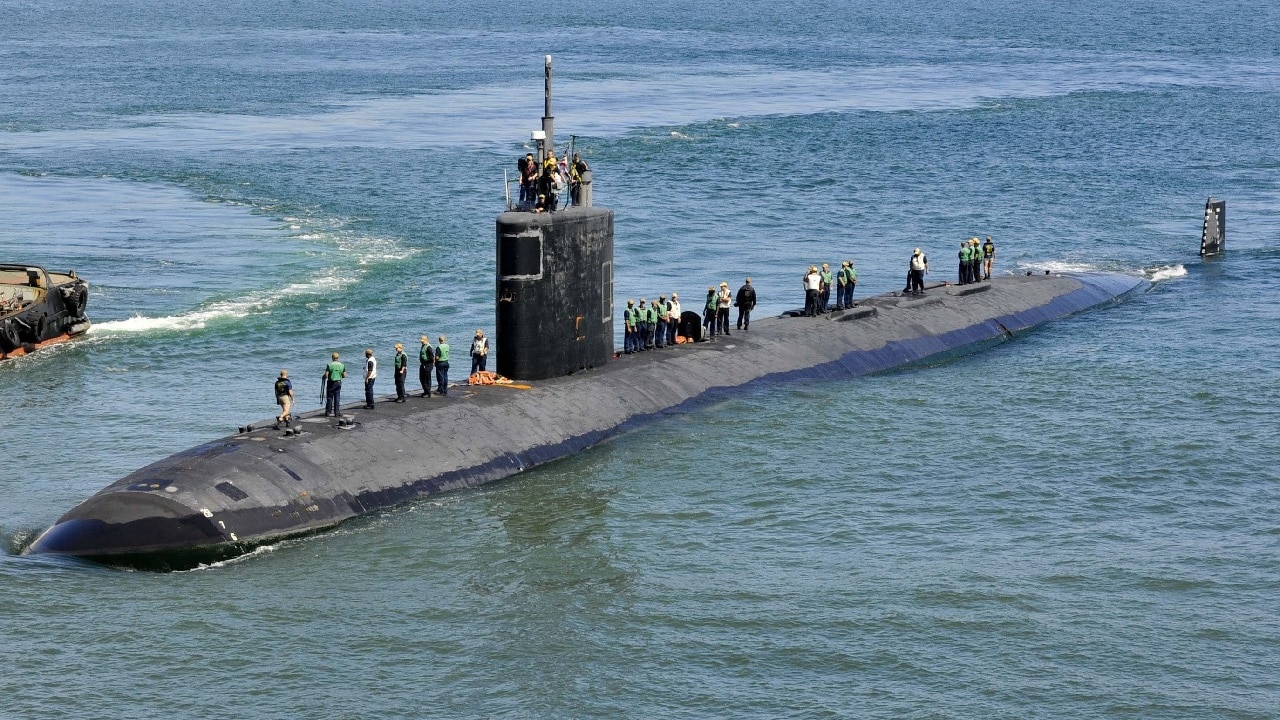
PUERTO PRINCESSA, Philippines – (Dec. 9, 2018) – The Los Angeles-class attack submarine USS Greenville (SSN 772) prepares to moor alongside the submarine tender USS Emory S. Land (AS 39), Dec. 9. Emory S. Land is a forward-deployed expeditionary submarine tender on an extended deployment conducting coordinated tended moorings and afloat maintenance in the U.S. 5th and 7th Fleet areas of operations. (U.S. Navy photo by Mass Communication Specialist 2nd Class Daniel Willoughby/RELEASED)
Once the wily Waller penetrated that screen, the Australian submarine simulated its attack on the carrier.
Thus, the Waller had successfully simulated an attack on an American Nimitz-class aircraft carrier, sending shockwaves through the US Navy.
Back in 1986, the Royal Australian Navy signed a contract for 3.9 billion Australian dollars to acquire six Collins-class diesel-electric attack submarines (at 1986 prices).
By December 1999, the approved project had reached 5.1 billion Australian dollars (at around 850 million Australian dollars per submarine).
While those figures are large for a smaller military, like Australia’s, the Abraham Lincoln’s cost figures were far greater.
Commissioned in 1989, the carrier cost more than $3 billion to build.
Throw in the operating costs of the carrier, the costs of maintaining the air wing, and the expense of the warships and submarines that comprise the carrier’s attendant battle group, and the US taxpayer forks over billions of dollars.
Despite the size of the carrier, as well as the size of its attendant battle group and air wing, a single, relatively small, Australian diesel-electric submarine was able to “sink” that carrier.
The Collins-Class Specs
As for the Collins-class submarines, size is relative. Compared to the carrier and its battle group, it’s small. When compared to many other diesel-electric subs, though, the Collins-class is big.
Each submarine of this class measures around 254 feet long and displaces 3,400 tons when submerged.
Three 18-cylinder diesel engines drive three 1,400-kilowatt generators, while a 7,200-horsepower electric motor drives a single 13.8-foot, seven-bladed propeller.
On the surface, the submarine has a top speed of 10 knots, but when submerged, she can push it to 20 knots.
In terms of armament, the Collins-class possesses six 533mm (21-inch for US audiences) torpedo tubes.
Modernized Collins-class submarines can carry Mk 48 Mod 7 CBASS heavyweight torpedoes and UGM-84 Harpoon anti-ship missiles.
It can also carry up to 44 mines (instead of torpedoes).
And here’s where things get very dangerous for modern nuclear-powered aircraft carriers: the diesel-electric submarine, while cheaper and likely not as advanced as the nuclear-powered submarine, is quieter.
A diesel-electric submarine can shut down its diesel engines underwater and operate solely on batteries.
At low speed, the sound generated is negligible.
Why Can’t the US Resist Attacks From Diesel-Electric Submarines
During RIMPAC 2000, Waller exploited that advantage.
What’s most remarkable about that tidbit is that the Collins-class submarines early in their life cycle struggled through noise-related complications due to their diesel engines, propellers, and other combat systems initially being too loud.
Australia was made to spend 266 million Australian dollars on a “Fast Track” improvement plan.
By the time the Waller went up against the Abraham Lincoln and its carrier battle group at RIMPAC 2000, those problems had been fixed.
A year later, the Waller reportedly “sank” two US amphibious assault ships while operating in water only slightly deeper than 70 meters, although the submarine was destroyed in the operation.
In 2002, the HMAS Sheean, another Collins-class submarine, sank a Los Angeles-class submarine in a drill.
In 2000, though, a 3,400-ton, 58-man, much cheaper Collins-class diesel-electric attack submarine cut through a Nimitz-class aircraft carrier battle group like butter and then scored a direct simulated hit on the carrier itself. That is a stunning defeat, even if only a simulated one.
About the Author: Brandon J. Weichert
Brandon J. Weichert is the Senior National Security Editor at 19FortyFive.com. He also manages The Weichert Brief on Substack. Weichert also hosts “National Security Talk” on Rumble. He is the author of four bestselling national security books, the most recent of which is A Disaster of Our Own Making: How the West Lost Ukraine (Encounter Books). Follow him via Twitter/X @WeTheBrandon.