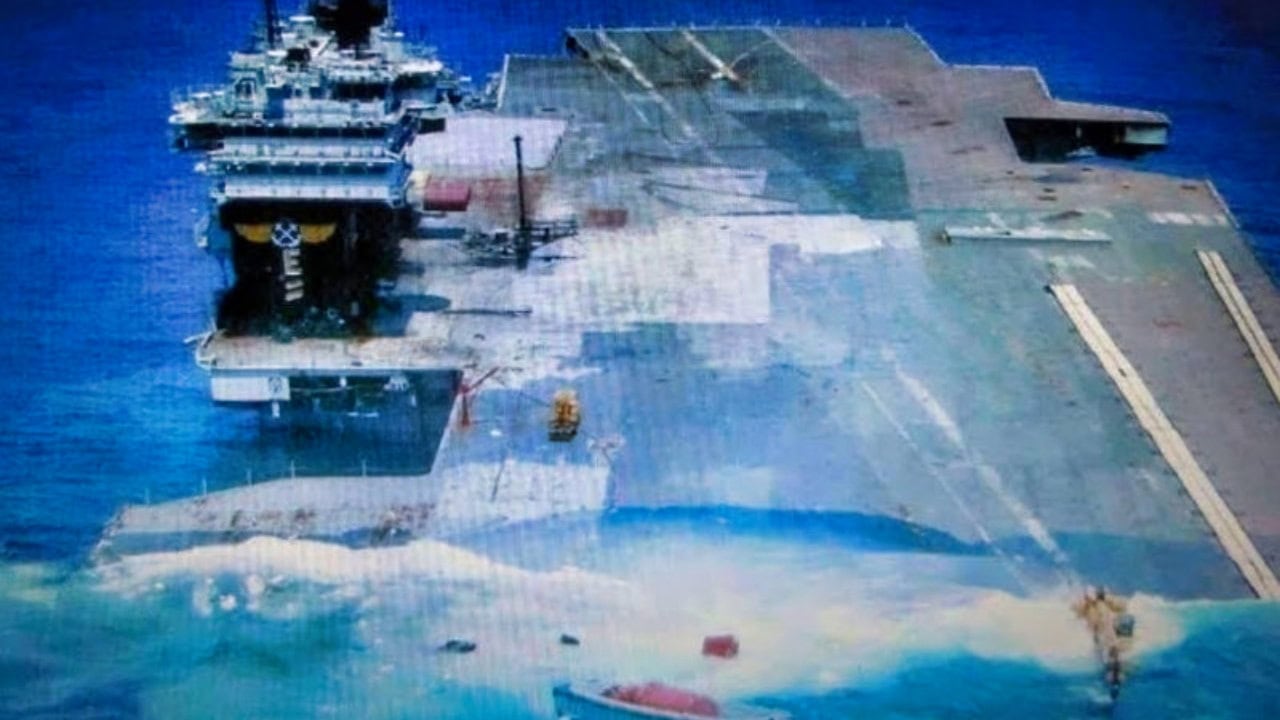
Summary and Key Points: When the US Navy set out to sink the decommissioned aircraft carrier USS America in 2005, it took 4 weeks. There was no crew aboard, no one fighting the flooding, and no one trying to save her. That is the measure of how hard it is to put a supercarrier on the bottom, and it is why sinking one was never a realistic objective. A carrier’s entire contribution to a battle is its air wing. Damage the flight deck, the catapults, or the arresting gear badly enough, and the ship stops contributing anything at all — while remaining perfectly afloat. The US Navy has 11 carriers on paper and can realistically deploy about 4; a carrier knocked out of the fight joins a repair queue at yards already short-staffed and slips.
Iran vs. US Navy Aircraft Carriers: Who Wins?
The Islamic Republic of Iran demonstrated a remarkable feat: successfully targeting an American Nimitz-class nuclear-powered aircraft carrier with an advanced medium-range ballistic missile, the Qassem Basir.
Of course, the Iranians did not hit the aircraft carrier.
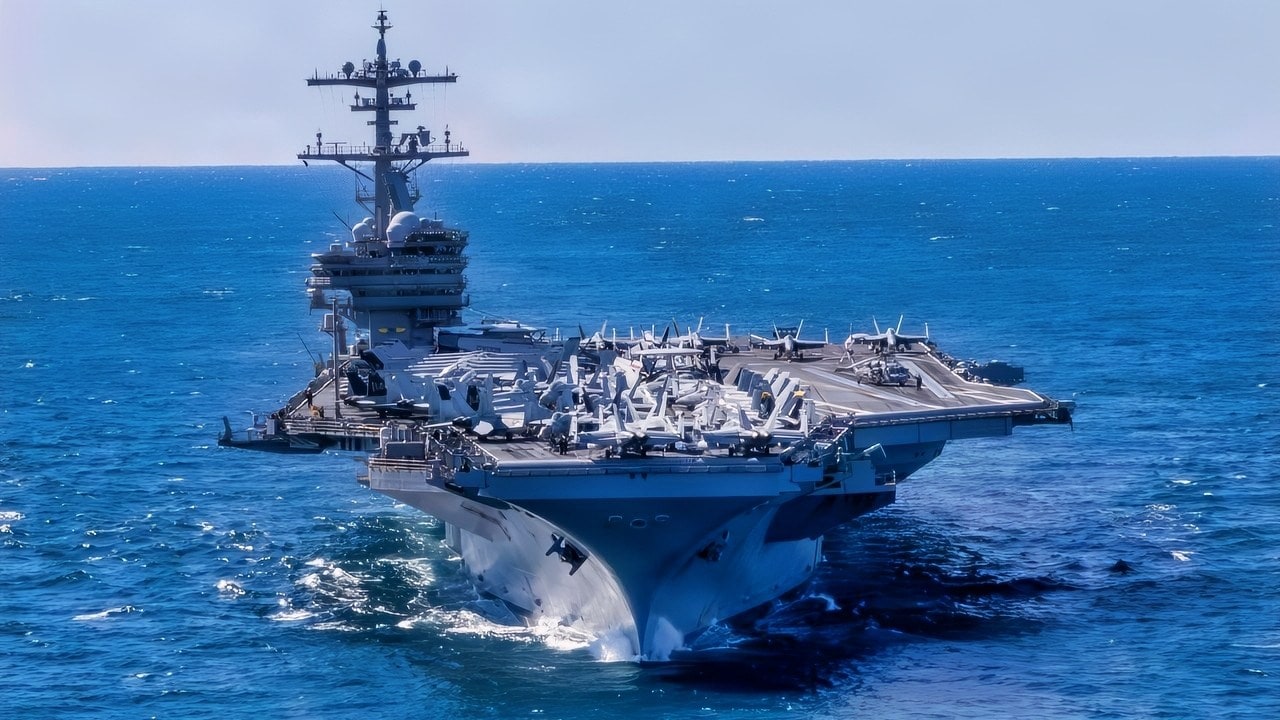
The Nimitz-class aircraft carrier USS George H.W. Bush transits the Atlantic Ocean, Feb. 8, 2026. The George H.W. Bush Carrier Strike Group is at sea training as an integrated warfighting team. Composite Training Unit Exercise (COMPTUEX) is the Joint Force’s most complex integrated training event and prepares naval task forces for sustained high-end Joint and combined combat. Integrated naval training provides combatant commanders and America’s civilian leaders highly capable forces that deter adversaries, underpin American security and economic prosperity, and reassure Allies and partners. (U.S. Navy photo by Mass Communication Specialist 2nd Class Jayden Brown)
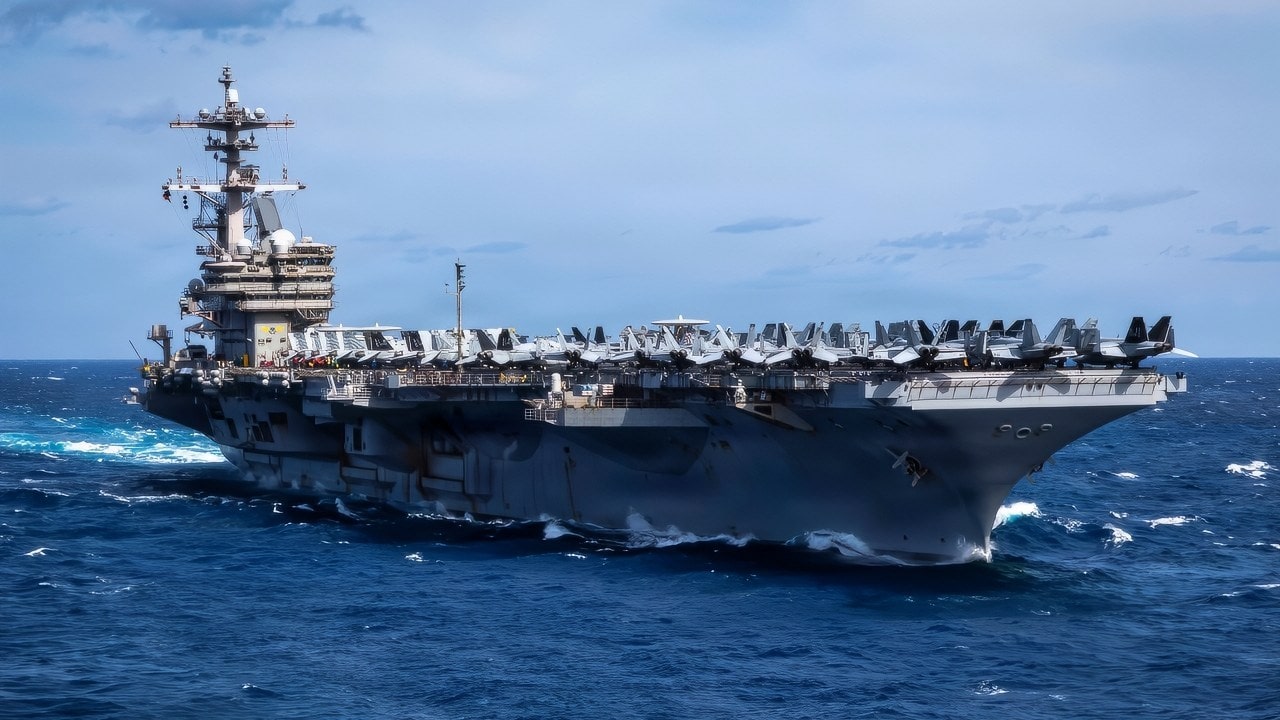
The Nimitz-class aircraft carrier USS George H.W. Bush (CVN 77) transits the Atlantic Ocean, Feb. 15, 2026. The George H.W. Bush Carrier Strike Group is at sea training as an integrated warfighting team. Composite Training Unit Exercise (COMPTUEX) is the Joint Force’s most complex integrated training event and prepares naval task forces for sustained high-end Joint and combined combat. Integrated naval training provides combatant commanders and America’s civilian leaders highly capable forces that deter adversaries, underpin American security and economic prosperity, and reassure Allies and partners. (U.S. Navy photo by Mass Communication Specialist 2nd Class Mitchell Mason)
But they got close enough with their new missile to force the carrier and its attendant guided-missile destroyer to take evasive action lest the Qassem Basir possibly strike them.
Breaking the Carrier
What the Iranians demonstrated was a proof of concept.
If needed, the Islamic Republic could likely damage an American flat top in combat.
Especially if the Iranians launched a volley of missiles and drone swarms (if the carrier was close enough to Iranian territory) at the carrier, that would have overwhelmed the ship’s defensive screen.
For now, it seems that CENTCOM will keep the carrier out of range of the Qassem Basir (which can travel more than 1,000 kilometers when fired).
But fighting at that distance creates complications for the US Navy, reducing the combat effectiveness of the carrier and its air wing’s combat effectiveness by stretching the carrier’s fuel and logistical supply chain supporting its combat operations.
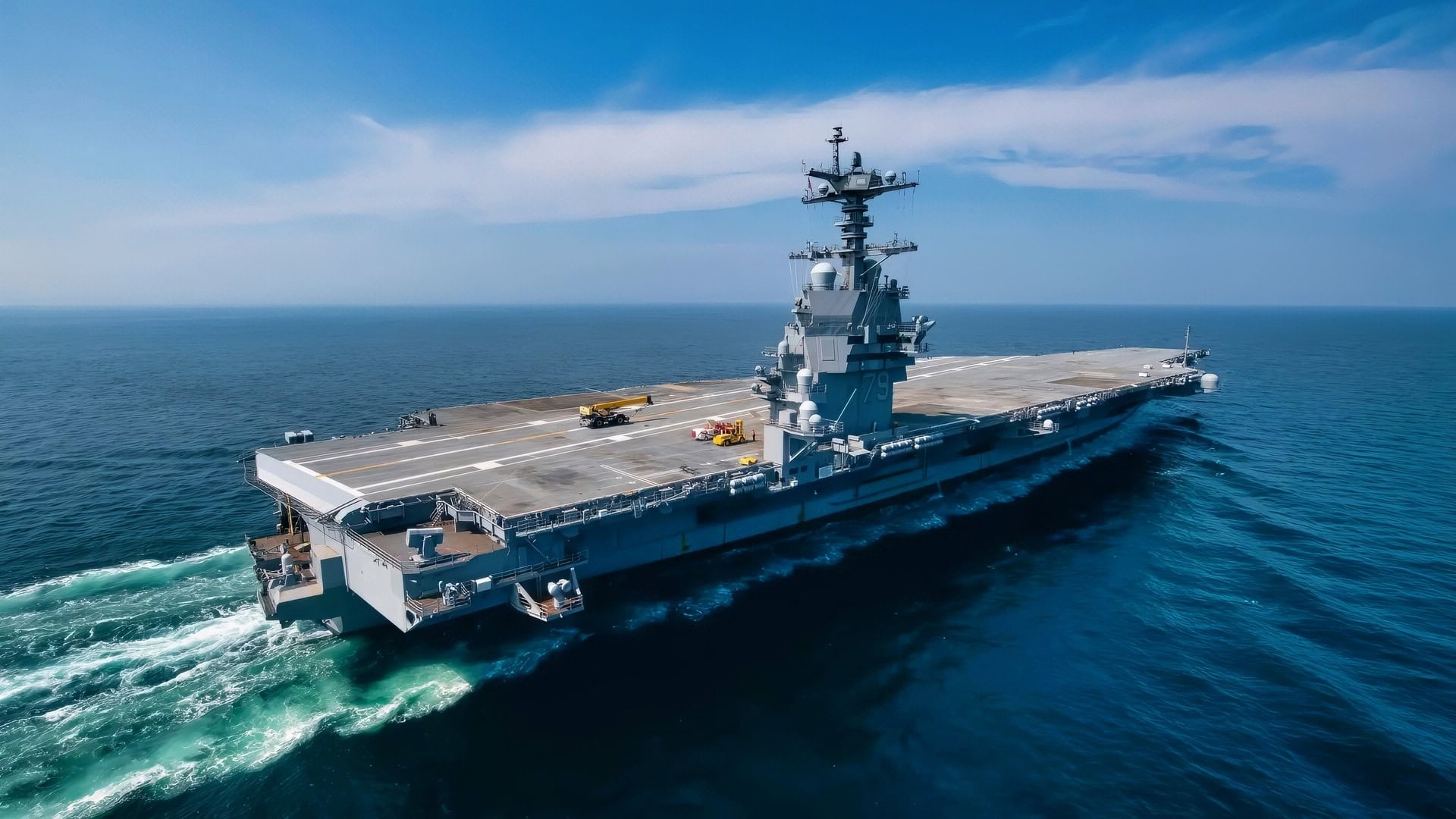
Ford-class Aircraft Carrier Industry Photo Handout
That, of course, is the real point of the Iranian strike.
To push the carrier back far enough to ensure that it doesn’t pose much of a threat to Iran or Iranian shipping utilizing the Strait of Hormuz (SoH), which the Americans have tried (and only partly succeeded) to blockade since the Iranians effectively took control of the SoH in the early part of the war.
The Carrier’s Defenses
But the Qassem Basir MRBM does pose a threat to the carrier.
At the same time, sinking a modern US carrier is very hard. For starters, modern supercarriers possess heavily armored hulls.
They are built with specialized internal compartmentalization to mitigate the risk of flooding if the ship were successfully attacked either by an anti-ship ballistic missile (ASBM) or torpedoes fired from a submarine.
There are also complex and redundant damage-control systems that would make sinking an aircraft carrier very difficult even for the most advanced attacking force.
In fact, the 2005 US Navy scuttling of the USS America highlighted how difficult it’d be for an attacker to sink a modern American carrier.
Plus, the crew on board is well-trained and capable of implementing robust damage-control measures that would likely keep the ship afloat.
The presence of the carrier’s Aegis-class destroyers further complicates the task for attackers.
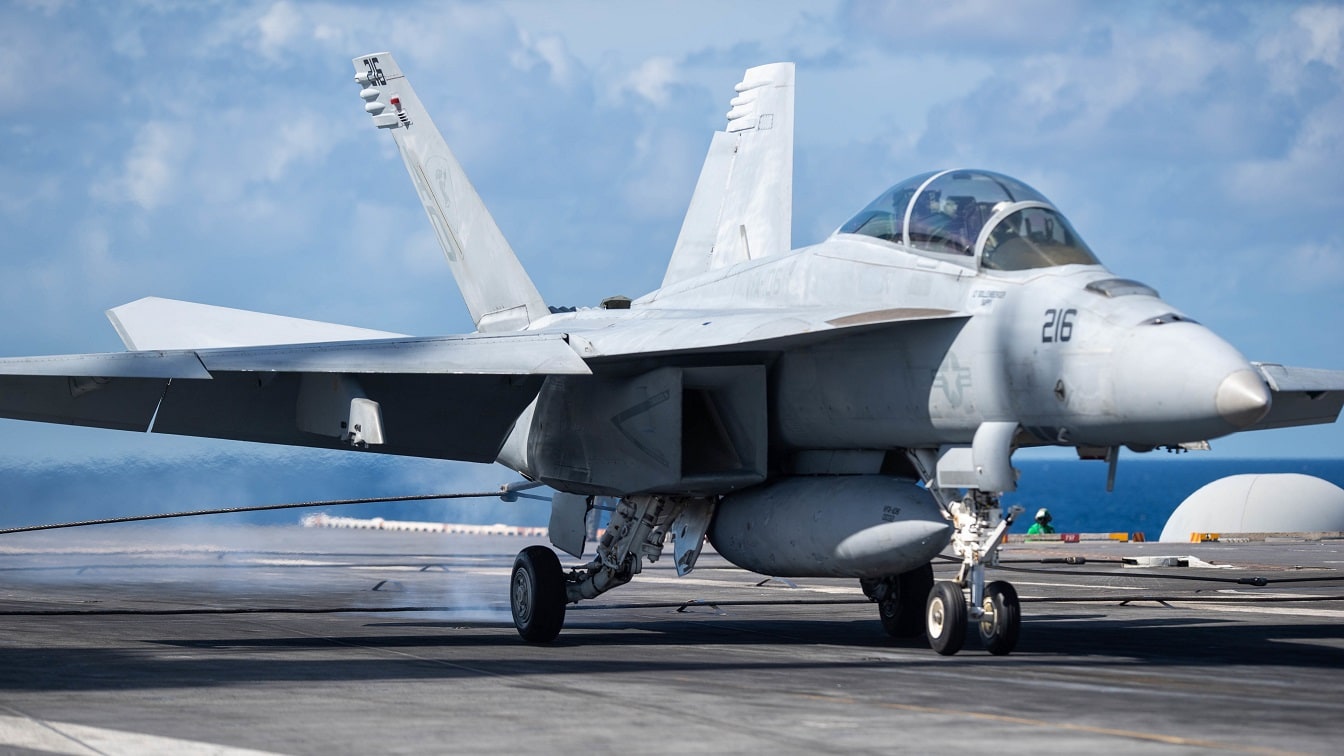
An F/A-18F Super Hornet, assigned to Strike Fighter Squadron (VFA) 106, catches an arresting gear wire while landing on the flight deck of the aircraft carrier USS John C. Stennis (CVN 74) in the Atlantic Ocean, Nov. 4, 2019. The John C. Stennis is underway conducting routine operations in support of Commander, Naval Air Force Atlantic. (U.S. Navy photo by Mass Communication Specialist 2nd Class Grant G. Grady)
At the same time, advanced electronic warfare (EW) decoys can make it harder for attacking missiles or drones to lock onto the carrier.
Carriers can travel fast, too. Most people assume that because of their size, carriers are slow.
Yet the carrier can travel at a fast clip—more than 30 knots when needed.
They can also evade attacks reliably. Of course, there is no foolproof way to prevent swarming attacks of advanced drones and missiles.
And if a carrier operates in a geographically limited area, such as within the SoH, it becomes harder to evade an attack. In the open waters, though, the carrier’s defenses become more effective.
Being Rendered Combat-Ineffective
What really threatens the carriers, therefore, is not the prospect of being sunk.
Instead, it is the possibility of the carrier’s flight deck or support systems being damaged sufficiently to render the carrier combat-ineffective.
The carrier does not bring a variety of weapons into battle.
On its own, it also lacks robust defenses.
Instead, the carrier brings large numbers of aircraft, both fixed-wing and rotorblade, to bear.
The air wing is the carrier’s contribution to battle.
And if the carrier cannot launch and recover aircraft, even if the ship isn’t sinking and its other systems are working well, the carrier becomes a sunk cost from a strategic perspective.
Once a carrier loses its ability to launch and recover aircraft, it will take years to repair and restore it to operational effectiveness.
In the meantime, critical gaps will emerge in the Navy’s surface warfare fleet, as the Navy has placed the carrier at the center of its power-projection capabilities.
While the Navy possesses 11 aircraft carriers on paper, nowhere near that number can be deployed at once. At most, the Navy can send out four carriers.
But that number is even a stretch, as the Iran War has demonstrated. Maintaining these ships in peacetime is complex and expensive enough.
Under wartime conditions, it is downright hard.
If the Navy had one of its vaunted carriers knocked out by an Iranian anti-ship ballistic missile attack, the ship would be brought back to the shipyard, where it would wait in a queue of other warships that are backlogged.
Once in drydock, the Navy would struggle to expedite repairs and redeployment due to a chronic shortage of shipyard workers and limited slips.
What’s more, the shipyard tasked with repairing a stricken carrier would face severe supply chain bottlenecks.
Feeling the Squeeze
In essence, the US Navy’s surface warfare fleet would feel the strategic squeeze at a time when America’s rivals were putting the strained force under immense pressure — so much so that the fleet could break under that pressure simply because the infrastructure supporting that strained fleet would give out.
That’s the real threat that Iranian and Chinese ASBMs pose to the American carrier fleet.
The loss of even one carrier due to damage sustained in combat could send it to the shipyard for years, and the Navy would lack requisite replacements on hand to sustain its global commitments at a time when America’s enemies were on the march.
This is what strategic defeat and the death of a military superpower looks like. It’s the slow bleed rather than the quick kill.
And the US carrier force is on the front lines of that fight.
About the author: Brandon J. Weichert
Brandon J. Weichert is the Senior National Security Editor at 19FortyFive.com. He also manages The Weichert Brief on Substack. Weichert also hosts “National Security Talk” on Rumble. He is the author of four bestselling national security books, the most recent of which is A Disaster of Our Own Making: How the West Lost Ukraine (Encounter Books). Follow him via Twitter/X @WeTheBrandon.