
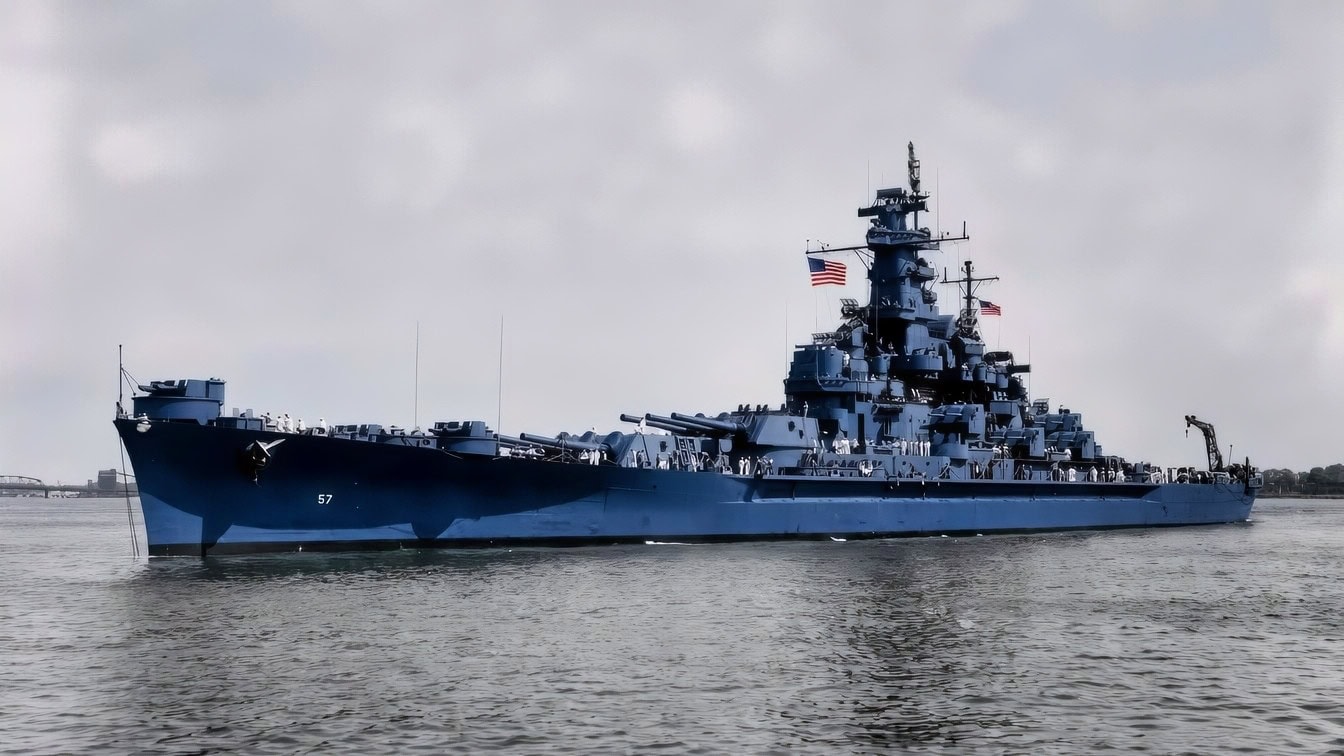
Summary and Key Points: On the night of 14-15 November 1942, off Guadalcanal, the USS South Dakota suffered a cascading electrical failure that blacked out her radar, her fire control, and her radios. In the minutes that followed, she was illuminated and hit repeatedly by Japanese shellfire across her superstructure. The damage never threatened her buoyancy, but 40 of her crew were killed. Among the men aboard was Seaman First Class Calvin Graham, who was twelve years old. Graham had lied about his age on his enlistment papers, which in 1942 was easy enough to do — manpower mattered more than background checks — and he went to one of the most violent surface actions of the Pacific war as a child.
Meet the US Navy Battleship USS South Dakota:
South Dakota is known as the “Mount Rushmore State” and is also a very military-friendly state—as evidenced by Ellsworth AFB, the current home of the B-1B Lancer, AKA the “Bone,” and future home of the B-21 Raider—and despite being a landlocked state, it became the namesake of four United States Navy warships.
Today, we shall discuss the third such ship, which was not only the biggest and most famous of the bunch but indeed lent her name to an entire class of USN fast battleships: the World War II battleship USS South Dakota (BB-57).
WWII South Dakota (BB-57) Initial History, Premise, and Vital Stats
As our ever-astute readers have probably already guessed from her name, the WWII iteration of USS South Dakota was the eponymous lead vessel of the four-ship-strong South Dakota-class, along with the USS Indiana (BB-58), USS Massachusetts (BB-59), and USS Alabama (BB-60). She was built by the New York Shipbuilding Corporation–which was actually located in the state of New Jersey, just like the home stadium of the so-called New York Jets and “New York Football Giants” of the National Football League; her keel was laid on 5 July 1939, she was launched on 7 June 1941, and she was commissioned on 20 March 1942.
The South Dakotas’ main battery consisted of nine 16-inch (406 mm)/45 caliber Mark 6 guns: two triple-gun turrets fore and one such turret aft. Secondary armament consisted of 20 5-inch (127 mm)/38 caliber Mark 12 guns, and tertiary armament was 76 Bofors 40 mm and 67 × Oerlikon 20 mm anti-aircraft guns.
Other vital stats included a hull length of 680 feet, a beam width of 108 feet 2 inches, a draft of 36 feet 2 inches, and a fully laden displacement of 45,233 tons.
Max speed was 27.5 knots. Crew complement was 2,634 commissioned officers and 1,772 enlisted seamen. The main armor belt was 12.2 inches at its thickest point.
Operational History in Brief
Alas, USS South Dakota’s most famous combat moment—which was also her “blooding” in battle—was a rather inauspicious one.
BB-57 was a participant in the Second Naval Battle of Guadalcanal on 14-15 November 1942, whereupon the North Carolina-class battleship USS Washington (BB-56) sank the Imperial Japanese Navy (IJN) battleship Kirishima along with the IJN destroyer Ayanami.
Unfortunately, the South Dakota didn’t score a single hit on the IJN adversaries in this engagement and therefore didn’t share in USS Washington’s glory & accolades; she was instead rendered hors de combat due to electrical failures that soon led to her sustaining multiple Japanese shellfire hits to her superstructure, which fortunately didn’t threaten her buoyancy but did cost 40 of her men killed in action and an additional 180 wounded.
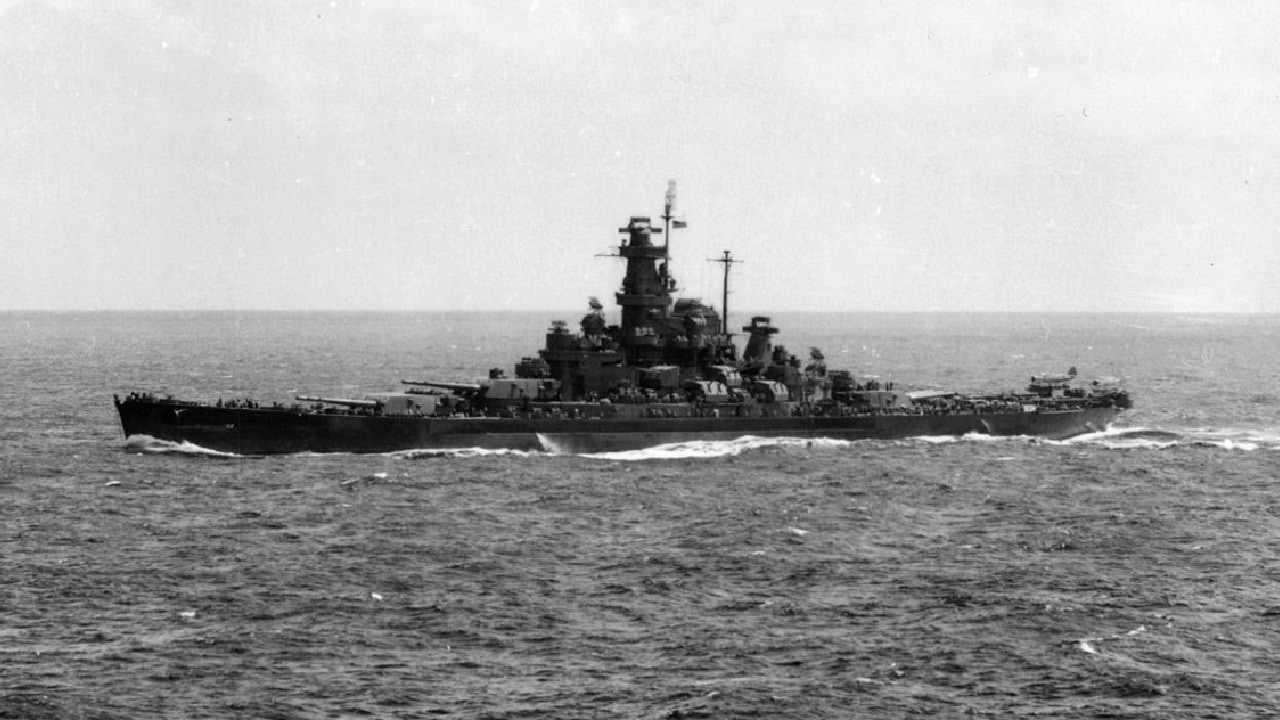
South Dakota-Class USS Alabama Battleship.
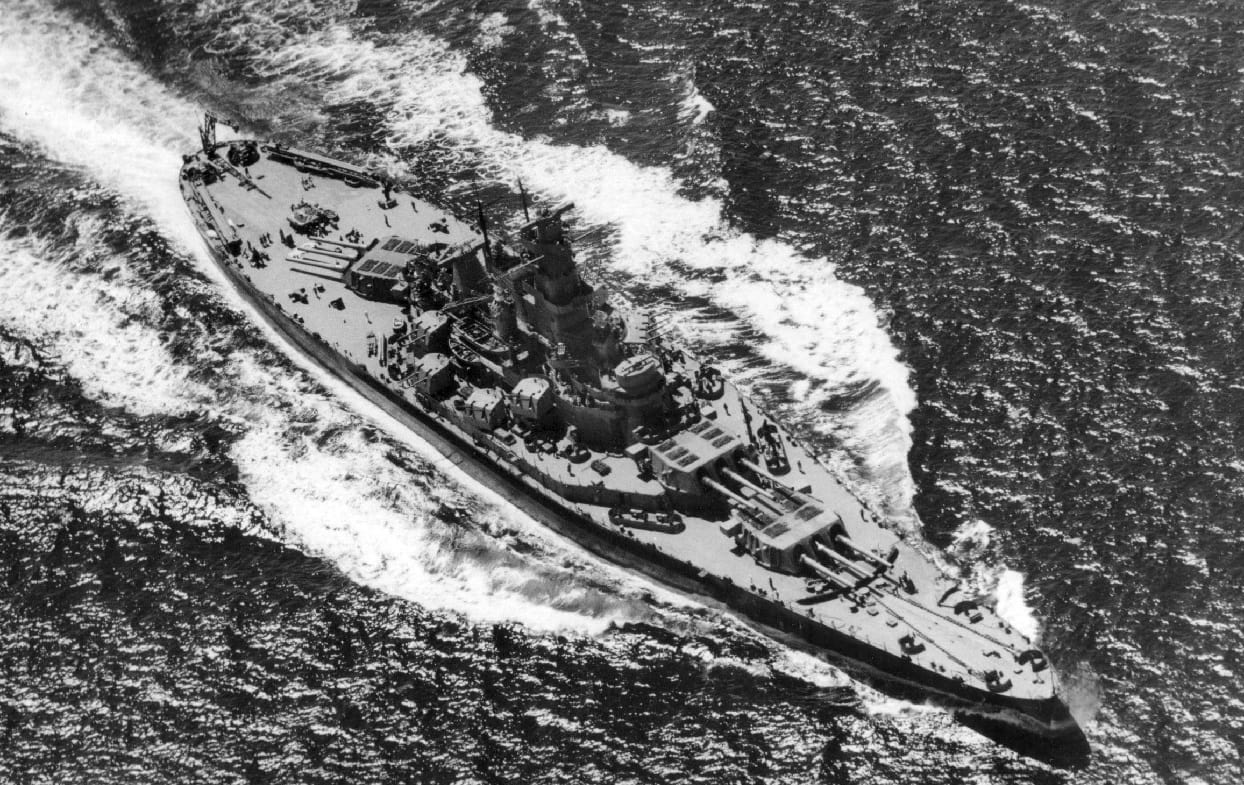
USS South Dakota. Image: Creative Commons.
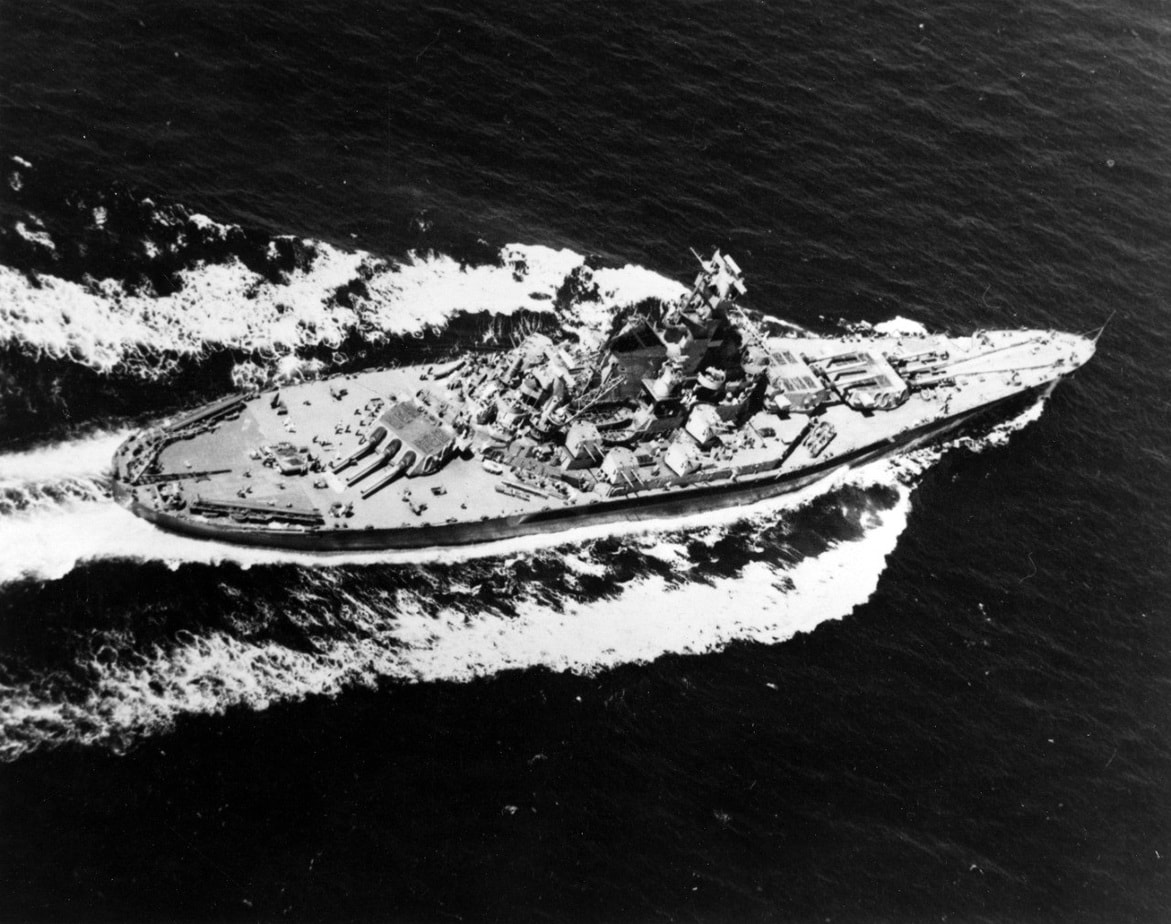
USS South Dakota-Class. Image: Creative Commons.
This harrowing incident was dramatized in pop culture thanks to a 1988 made-for-TV movie titled “Too Young the Hero,” starring Ricky Schroder in the true story of Seaman First Class Calvin Graham, who heroically served on that ship and in that battle at the tender age of twelve.
In case you’re wondering about Calvin Graham’s seemingly disqualifying young age, it was quite easy to lie about your age on your enlistment papers and get away with it back then; background investigations for military enlistees weren’t nearly as stringent as they are nowadays, thanks to the need for manpower taking precedence.
That’s not to say that South Dakota still didn’t get in plenty of licks against the enemy during her WWII career.
These actions included shore bombardments of Japanese positions at Guadalcanal, Santa Cruz, the Gilberts and Marshalls, and the Marianas campaign.
Where Is She Now?
BB-57 was decommissioned on 31 January 1947, but remained in the Atlantic Reserve Fleet, AKA the “Mothball Fleet,” for 15 years.
She was sadly and ignominiously consigned to the scrapyard, stricken from the Naval Register on 1 June 1962, and broken up that same year.
Thankfully, she wasn’t a total loss, as her screws and a section of armor plate were saved for posterity and placed on display at the National Museum of the United States Navy on the grounds of the Washington, DC Navy Yard.
The Battleship South Dakota Memorial and museum in Sioux Falls also includes artifacts from the ship, such as an anchor, a simulated gun turret, a 16-inch gun, her bell, sailors’ uniforms, and a scale model of the vessel.
Two of South Dakota’s sister ships *were* preserved as floating museums: (1) USS Alabama at Battleship Memorial Park in Mobile, Alabama; and (2) USS Massachusetts (” Big Mamie”) at Battleship Cove in Fall River, Massachusetts.
Meanwhile, the USS South Dakota naming legacy continues with the Virginia-class attack submarine SSN-790, commissioned on 2 February, 2019.

The Virginia-class attack submarine Pre-commissioning Unit (PCU) John Warner (SSN 785) is moved to Newport News Shipbuilding’s floating dry dock in preparation for the Sept. 6 christening. A team of shipbuilders spent about eight hours to move the submarine from the facility where it was assembled to the dock. (U.S. Navy photo courtesy of Huntington Ingalls Industries by John Whalen/Released)
About the Author: Christian D. Orr
Christian D. Orr is a Senior Defense Editor. He is a former Air Force Security Forces officer, Federal law enforcement officer, and private military contractor (with assignments worked in Iraq, the United Arab Emirates, Kosovo, Japan, Germany, and the Pentagon). Chris holds a B.A. in International Relations from the University of Southern California (USC) and an M.A. in Intelligence Studies (with a concentration in Terrorism Studies) from American Military University (AMU). He is also the author of the book “Five Decades of a Fabulous Firearm: Celebrating the 50th Anniversary of the Beretta 92 Pistol Series,” the second edition of which was recently published.