

Summary and Key Points: Gen. George S. Patton said one of the most frequently noted traits of great men who remained great was loyalty to their subordinates. A 1909 West Point graduate, he commanded the Morocco landings in 1942, rebuilt II Corps after Kasserine Pass, took Seventh Army across Sicily, was sidelined for slapping two soldiers, fronted the fictional army that fooled Germany before D-Day, then led Third Army across France and into Bastogne. He died at 60 in December 1945.
There Will Never Be Another George Patton
“One of the most frequently noted characteristics of great men who have remained great is loyalty to their subordinates.” – General George Patton
George S. Patton’s reputation varied among factions during the Second World War. The Germans feared him, the British loathed him, his fellow commanders found him difficult to get along with, but above all, his troops respected him immensely.
Because of this respect, Patton sent his men into perilous combat operations under some of the most difficult conditions, and they followed his orders every time. From Africa to central Europe, Patton and his men pushed forward aggressively, even against insurmountable odds.
George Patton: Early Life and the Second World War
Patton was born on November 11, 1885, in San Gabriel, California, into a family with a long and rich military history. From a young age, Patton believed he was destined for greatness.
This, combined with his unusual beliefs on reincarnation, made him both fearless and determined. Despite his academic difficulties, especially with reading and spelling, Patton graduated from the U.S. Military Academy at West Point in 1909. Over the next three decades, he distinguished himself as a cavalry officer, competed in the 1912 Olympics, and developed an early interest in tanks and mechanized warfare, gaining practical experience with armored units during World War I.
By the time the United States entered World War II in December 1941, Patton had already earned a distinct reputation. He believed wars were won through speed and aggressive leadership. His first major World War II assignment came during Operation Torch, the Allied invasion of North Africa in November 1942. As commander of the Western Task Force, Patton oversaw the invasion of Morocco.
Although the landings faced minimal resistance from Vichy French forces, the operation revealed serious operational weaknesses that, if left unaddressed, could be disastrous. Patton responded by enforcing strict discipline and insisting on proper uniforms, salutes, and aggressive command behavior.
Patton believed outward military order reflected inner combat readiness, and he thought lax discipline would lead to battlefield failure.
Africa and Sicily: Patton’s Early Victories
Patton’s first real test as a commander came after the American defeat at Kasserine Pass in February 1943, where German forces under Field Marshal Erwin Rommel inflicted a humiliating setback on inexperienced U.S. troops.
In response, General Dwight D. Eisenhower appointed Patton commander of II Corps. He immediately set out to restore order and discipline to the battered, demoralized Corps. Under his leadership, II Corps performed better in subsequent engagements, pushing Axis forces back across Tunisia. Though the victory was not as quick or conclusive as he had hoped, Patton still distinguished himself during the African campaign.
Patton’s next major campaign was the Allied invasion of Sicily in July 1943. As commander of the U.S. Seventh Army, he was subordinated to British General Bernard Montgomery, whose cautious approach deeply frustrated Patton.
Determined to one-up the British, Patton launched a rapid drive across western and northern Sicily, capturing Palermo and racing eastward toward Messina.
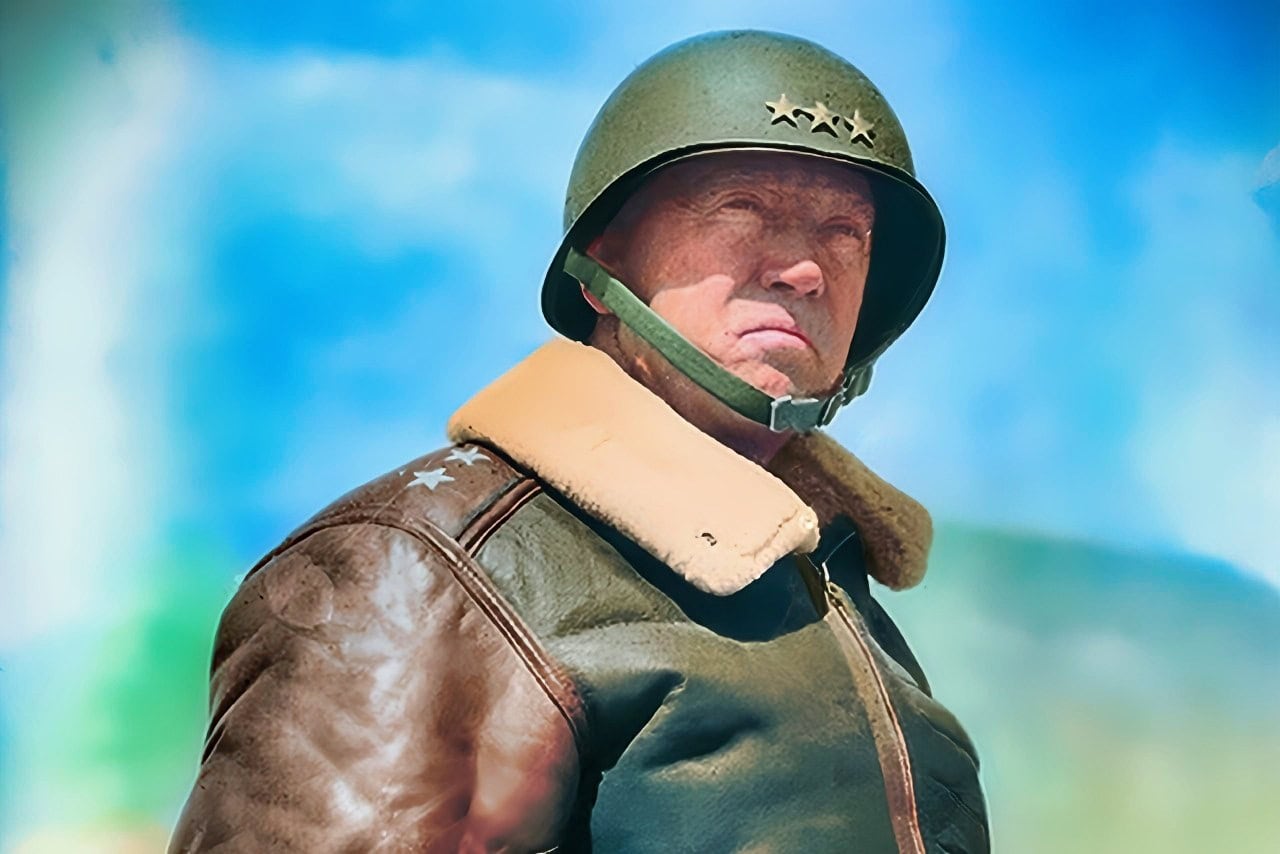
George Patton U.S. Army Photo
His forces reached the city before Montgomery’s, frustrating the high command. During the Sicily Campaign, the notorious slapping incidents also occurred. As he visited wounded troops, he struck two soldiers who had what we now know as PTSD. Patton, however, saw them as cowards and berated them physically and verbally. As a result, Eisenhower removed Patton from operational command for nearly a year.
Sidelined During D-Day
Rather than sideline him to a harmless desk job on the mainland, Eisenhower used him as the centerpiece of one of the war’s most important deception operations. In preparation for the Normandy invasion, the Allies placed Patton in nominal command of the fictional First U.S. Army Group, supposedly poised to invade France at Pas-de-Calais.
German intelligence practically revered Patton and concluded that any invasion he commanded would be the main effort. His presence alone convinced the German command to hold key divisions away from Normandy, significantly contributing to D-Day’s success on June 6, 1944.
In August 1944, Patton was returned to active combat as commander of the U.S. Third Army following the Allied breakout from Normandy. What followed was one of World War II’s most spectacular operational advances.
Once back on the front, he unleashed the Third Army. With extraordinary speed, his forces raced across Western France, exploiting every possible gap in the enemy defenses. Town after town fell as German units were encircled, overrun, or forced to retreat. Patton encouraged initiative at every level, allowing subordinate commanders wide latitude to exploit opportunities. He believed hesitation was fatal and that constant pressure prevented the enemy from reestablishing defensive lines.
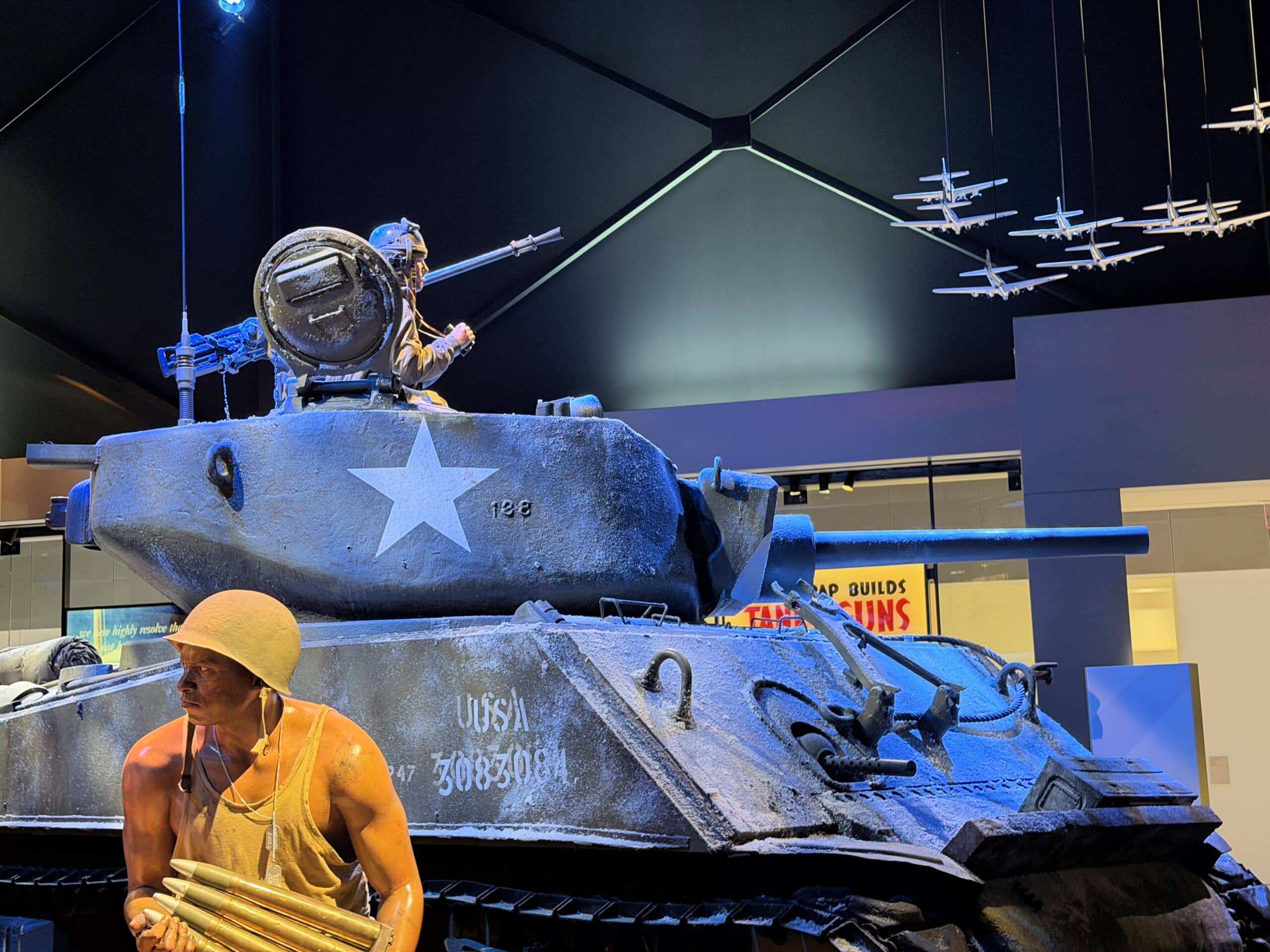
M4 Sherman. 19FortyFive Image.
The Battle of the Bulge and the End of the War
His greatest contribution to Allied victory came during the Battle of the Bulge in December 1944, when German forces launched a surprise offensive through the Ardennes. Anticipating such an attack, Patton had already prepared contingency plans.
When Eisenhower asked if the Third Army could pivot north to relieve the besieged town of Bastogne, Patton famously replied that he could attack within days. In a remarkable feat of coordination, Patton swung three divisions ninety degrees in freezing winter conditions and struck the German southern flank. The relief of Bastogne became one of the war’s iconic moments and perhaps the clearest demonstration of Patton’s operational brilliance.
As Allied forces advanced into Germany in early 1945, the Third Army crossed the Rhine, captured huge numbers of prisoners, and overran critical industrial and military targets. Patton’s outspoken criticism of denazification policies and his hostility toward the Soviet Union once again frustrated his superiors.
In October 1945, his superiors relieved him of command of the Third Army and assigned him to the largely administrative Fifteenth Army.
Only weeks later, on December 9, 1945, Patton was seriously injured in an automobile accident in Germany. He died on December 21, 1945, at the age of sixty. His death ended the career of a man who had lived for war and believed he was born to fight.
About the Author: Isaac Seitz
Isaac Seitz, a Defense Columnist, graduated from Patrick Henry College’s Strategic Intelligence and National Security program. He has also studied Russian at Middlebury Language Schools and has worked as an Intelligence Analyst in the private sector.