

Key Points and Summary: General George Patton, famous for his quote on perseverance and his leadership during the Battle of the Bulge, met a tragic end shortly after World War II.
-On December 9, 1945, while on a hunting trip in Germany, his Cadillac—driven by a notorious “speed demon”—collided with an Army truck.
-Patton suffered a broken neck and paralysis, eventually succumbing to pulmonary edema and heart failure on December 21.
-Ironically surviving the war’s fiercest battles, “Old Blood and Guts” died in a peacetime accident and was buried in Luxembourg alongside his soldiers.
“Any Man Can Become Great”: The Quote That Defined General Patton
“By perseverance, and study, and eternal desire, any man can become great.” – General George Patton, U.S. Army
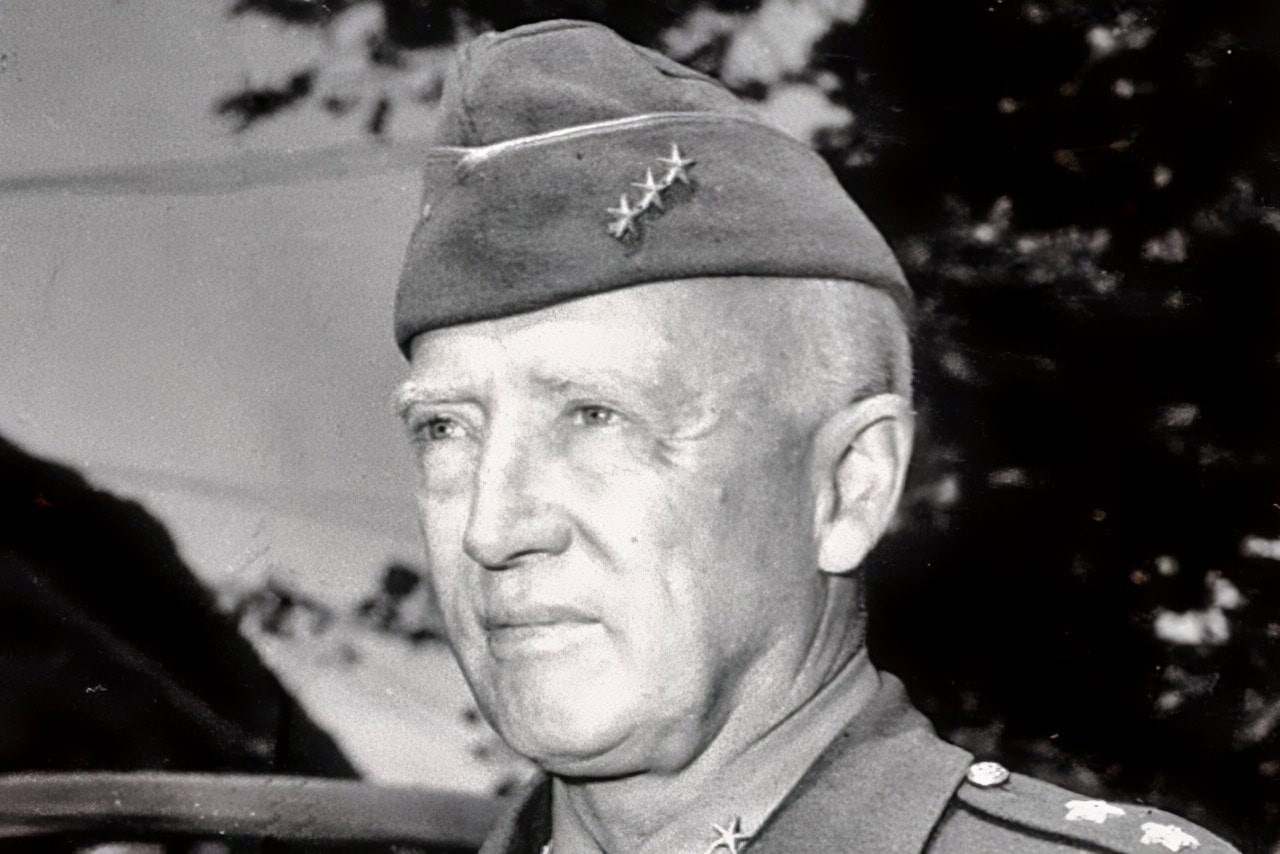
George S. Patton Quote of the Day. Creative Commons Image.
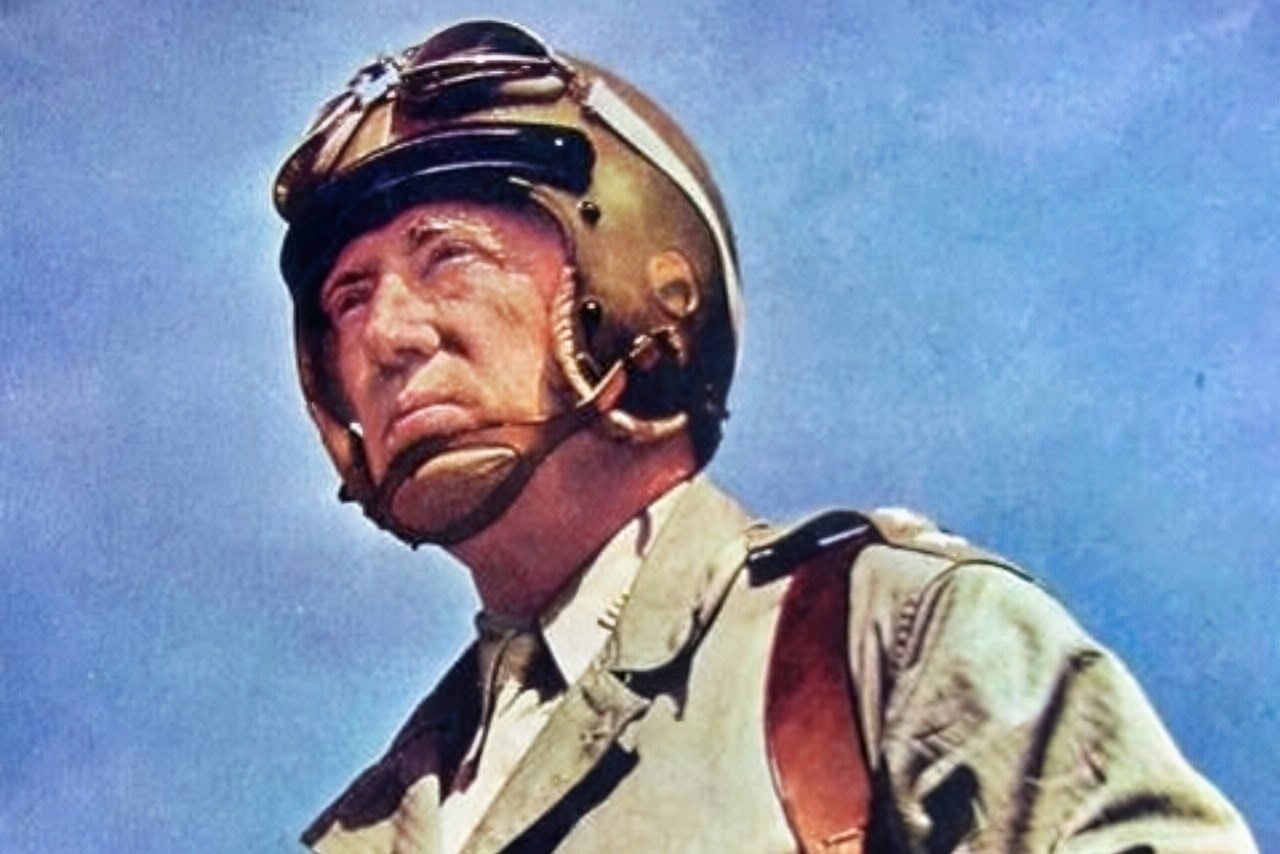
General George Patton of the U.S. Army. Image Credit: Creative Commons.
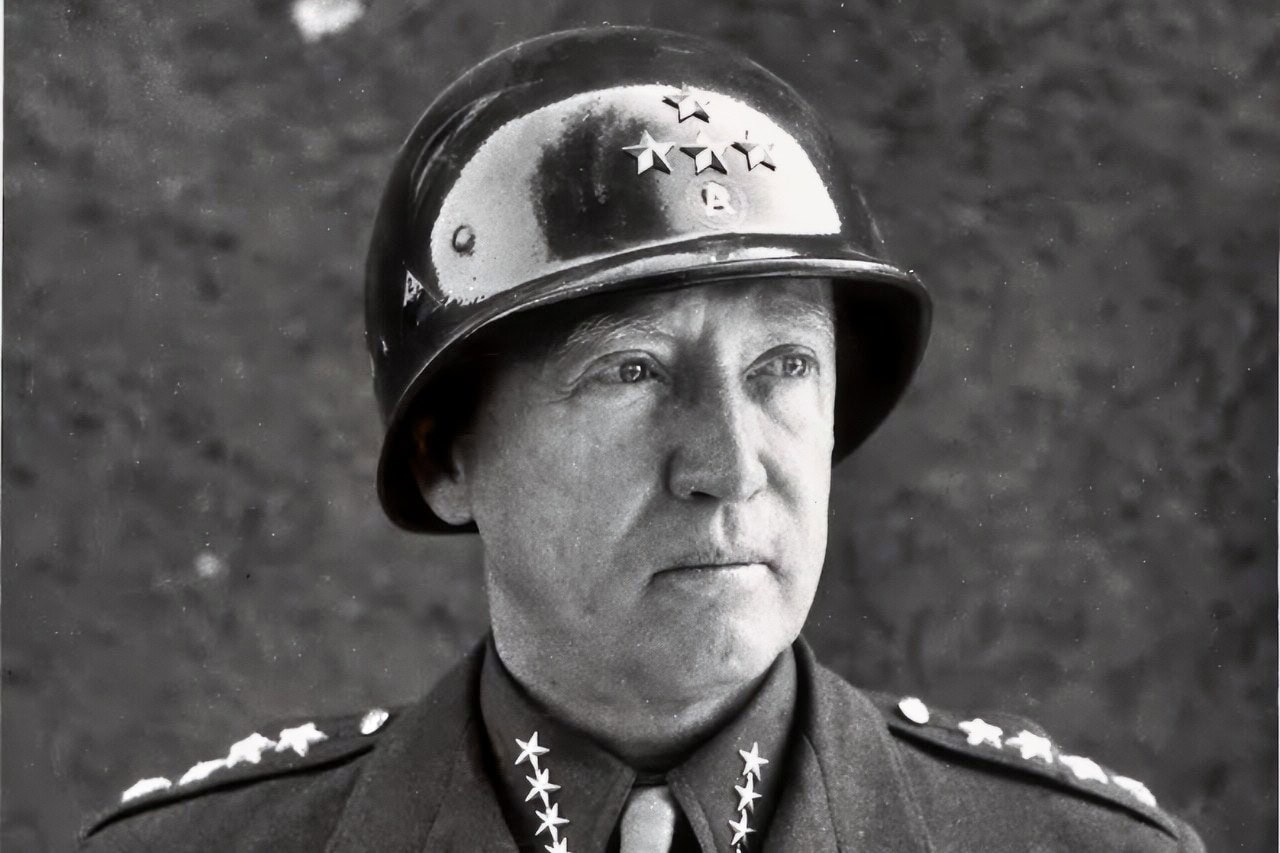
U.S. Army General George Patton
That is yet another memorable quote uttered by the colorful and flamboyant General George Smith Patton Jr.—one of the most accomplished and beloved, yet also controversial, general officers in U.S. Army history. Patton certainly lived up to his own statement by overcoming dyslexia—which prevented him from learning to read or write until age 11 and forced him to repeat his plebe year at West Point —to attain greatness.
That greatness reached its peak during the Battle of the Bulge in December 1944, when Patton’s bold and decisive actions snatched a smashing Allied victory from the jaws of a crushing defeat. Barely a year later, the great general was dead, after injuries suffered in a car crash proved to be too much even for Patton’s powers of perseverance.
The Fateful (and Fatal) Crash
The crash happened at 11:45 a.m. on December 9, 1945, near Speyer, Germany, an old city on the Rhine.
Because of his statements about denazification and America’s erstwhile Soviet allies, General Patton had been set aside by his superiors. In an effort to boost Patton’s spirits, his chief of staff, Major General Hobart Raymond “Hap” Gay invited his boss on a pheasant-hunting trip.
Patton, who was also a few days away from taking Christmas leave to visit his beloved wife Beatrice, accepted Hap’s invitation. They got in the back seat of a 1938 Model 75 Cadillac staff car driven by a new chauffeur, 19-year-old Private First Class Horace L. “Woody” Woodring of Kentucky.
As noted by Blaine Taylor in a November 2004 article for Warfare History Network, “Woodring had become the general’s driver after Patton’s regular driver of many years, M. Sgt. John L. Mims, had left the service on May 20 to return home. Patton’s personal note to Mims stated, ‘You have been the driver of my official car since 1940.
During that time, you have safely driven me in many parts of the world under all conditions of dust and snow and ice and mud, of enemy fire and attack by enemy aircraft. At no time during these years of danger and difficulty have you so much as bumped a fender!’
“Mims’ replacement, however, was a speed demon who regularly liked to drive 70 mph.
Patton took to him immediately, as both loved to dare the odds. This was an ominous sign for a man like the flamboyant general, who had been notoriously accident-prone all his life.”
At one point during the fateful drive, General Patton remarked, “How awful war is. Think of the waste.” This stands in sharp contrast to the famous rah-rah wartime speeches that had helped earn him the nickname, “Old Blood and Guts.”
A few moments after uttering those words, his Cadillac collided with an U.S. Army truck driven by Technician 5th Grade Robert L. Thompson. Gay and Woodring (whom Patton refused to blame for the crash) were only slightly injured, but Old Blood and Guts wasn’t so lucky.
He hit his head on the glass partition that separated the front and back seats; it opened a bloody gash.
More significantly, Patton sustained a broken neck and cervical spinal cord injury that left him paralyzed from the neck down.
Patton was rushed to a Heidelberg hospital where he spent 12 days in spinal traction before succumbing in his sleep to pulmonary edema and congestive heart failure on December 21, 1945, at age 60.
Three days later, he was laid to rest at the Luxembourg American Cemetery and Memorial in the Hamm district of Luxembourg City, in accordance with his wish to be buried with his soldiers.
Filmic Dramatization
George Patton’s medical ordeal is depicted in the 1987 made-for-TV movie The Last Days of Patton, the latter half of which is a true emotional gut punch.
The film also contains multiple flashbacks to Patton’s early life, including his courtship of Bea, his efforts as a young officer to sell a recalcitrant General Staff on the merits of the newfangled tank, a riding accident, and his early childhood.
Indeed—spoiler alert—the last word uttered by the General before the closing credits roll is “Papa,” as he flashes back to singing Christmas carols with his parents.
About the Author: Christian D. Orr, Defense Expert
Christian D. Orr is a Senior Defense Editor. He is a former Air Force Security Forces officer, Federal law enforcement officer, and private military contractor (with assignments worked in Iraq, the United Arab Emirates, Kosovo, Japan, Germany, and the Pentagon). Chris holds a B.A. in International Relations from the University of Southern California (USC) and an M.A. in Intelligence Studies (concentration in Terrorism Studies) from American Military University (AMU). He is also the author of the newly published book “Five Decades of a Fabulous Firearm: Celebrating the 50th Anniversary of the Beretta 92 Pistol Series.”