Synopsis: The U.S. Navy confirmed that Carrier Air Wing 8 executed a coordinated formation flight over supercarrier USS Gerald R. Ford during an aerial change-of-command ceremony while underway in the Caribbean.
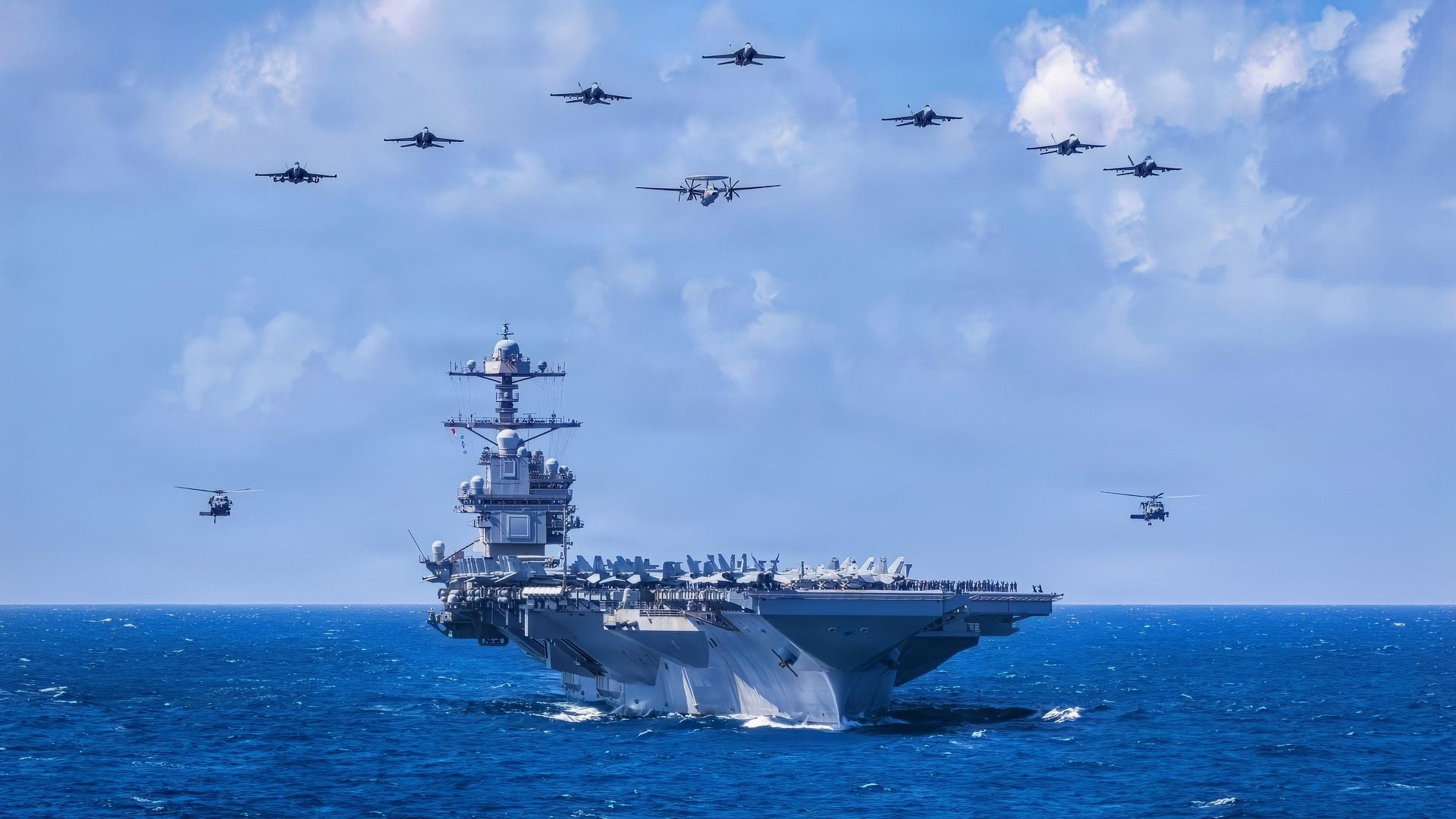
-The flyover included seven F/A-18 Super Hornets, two MH-60 Seahawk helicopters, and an E-2D Hawkeye—less an airshow moment than a visible demonstration of integrated carrier air wing proficiency.
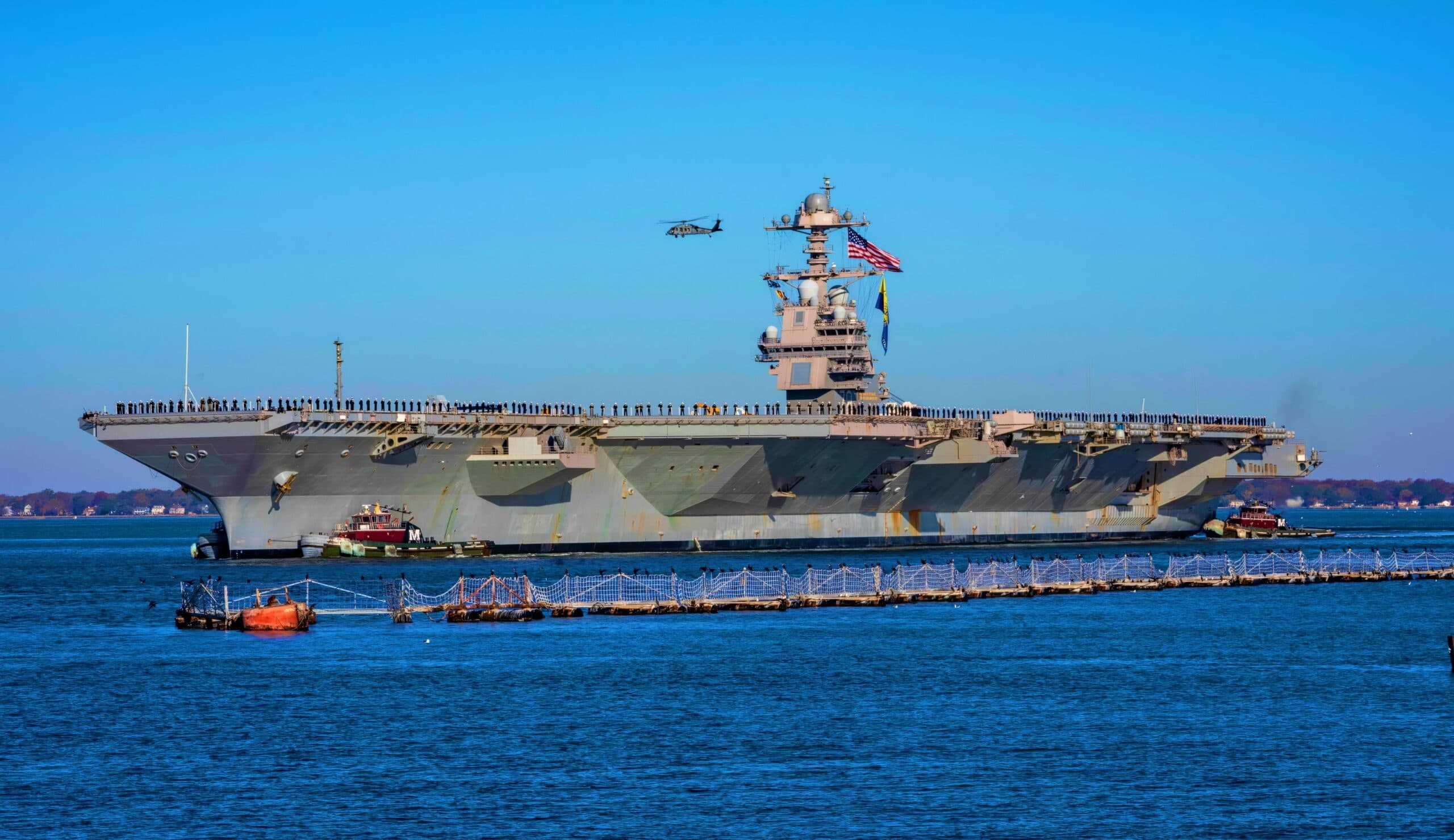
NORFOLK (Nov. 26, 2022) The USS Gerald R. Ford (CVN 78) returns to Naval Station Norfolk after completing their inaugural deployment to the Atlantic Ocean with the Gerald R. Ford Carrier Strike Group (GRFCSG), Nov. 26. The GRFCSG, returned to Naval Station Norfolk following a scheduled deployment with Allies and partners in an effort to build strategic relationships and contribute to a stable and conflict-free Atlantic region, while also showcasing the U.S. Navy’s most advanced class of aircraft carrier. (U.S. Navy Photo/Video by Mass Communication Specialist First Class Nathan T. Beard)
U.S. Navy Carrier Air Wing 8 aircraft fly in formation over the world’s largest aircraft carrier, Ford-class aircraft carrier USS Gerald R. Ford (CVN 78), during Carrier Air Wing 8’s aerial change of command ceremony while underway in the Caribbean Sea, Jan. 19, 2026. U.S. military forces are deployed to the Caribbean in support of the U.S. Southern Command mission, Department of War-directed operations, and the president’s priorities to disrupt illicit drug trafficking and protect the homeland. (U.S. Navy photo)
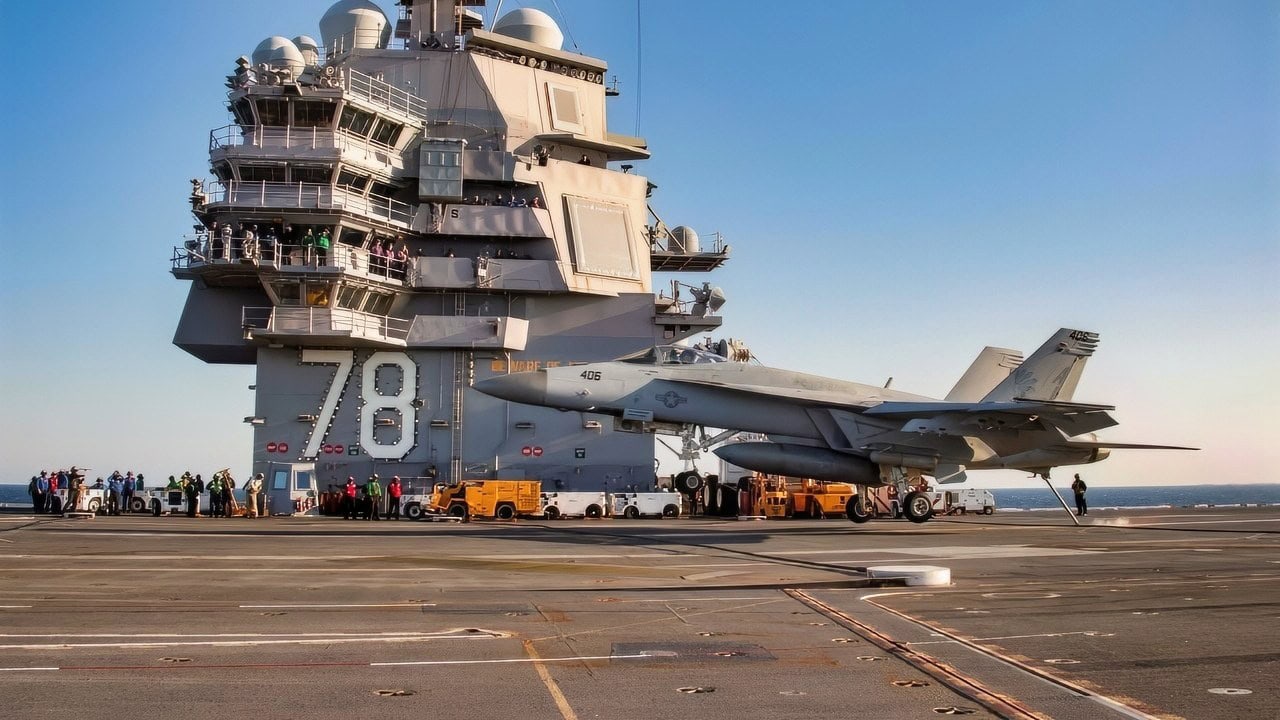
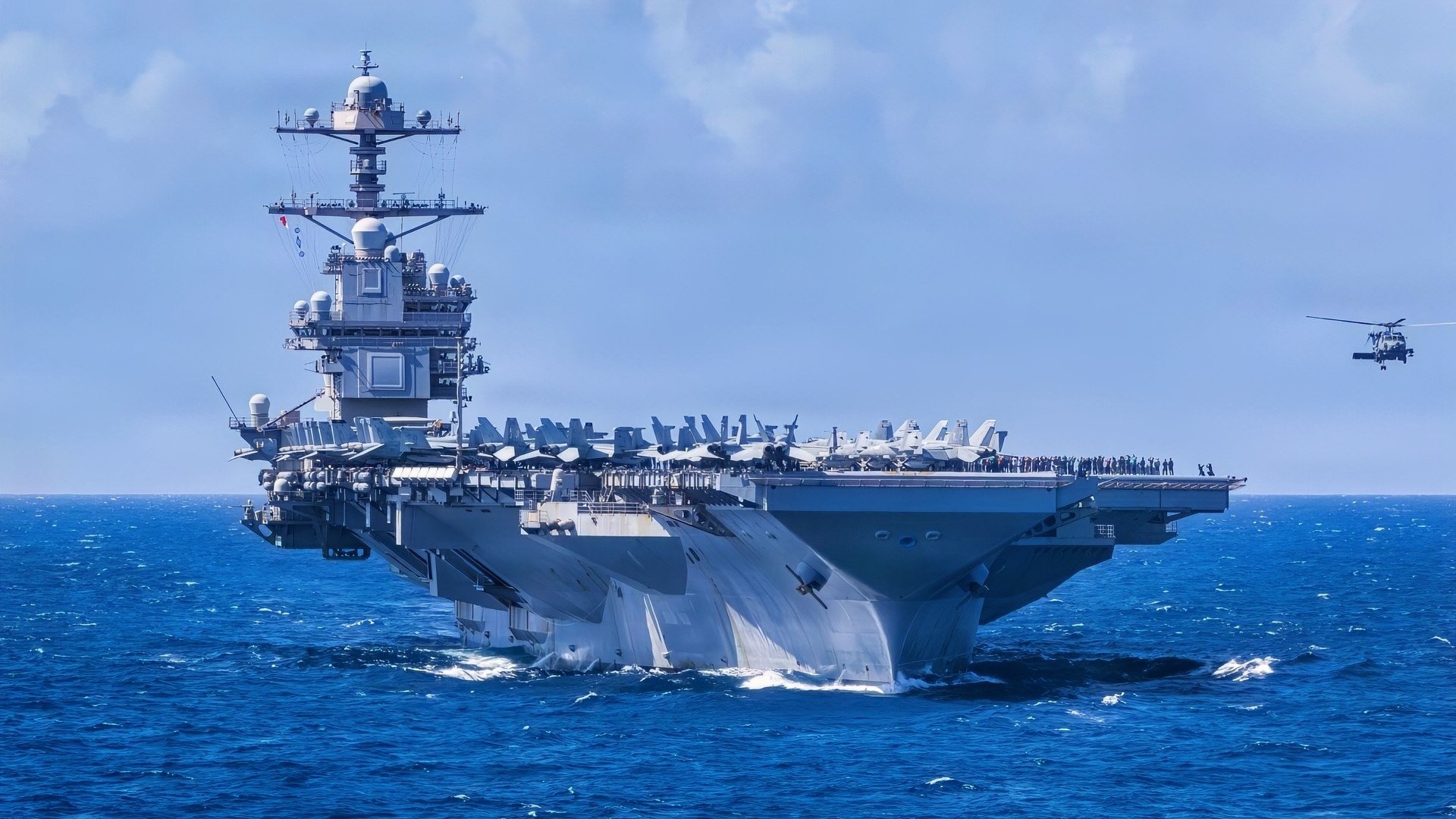
USS Gerald R. Ford Supercarrier Flight Deck. Image Credit: Creative Commons.
-The Navy framed the deployment as supporting U.S. Southern Command priorities, including disrupting illicit drug trafficking and protecting the homeland. The public timing also amplifies broader readiness messaging, pairing ceremony with operational signaling as U.S. naval forces remain active across multiple theaters.
Navy Confirms Formation Flight Over USS Gerald R. Ford Supercarrier
The U.S. Navy confirmed in a January 28 X social media post that military aircraft conducted a coordinated formation flight over the deck of the aircraft carrier USS Gerald R. Ford (CVN-78) during an aerial change-of-command ceremony. The post included imagery of the flight and a reminder of the carrier’s reason for being in the Caribbean Sea.
Describing the flight as a “show of force,” the post said that U.S. Navy Carrier Air Wing 8 aircraft flew in formation “over the world’s largest aircraft carrier, Ford-class aircraft carrier USS Gerald R. Ford (CVN 78), during Carrier Air Wing 8’s aerial change of command ceremony while underway in the Caribbean Sea.”
“U.S. military forces are deployed to the Caribbean in support of the U.S. Southern Command mission, Department of War-directed operations, and the president’s priorities to disrupt illicit drug trafficking and protect the homeland,” it continues.
What Is a Military Formation Flight?
While the imagery may at first glance appear to be a snapshot of an airshow, there is more to the story: a formation flight, where multiple aircraft fly in coordinated positions, is a tactical procedure designed to signal to adversarial forces.
A formation flight occurs when two or more aircraft operate closely in synchronized, predetermined positions under a common flight plan.
The practice, which is designed to signal cohesion and readiness to adversaries, has deep roots in aviation history.
Early aerial warfare in World War I demonstrated that coordinated flights reduced losses and improved effectiveness; since then, formation flying has become standard for both combat and demonstration purposes.
In disciplined military formation flying, aircraft maintain a precise spacial relationship relative to a flight leader or a predetermined pattern. For tactical units, the benefits of formation flights go well beyond optics.
Flying together improves target coverage and provides mutual support for each aircraft and pilot – with wingmen providing support within meters of each other while traveling at hundreds of knots. These are skills only experienced, trained pilots possess – and when utilized, they ensure every pilot is supported in the air.
What Happened in the Caribbean?
The formation flight recently confirmed by the U.S. Navy included seven F/A-18 Super Hornets fighters, two MH-60S/R Seahawk helicopters, and one E-2D Hawkeye airborne early warning aircraft. According to the Navy, the aircraft flew in formation over CVN-78 while at sea.
While the flyover was technically ceremonial, it functioned differently from the kind of ceremonial flyovers witnessed at air shows and public events.
The flyover is designed to reflect carrier air wing standard operating procedures, in which squadrons routinely practice tightly integrated flight patterns as they prepare for deployments and operational tasks.
And, the decision to showcase capability during a change-of-command ceremony was deliberate: senior leaders often use high-visibility events to broadcast readiness to domestic audiences, and indeed to allies and potential adversaries.
Why Now?
The timing of the public display is relevant because it occurred as tensions grow in multiple strategic theaters where U.S. naval forces are presently active, and in the wake of the capture and arrest of Venezuelan President Nicolas Maduro.
On February 3, 2026, reports also described how U.S. Navy F-35 fighters shot down an Iranian Shahed-139 drone that was reportedly “aggressively” approaching the aircraft carrier USS Abraham Lincoln in the Arabian Sea.
That most recent incident, coupled with the reported harassment of a U.S.-flagged merchant vessel in the Strait of Hormuz, has prompted the further bolstering of U.S. naval presence in the region.
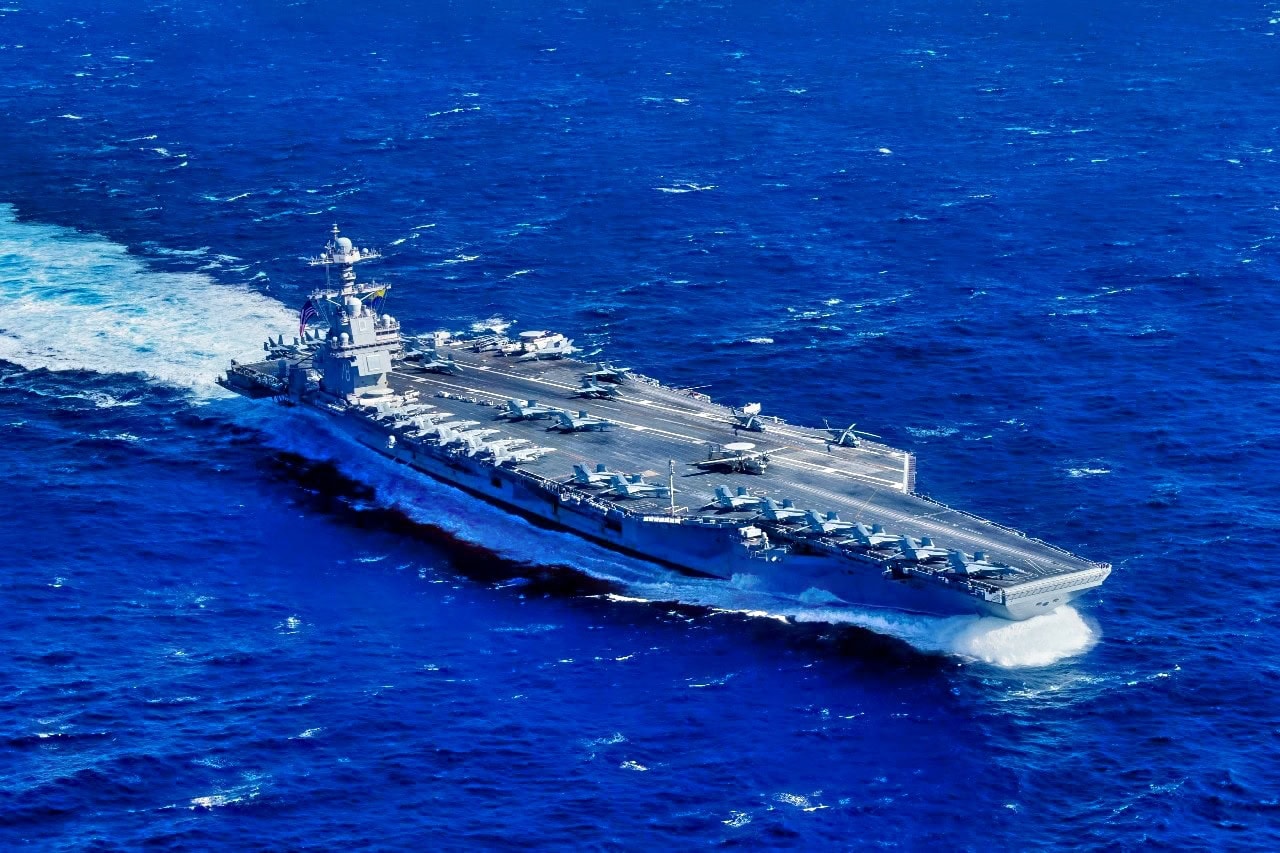
The world’s largest aircraft carrier, USS Gerald R. Ford (CVN 78), sails in formation with the Arleigh Burke-class guided missile destroyers USS Winston Churchill (DDG 81), USS Mitscher (DDG 57), USS Mahan (DDG 72), USS Bainbridge (DDG 96), and USS Forrest Sherman (DDG 98) in the Atlantic Ocean, Nov. 12, 2024. The Gerald R. Ford Carrier Strike Group is underway in the Atlantic Ocean completing Group Sail. Group Sail is the first at-sea integrated phase training event during a routine deployment training cycle. It is designed to challenge the Gerald R. Ford CSG’s ability to use the capabilities of the USS Gerald R. Ford (CVN 78), USS Winston S. Churchill (DDG 81), Carrier Air Wing (CVW) 8, Destroyer Squadron (DESRON) 2, and embarked Information Warfare team as a cohesive Strike Group to meet Navy and Joint Warfighting requirements that increases warfighting capability and tactical proficiency across all domains. (U.S. Navy photo by Mass Communication Specialist 2nd Class Maxwell Orlosky)
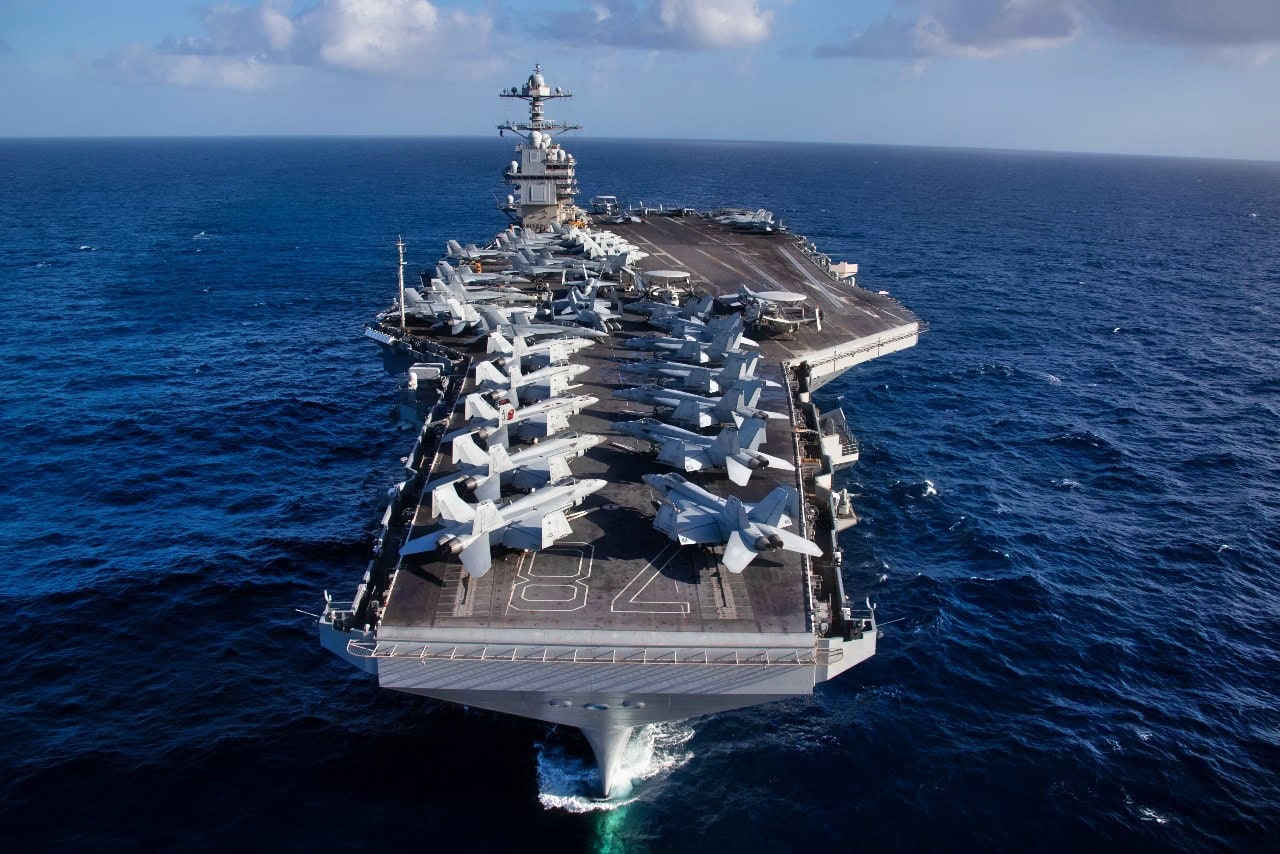
The world’s largest aircraft carrier USS Gerald R. Ford (CVN 78), steams in the Mediterranean Sea, Dec. 24, 2023. The Gerald R. Ford Carrier Strike Group is currently operating in the Mediterranean Sea. The U.S. maintains forward-deployed, ready, and postured forces to deter aggression and support security and stability around the world. (U.S. Navy photo by Mass Communication Specialist 2nd Class Jacob Mattingly)
Carrier strike groups are central to U.S. power projection.
Forward-deployed carriers like the USS Ronald Reagan routinely operate in the Indo-Pacific and other contested waters, giving U.S. airborne forces flexibility without relying on foreign bases. USS Abraham Lincoln is currently in the Middle East, while USS Gerald R. Ford is in the Caribbean.
Why Supercarrier Gerald R. Ford Is in the Caribbean
The USS Gerald R. Ford is the U.S. Navy’s most advanced and largest aircraft carrier – the lead ship of the Ford-class nuclear-powered carriers, measuring about 1,092 feet long and displacing roughly 100,000 tons, with the capacity to support a full air wing of fixed-wing aircraft and helicopters.
Since entering the U.S. Southern Command area of responsibility in late 2025, Ford and her strike group have been integral to Operation Southern Spear, conducting maritime security and interdiction operations aimed at disrupting illicit trafficking in the Caribbean Sea.
In addition to the January formation flight ceremony note previously, Ford-based personnel have participated in direct actions, including tanker boardings against vessels linked to sanctioned activities.
About the Author:
Jack Buckby is a British researcher and analyst specialising in defence and national security, based in New York. His work focuses on military capability, procurement, and strategic competition, producing and editing analysis for policy and defence audiences. He brings extensive editorial experience, with a career output spanning over 1,000 articles at 19FortyFive and National Security Journal, and has previously authored books and papers on extremism and deradicalisation.