Summary and Key Points: Four U.S. B-52 bombers flying with Japanese fighters over the Sea of Japan and East China Sea sent a clear political signal to China, but the military message is more complicated.
-The argument is that modern warfare has shifted toward drones, beyond-visual-range combat, and dense air defense networks, making non-stealth bombers far less decisive than before.

A modified B-52H Stratofortress departs Edwards Air Force Base for an evening training mission on June 25, 2025. The aircraft is assigned to the 419th Flight Test Squadron, Global Power Bombers Combined Test Force, tasked with supporting developmental testing across the B-52, B-1, and B-2 bomber portfolio. Along with most 412th Test Wing aircraft, B-52H bombers at Edwards include special instrumentation to conduct a variety of testing activities. (Air Force photo by Chase Kohler)
-In a China fight, the B-52’s role would likely be limited to launching stand-off weapons from distance rather than penetrating contested airspace.
-That still matters, but it also raises a hard question: whether older bombers can remain central in a battlespace dominated by A2/AD threats.
Why China May Not Fear the B-52 Bomber the Way It Once Did
The U.S. Air Force and Japan Air Self-Defense Force (JASDF) held two days of joint air exercises earlier this month over the Sea of Japan and the East China Sea. Four U.S. B-52 nuclear-capable strategic bombers and a coterie of Japanese warplanes participated.
US-Japan Drills Send Signal to Beijing
The drills practiced coordinated operations between bomber and fighter forces from the two countries—necessary maneuvers during any potential future war with China.
That four nuclear-capable B-52s were involved, at any other time, would have sent shivers down the spines of Chinese military leaders.
But those days are, sadly, over. The B-52s barely register as a serious threat to China, because the nature of airpower has changed in recent years.
This was most drastically demonstrated in Ukraine. In that war, drones and beyond-visual-range (BVR) attacks have dominated the experience of the two sides.
Similar experiences were had by Israeli forces fighting during last year’s 12-Day War against Iran.
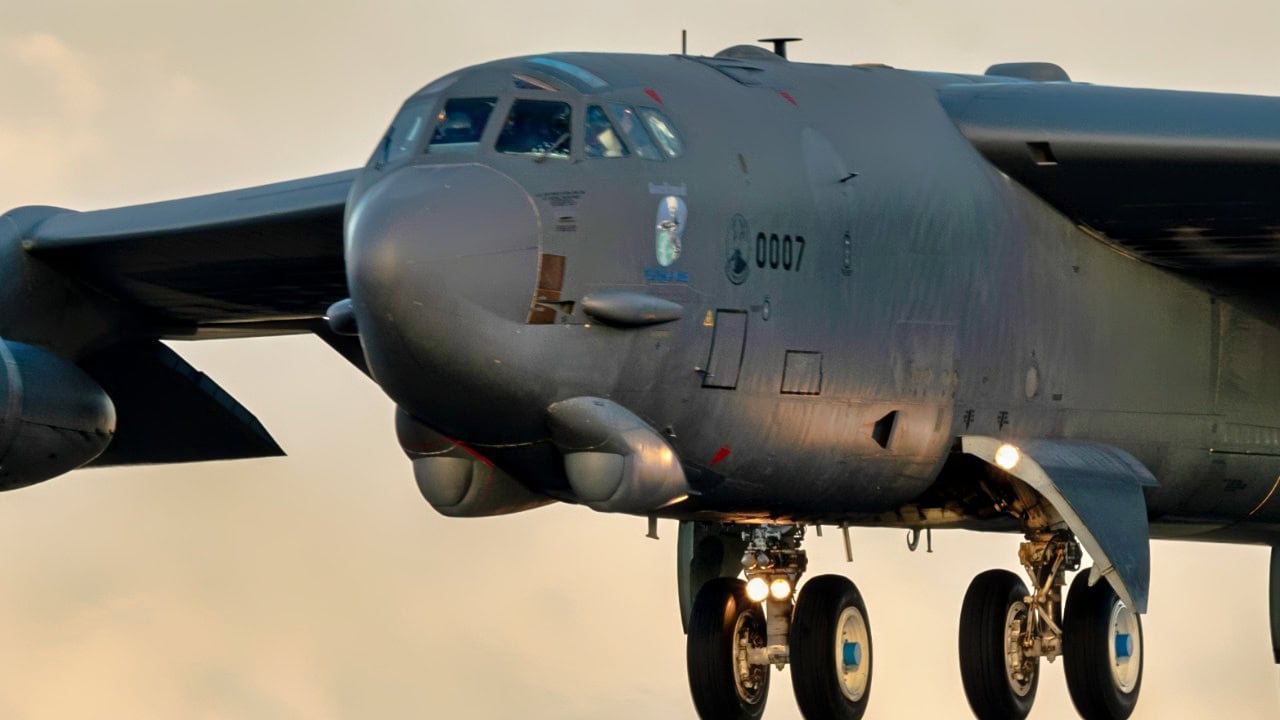
U.S. Air Force B-52H Stratofortress lands at RAF Fairford, England, following a sortie in support of Bomber Task Force 25-2, Feb. 27, 2025. The U.S. maintains a strong, credible strategic bomber force that enhances the security and stability of Allies and partners. (U.S. Air Force photo by Airman 1st Class Luis Gomez)
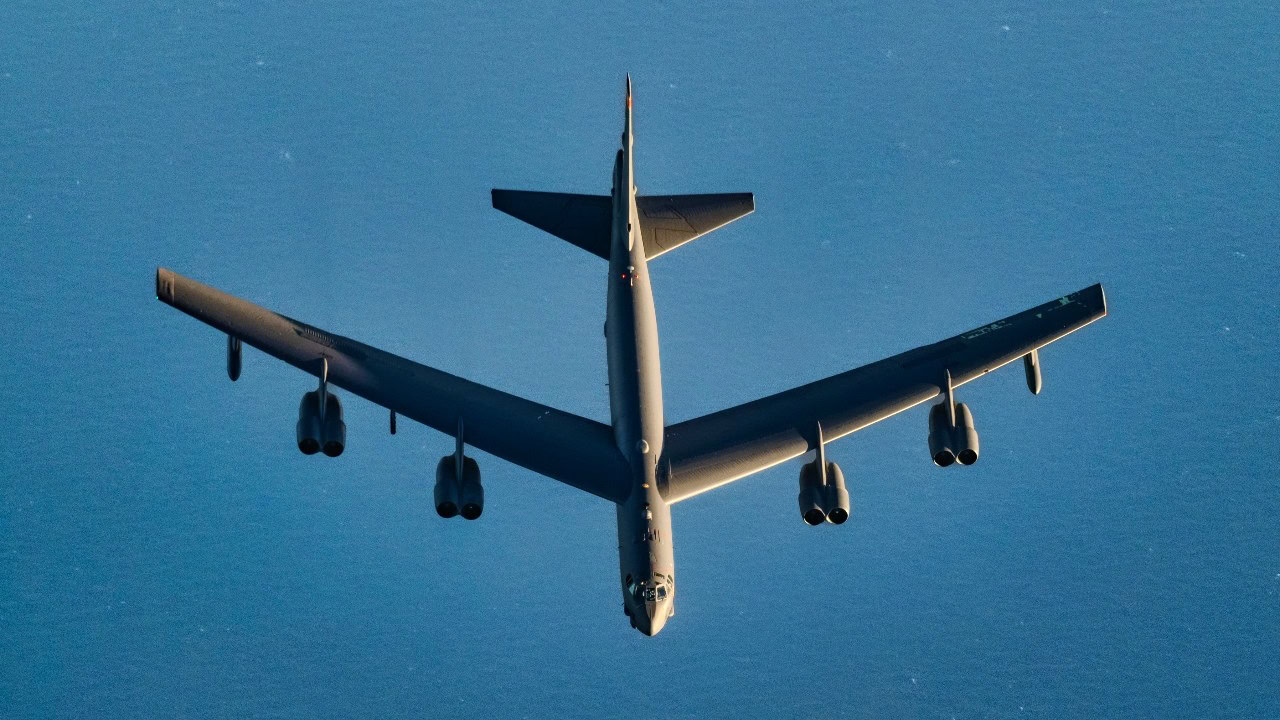
A U.S. Air Force B-52H Stratofortress flies a show of presence mission over the U.S. Central Command area of responsibility, Feb. 20, 2025. Strategic bombers contribute to stability in the CENTCOM theater by demonstrating the credibility, capability, and readiness of the U.S. bomber force, which is critical to deterring attacks against the U.S. and its allies and partners. (U.S. Air Force photo by Staff Sgt. Jackson Manske)
So, a strategic bomber, like the B-52, unless it’s going to threaten nuclear attack upon China (something that no American leader is seriously contemplating), is simply not the kind of threat to China that many assume it to be.
China’s First Island Chain A2/AD Trap
Thanks to China’s anti-access/area-denial (A2/AD) network arrayed across the First Island Chain (the region stretching from the Kamchatka Peninsula down through Japan and Taiwan, and into the Philippines), conventional bombardment in a war against China would be impossible.
Any such bombardment of Chinese targets by U.S. forces would need to be done with standoff weapons.
B-52H variants, which are set to be replaced by the still-under-development B-52J, can fire an assortment of standoff weapons, including the Joint Air-to-Surface Standoff Missile and AGM-86B air-launched cruise missile. The B-52 will eventually be able to launch hypersonic weapons, when those become available.
Nevertheless, the B-52 is a plane that first took flight during the presidency of Harry S. Truman.
It has seen multiple conflicts, but many question whether the B-52 is still relevant. After all, the B-52 is not particularly stealthy, it isn’t fast, and it is seeing its mission set become narrower with each passing year, especially as A2/AD systems get better. Could the B-52’s mission set be performed better by a cheaper, unmanned system or even a smaller fighter jet?
Standoff Weapons for B-52
Yes, it could. The presence of the B-52 on the battlefield seems more like a sentimental move and less like real strategy. Sure, these planes are mighty. But they’re also old, and they lack any real capability to stay alive in a fight in which the entire area becomes flooded with A2/AD weapons all meant to stop U.S. systems.
The Russians have pioneered how best to employ long-range stealth bombers, such as their Tu-95 and Tu-160 long-range strategic bombers, since the outbreak of the Ukraine War.
By flying these planes just outside Ukraine’s air defense perimeter, the Russians fire standoff weapons at Ukraine from within Russia. This has proven extremely effective. But Russian pilots are required to take their planes just outside visual range and launch them.
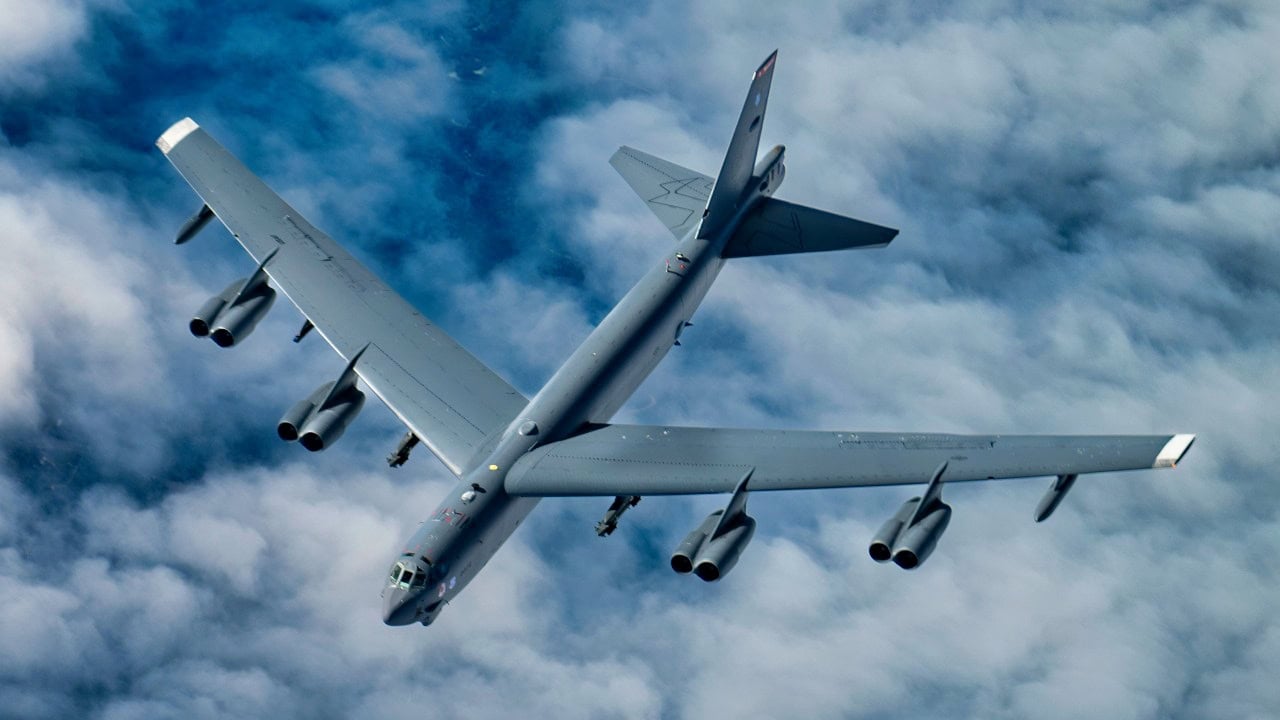
A B-52 Stratofortress assigned to the 2nd Bomb Wing, Barksdale Air Force base, Louisiana, approaches a KC-135 Stratotanker assigned to the 6th Air Refueling Wing, MacDill AFB, Florida, for fuel over the southeastern United States, Dec. 4, 2024. The B-52 Stratofortress is a long-range, heavy bomber that can perform a variety of missions. The aircraft can carry nuclear or precision guided conventional ordnance with worldwide precision navigation capability. (U.S. Air Force photo by Staff Sgt. Lauren Cobin)
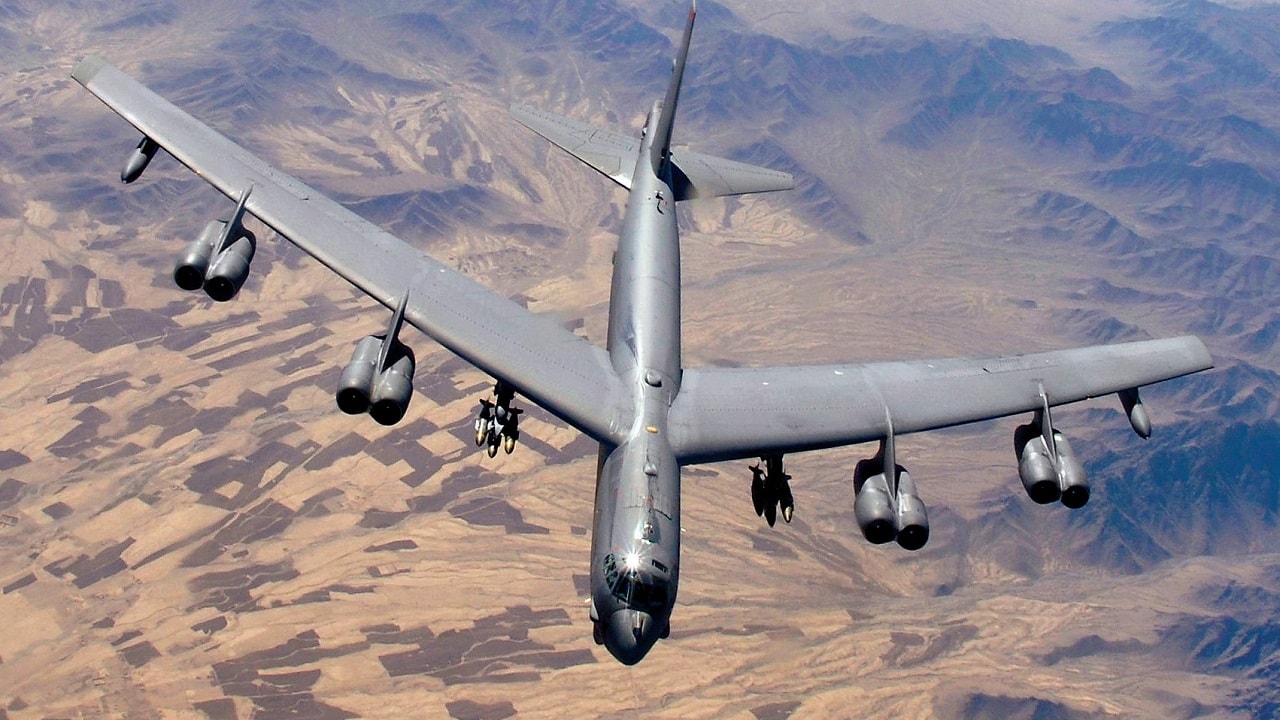
B-52H Stratofortress Primary function: Heavy bomber. Speed: 650 mph. Dimensions: Wingspan 185 ft.; length 159 ft. 4 in.; height 40 ft. 8 in. Range: 8,800 miles unrefueled. Armament: M117, Mk-56/62/65/82/84, CBU- 87/89/103/104/105, AGM-86B/C/D/129A/158A, GBU- 10/12/28/31/38; nuclear weapons. Crew: Five. (U.S. Air Force photo by Master Sgt. Lance Cheung)
Could Cheaper Drones Replace the Stratofortress Bomber?
Russian long-range bombers are capable of delivering large amounts of ordnance upon distant targets. If the B-52s can be used in that way during any conflict with China, then the B-52s could unleash massive amounts of firepower from a distance.
Of course, given the prevalence not only of A2/AD systems but of advanced air defense systems around potential targets in China, there’s a significant chance of running out of missiles long before any B-52 pilot could claim victory.
Yes, the B-52 being present at those recent US-Japanese training exercises is a serious signal to Beijing not to screw with the United States. At the same time, China fully understands that four meager B-52s was hardly sufficient for the Americans to believe that they will do anything other than pose tempting targets to Chinese air defense operators.
Beijing is unlikely to ever be threatened by the B-52H (or B-52J) in ways that the people bandying about these grand plans ever believe.
About the Author: Brandon J. Weichert
Brandon J. Weichert is the Senior National Security Editor at 19FortyFive.com. He was previously the senior national security editor at The National Interest. Weichert is the host of The National Security Hour on iHeartRadio, where he discusses national security policy every Wednesday at 8pm Eastern. He hosts a companion show on Rumble entitled “National Security Talk.” Weichert consults regularly with various government institutions and private organizations on geopolitical issues. His writings have appeared in numerous publications, among them Popular Mechanics, National Review, MSN, and The American Spectator. And his books include Winning Space: How America Remains a Superpower, Biohacked: China’s Race to Control Life, and The Shadow War: Iran’s Quest for Supremacy. Weichert’s newest book, A Disaster of Our Own Making: How the West Lost Ukraine, is available for purchase wherever books are sold. He can be followed via Twitter/X @WeTheBrandon.