

Summary and Key Points: Isaac Seitz, a Defense Columnist and Strategic Intelligence expert, analyzes the life of Benjamin Franklin as a masterclass in asymmetrical diplomacy.
-From his early days as a printer at The Pennsylvania Gazette to his role on the Committee of Five, Franklin utilized the “virtue of information” to mobilize colonial resistance.
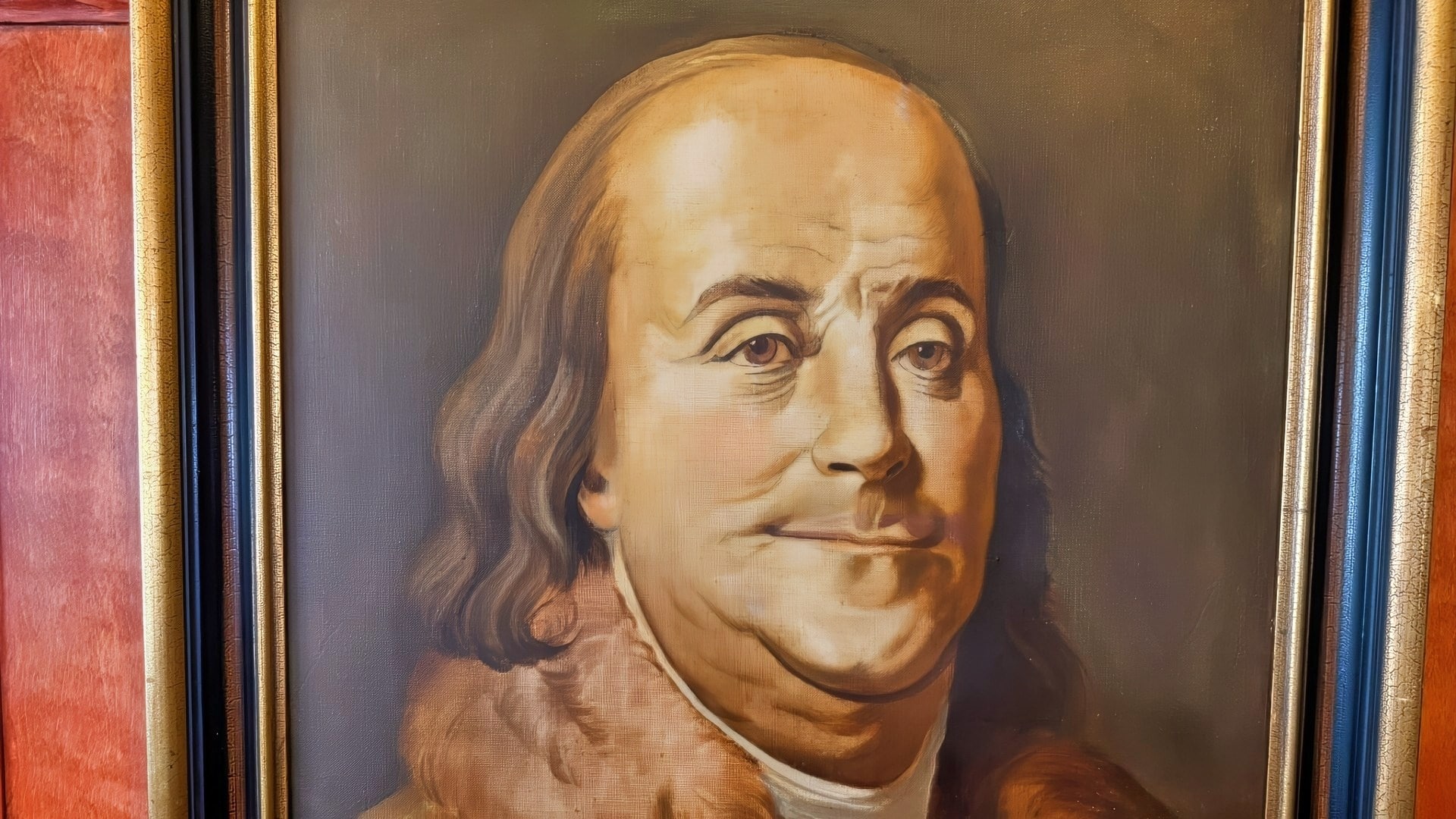
Benjamin Franklin 19FortyFive Image. Taken by Harry J. Kazianis at the Hall of Presidents at Walt Disney World, Florida.
-This 19FortyFive report explores his critical 1776 appointment as Ambassador to France, evaluating how his negotiation of the Treaty of Paris secured the military alliance essential for defeating England and establishing United States sovereignty.
Quote of the Day from the Great Benjamin Franklin
“Money never made a man happy yet, nor will it. There is nothing in its nature to produce happiness. The more a man has, the more he wants. Instead of filling a vacuum, it creates one.” – Benjamin Franklin
These were the words uttered by Benjamin Franklin, one of the most influential intellectuals in U.S. history.
Money has always been at the center of civilization and at the center of people’s hearts and minds.
Money can be used for many good things, but the love of money is the root of all evil, as the saying goes.
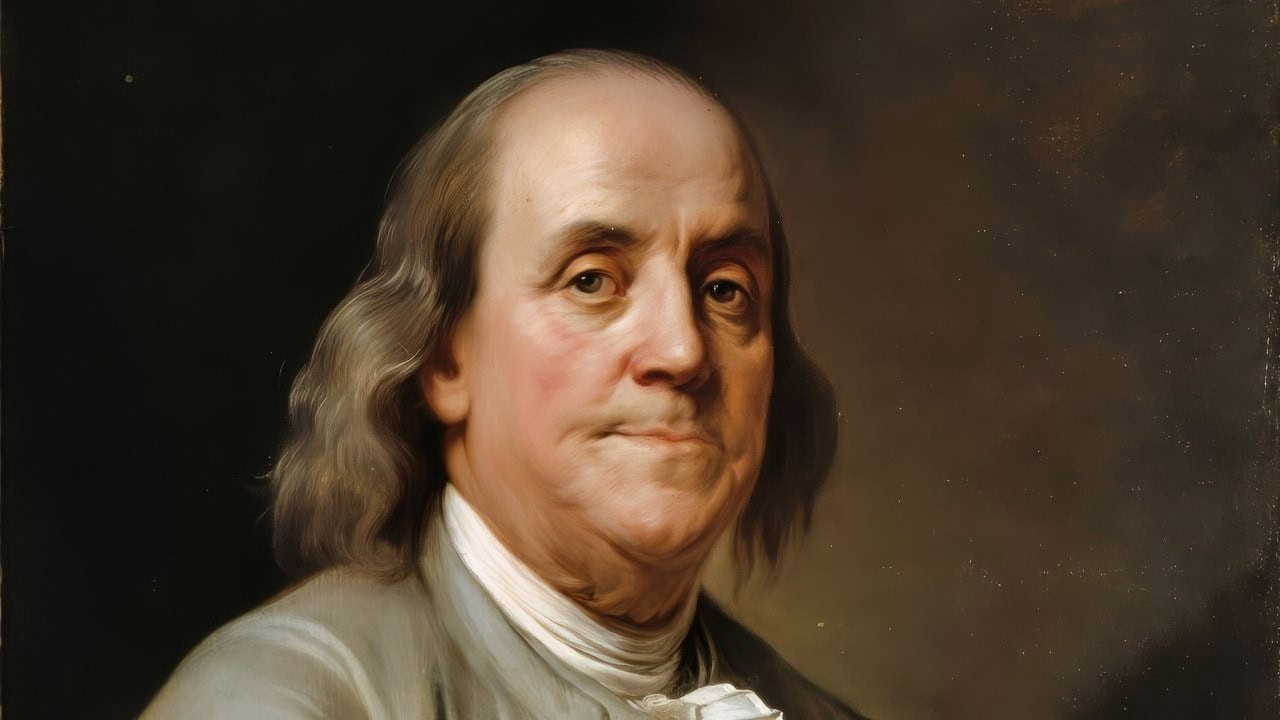
Benjamin Franklin. Image Credit: Creative Commons.
Ironically, Franklin is remembered by many as the face of the one-hundred-dollar bill, but his advice was not merely a nice-sounding platitude; it was the result of his many years of experience and observation.
Early Life of Benjamin Franklin
Franklin was born in Boston, Massachusetts, as the eighth of seventeen children. His father wanted him to pursue a career as a clergyman in the Church and sent him to Boston Latin School.
His family did not have the money for a complete education, so he attended the school for only two years without graduating.
Benjamin, however, was uninterested in a church position, so he took up an apprenticeship with his older brother, James Franklin.
James had founded The New-England Courant when Benjamin was only 15 years old, which was the third printing press in Boston at the time.
This early career in printing would jumpstart Franklin’s love of free speech.
At the age of 17, Franklin left his home in Boston and moved to Philadelphia, where he took a number of jobs at local printing presses.
Eventually, after a brief stay in London, he set up his own printing house and became the publisher of The Pennsylvania Gazette in Philadelphia. Over time, his commentary earned him respect as an intellectual young man. His interests spanned philosophy, science, politics, and a wide range of other topics in which he became well-versed.
In Franklin’s eyes, the printing press was not only a tool for informing the public but also for instructing his fellow colonials in a moral and virtuous way. Thus, when the King later tried to suppress the printers, Benjamin Franklin viewed this as an attack on virtue itself.
Climbing the Social Ladder
From 1737 to 1753, Franklin held the title of Postmaster in Philadelphia, which made him responsible for all the postage in the British colonies from Philadelphia to Newfoundland in Canada.
He also entered the ring of politics around this time, being sent to London to advocate against the Penn family’s influence and to protest the Stamp Act of 1765. At the time, Franklin had little influence in London, so these expeditions mostly ended in failure.
After the French and Indian War, Franklin became the main advocate for the American colonies in British Parliament. London argued that taxes should be raised in the colonies to offset the cost of the war. Franklin claimed that the colonies had raised and supplied 25,000 soldiers to fight against the French, which was equal to the number of troops Britain had raised for the war.
Franklin’s advocacy for the colonies invited suspicion from the British, and any attempts at peaceful settlement were often dismissed and ridiculed.
The American War for Independence
In 1775, Franklin returned to Philadelphia after unsuccessfully negotiating for the repeal of the Stamp Act. By the time he returned, however, the American Revolution was in full swing, and the Battles of Lexington and Concord had already passed.
The Pennsylvania Assembly unanimously selected Franklin as their delegate to the Continental Congress, where he was then appointed as a member of the Committee of Five that drafted the Declaration of Independence. Franklin was stricken with gout during this time, only being able to attend a few meetings and making “small but important changes.”
In 1776, Benjamin Franklin was appointed as the Ambassador to France from the newly independent United States of America. His efforts in France were critical in persuading the French government to support the U.S. independence movement. His efforts secured the military alliance with France, which was absolutely vital for the war effort against England. He organized and signed the Treaty of Paris, which officially ended the War for Independence and secured the national sovereignty of the United States. He returned home in 1785, where he was hailed as a national hero, second only to George Washington. Less than five years later, he died from a pleuritic attack, his place in history forever cemented.
What Made Benjamin Franklin a Great Man?
What was it that made Benjamin Franklin a great and influential man?
Franklin possessed a sharp wit that made him remarkably sarcastic and well-versed in many areas. In science, he made many discoveries about the nature of electricity and thermodynamics. As a politician and diplomat, he helped draft the Declaration of Independence, one of the most critical documents in American history, and the treaty that secured America’s victory over England.
George Washington At Hall of Presidents at Walt Disney World. Image Taken by Harry J. Kazianis for 19FortyFive.com
At the core, however, Benjamin Franklin possessed a moral character that emphasized virtue and excellence.
This core is what truly made Benjamin Franklin a great man and enabled him to achieve all the things listed in the history books, and it is that legacy of virtue that forged the United States.
About the Author: Isaac Seitz
Isaac Seitz, a Defense Columnist, graduated from Patrick Henry College’s Strategic Intelligence and National Security program. He has also studied Russian at Middlebury Language Schools and has worked as an intelligence Analyst in the private sector.