
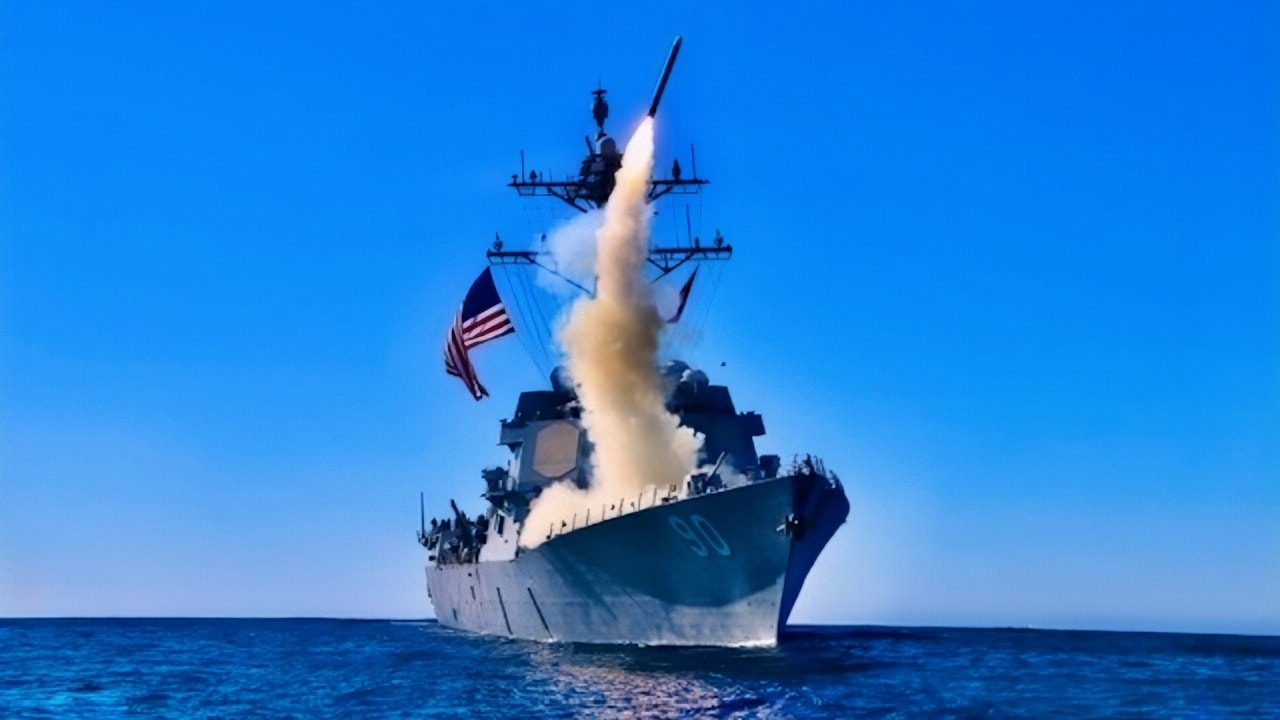
Summary and Key Points: Defense analyst Jack Buckby evaluates the critical depletion of Tomahawk cruise missiles during the 2026 conflict with Iran.
-Since the start of Operation Epic Fury, the U.S. has utilized the TLAM’s 1,000-mile range to strike IRGC command centers and air-defense networks.
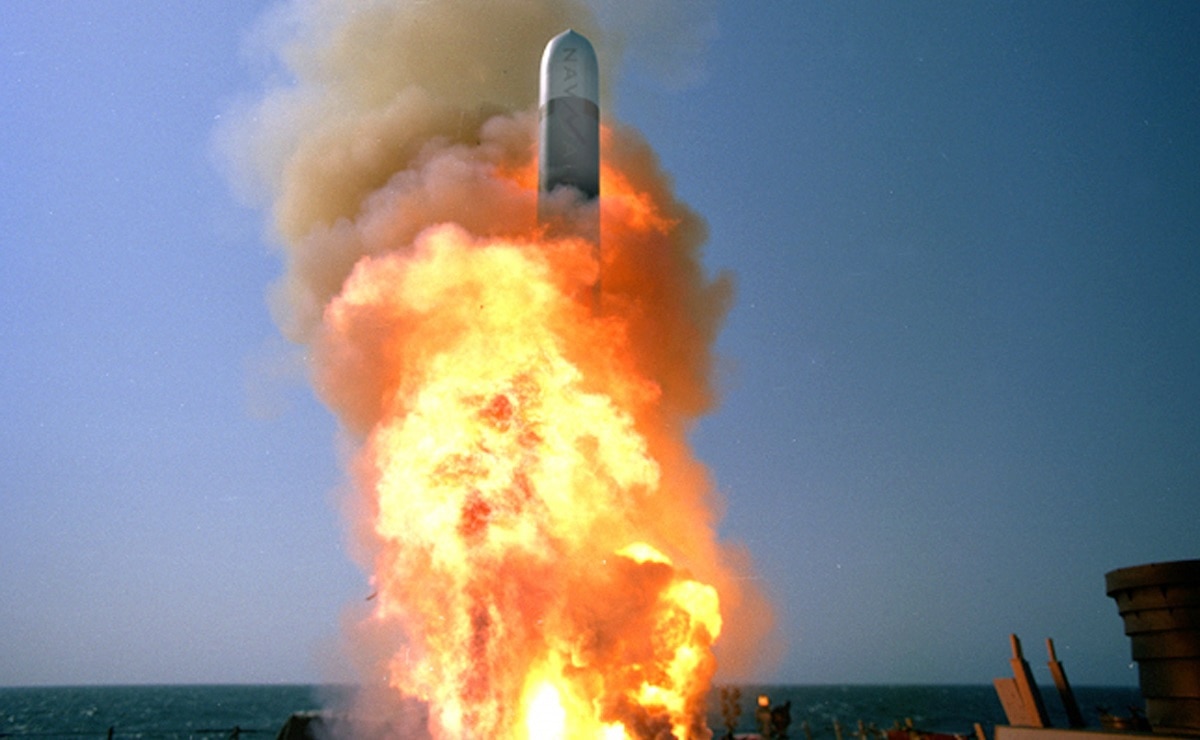
At sea aboard USS Stethem (DDG 63) Ð A Tactical Tomahawk Cruise Missile launches from the guided missile destroyer USS Stethem (DDG 63) during a live-warhead test. The missile traveled 760 nautical miles to successfully impact itÕs intended target on San Clemente Island, part of the Naval Air Systems Command (NAVAIR) test range in Southern California. The Tactical Tomahawk is the next generation of Tomahawk cruise missile, adds the capability to reprogram the missile while in-flight to strike any of 15 preprogrammed alternate targets, or redirect the missile to any Global Positioning System (GPS) target coordinates. It also will be able to loiter over a target area for some hours, and with its on-board TV camera, will allow the war fighting commanders to assess battle damage of the target, and, if necessary redirect the missile to any other target. Launched from the Navy’s forward-deployed ships and submarines, Tactical Tomahawk will provide a greater flexibility to the on-scene commander. Tactical Tomahawk is scheduled to join the fleet in 2004. U.S. Navy photo. (RELEASED)
-This report analyzes the industrial challenge of replacing a finite stockpile—estimated at 4,000 missiles pre-war—when annual production has historically capped at 90 units.
-Buckby explores RTX’s plans to expand capacity to 1,000 missiles per year, concluding that the two-year manufacturing cycle and complex supply chains will leave a significant capability gap through the late 2020s.
How Long Will It Take to Rebuild America’s Tomahawk Arsenal After Iran?
Tomahawk cruise missiles have so far been a vital tool in the U.S. and Israeli strikes against Iran, with the long-range weapon being used to strike air defenses and missile bases, command centers, and other high-priority sites across the country since the opening stages of the war.
The weapon has become a centerpiece of the campaign because it allows American forces to hit targets deep inside Iran without exposing aircraft or pilots to the country’s layered air defense network.
But the growing number of missiles fired in the campaign raises a question: how quickly can the United States replace them?
Tomahawks are valuable assets, and while the U.S. stockpile is by no means small, it is also finite. They are also relatively expensive precision weapons, costing roughly $1.3 million each.
The U.S. entered the conflict with a substantial stockpile, but the pace of modern missile warfare can burn through them quickly – and, indeed, that stockpile is diminishing by the day. With hundreds of missiles potentially used in recent strikes and production only now expanding, rebuilding the arsenal could take years, depending on how long the conflict continues and how fast the industrial base can respond.
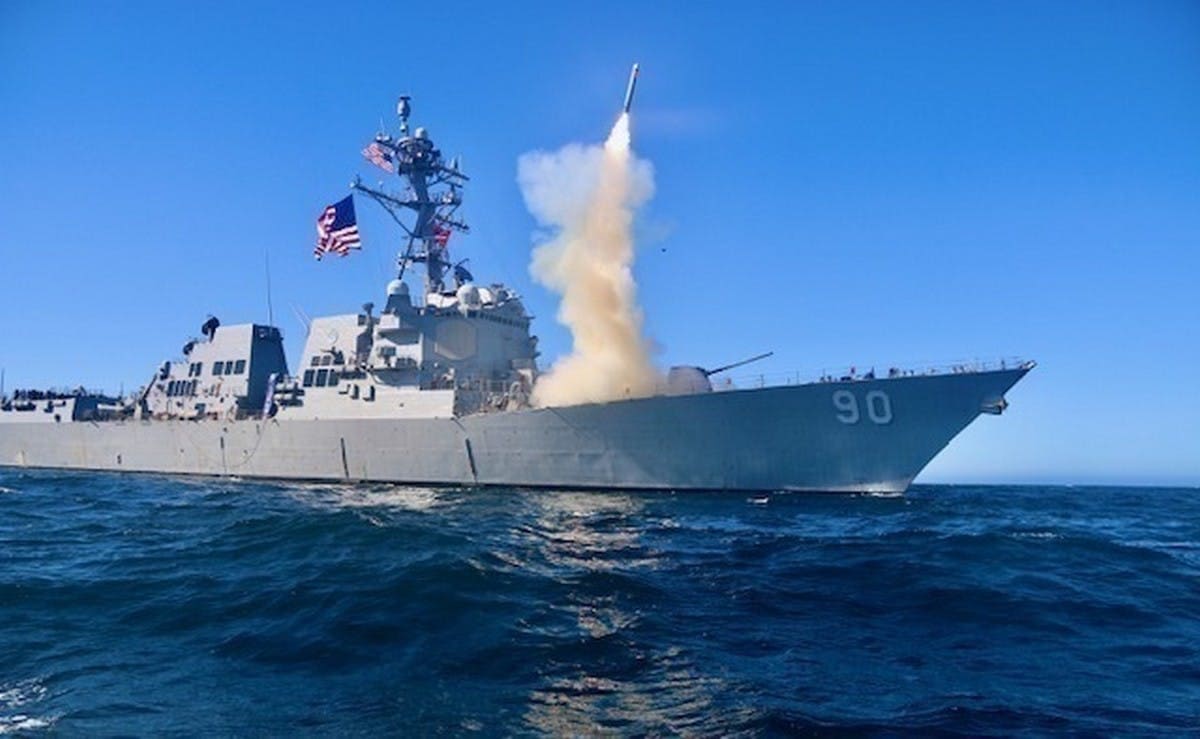
Tomahawk Missile. Image: Creative Commons.
The Tomahawk, and Why It Matters In Iran
The Tomahawk Land Attack Missile (TLAM) has been one of the U.S. military’s most important long-range strike weapons for more than four decades now.
Developed during the Cold War and first used in combat during the 1991 Gulf War, the missile has remained a critical tool for presidents seeking to strike adversaries without deploying large numbers of troops.
Tomahawks are cruise missiles that fly at low altitude, often around 100 feet above the ground, using terrain-following guidance systems and GPS navigation to evade radar and air defenses. Their range is roughly 1,000 miles or more, depending on the variant, allowing ships or submarines far from hostile territory to strike targets deep inland.
The missile can be launched from multiple platforms, including U.S. Navy destroyers, cruisers, and submarines – as we are seeing unfold right now. Once launched, the rockets are propelled by a booster before the missile deploys wings and flies like a small aircraft toward its target.
By offering a reliable combination of range and precision – on top of the fact that they reduce risk for expensive aircraft – the Tomahawk has become the weapon of choice for the U.S. military, particularly in the early phases of operations.
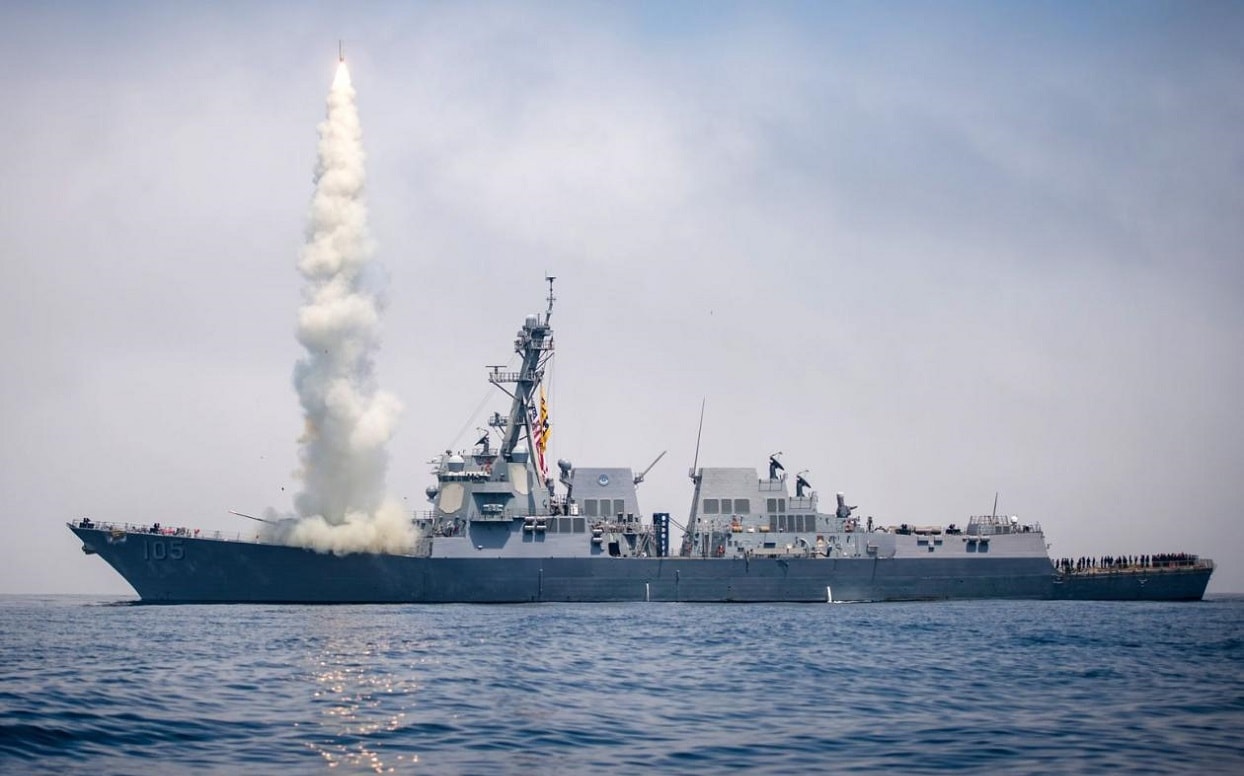
Tomahawk Cruise Missile. Image Credit: US Navy.
The missile can disable air defenses and command systems before aircraft enter hostile airspace – and that’s exactly how it has been used in the Iran campaign so far, striking hardened targets across a geographically large and diverse country.
How Many Tomahawks Have Been Used So Far?
Estimating the size of the U.S. Tomahawk arsenal is difficult because the Pentagon does not publicly release exact stockpile numbers – for obvious reasons.
However, analysts generally believe that the United States had roughly 4,000 missiles in its inventory in the early 2020s.
Pentagon procurement figures indicate that the U.S. Navy has purchased roughly 9,000 Tomahawk missiles since the 1980s, although thousands have been fired in combat or retired, while some have also been used in training exercises. For years, production rates have been relatively low – often around several dozen to roughly 90 missiles annually, depending on budgets.
Recent agreements, however, suggest that the Pentagon is looking to change that. Under new long-term contracts, RTZ has announced plans to dramatically expand production, potentially increasing annual output to more than 1,000 missiles as part of a broader effort to rebuild U.S. munitions inventories. Even so, rebuilding the stockpile will take time.
The production cycle for a Tomahawk can actually take up to two years due to complex supply chains and the need for specialized components, so while those deals are taking shape, there is always room for delays – and a spike in use before production ramps up means the U.S. stockpile could remain substantially diminished for some time.
If hundreds of missiles have already been used in the Iran campaign, replacing them might well take several years of sustained production, even with the planned manufacturing expansion. And the strategic need for these weapons is unlikely to disappear any time soon.
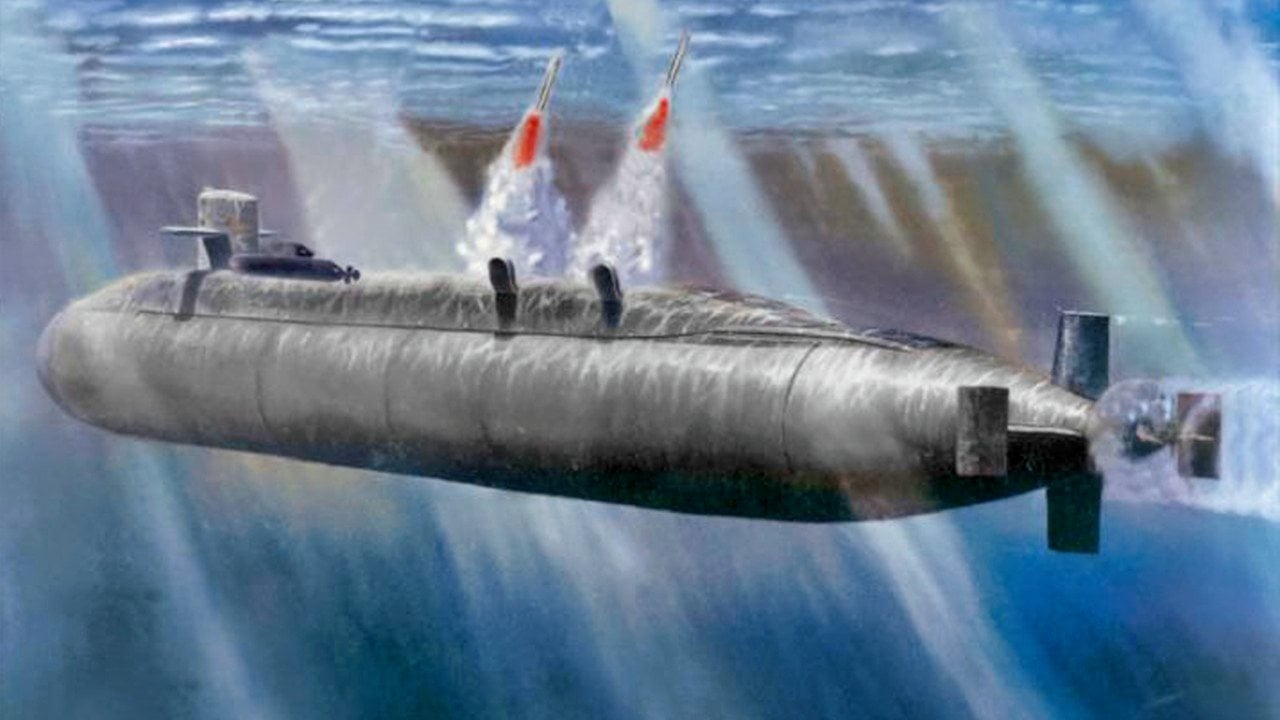
Puget Sound Naval Shipyard, Wash. (Aug. 14, 2003) — Illustration of USS Ohio (SSGN 726) which is undergoing a conversion from a Ballistic Missile Submarine (SSBN) to a Guided Missile Submarine (SSGN) designation. Ohio has been out of service since Oct. 29, 2002 for conversion to SSGN at Puget Sound Naval Shipyard. Four Ohio-class strategic missile submarines, USS Ohio (SSBN 726), USS Michigan (SSBN 727) USS Florida (SSBN 728), and USS Georgia (SSBN 729) have been selected for transformation into a new platform, designated SSGN. The SSGNs will have the capability to support and launch up to 154 Tomahawk missiles, a significant increase in capacity compared to other platforms. The 22 missile tubes also will provide the capability to carry other payloads, such as unmanned underwater vehicles (UUVs), unmanned aerial vehicles (UAVs) and Special Forces equipment. This new platform will also have the capability to carry and support more than 66 Navy SEALs (Sea, Air and Land) and insert them clandestinely into potential conflict areas. U.S. Navy illustration. (RELEASED)
Iran’s geography, among other things, makes a large-scale ground invasion extremely difficult.
As a result, long-range stand-off weapons like the Tomahawk will likely remain central to any extended campaign. In other words, the conflict with Iran is not only testing American military power, but it might also begin testing how quickly its defense industry can rebuild the arsenal on which that power depends.
About the Author: Jack Buckby
Jack Buckby is a British researcher and analyst specialising in defence and national security, based in New York. His work focuses on military capability, procurement, and strategic competition, producing and editing analysis for policy and defence audiences. He brings extensive editorial experience, with a career output spanning over 1,000 articles at 19FortyFive and National Security Journal, and has previously authored books and papers on extremism and deradicalisation.