
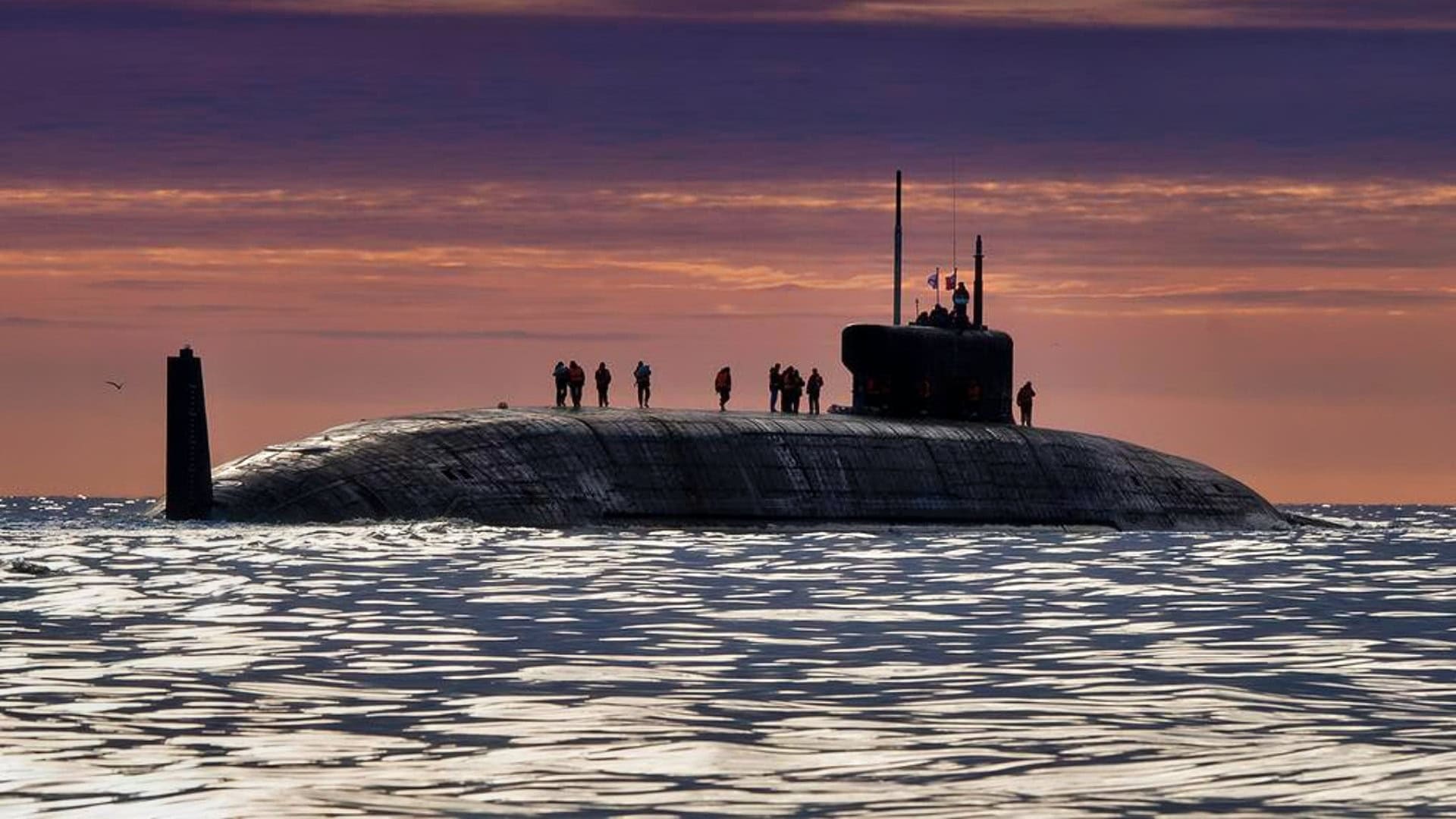
The Russian Navy has announced an ambitious plan to replace its entire fleet of third-generation nuclear-powered attack submarines with Project 885 Yasen and Project 885M Yasen-M attack submarines by 2035.
This bold move would replace all of its aging Soviet-era attack submarines with the modern Yasen and Yasen-M class boats.
This initiative was confirmed by Army Recognition, citing a March 19 confirmation from Navy Commander-in-Chief Aleksandr Moiseyev via Tass. The plan would phase out all of the remaining Akula, Sierra, and Oscar-II submarines in favor of a streamlined, standardized fleet of 10 to 12 Yasen-class attack submarines.
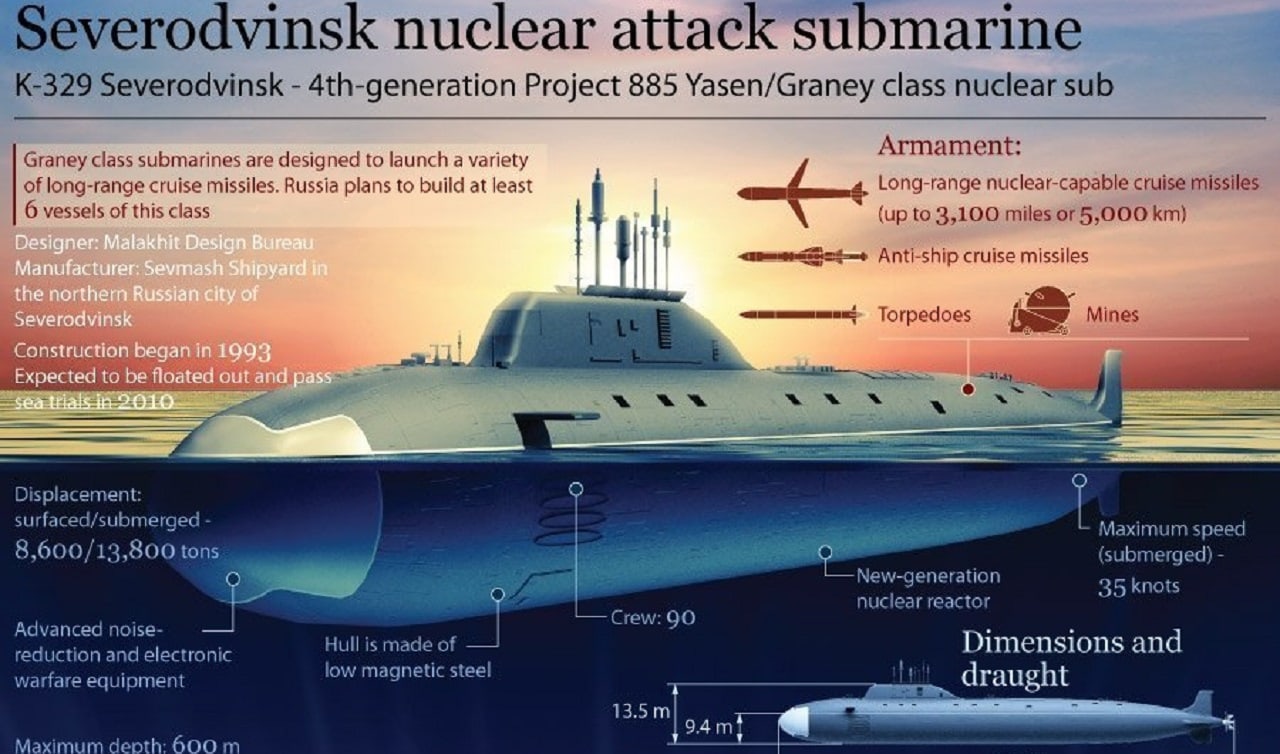
Yasen submarine diagram from Russian state media.
The Russian Navy’s aging submarine platforms are plagued by worn-out reactors, outdated electronics, parallel logistics chains, and distinct maintenance requirements tied to multiple designs.
The new replacement strategy will streamline maintenance for just one type of submarine, the Yasen class, which should be a significant cost-saving move.
“Regarding multipurpose submarines, the primary project going forward — the Yasen/YasenM, designed by the Malakhit Design Bureau of the United Shipbuilding Corporation (USC) — will replace all third-generation submarines currently in the Navy’s inventory within the next decade: Projects 971, 945, and 949,” Moiseyev stated in an interview.
A Smaller But More Lethal Fleet Of Submarines
This directive is a significant step toward modernizing the fleet, while moving away from the Soviet-era model of a large, diverse fleet.
In contrast, the Russians are pushing all of their chips into the middle of the table, betting on a single, versatile, multipurpose platform.
The Yasen and Yasen-M classes of attack submarines are definitely more capable than their Soviet-era brethren. If Russia can actually build that many submarines over the next decade, it would represent a significant qualitative leap in Russia’s undersea capabilities.
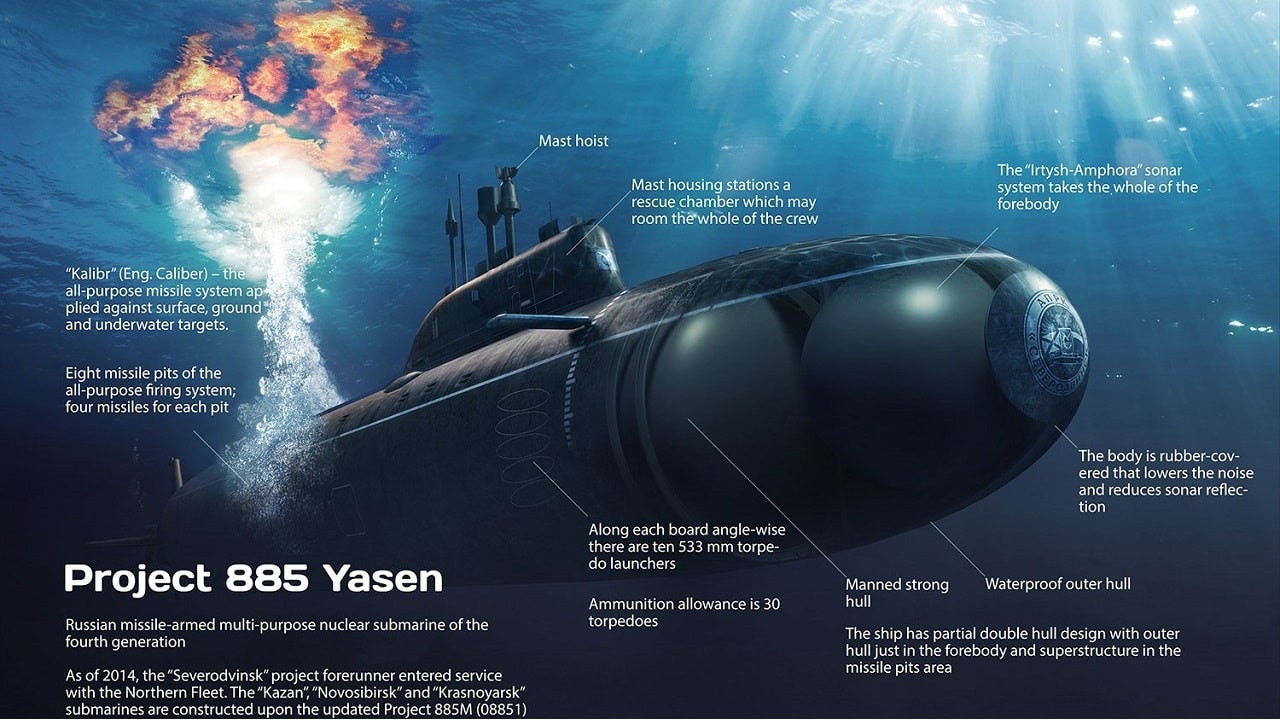
Yasen-M attack submarine. Image Credit: Russian Government.
“As for ammunition, they are equipped with all the Navy’s modern missile weapons — Kalibr, Oniks, Tsirkon (Zircon), and naval underwater weapons. The subs can operate covertly and for extended periods in virtually any area of the ocean and, of course, pose a great threat to naval groups and land targets of any adversary,” Moiseyev added.
Russia Launched The Latest Yasen-M Class Submarine A Year Ago
The Russian Navy’s latest nuclear-powered attack submarine, the Perm, a fourth-generation Yasen-M class submarine, was launched by Russian President Putin on March 27, 2025.
Named after the city of Perm in the Urals, it is the sixth vessel in the Yasen/Yasen-M series and the first Russian nuclear submarine to be officially equipped with the 3M22 Zircon hypersonic cruise missile as a standard feature.
The submarine’s keel was laid down on July 29, 2016, at the Sevmash shipyard in Severodvinsk. The Perm is scheduled to enter service with the Russian Navy in 2026, following a year of sea trials.
The Yasen-M class (Project 885M) is a modernized version of the Yasen-class submarines, developed by the Malakhit Marine Engineering Bureau under the guidance of Chief Designer Vladimir Pyalov.
The Yasen-M Class Propulsion System
The Perm is powered by an updated KTP-6-185SP pressurized water-cooled nuclear reactor, generating approximately 200 megawatts (equivalent to approximately 268,204 hp).
Propulsion is provided through a single shaft and low-noise propeller, supported by two thrusters, allowing the submarine to reach speeds of up to 31 knots underwater and 16 knots on the surface.
This fourth-generation nuclear reactor has a 25–30-year core life, eliminating the need for mid-life refueling, and allows for natural coolant circulation, contributing to lower acoustic signatures on par with the latest Western SSNs.
The Perm’s overall length is 130 meters, with a beam of 13 meters and a draft of 9.4 meters, and it accommodates a crew of 64 officers and crew.
With a maximum diving depth of 600 meters and an operational depth of 520 meters, the Perm can remain submerged for up to 100 days. The vessel has a submerged displacement of 13,800 tons and a surface displacement of 8,600 tons, slightly less than those of earlier Yasen-M units.
Yasen-M Class Armaments
The Yasen-M Class is a potent platform. It has greater strike capability than Western submarines. The weapons carried by these submarines represent a significant shift in their mission from the hunter-killer role to the launch of a full range of anti-ship and land-attack missiles.
These missiles are based on a vertical launch system with eight cells, including the advanced Kalibr missiles for land targets, the Oniks cruise missiles for anti-ship missions, and the hypersonic Zircon missiles. These weapons, along with their torpedo armament, allow the submarine to conduct anti-submarine, anti-ship, and land-attack missions.
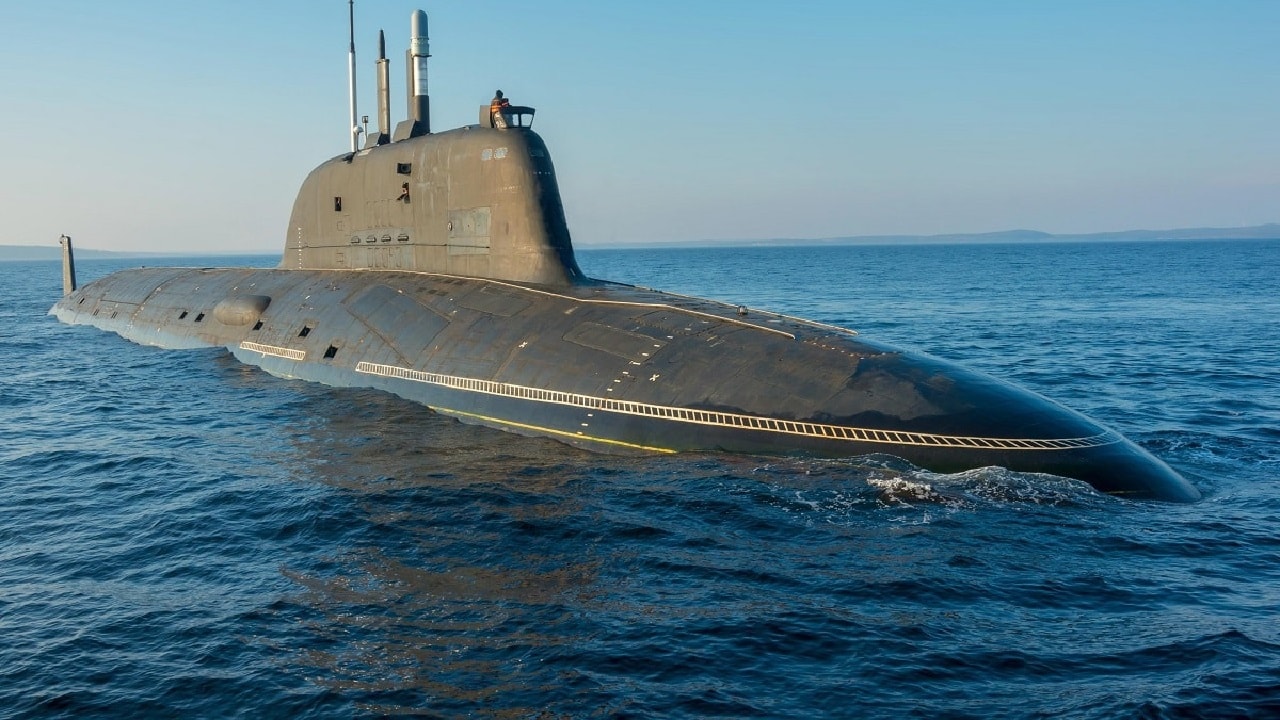
Russian Yasen-class Submarine.
The Zircon hypersonic cruise missile (also known as Tsirkon or SS-N-33) is a Russian hypersonic cruise missile with a scramjet engine and nuclear capability. It’s designed for deployment from surface vessels, submarines, and aircraft. The Yasen-class submarines can carry up to 32 Zircon cruise missiles.
The Zircon reportedly has a top speed of Mach 9 and a range of up to 1,000 kilometers, according to Putin’s 2019 State of the Nation address.
However, many Western experts at the time believed that Zircon’s firing range would fall somewhere between 400 and 500 km [215-270 nm], and its top speed would be limited to between Mach 5 and 6. However, that capability is still a potent weapon.
The Yasen-M’s armament includes ten 533 mm-caliber torpedo tubes, located in the midsection of the hull and mounted at an angle due to the presence of a large spherical sonar array in the bow.
Torpedoes From the Soviet Era: A Question Mark
The Yasen-class is capable of launching various types of torpedoes, including the USET-80, Fizik-2, and Case models, as well as naval mines.
But it is the Yasen-M’s torpedoes, Izvestia, a Russian state-owned newspaper, raised questions about.
“There are also certain questions about the torpedo armament — it is from the Soviet era — and they will have to be resolved. The new torpedoes have not yet been fully tested — there is work to do, something to improve,” the newspaper said. “Potentially, this is a very important acquisition,” it added.
Izvestia was speaking indirectly about the disaster aboard the Kursk, a nuclear submarine that sank in 2000 after a torpedo exploded inside the ship.
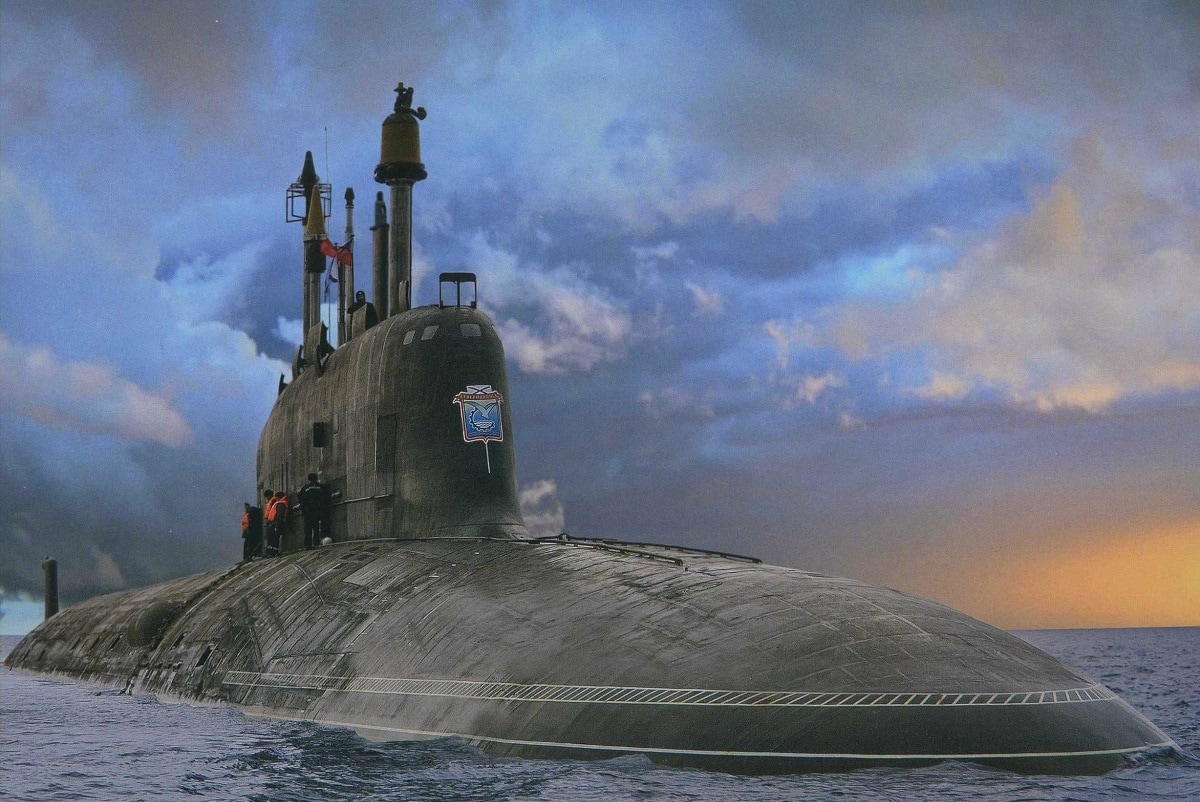
Image: Creative Commons.
A report from the Royal United Services Institute (RUSI) stated that “the Yasen-M Class submarine’s role has changed from a hunter-killer to a nuclear-guided missile submarine (SSGN), likely indicative of a shift in how Russian submarines will contribute to future campaigns.”
RUSI added that, “long-range strike missions appear to be superseding sea lines of communication (SLOC) interdiction as a primary task.
“This will likely necessitate a change in how NATO manages the anti-submarine warfare (ASW) challenge in the High North, given that a strategy of barrier defence at the GIUK (Greenland–Iceland–UK) gap may actually do little to impact Russian submarines, which may have little need to traverse this barrier to achieve their operational ends.”
Construction Timelines Will Make Meeting The 2035 Deadline Difficult
Numerous factors limit the annual output rate to approximately one submarine or fewer. The Russian economy, which has taken a massive hit since the invasion of Ukraine, is stretched tight for resources. The Navy has taken a back seat to the Army in terms of resources due to the “special military operation.”
International sanctions have taken a toll on foreign supply chains that furnish parts of the Yasen class. They also face delays in turbine supply.
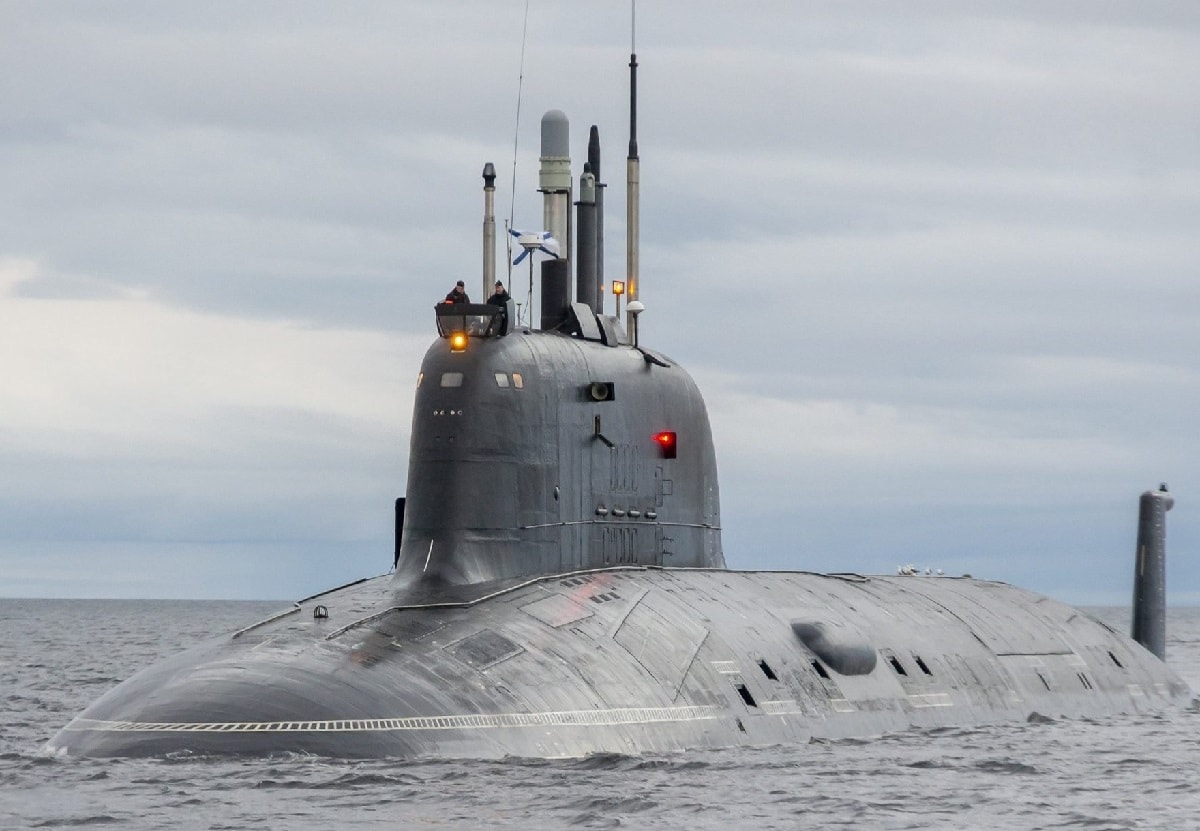
Yasen-Class Image: Russian Navy.
Russia plans to build 12 Yasen-M-class boats, and these can hit most European capitals from the North Sea. These submarines are quieter and can bring the fight to Russia’s enemies by using stealth to approach carrier strike groups, eliminating escort vessels, and firing cruise missiles at land targets.
But Russia’s submarine force will be stretched really thinly trying to defend the homeland. They currently have 30 nuclear attack submarines in the inventory. Even if they can afford to build another half dozen in the next decade, a big if, stretching their defenses to just 12 boats? That is too thin.
About the Author: Steve Balestrieri
Steve Balestrieri is a National Security Columnist. He served as a US Army Special Forces NCO and Warrant Officer. In addition to writing on defense, he covers the NFL for PatsFans.com and is a member of the Pro Football Writers of America (PFWA). His work was regularly featured in many military publications.