
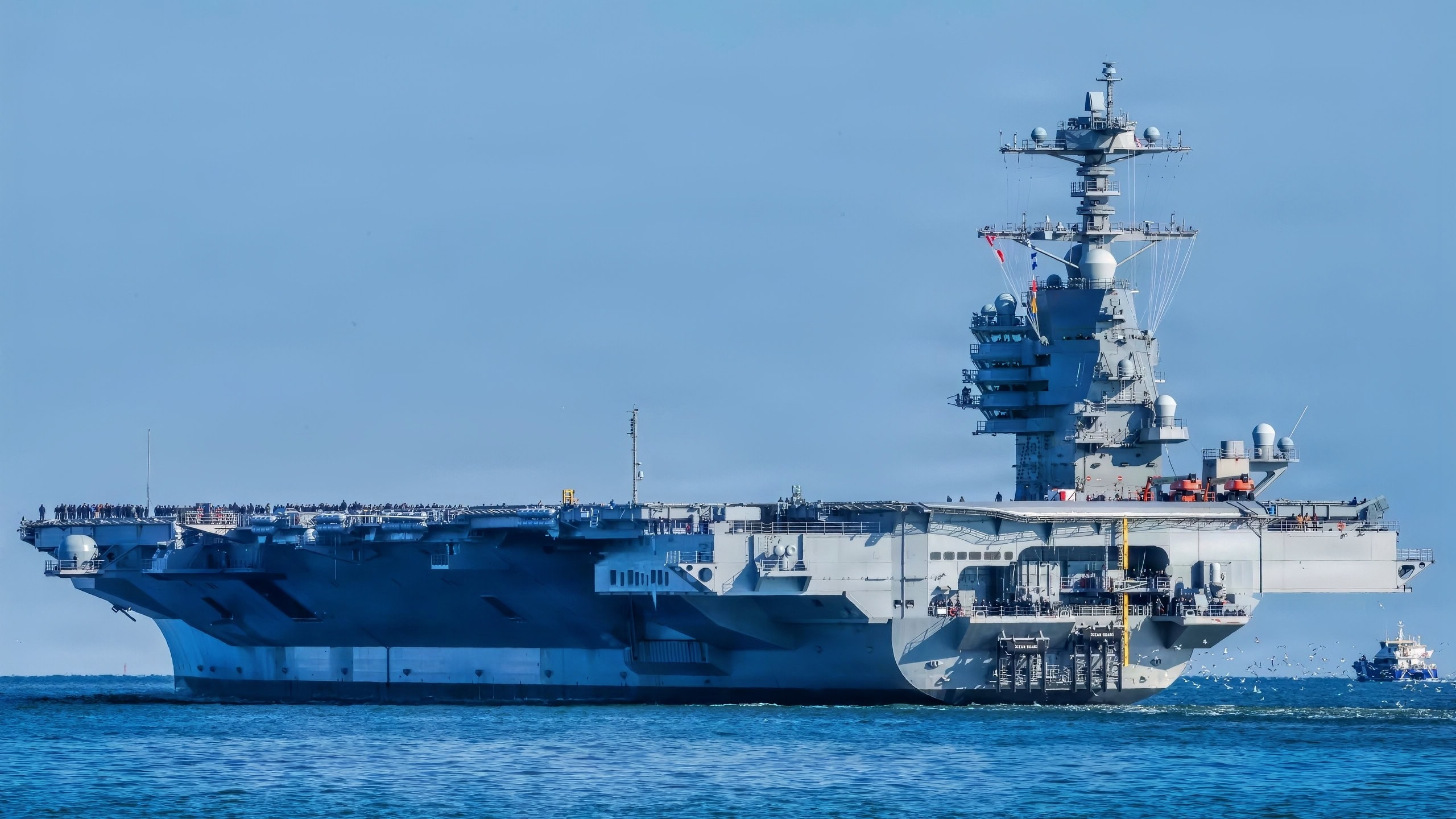
Ford-Class: The USS John F. Kennedy Aircraft Carrier Is Coming Soon (Just Not Fast Enough)
During his mere thousand days in the White House (January 20, 1918 – November 22, 1963), then-U.S. President John Fitzgerald Kennedy frequently didn’t see eye-to-eye with his generals, particularly then-U.S. Air Force Chief of Staff Gen. Curtis Emerson LeMay.
This butting of heads in turn provided much grist for the conspiracy rumor mills that the “military industrial complex” was responsible for his assassination.
Be that as it may, JFK was very proud of his U.S. Navy service in World War II as the skipper of PT-109.

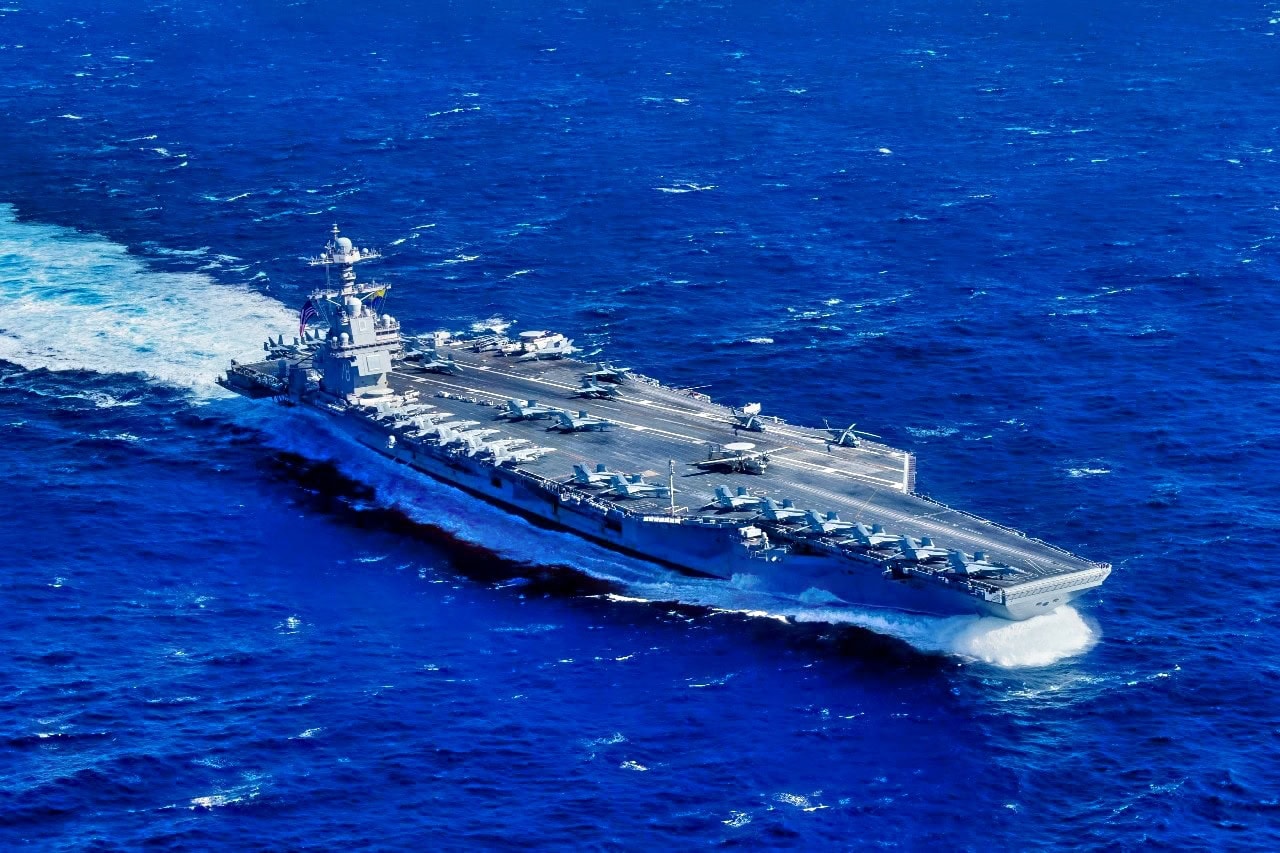
ATLANTIC OCEAN (Oct. 29, 2019) USS Gerald R. Ford (CVN 78) conducts high-speed turns in the Atlantic Ocean. Ford is at sea conducting sea trials following the in port portion of its 15 month post-shakedown availability. (U.S. Navy photo by Mass Communication Specialist 3rd Class Connor Loessin)
Fittingly, not just one, but two USN warships, both of them aircraft carriers, have been named in his honor. Now, the newer vessel of that eponymous duo, USS John F. Kennedy (CVN-79), is being fast-tracked into service, and, given the various crises the Navy (not to mention America as a whole) is contending with, not a moment too soon.
Bottom Line Up Front (BLUF)
An initial source of information from the ever-savvy Wiley Stickney of Bolt Flight in a January 8, 2026, article titled “U.S. Fast-Tracks USS John F. Kennedy Amid Ford-Class Combat Debut.”
Therein, Mr. Stickney reports on a U.S. Navy announcement, made two days prior during a high-profile visit by U.S. Secretary of War Pete Hegseth to Huntington Ingalls Industries (HII), the nation’s largest military shipbuilder, affirming the official acceleration of the construction timeline of the CVN-79, the second ship of the Ford-class supercarriers.
Mr. Stickney notes that a major impetus for JFK’s accelerated timeline was the “blooding” in combat of the lead ship of the class, USS Gerald R. Ford (CVN-78), which occurred during Operation Absolute Resolve, the January 3, 2026, capture of Venezuelan communist dictator Nicolás Maduro.
Now, with CVN-78 sidelined due to a freakish shipboard fire, and her crew mentally fatigued (and possibly on the edge of burnout) via an extended deployment that included participation in the Operation Epic Fury combat ops against the Islamic Republic of Iran, there is an even greater sense of urgency to get CVN-79 up and running sooner rather than later.
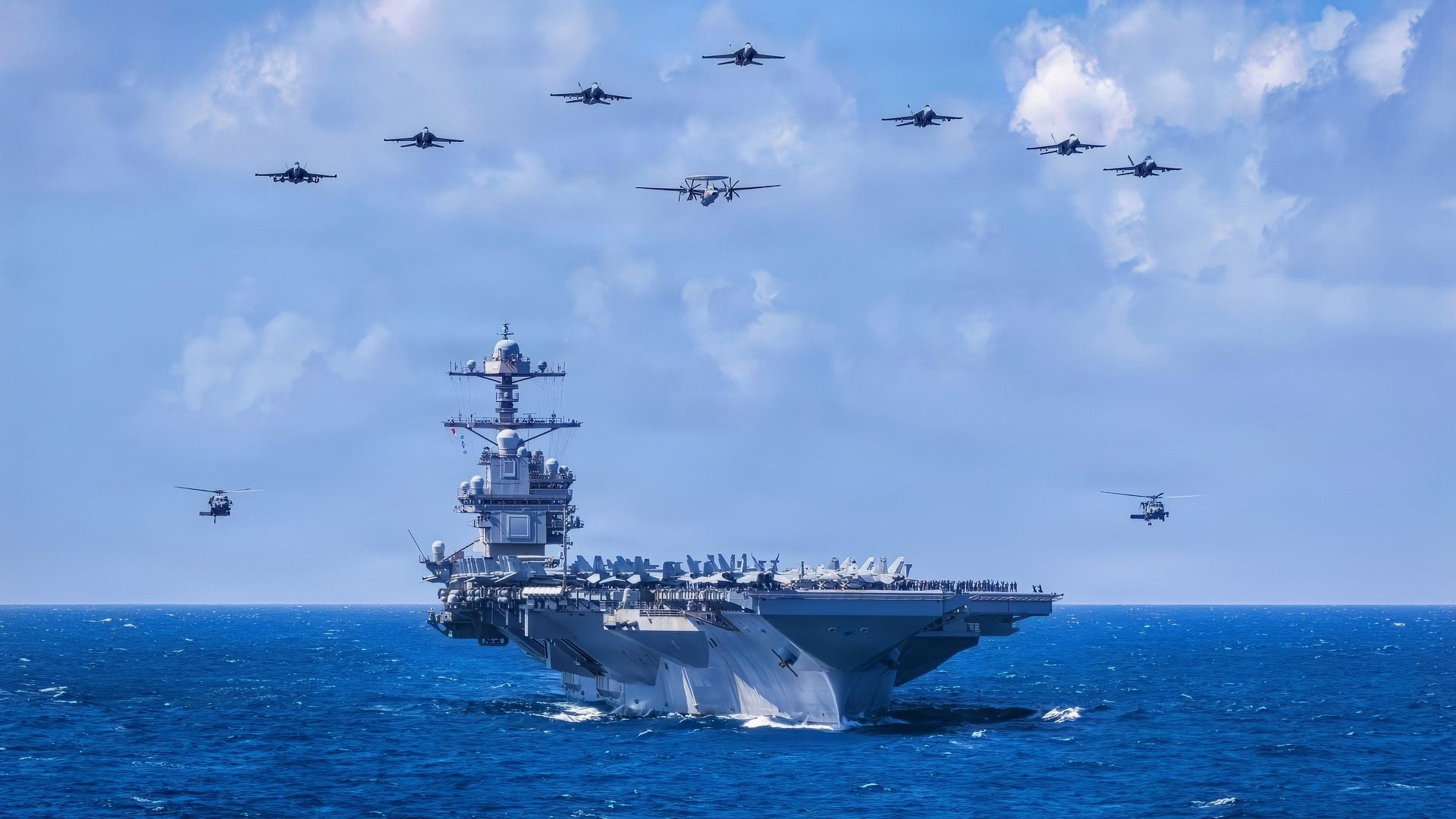
USS Ford Supercarrier U.S. Navy. Image Credit: U.S. Navy.
The U.S. Navy’s Supercarrier Shortage
Though not touched upon by Mr. Stickney, another reason for the sense of urgency to commission the Kennedy ASAP is the shortage of battle-tested but aging Nimitz-class supercarriers. That shortage boils down to two major factors:
-CVNs are required to undergo a refueling and complex overhaul (RCOH) every 25 years. This procedure entails cutting a massive hole into the hull and replacing everything from catapult systems to water purifiers. Case in point of the agonizing slowness of the RCOH process: the USS George Washington (CVN-73) was out of action for a whopping 2,100 days!
-Navy logisticians apply a “rule of thirds” to work on carriers: At any given time, one-third of carriers are deployed, one-third are preparing for deployment, and one-third are undergoing maintenance. With 11 carriers in the fleet, this means that only three to four are typically out to sea. (And right now, USS Abraham Lincoln [CVN-72] is left as the only carrier taking the fight to Iran, though both the USS George H.W. Bush (CVN-77) and the USS Tripoli [LPH-10] are on their way.)
Indeed, as Eric Chewning, HII executive vice president of maritime systems and corporate strategy, recently stated in an interview, “There is a sense of urgency around everything we do. HII is always focused on meeting and delivering on our commitments to the U.S. Navy and the warfighter.”
Accordingly, the John F. Kennedy has been slated for commissioning in March 2027.
Moving In the Right Direction (Thus Far) on Ford-Class Supercarrier
“Talk is cheap,” as the saying goes, so that begs the question: How are the Navy’s lofty words and goals being put into action?
Well, so far, so good (knock on wood). 20 days after the Stickney article was published, the Kennedy departed for her sea trials, which served the purpose of testing the ship and its systems ahead of delivery to the Navy.
The world’s largest aircraft carrier, USS Gerald R. Ford (CVN 78), sails in formation with the Arleigh Burke-class guided missile destroyers USS Winston Churchill (DDG 81), USS Mitscher (DDG 57), USS Mahan (DDG 72), USS Bainbridge (DDG 96), and USS Forrest Sherman (DDG 98) in the Atlantic Ocean, Nov. 12, 2024. The Gerald R. Ford Carrier Strike Group is underway in the Atlantic Ocean completing Group Sail. Group Sail is the first at-sea integrated phase training event during a routine deployment training cycle. It is designed to challenge the Gerald R. Ford CSG’s ability to use the capabilities of the USS Gerald R. Ford (CVN 78), USS Winston S. Churchill (DDG 81), Carrier Air Wing (CVW) 8, Destroyer Squadron (DESRON) 2, and embarked Information Warfare team as a cohesive Strike Group to meet Navy and Joint Warfighting requirements that increases warfighting capability and tactical proficiency across all domains. (U.S. Navy photo by Mass Communication Specialist 2nd Class Maxwell Orlosky)
A week later, the ship safely returned from those sea trials. As noted by a press release from HII’s Newport News Shipbuilding (NNS) division, “The sea trials brought together NNS shipbuilders, John F. Kennedy sailors and Navy personnel to execute the testing and demonstrate ship operations.”
This successful completion of the sea trials lends credence to NNS president Kari Wilkinson’s statement last December that John F. Kennedy is scheduled for preliminary acceptance in the middle of this year.
The Old JFK vs. The New JFK Supercarrier
Regarding the original USS John F. Kennedy (CVA-67), she was the first in class and the last conventionally powered aircraft carrier built for the U.S. Navy, commissioned on September 7, 1968 (not quite five years after her namesake’s untimely assassination).
She served in multiple conflicts, including Operation Desert Storm, Operation Enduring Freedom, and Operation Iraqi Freedom, before being ultimately decommissioned in 2007.
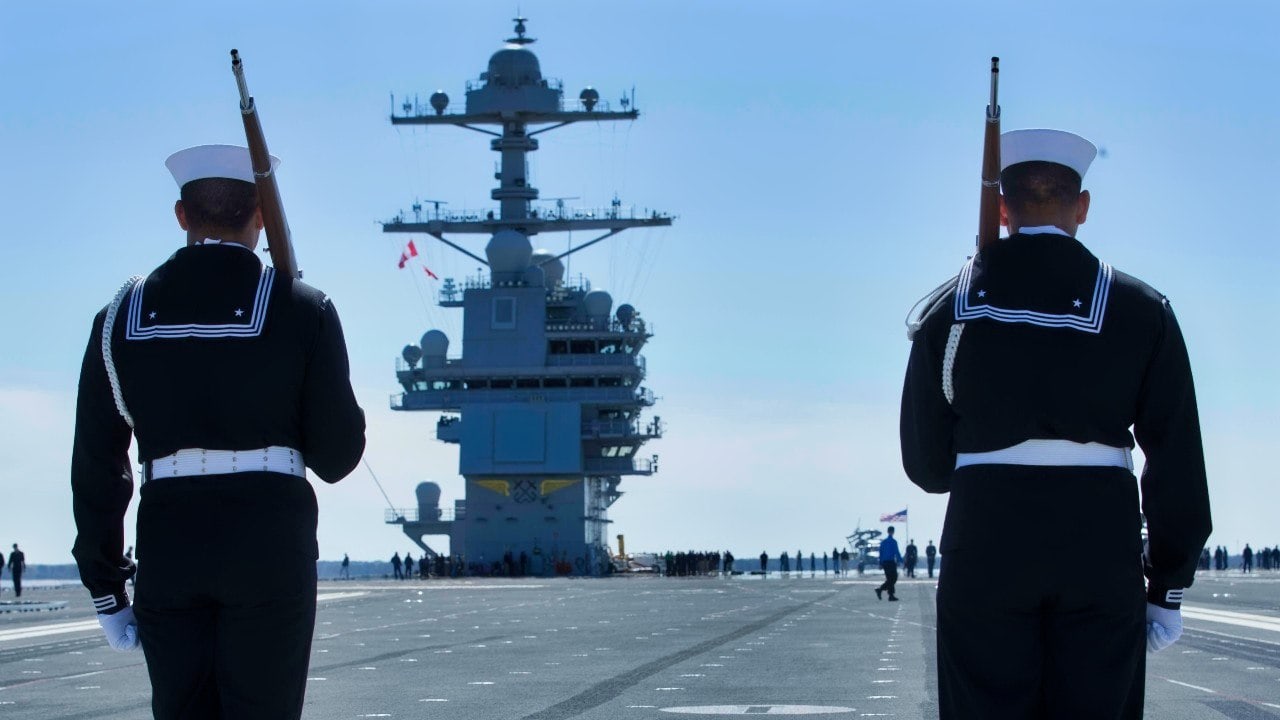
(April 8, 2017) — Logistics Specialist 3rd Class Miguel Monduy, from Miami, Florida, and Aviation Ordnanceman Airman Michael Valdez, from Pheonix, Arizona, assigned to Pre-Commissioning Unit Gerald R. Ford (CVN 78), stand on the flight deck for shifting colors. The future USS Gerald R. Ford (CVN 78) is underway on its own power for the first time. The first-of-class ship — the first new U.S. aircraft carrier design in 40 years — will spend several days conducting builder’s sea trials, a comprehensive test of many of the ship’s key systems and technologies. (U.S. Navy photo by Mass Communication Specialist Seaman Gitte Schirrmacher)
With a fully-laden displacement of 82,655 long tons and a hull length of 1,052 feet, she was 18,000 tons lighter and 54 feet shorter than the JFK “sequel” (so to speak).
CVA-67 is currently in Brownsville, Texas, awaiting scrapping.
MORE – China Will Be ‘Surrounded’ By A New Fleet of F-35A, F-35C, and New F-15EX Eagle II Fighters
MORE – The F-22 Raptor Mistake: 750 Ordered, 189 Built
About the Author: Christian D. Orr, Defense Expert
Christian D. Orr is a Senior Defense Editor. He is a former Air Force Security Forces officer, Federal law enforcement officer, and private military contractor (with assignments worked in Iraq, the United Arab Emirates, Kosovo, Japan, Germany, and the Pentagon). Chris holds a B.A. in International Relations from the University of Southern California (USC) and an M.A. in Intelligence Studies (with a concentration in Terrorism Studies) from American Military University (AMU). He is also the author of the book “Five Decades of a Fabulous Firearm: Celebrating the 50th Anniversary of the Beretta 92 Pistol Series,” the second edition of which was recently published.