
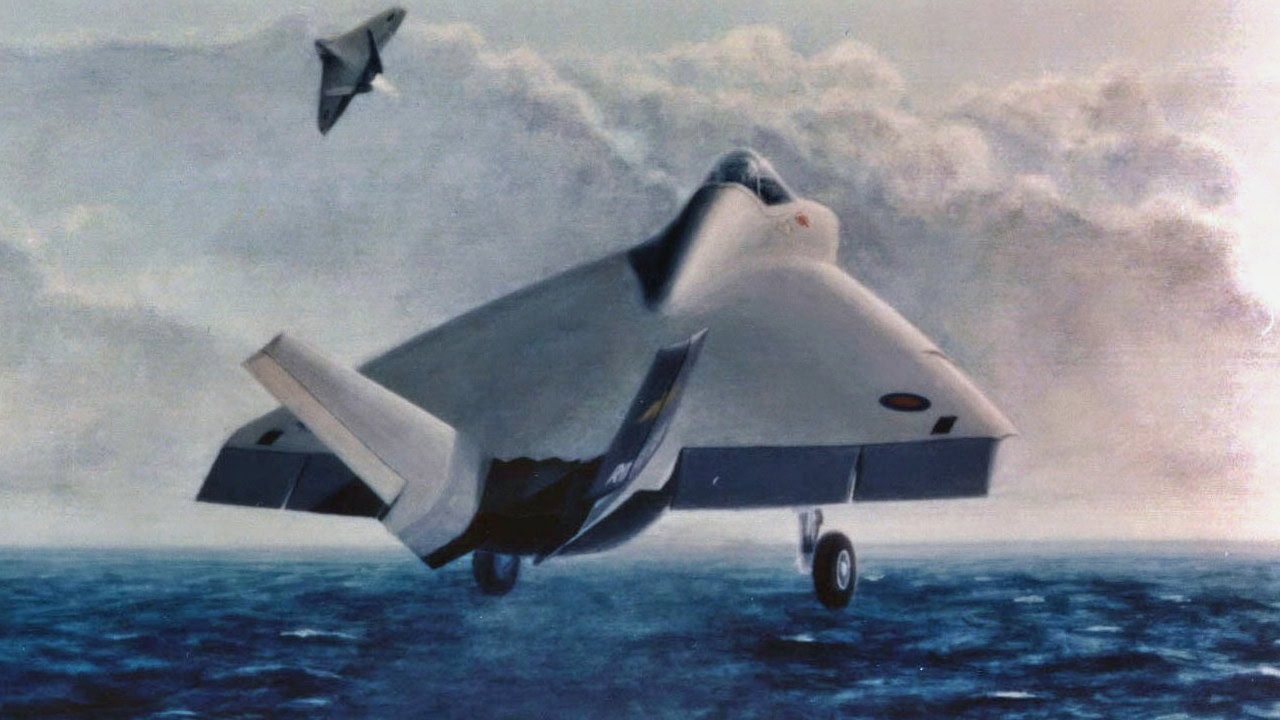
The X-32 Was Mocked for Its Looks and Forgotten After It Lost
The X-32 Sits Collecting Dust in 2 Museums – It Was No Failure – When the U.S. Department of Defense awarded the Joint Strike Fighter contract in October 2001, it was deciding the future of Western airpower for decades. The program, launched in 1993, aimed to produce a single multirole aircraft to replace platforms ranging from the F-16 to the AV-8B Harrier.
Boeing’s X-32 was one of two finalists, and today it is largely remembered for its unconventional appearance. This odd-looking craft had a large chin-mounted intake and wide fuselage – but its odd looks didn’t mean pilots didn’t like it.
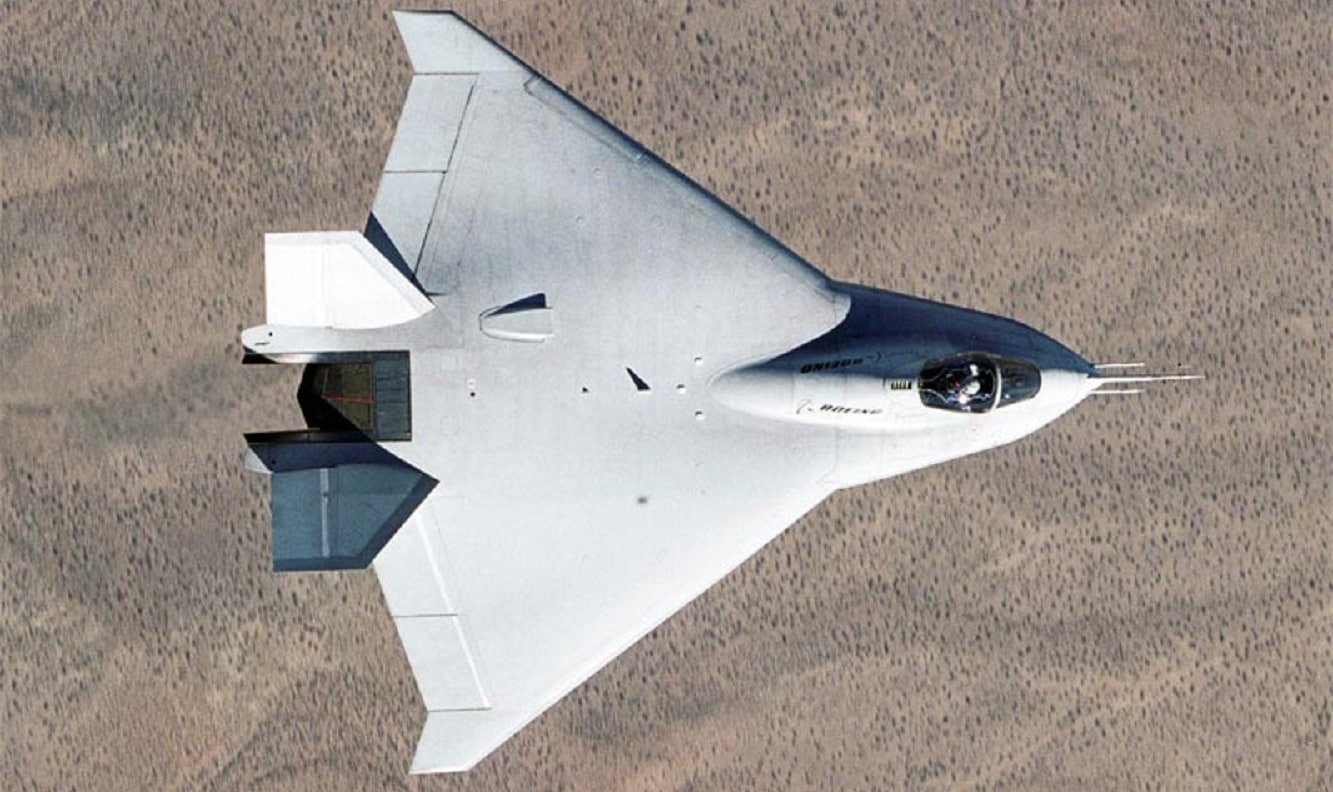
Boeing X-32. Image Credit: Creative Commons.
In fact, those who flew it liked it a lot. And the aircraft worked. It flew well, and it met its test objectives. U.S. Navy test pilot Commander Phillip “Rowdy” Yates even compared its handling to the F/A-18 and described its control response as smooth and precise. It’s exactly the kind of review Boeing was looking for.
But if the X-32 was such a capable aircraft that pilots trusted, why did it lose one of the most important defense competitions of modern history, and help usher in the age of the F-35?
Meet the X-32 from Boeing
From a flight-test perspective, the X-32 was not a problematic aircraft. It was predictable, stable, and in several respects, easier to handle than its competitor. Boeing’s own flight testing data reinforces that point.
After its first flight on September 18, 2000, the X-32A completed more than 50 flight hours with multiple pilots, meeting all required test objectives and exceeding several of them.
Multiple test pilots are on record saying the aircraft closely matched their expectations. Boeing lead test pilot Fred Knox, for example, said that from the first flight, the aircraft flew exactly like the simulator – a level of predictability that is unusual for an experimental platform.
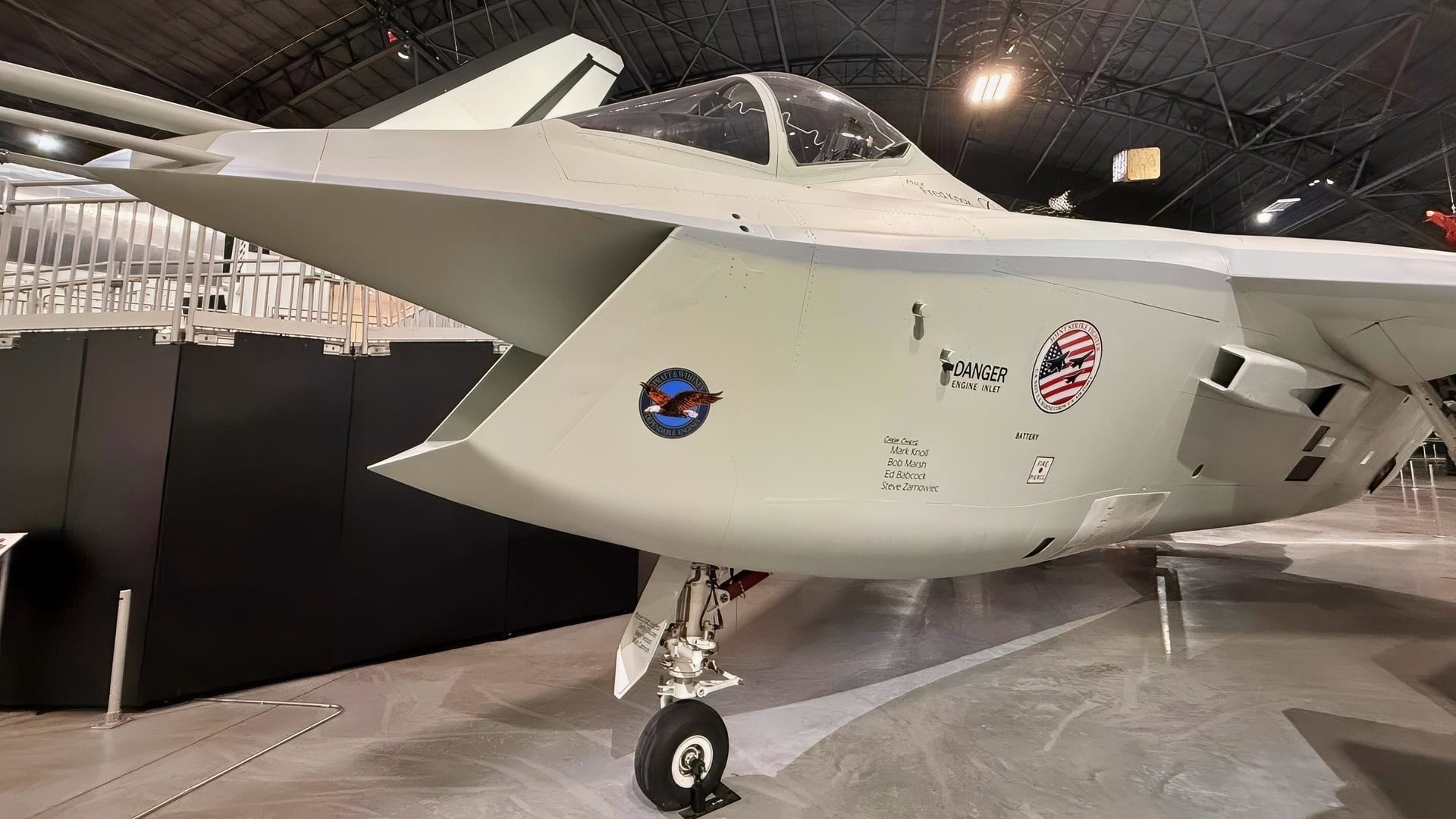
Boeing X-32 19FortyFive.com Photo
And, its operational handling characteristics were just as strong. During simulated carrier landing tests, Yates noted that the aircraft was extremely capable.
“The X-32A demonstrated excellent low-speed flying qualities in the carrier mode configuration,” Yates said, according to a Boeing press release. “Flight path control was precise all the way to touch down – this aircraft continues to fly as simulations predicted it would.”
These assessments are important because carrier operations are among the most demanding environments for aircraft. Stability at low speed and predictable control response are critical, and the X-32 delivered that and more.
It even performed well in routine operational tasks. During aerial refueling testing, it was able to maintain a stable position behind a tanker with minimal correction, proving that its great handling qualities didn’t change even during complex flight operations.
The aircraft was often described as straightforward and predictable, which is crucial in aviation.
Pilots need to be confident operating it across a range of conditions, and by those metrics, the X-32 was successful.
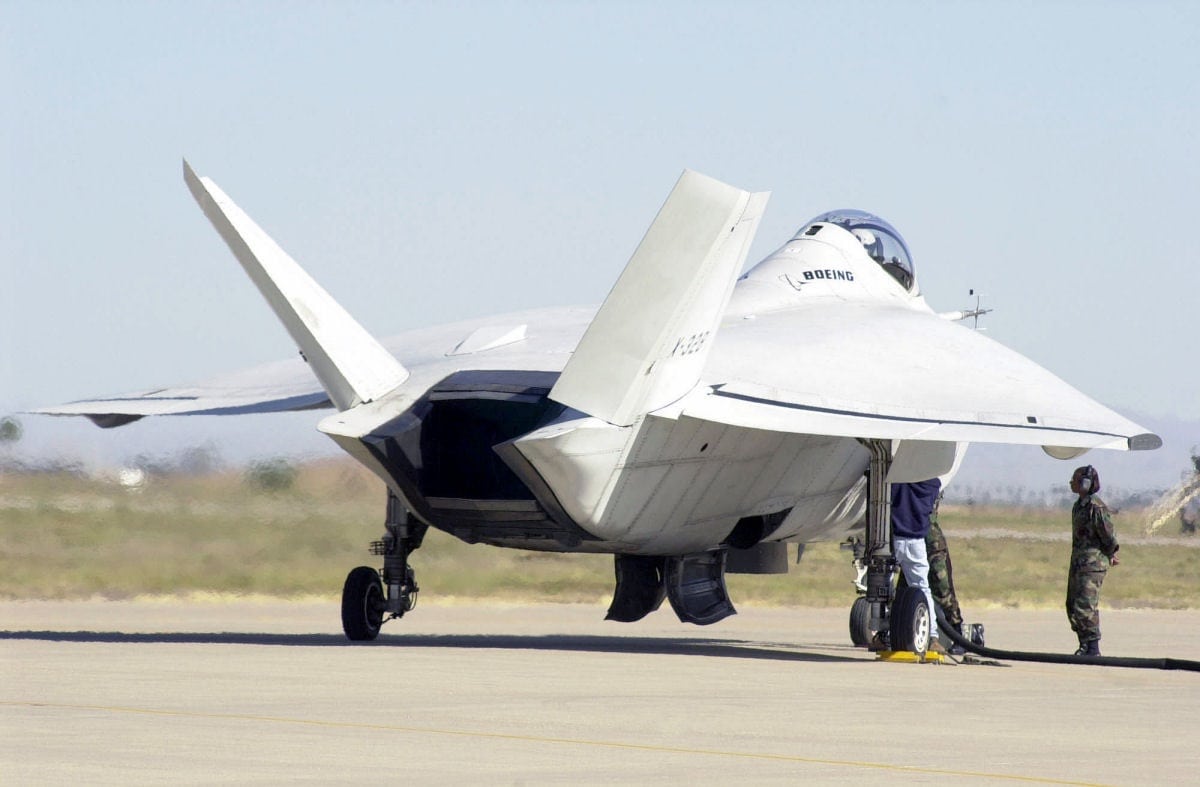
The Boeing Joint Strike Fighter (JSF) X-32B fills-up at a “hot pit” refueling station at Luke AFB during a cross-country trip. The X-32B is making a trip across the United States, making other stops along the way.
Why It Looked So Strange
The X-32’s appearance became one of its defining characteristics, but that design was driven by specific engineering requirements above all else.
The most prominent feature – its large chin-mounted intake – was a result of the aircraft’s need to feed sufficient airflow into the engine during vertical or near-vertical flight. While hovering, the aircraft cannot rely on forward motion to compress incoming air, making intake efficiency critical for its safe and effective operation.
The wide fuselage and large delta wing also served similar purposes. The wing was designed to hold up to 20,000 pounds of fuel, extending the range of the aircraft substantially.
The high sweep angle allowed a thick wing structure, providing sufficient fuel storage while maintaining aerodynamic performance.
The design philosophy was also a result of Boeing’s approach to the competition, which centered around reducing variation between the three variants at both the structural and mechanical levels.
Rather than designing fundamentally different airframes for the Air Force, Navy, and Marine Corps, Boeing attempted to keep the X-32 as close to a single baseline configuration as possible – and that philosophy drove a number of decisions that contributed to its unique look.
The aforementioned delta wing, for example, meant that the fuselage was built around a relatively simple internal layout, with fewer moving aerodynamic surfaces and less reliance on complex mechanisms.
Boeing’s short takeoff and vertical landing (STOVL) design also relied on direct vectored thrust from the main engine, eliminating the need for additional lift devices and reducing mechanical complexity.
The design was a great success in many ways, but – as with any design – there were trade-offs. The large intake, for example, created potential radar signature issues by exposing the engine’s compressor face.
The delta wing, while efficient for fuel storage and simplicity, was also less adaptable to changing maneuverability requirements. The result was an aircraft that prioritized function but had an unconventional form.
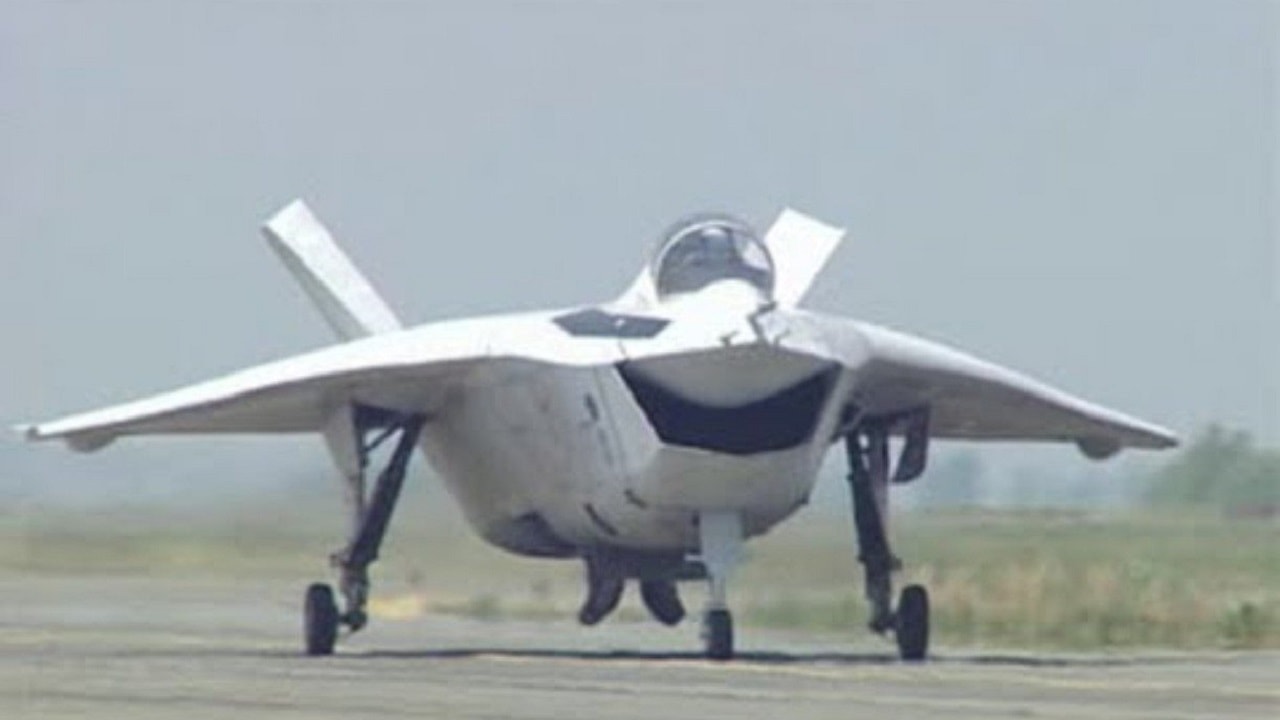
Boeing X-32 stealth fighter. Image Credit: Creative Commons.
The Test Program and Where It Fell Short
The X-32’s failure to win the Joint Strike Fighter test program didn’t mean it wasn’t a capable aircraft, but there were a fair number of reasons why it ultimately lost out to Lockheed Martin’s design.
The aircraft’s first flight took place in September 2000. Over the following months, it demonstrated conventional takeoff and landing, carrier approach handling, aerial refueling, and supersonic flight.
The X-32 completed all the necessary elements of the competition, but the problem occurred during the STOVL phase. Boeing’s direct-lift system, which used vectored engine thrust to achieve vertical flight, introduced a limitation.
As the aircraft approached hover conditions, hot exhaust gases were drawn back into the intake, reducing thrust and increasing engine temperatures.
To address this problem, Boeing introduced a jet screen system that would prevent the engine from choking by screening the engine inlet with cooler air.
The aircraft also faced another limitation: it could not demonstrate all required capabilities in a single configuration.
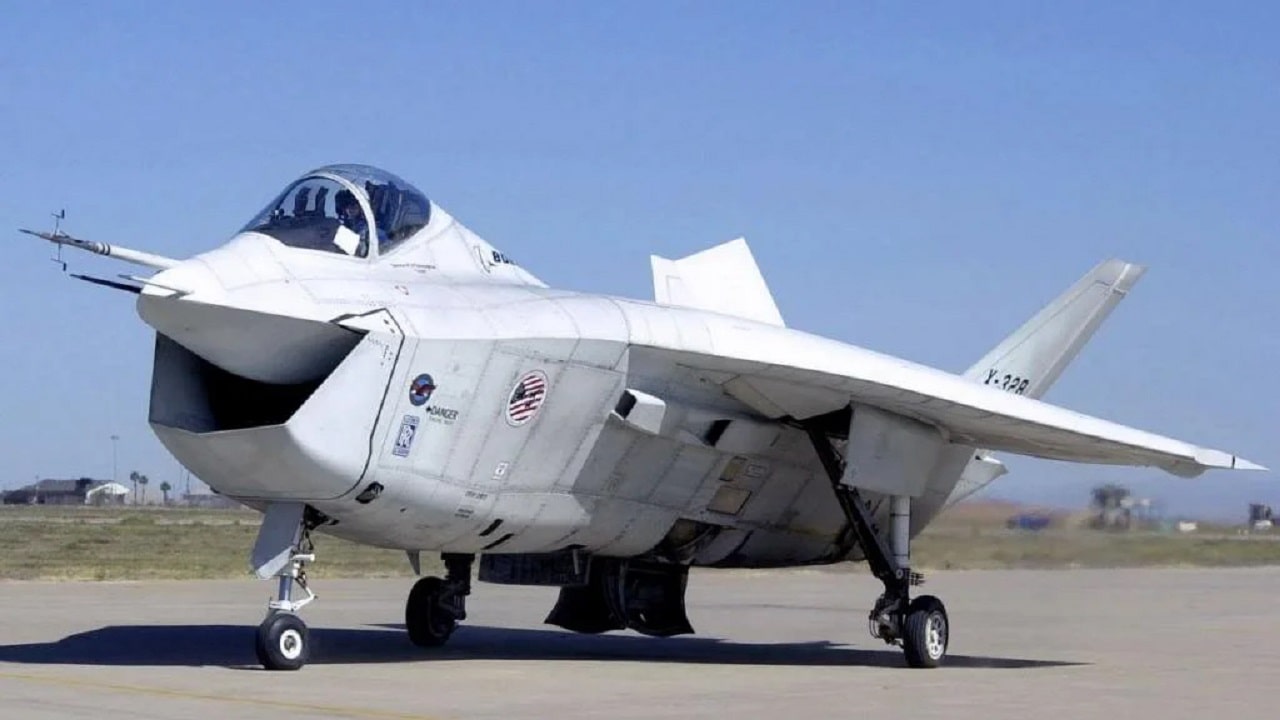
Boeing X-32. Image Credit: Creative Commons.
One such failure was the X-32’s inability to perform supersonic flight and STOVL operations without modifying the aircraft between test phases – a decisive weakness compared to Lockheed Martin’s competing X-35, which could reconfigure itself between supersonic and STOVL modes mid-flight.
In one of the most important demonstrations of the entire competition, the X-35 performed a short takeoff, accelerated to supersonic speed, and then completed a vertical landing, all in a single flight. That demonstration arguably sealed the deal, proving that the platform was capable and well integrated, and that it could meet multiple mission requirements. The X-32 failed to do the same.
Was This Really the End for the X-32?
Boeing’s loss did not end the influence of the X-32 program.
The aircraft itself was retained for testing and is now preserved, but the more important legacy was the way in which it was designed and its surprisingly good handling when compared to simulations.
Boeing, after all, relied heavily on simulation during development, and the high degree of correlation between digital modeling and real-world performance was something Boeing would later build on extensively.
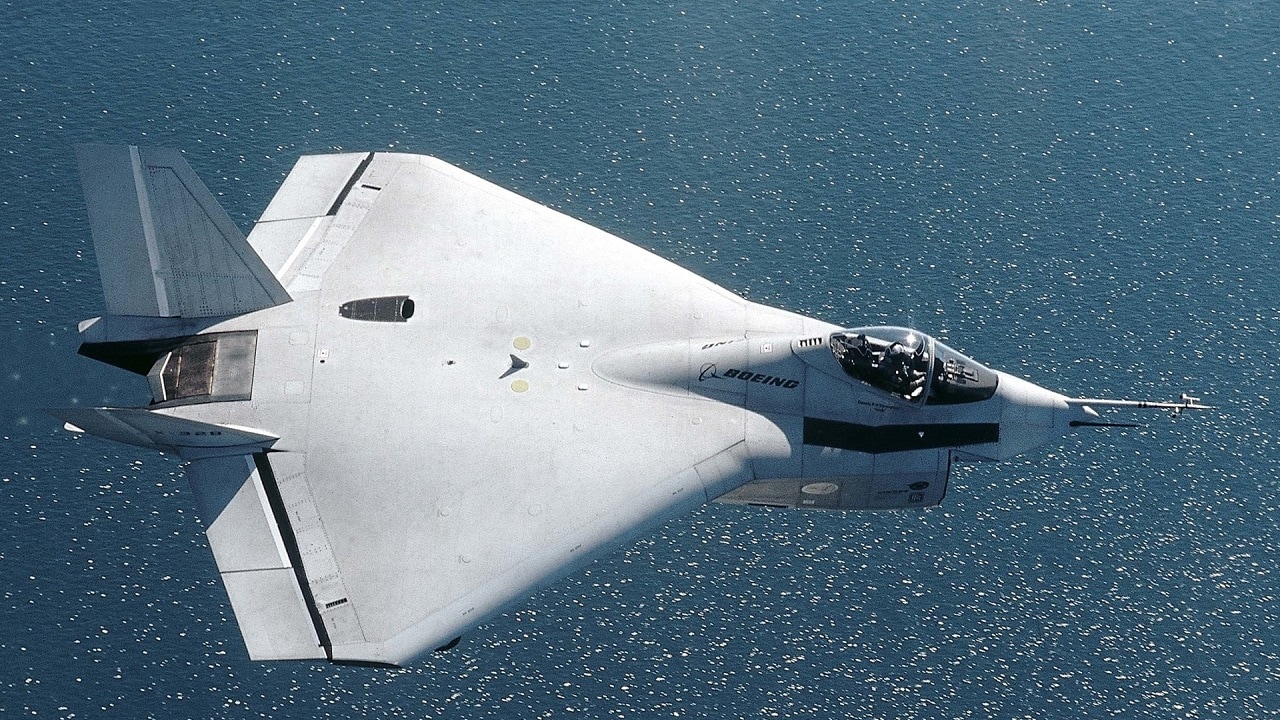
X-32 Stealth Fighter from Boeing. Image Credit: Creative Commons.
Digital modeling became central to later programs, perhaps most notably the Boeing T-7 Red Hawk, which was designed using model-based engineering and advanced digital simulation. That technology allowed the aircraft to move from concept to first flight in just 36 months.
The X-32 may have lost the competition, but in doing so, it helped reshape aircraft design and ushered in a new era of networked airpower built around the F-35 Lightning II, now used by air forces around the world.
About the Author: Jack Buckby
Jack Buckby is a British researcher and analyst specializing in defense and national security, based in New York. His work focuses on military capability, procurement, and strategic competition, producing and editing analysis for policy and defense audiences. He brings extensive editorial experience, with a career output spanning over 1,000 articles at 19FortyFive and National Security Journal, and has previously authored books and papers on extremism and deradicalization.