
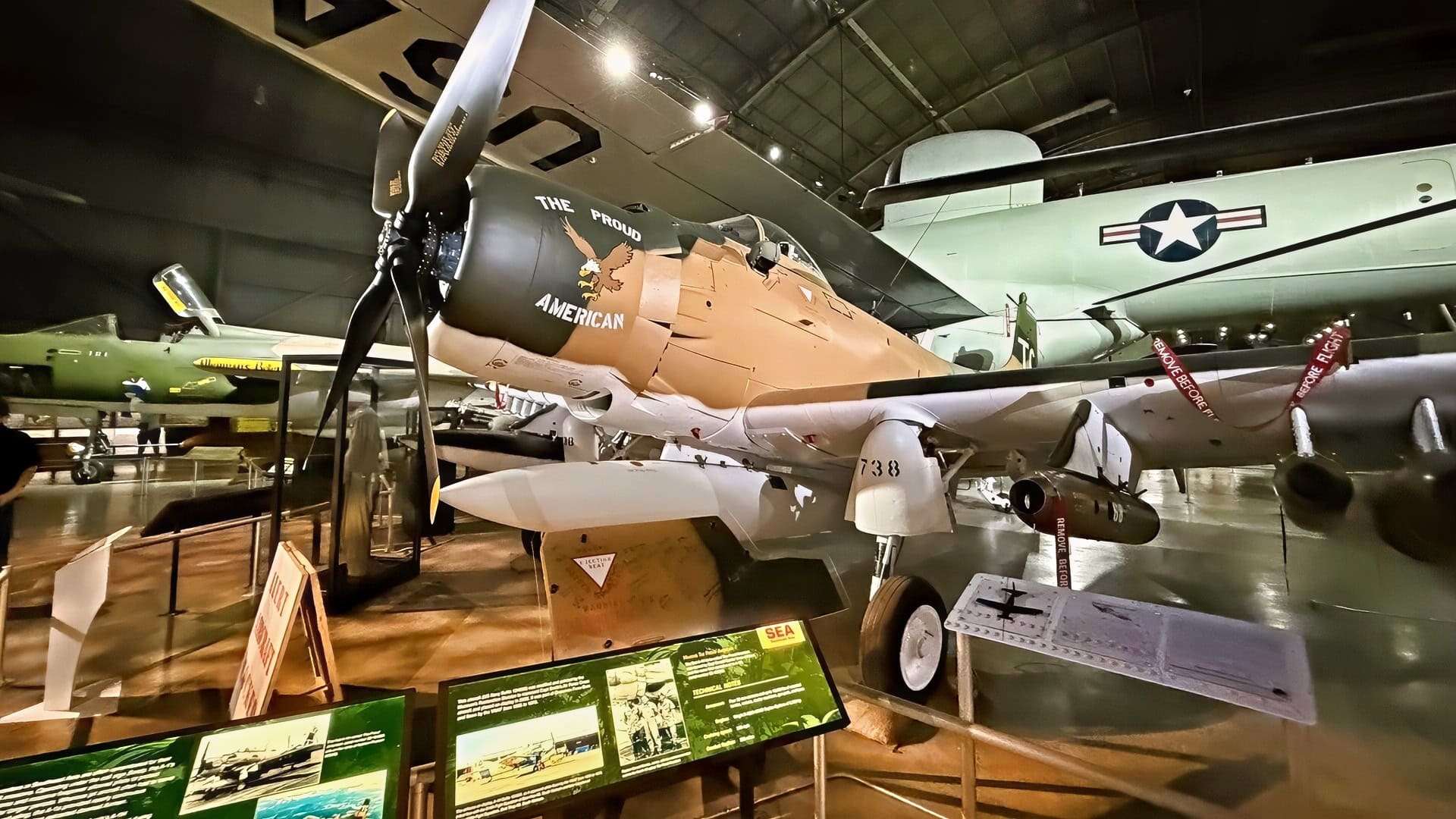
The U.S.-made A-1H Skyraider was a single-engine propeller-driven warplane. It looked woefully obsolescent in the Jet Age, yet it served ably during the hot wars of the Cold War in Korea and Vietnam.
It fully earned its place as an exhibit at the National Museum of the United States Air Force—on the grounds of Wright-Patterson Air Force Base, Ohio—where our editor, Harry J. Kazianis, took some photos of an A-1H Skyraider during a recent visit back last July.
A-1H Skyraider. 19FortyFive.com Photo Taken July 19, 2025.
As a former U.S. Air Force officer and lifelong military aviation buff, I’m not the least bit jealous of my boss—oh no, not at all.
So then, how did Skyraider succeed in the crucible of Cold War combat despite her World War II origins?
A-1/A-1/ AD-1 Skyraider Initial History and Tech Specs
The Douglas A-1/AD-1 Skyraider made her maiden flight on March 18, 1945—one month before Nazi Germany’s surrender, and six months before Imperial Japan’s surrender, which finally brought World War II to an end.
If the pictures accompanying this article make you think the Skyraider bears a resemblance to another famous Douglas warbird, you’re not hallucinating.
The Skyraider is directly descended from the legendary Douglas SBD Dauntless dive bomber that absolutely ravaged Imperial Japanese shipping during World War II—especially during the tide-turning Battle of Midway.
Indeed, the prototype that made the maiden flight was initially designated the XBT2D-1 Dauntless II.
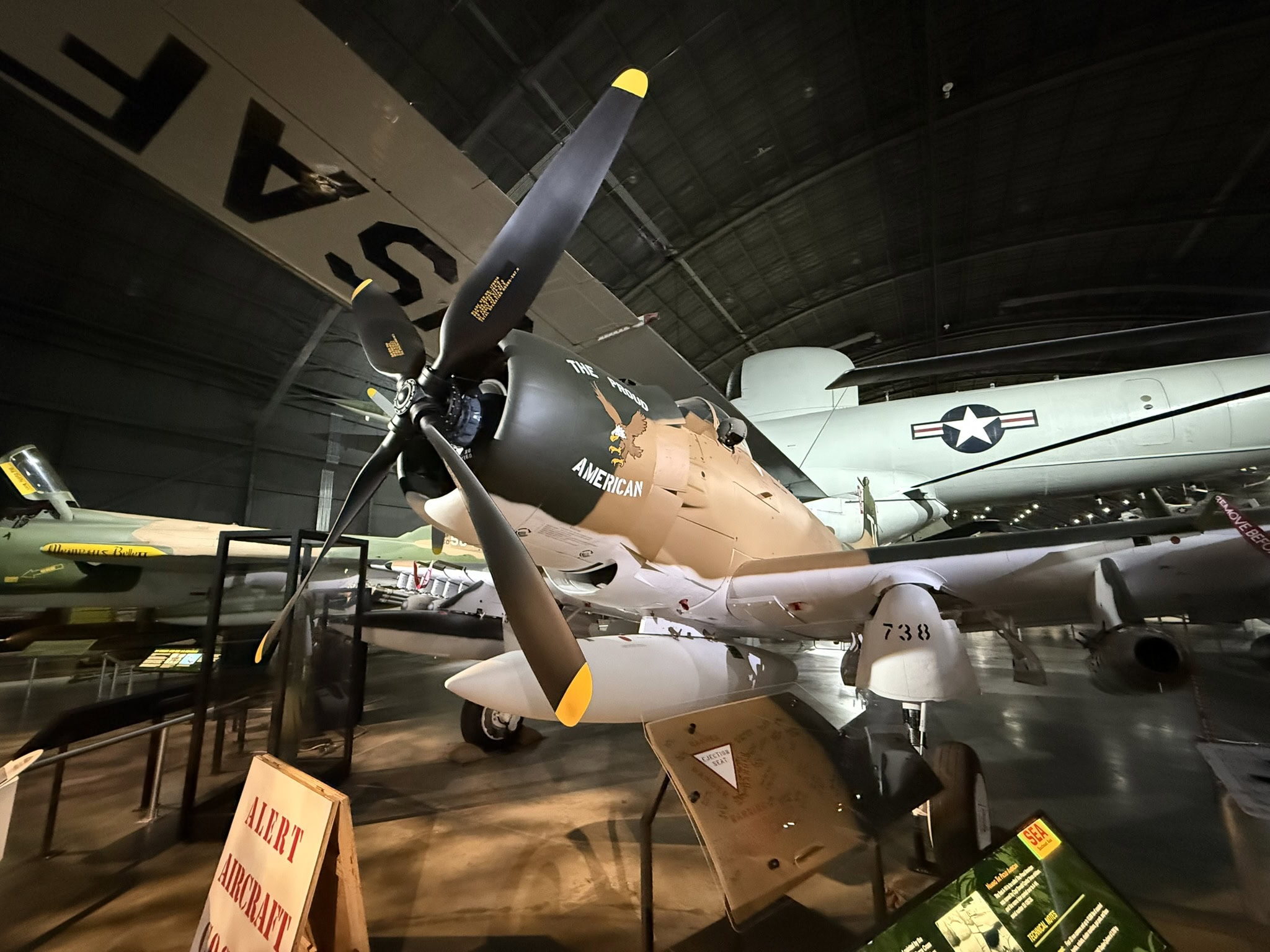
A-1H Skyraider. 19FortyFive.com Photo Taken July 19, 2025.
However, by the time the final production-phase product was delivered to the U.S. Navy in December 1946, the official moniker had been changed to Skyraider.
The Skyraider soon found itself adopted by the U.S. Air Force and Marine Corps, as well as the British Royal Navy Fleet Air Arm, the French Air Force, and the Republic of Vietnam Air Force. It sported a fuselage length of 38 feet 10 inches, a wingspan of 50 feet, and a maximum takeoff weight of 25,000 pounds. Its single Wright R-3350-26W engine churned out 2,700 horsepower, enabling a max airspeed of 343 miles per hour at 20,000 feet. Armament consisted of four AN/M3 20-mm fixed forward-cannon—located internally within the wing panels—and 8,000 pounds of ordnance.
Combat Performance (and Earning Multiple Monikers)
As noted by the National Naval Aviation Museum info page: “The ‘Able Dog’ or ‘Spad,’ as the Skyraider was called, earned its stellar reputation as one of the finest attack aircraft ever built in the skies over Korea.”
During that conflict, the “Spad” demonstrated its versatility. It performed a variety of combat missions, from attacking heavily defended industrial targets such as power plants and bridges, to knocking out the Hwachon Dam with aerial torpedoes, and earning the affection of many a grunt with its close air support capabilities.
After the Korean War armistice was signed, some pilots trained for the possibility of the “Doomsday Mission,” long-range flights to deliver nuclear bombs at low altitude that involved such an extended amount of time in the cockpit that aviators nicknamed them “Butt Busters.”
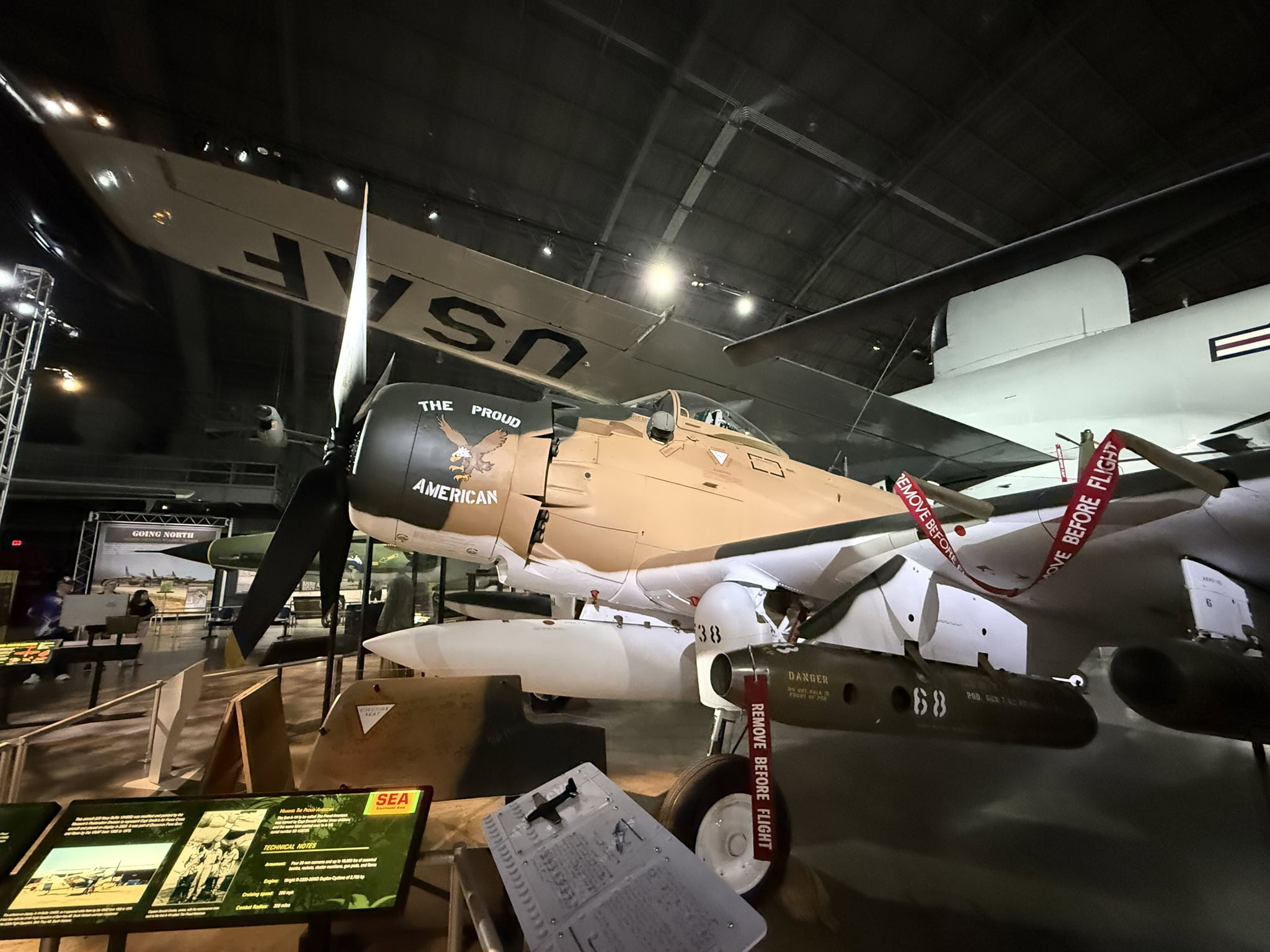
A-1H Skyraider. 19FortyFive.com Photo Taken July 19, 2025.
The “Spad” moniker was bestowed to honor a French fighter plane of World War I. It wasn’t until the heady days of the Vietnam War that the Skyraider would earn its most famous unofficial sobriquet, “Sandy.”
By the time America’s air campaign in the skies over Southeast Asia kicked off in earnest in 1964, a different Douglas-built warbird—the jet-powered, transonic A-4 Skyhawk—had become the mainstay of the Navy’s carrier-based fleet. But the tenacious A-1/AD still managed to cement her place in naval aviation history by participating in the first strikes against North Vietnam, in August 1964, in response to the Gulf of Tonkin Incident. The Navy continued flying attack missions with the “Spad” until 1968.
Meanwhile, the U.S. Air Force employed the A-1 on combat search-and-rescue and air commando missions, as dramatized in the 1991 motion picture Flight of the Intruder, based on the bestselling novel by Stephen Coonts.
(The “Intruder” in question was the Grumman A-6 Intruder.) It was during CSAR missions that the “Sandy” moniker came into being.
Wayne Mutza explained in his 2003 book The A-1 Skyraider in Vietnam: The Spad’s Last War that the nickname originated in late 1965 with Captain J.W. ‘Doc’ George during a flight to one of the several A-1 groups that rotated through Udorn Royal Thai Air Force Base.
Initially, it had simply been Doc’s departure call sign when embarking from Bien Hoa Air Base in South Vietnam. After his arrival at Udorn, he was asked what call sign he would like to use while there, and he answered, “Sandy.” Doc’s replacement retained the call sign, and soon the moniker was applied to any Skyraider performing the CSAR mission.
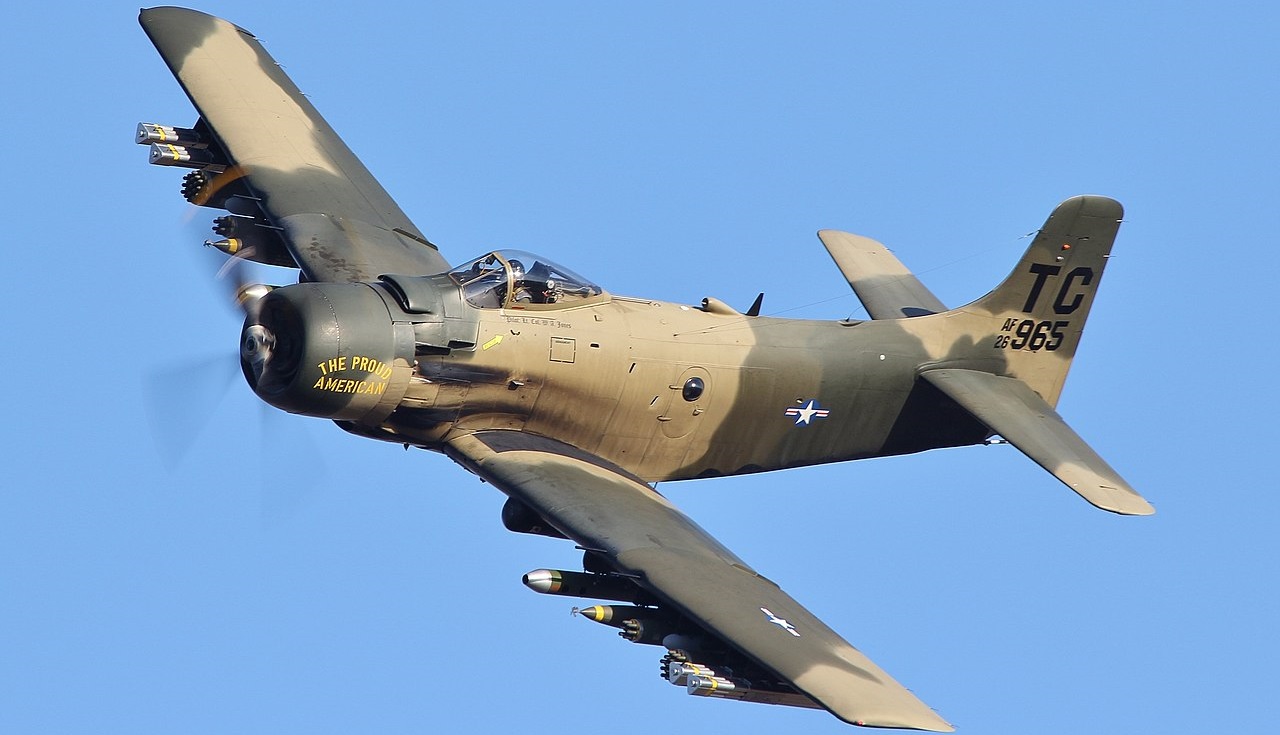
The Douglas A-1 Skyraider (AD-4NA, 126965) is flying. This aircraft is owned by Heritage Flight Museum.
Soon enough, a “Sandy” driver would earn the greatest distinction of all: the Medal of Honor. On March 19, 1966, Major Bernard Fisher rescued a fellow pilot who had been shot down over South Vietnam by landing in enemy territory under heavy fire and flying him to safety.
Where Are They Now?
A total of 3,180 A-1s/ADs were built between 1945 and 1967. They were retired from U.S. military service in 1973, but the Gabonese Air Force kept them in service until 1985, giving the plane a 40-year career.
Roughly 15 airworthy Skyraiders survive today, including specimens based at the Warbird Heritage Foundation in Waukegan, Illinois, and the Military Aviation Museum in Virginia Beach, Virginia.
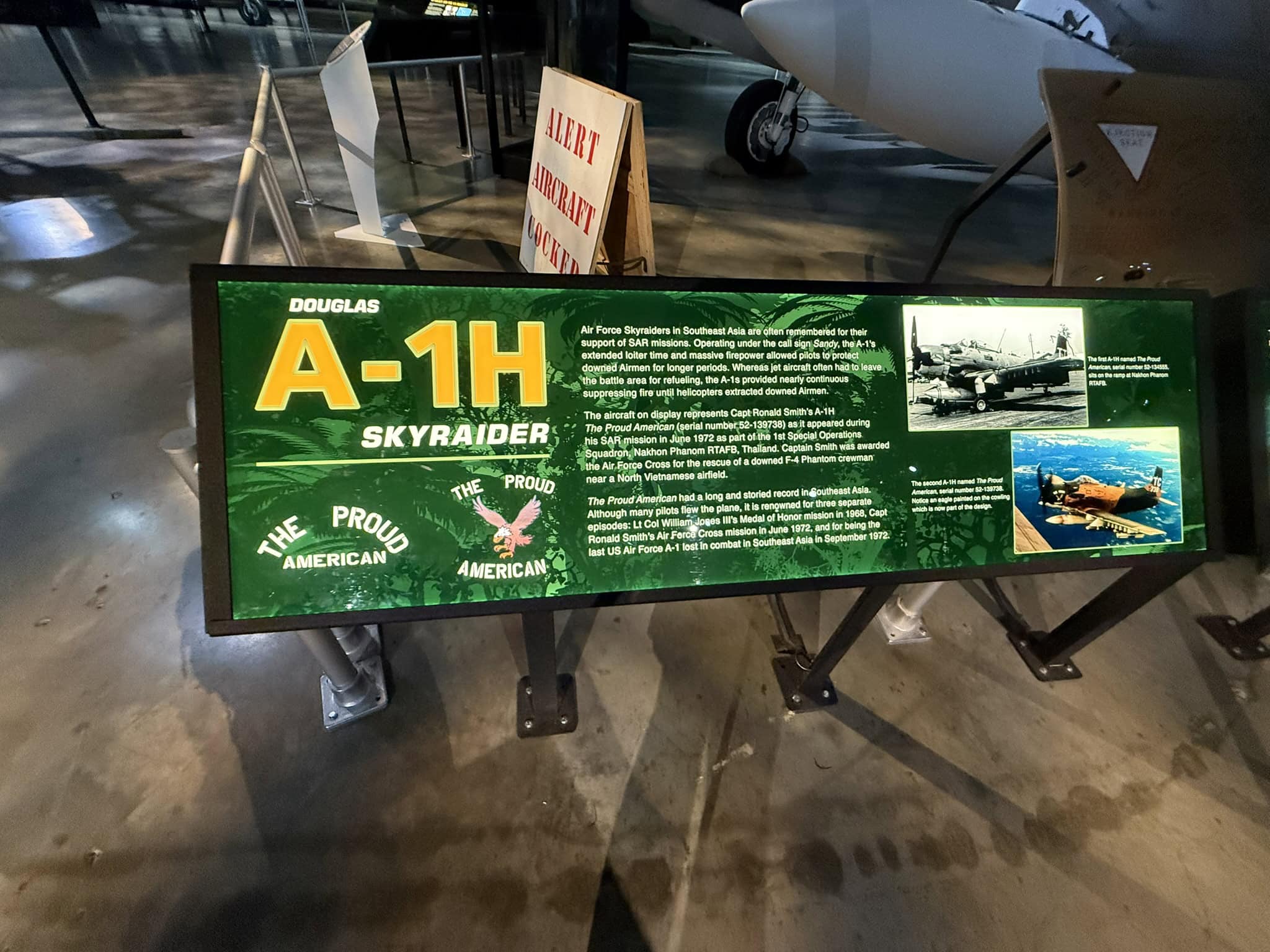
As for static museum displays, there are approximately 30. We direct your attention to “Sandy,” whose photos adorn this article. Bearing AF Serial No. 52-132649, this is the one flown by Major Fisher during his Medal of Honor-winning mission.
It’s housed within the museum’s Southeast East War Gallery.
About the Author: Christian D. Orr
Christian D. Orr is a Senior Defense Editor. He is a former Air Force Security Forces officer, Federal law enforcement officer, and private military contractor (with assignments worked in Iraq, the United Arab Emirates, Kosovo, Japan, Germany, and the Pentagon). Chris holds a B.A. in International Relations from the University of Southern California (USC) and an M.A. in Intelligence Studies (with a concentration in Terrorism Studies) from American Military University (AMU). He is also the author of the book “Five Decades of a Fabulous Firearm: Celebrating the 50th Anniversary of the Beretta 92 Pistol Series,” the second edition of which was recently published.