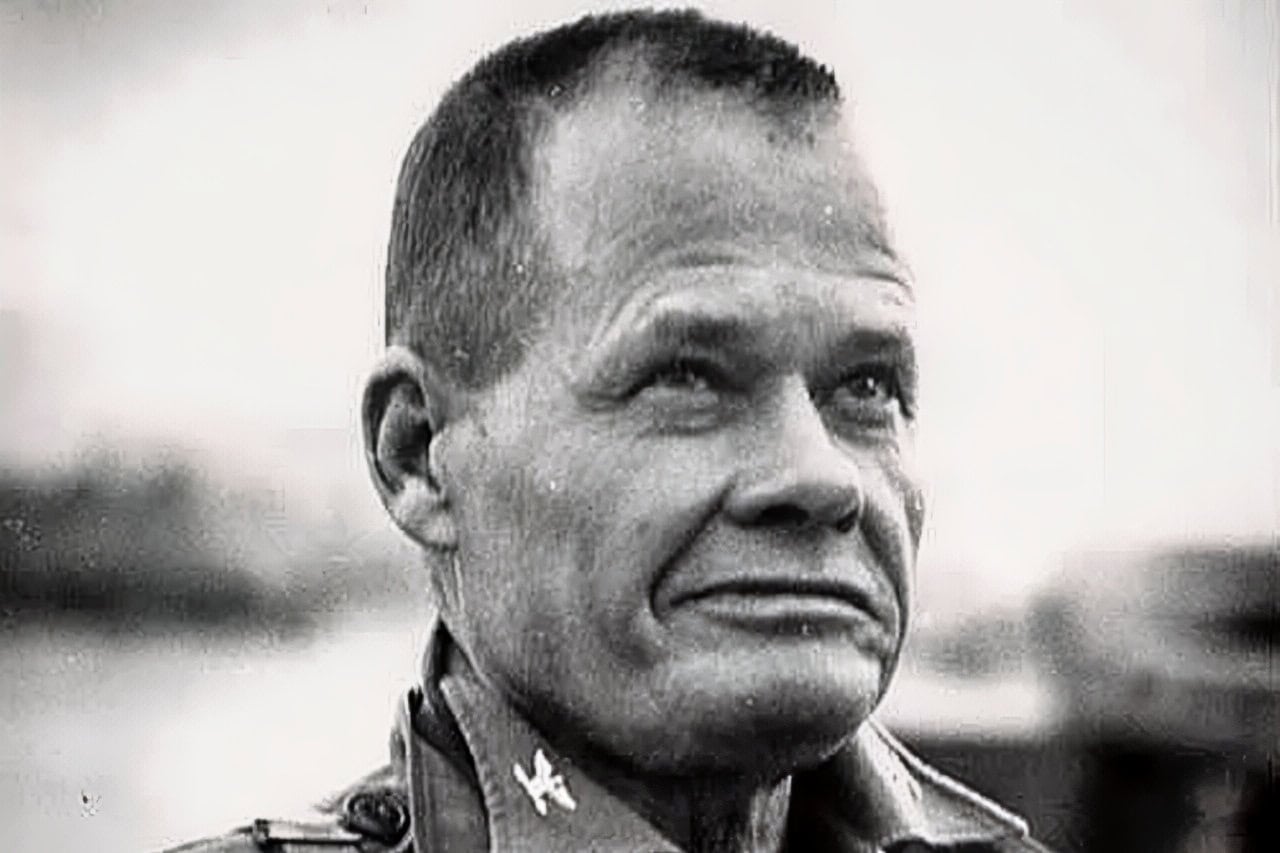
“We’ve been looking for the enemy for some time now. We finally found them. We’re surrounded. That simplifies the problem.” – Lewis “Chesty” Puller USMC Legend
The Marine Corps arguably more than the other military services embraces its history and legacy. The Marine Corps motto, “Semper Fidelis” or shortened to “Semper Fi,” means always faithful.
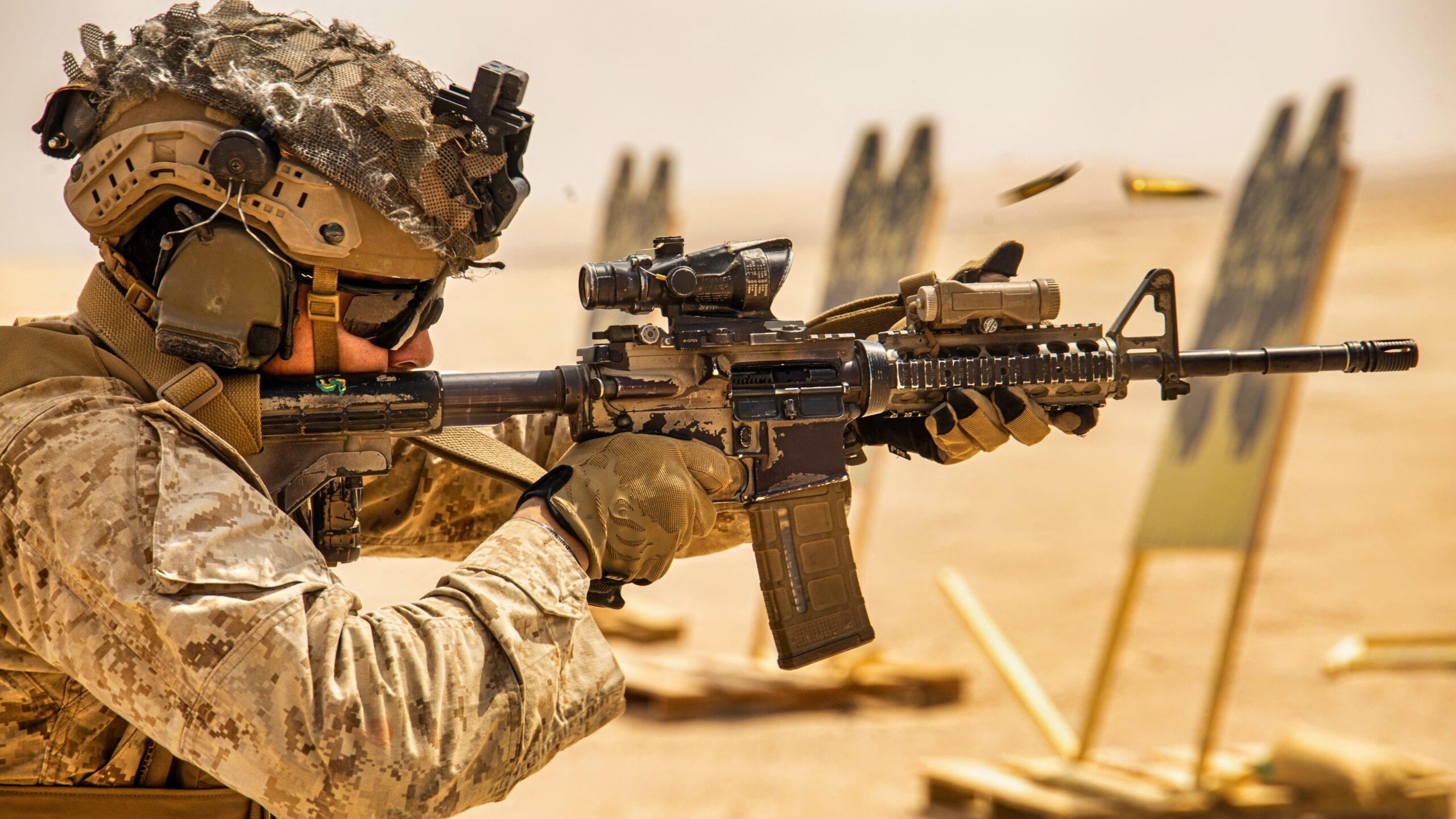
US Marines. Image Credit: Creative Commons.
Marines pride themselves, rightfully so, on being hard-charging, always faithful war fighters. No one epitomized that more than Lewis “Chesty” Puller.
The famous quote was made by Lieutenant General Lewis “Chesty” Puller during the Korean War, specifically around December 1950 during the Battle of the Chosin Reservoir.
Surrounded by Chinese forces and heavily outnumbered, Puller’s 1st Marine Division used this remark to highlight that having the enemy on all sides allowed his Marines to shoot in any direction.
During the battle, temperatures plummeted to -25°F, and his disdain for the elements and the enemy reflected Puller’s aggressive, forward-leaning combat leadership style, often interpreted as “Good. Now we can shoot in every direction”.
Puller led his Marines in a fighting breakout from the encirclement, inflicting massive casualties on the enemy and ensuring all equipment and wounded were evacuated. He was a Marine Corps legend long before the Chosin Reservoir.
Who Was Lewis “Chesty” Puller?
Chesty Puller is the most decorated Marine in U.S. history, famously earning five Navy Crosses. He was born Lewis Burwell Puller on June 26, 1898, in West Point, Virginia, and grew up listening to relatives tell tales of the Civil War.
Puller’s ancestors came to Virginia from Bedfordshire, England, in 1621. He was a voracious reader, poring through countless books of military history. His childhood hero was Thomas “Stonewall” Jackson, a Civil War figure. He was a distant cousin of Army General George S. Patton.
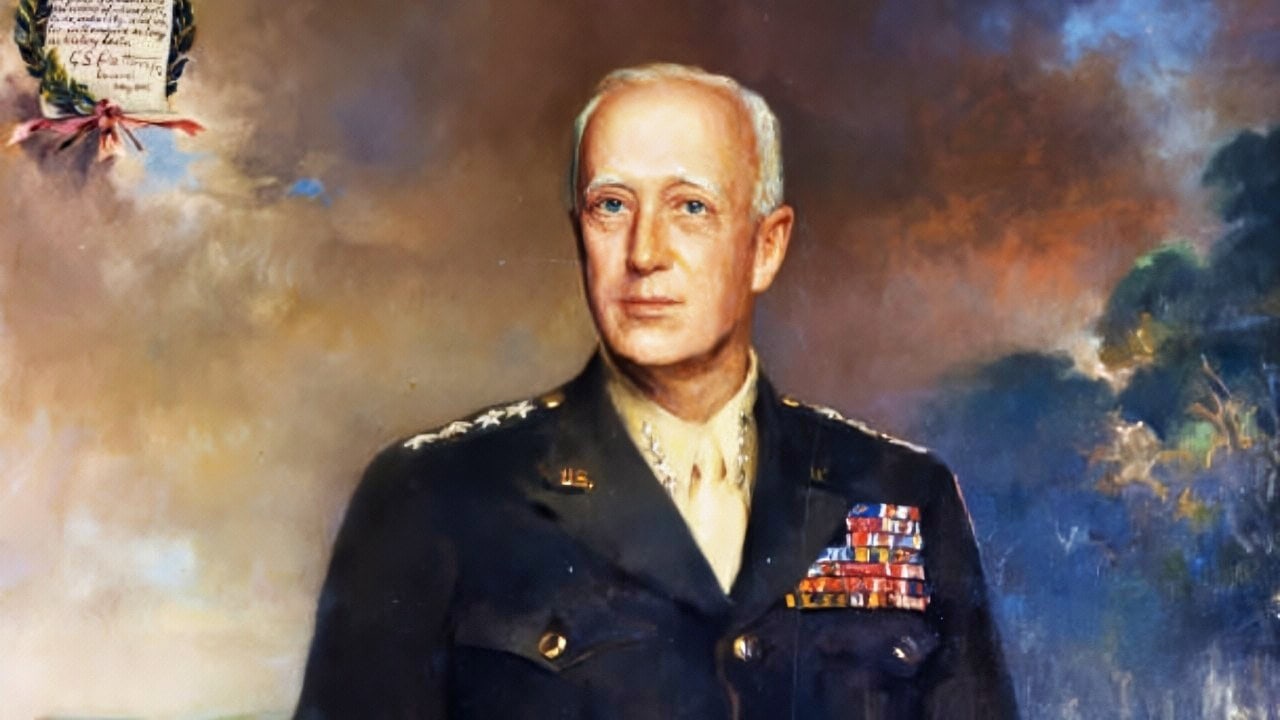
Portrait of Army General Patton. Image Credit: Creative Commons.
Puller wanted to join the Mexican Punitive Expedition against Pancho Villa, but was too young. He enrolled in the Virginia Military Institute, but left in August 1918 to join the Marine Corps, who were in the midst of World War I in France.
His reasoning, “Go Where The Guns Are.”His love of history and military expertise was piqued by the story of the Battle of Belleau Wood and the Fifth Marines. He enlisted in the Marine Corps and went to the Marine Recruit Depot at Parris Island, South Carolina, for boot camp.
World War I ended before Puller could reach France, but the Marines were still expanding, and he attended the Marines’ Non-Commissioned Officer Academy and Officer Candidate School (OCS).
After graduating as a 2LT in 1919, his time as an officer was initially short-lived. The Marines conducted a huge reduction-in-force (RIF), and he was discharged as a Lieutenant, but given the rank of Corporal.
Interwar “Banana War” Years In Haiti and Nicaragua
Corporal Puller was deployed to Haiti to serve in Haiti as a brevet lieutenant, training the newly formed Gendarmerie d’Haiti, a constabulary force that consisted of Haitian enlisted personnel and Marine officers.
While there, Puller served as the aide to the future Marine Commandant, Major Alexander Vandegrift, and participated in over 40 skirmishes against Caco rebels. He developed expertise in small-unit jungle warfare and night ambushes. In one famous action, Puller led an “L-shaped” ambush that killed all 17 Caco rebels in the kill zone.
He continued to lead other raids and ambushes, contributing significantly to Haiti’s stability, before regaining his US Marine officer commission as a lieutenant with Vandegrift’s backing upon returning to the United States.
After continuing his training as an officer at Quantico, Virginia, Puller was assigned to Hawaii for two years before returning to San Diego.
In December 1928, Puller was deployed to Nicaragua to serve with the Nicaraguan National Guard detachment fighting rebels led by Augusto Sandino.
During his time in Nicaragua, Puller would earn the first of his five Navy Crosses for his actions from February 16 to August 19, 1930, when he led “five successive engagements against superior numbers of armed bandit forces.”
He returned stateside in July 1931 and completed the year-long Company Officers Course at Fort Benning, Georgia, thereafter returning to Nicaragua from September 20 to October 1, 1932, and was awarded a second Navy Cross.
Puller led American Marines and Nicaraguan National Guardsmen into battle against Sandinista rebels in the last major engagement of the Sandino Rebellion near El Sauce on December 26, 1932. During that action, Puller’s force of Guardia Nacional killed 31 Sandinista rebels and captured 63 horses.
After his service in Nicaragua, Puller was assigned to China, and then the cruiser Augusta, where he was in command of the Marine detachment. The Augusta was commanded by then-Captain Chester Nimitz.
While in China, Puller, now a Major, served as the Commanding Officer of the 2nd Battalion, 4th Marines. He returned to the United States in August 1941 and was assigned as the Battalion Commander, 1st Battalion, 7th Marines (1/7) of the 1st Marine Division, stationed at New River, North Carolina (later Camp Lejeune).
World War II And Fame
Shortly after the Japanese bombed Pearl Harbor in the Pacific, Puller’s 7th Marines formed the core of the newly-created 3rd Marine Brigade, and the battalion arrived in Samoa to defend the island from Japanese forces in early May of 1942.
Later that September, the 7th Marines rejoined the 1st Division during the invasion of Guadalcanal.

Route followed by the Japanese fleet to Pearl Harbor and back.
Puller’s battalion was involved in fierce fighting along the Matanikau River. During the engagement, three of his companies were surrounded and cut off from American forces by Japanese troops.
Puller ran to the shore, signaled a U.S. Navy destroyer, the USS Monssen, and directed the ship to provide covering fire while landing craft rescued the surrounded Marines. Puller’s quick thinking in organizing the rescue saved the three companies and earned Puller the Bronze Star with Combat “V” device.
The Battle for Henderson Field
One of the most intense battles of the war occurred in what was later known as the “Battle for Henderson Field”. Puller’s 1st Battalion, 7th Marines (1/7), and the 3rd Battalion of the U.S. Army’s 164th Infantry Regiment (3/164) were holding the airfield against a Japanese regiment-sized force.
During suicidal attacks by the Japanese, the two American units suffered 70 casualties in three hours. In contrast, the Japanese lost more than 1,400 killed. Puller was awarded the third Navy Cross of his career. But he nominated Marine Sgt John Basilone for the Medal of Honor.
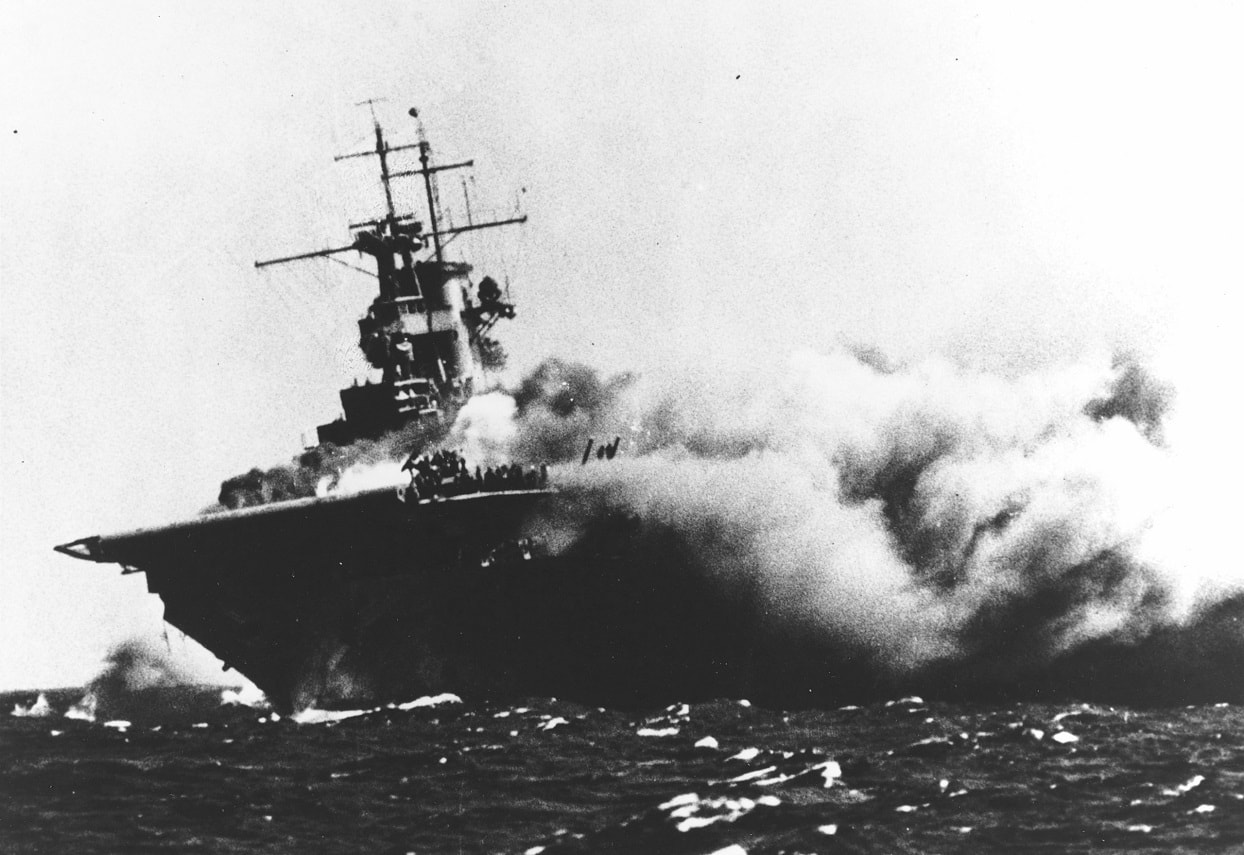
The U.S. Navy aircraft carrier USS Wasp (CV-7) burning and listing after she was torpedoed by the Japanese submarine I-19, on 15 September 1942, while operating in the Southwestern Pacific in support of forces on Guadalcanal. Note that the wartime censor has removed the CXAM-1 radar antenna, only its lower frame is still visible.
Puller was seriously wounded on Guadalcanal, but quickly returned to his battalion during the battle.
“Fatal Pride” At Peleliu
During the bloody invasion of Peleliu, Puller was criticized for the first time. The Japanese were entrenched on the island and made the Marines pay dearly for every inch of territory they lost.
Puller’s 1st Marine Regiment suffered 1,749 killed and wounded out of approximately 3,000 men. However, they continued to hammer the Japanese with frontal assaults.
When his Corps commander, General Geiger, visited, Puller seemed physically and mentally exhausted. His leg wound from Guadalcanal was swollen to twice its size. Geiger asked Puller if he needed reinforcements, but Puller’s pride would not allow him to ask for help from Army units held in reserve.
John McManus, in his very critical article in the Warfare History Network, wrote that Captain Everett Pope, who was one of Puller’s company commanders and himself awarded the Medal of Honor, was highly critical of Puller’s actions.
“I had no use for Puller,” said Pope. “He didn’t know what was going on. The adulation paid to him these days sickens me.”
General Cushman. who would later serve as Commandant of the Marine Corps, believed that Puller was a great combat leader who nonetheless could not understand anything except constant attacks, regardless of the circumstances.
“He was beyond his element in commanding anything larger than a company—maybe a battalion—where he could keep his hands on everything and be right in the middle of it.” The 1st Marine Regiment was pulled out of the line shortly afterward, followed by the other Marine Regiments.
In November 1944, Puller was reassigned as the commander of the Marine Infantry Training Regiment at Camp Lejeune, North Carolina.
Korean War And The “Frozen Chosin
Once the US entered the Korean conflict, Puller was again in command of the 1st Marine Regiment.
On September 15, 1950, Puller’s Marines took part in the landing at Inchon, for which Puller was awarded the Silver Star.
For his overall leadership from September 15 to November 2, 1950, Puller was awarded a second Legion of Merit.
Puller was awarded the Distinguished Service Cross by the U.S. Army for heroism in action from November 29 to December 4, and he received his fifth Navy Cross for heroism for his actions during the Battle of the Chosin Reservoir from December 5-10, 1950.
It was during the Battle of the Chosin Reservoir that Puller uttered the famous quote, “We’ve been looking for the enemy for some time now. We’ve finally found him. We’re surrounded. That simplifies things.”
In early 1951, Puller was promoted to Brigadier General and appointed Assistant Division Commander. But shortly after that, he assumed command when the commander of IX Corps, Major General Oliver Prince Smith, had to take command after the Army commander died.
Puller returned to the United States in May 1951. He was promoted to Major General in 1953.
While commanding the 2nd Marine Division in 1955, he suffered a stroke and was retired by the Marine Corps as a Lieutenant General.
Puller passed away on October 11, 1971, and is buried in Saluda, Virginia, next to his wife, Virginia Montague Evans.
About the Author: Steve Balestrieri
Steve Balestrieri is a National Security Columnist. He served as a US Army Special Forces NCO and Warrant Officer. In addition to writing on defense, he covers the NFL for PatsFans.com and is a member of the Pro Football Writers of America (PFWA). His work was regularly featured in many military publications.