
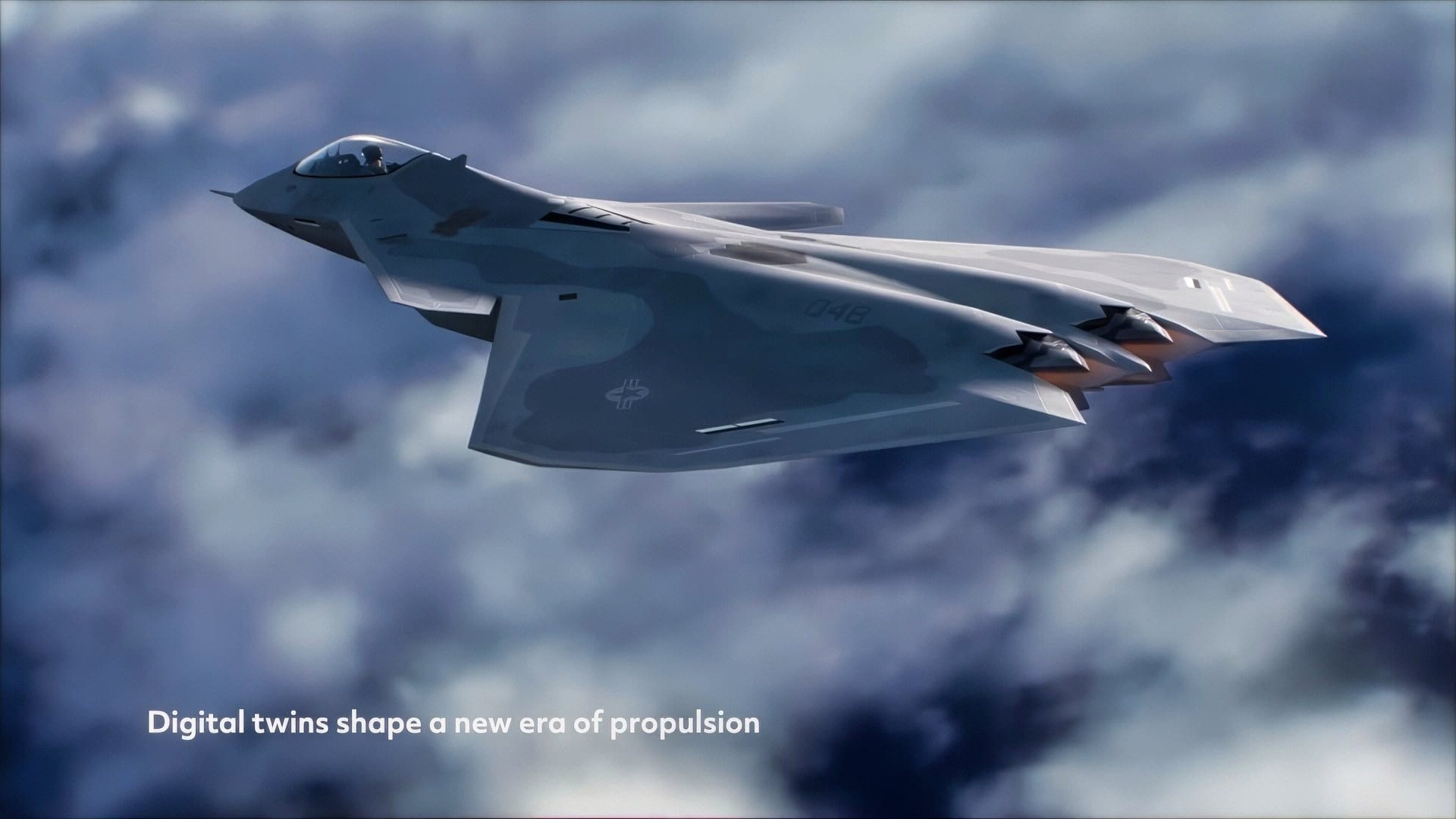
China has been flying what appear to be two sixth-generation fighter prototypes in open daylight, photographed repeatedly by civilians and tracked by analysts worldwide, for roughly eighteen months — while America’s F-47, the most-watched fighter program on earth, exists in public only as deliberately blurry teaser images and will not take to the air until 2028. That contrast has fueled a wave of commentary declaring that China has pulled ahead in the race for the next generation of air power.
The reality is more interesting, and the simple version is wrong. The honest question is not who has flown a sixth-generation jet, because both nations have.
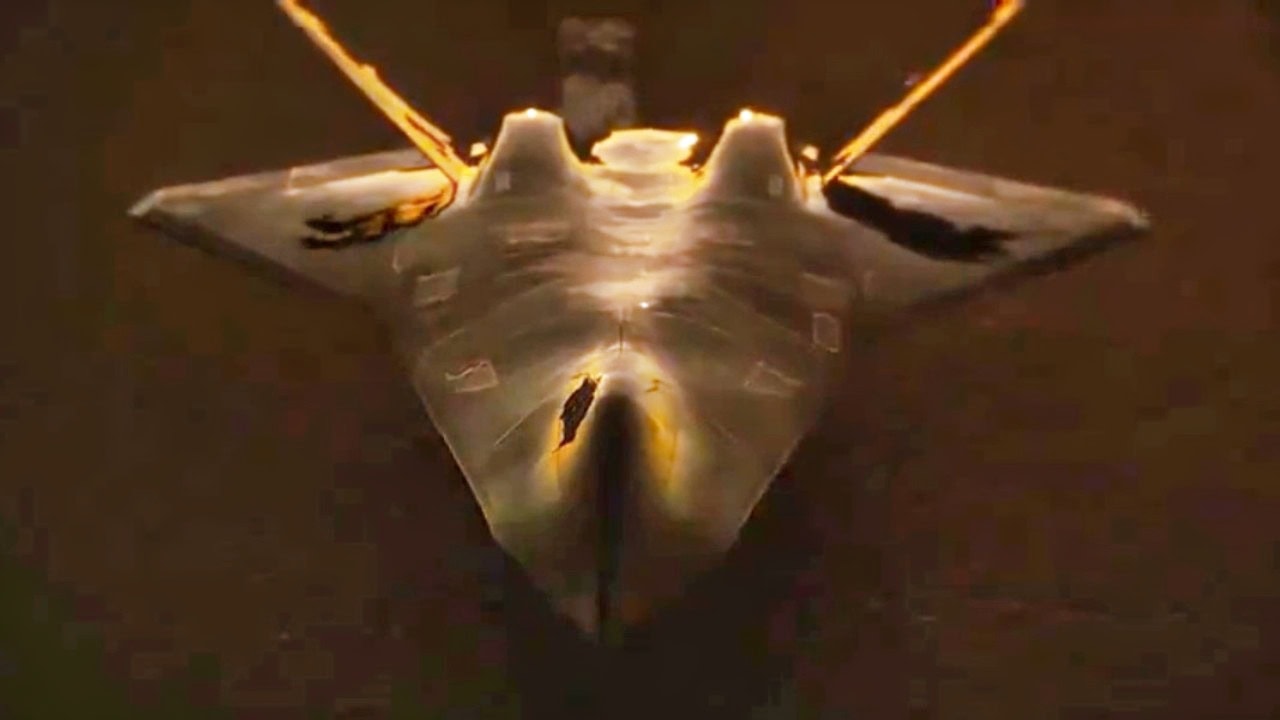
F-47 Fighter from Boeing. Image Credit: U.S. Air Force Screenshot.

Shown is a graphical artist rendering of the Next Generation Air Dominance (NGAD) Platform. The rendering highlights the Air Force’s sixth generation fighter, the F-47. The NGAD Platform will bring lethal, next-generation technologies to ensure air superiority for the Joint Force in any conflict. (U.S. Air Force graphic)
It is who reaches operational capability first, and on that measure, the two are far closer than the daylight-versus-secrecy optics suggest.
What The J-36 And J-50 Are
The two Chinese aircraft are parallel programs from rival design houses, and nearly everything known about them comes from social-media imagery, satellite observations, and Pentagon assessments rather than any Chinese disclosure, so every specific detail should be read as an informed inference.
The Pentagon’s latest annual report on Chinese military power states that China began testing a pair of sixth-generation aircraft in December 2024, the tailless jets tentatively designated the Chengdu J-36 and the Shenyang J-50, also referred to as the J-XDS.
Both are tailless stealth designs, a configuration that trades the maneuverability of tail surfaces for a reduction in radar signature, and both are believed to be built around the defining sixth-generation traits: long range, advanced sensor fusion, and the ability to control uncrewed combat aircraft as airborne teammates.
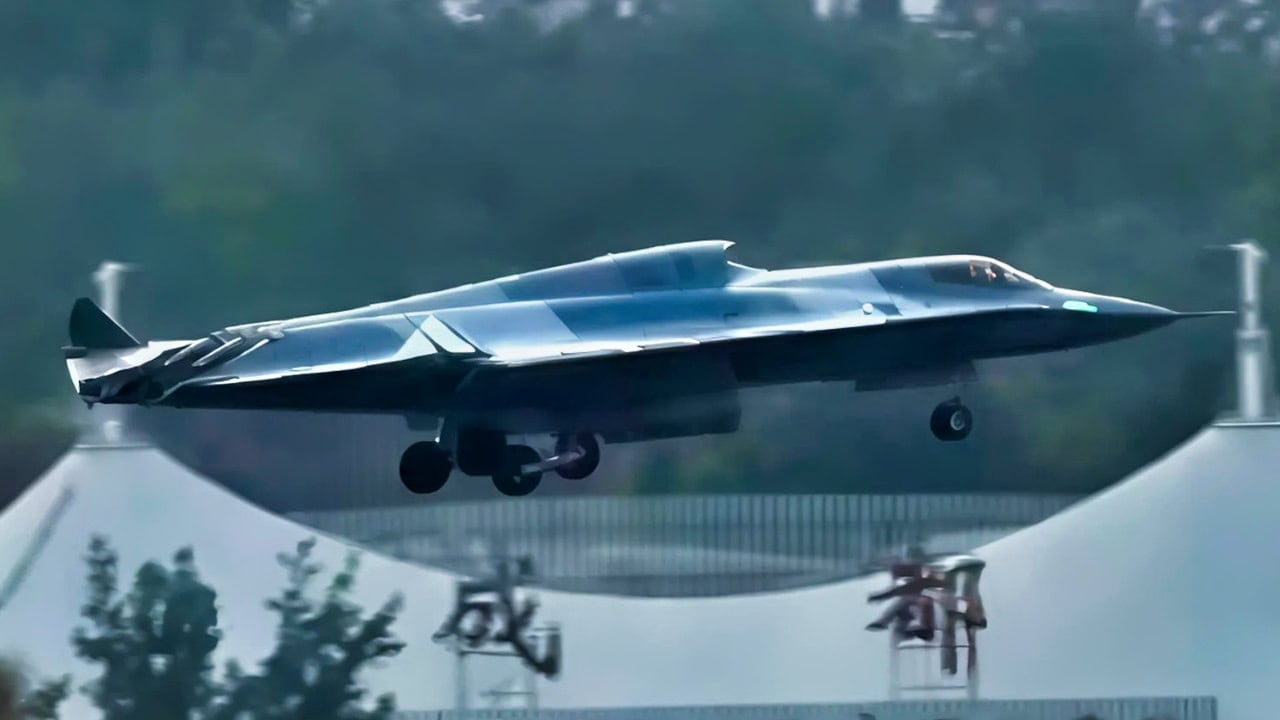
J-36 Fighter from X/Screenshot.
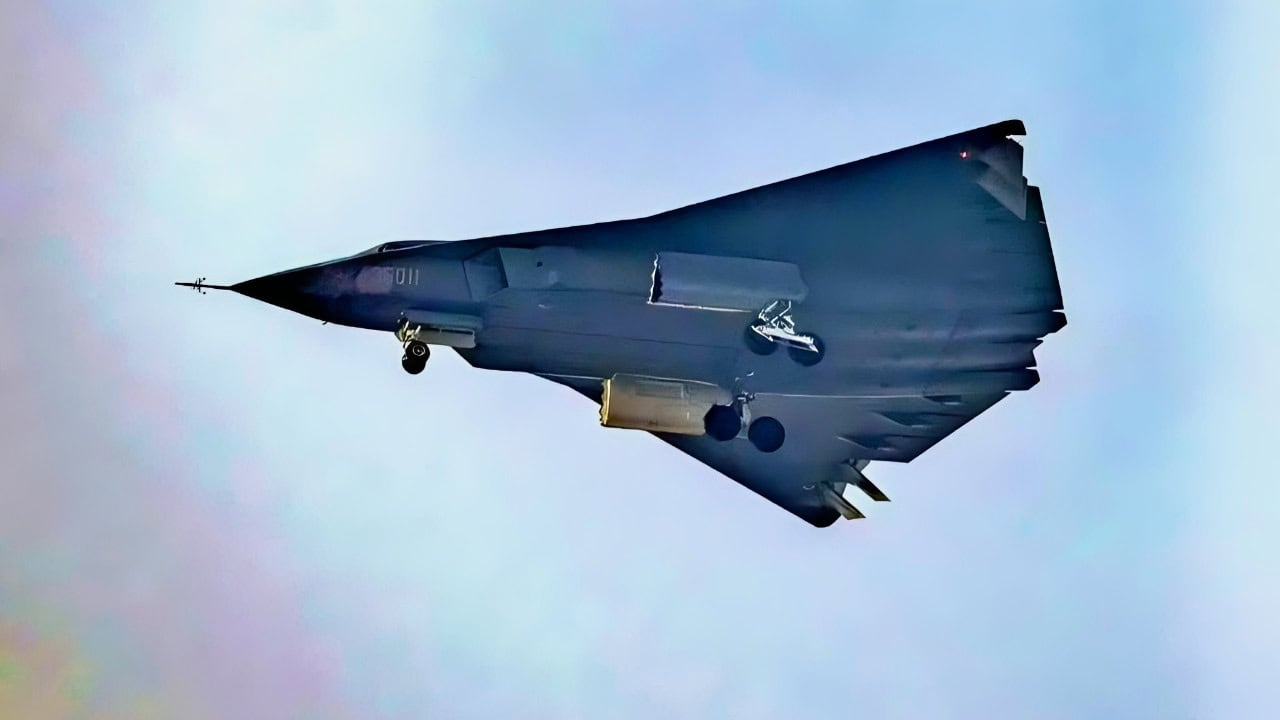
J-36 Fighter from China. Image Credit: X Screenshot.
The most striking detail is the J-36’s engine count. The Chengdu aircraft appears to have three engines and larger dimensions and has been observed flying alongside a two-seat J-20, while the Shenyang J-50 is a twin-engine tailless design spotted on multiple flights since its debut. Three engines are an unusual configuration for a fighter — most have one or two — and analysts read it as a sign the J-36 is built for long-range, high-payload missions, deep strike, and air dominance far out over the Pacific. The J-50, smaller and twin-engine, is believed to be oriented toward future carrier-based operations, which would give China a naval sixth-generation fighter to pair with the expanding carrier fleet it is building.
The pairing — one program for land-based air dominance, one for the carriers — mirrors how the United States is splitting its own next-generation effort between the Air Force’s F-47 and the Navy’s F/A-XX.
The Pace: Three Prototypes And A Deliberate Acceleration
What sets the Chinese programs apart is not any confirmed performance figure, which no one outside China actually has, but the observable tempo of testing.
The aircraft first flew in December 2024, and footage from late 2025 through early 2026 shows the J-36 in an increasingly intensive phase of flight testing rather than the occasional, carefully spaced flights of an early experimental program. Around December 25, 2025, observers documented a third J-36 prototype completing a milestone flight, with analysts noting the aircraft’s flight-test instrumentation pitot tube had been removed, an indication the program may have moved past its earliest evaluation phase.
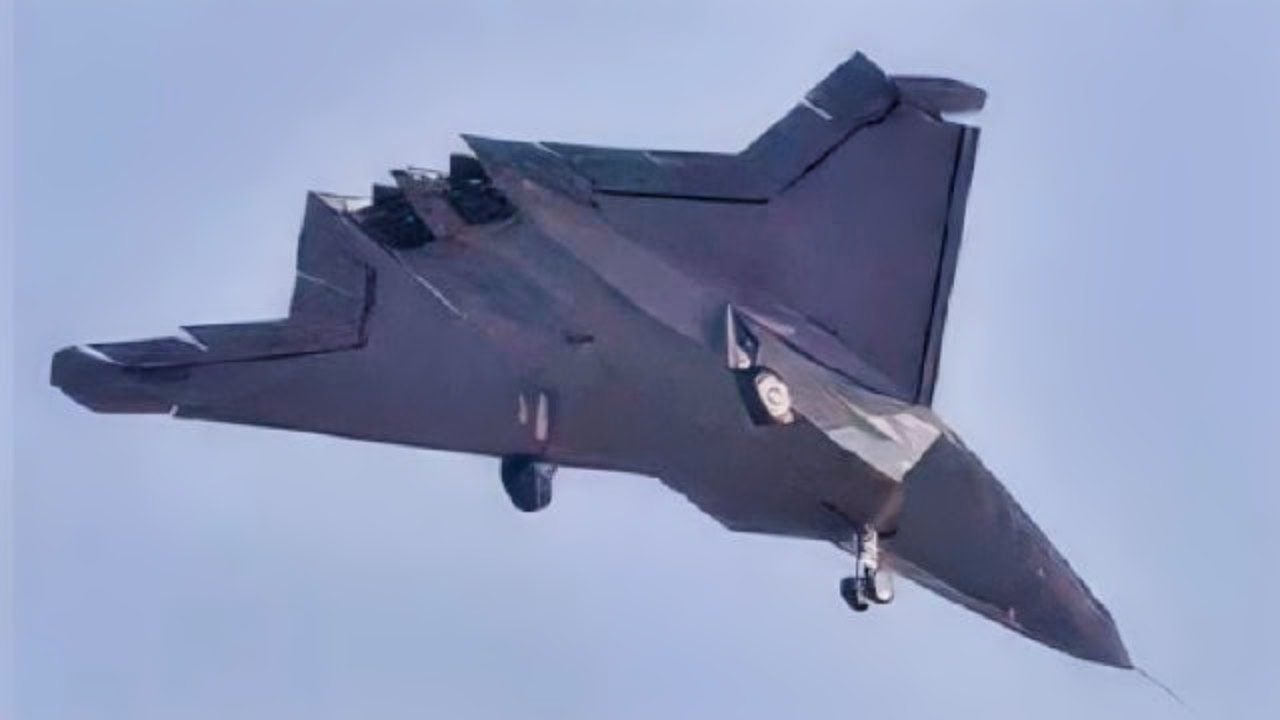
China’s J-50 Fighter. Image Credit: Screenshot from X.
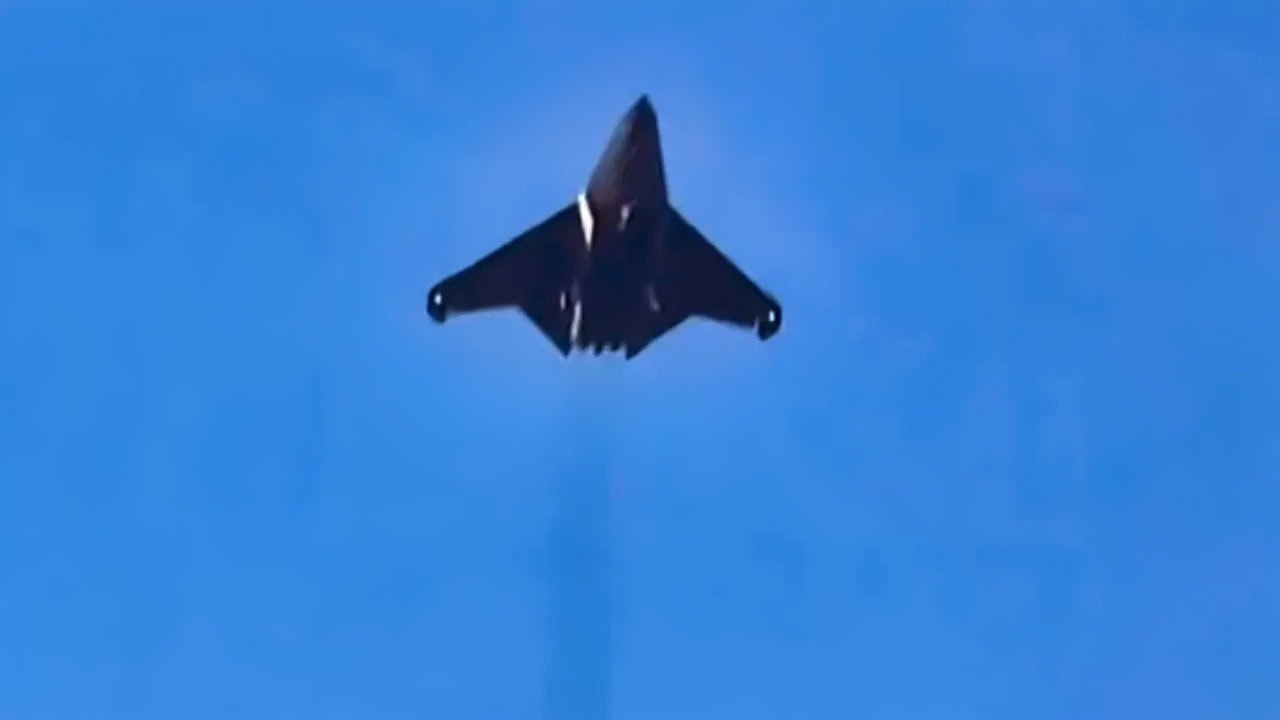
J-50 Fighter from China. Image Credit: Screenshot from Social Media.
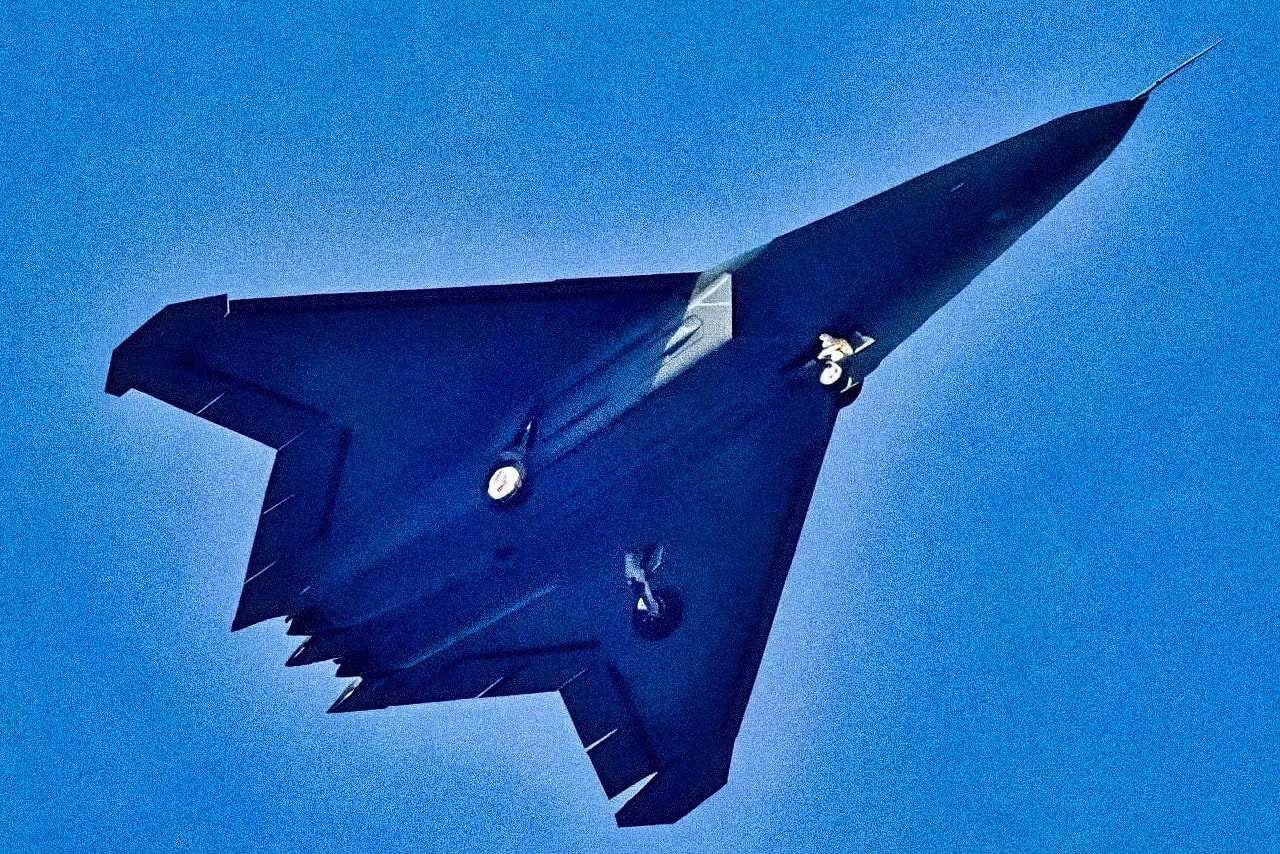
J-50 Fighter. Image Credit: Creative Commons/Screenshot.
A third flying prototype within twelve months of a program’s public debut is a fast cadence by any standard, and Western analysts read it as evidence China is running a parallelized, risk-tolerant development model — flying multiple prototypes at once and iterating quickly rather than perfecting one design before building the next.
The honest framing of the timeline comes from the Pentagon itself and is more measured than the imagery suggests. The same assessment that confirms the testing judges both aircraft to be in the nascent stages of development and potentially operational by 2035. Flying prototypes are a real and significant milestone, but they are years removed from a fielded, combat-ready fighter with trained pilots, mature weapons, and a sustainment system behind it. China has reached the starting line for public flight testing. It has not crossed the finish line of operational capability, and by the Pentagon’s reckoning, it is roughly a decade from doing so.
The F-47 Contrast: A Production Jet That Has Not Flown
Against that visible activity, the American program looks, from the outside, like nothing is happening. The Boeing F-47, the crewed sixth-generation fighter the Air Force selected in March 2025, is under construction in St. Louis and remains on track for a first flight in 2028.
As the designed and selected production aircraft, it has never flown.
Its appearance remains almost entirely speculative, known to the public only through deliberately blurred official teaser renderings and a possible brief glimpse in a 2026 engine-test video. The program runs on a level of secrecy that is the deliberate opposite of China’s open testing: no flights to photograph, no prototypes parked on visible flight lines, only artists’ impressions and a 2028 date.
The cost and classification match the secrecy. Congress appropriated roughly $8.2 billion a year for the Next Generation Air Dominance program across 2022 through 2025, the Congressional Budget Office has estimated such an airframe could cost up to $300 million each, and the program was expensive enough that it was paused in 2024 for a review of whether it should proceed at all before the Air Force concluded it was necessary and awarded the contract to Boeing.
From the public’s vantage point, the F-47 is a blurry image, a price tag, and a promise to fly in 2028, set against Chinese jets that anyone with a camera near the right airfield has been able to photograph for a year and a half.
The Complication That Resets The Scoreboard
The contrast that drives the “China is winning” headlines rests on a false premise, and correcting it is the single most important point in any honest assessment.
The United States has also flown sixth-generation aircraft.
It simply did so in secret years ago, and the jets that flew were not F-47s. The Defense Advanced Research Projects Agency has disclosed that two NGAD risk-reduction demonstrators, one built by Boeing and one by Lockheed Martin, first flew in 2019 and 2022 and logged several hundred hours each. Boeing’s 2019 aircraft appears to be the full-scale demonstrator that the Air Force’s then-acquisition chief, Will Roper, was referring to in 2020, when he said the service had built and flown a full-scale flight demonstrator that broke records. The technology-proving aircraft flew years before China’s prototypes ever left the ground.
The distinction that matters — the one that keeps this accurate — is what those American aircraft were. Former Air Force Secretary Frank Kendall has stressed that the demonstrators were entirely experimental aircraft, not reflective of a production prototype for a tactical design. They were X-planes built to prove out technologies and reduce risk, not pre-production versions of a fighter meant for squadron service.
So the real comparison is not “China has flown a sixth-generation fighter, and America has not,” which is false. It is that both nations flew sixth-generation demonstrators years ago, and China chose to show the world its actual prototypes while America kept its X-planes black and its production F-47 hidden.
The public visibility of the J-36 and J-50 is a deliberate choice, not a measure of technical lead, and exposing a third J-36 prototype on camera functions as strategic signaling, shaping how adversaries perceive the threat, as much as it reflects engineering progress. “China is ahead because we can see its jets” is precisely the misreading the evidence corrects. Visibility is a decision about secrecy, not a position on a scoreboard.
The Verdict: The Race Is To Operational Capability, And It Is Close
Strip away the optics and the contest comes down to who fields a working sixth-generation fighter first, and on that axis the two programs are far nearer than the daylight-versus-secrecy framing implies.
The Pentagon assesses that China’s jets could be operational by 2035. The Air Force targets a first F-47 flight in 2028 and initial fielding in the early 2030s, a timeline that, if it holds, would put the American fighter in service around the same time as China’s or slightly ahead. China’s open testing is genuine progress and deliberate psychological signaling at once; it is not proof that Beijing will cross the operational finish line first.
The caveat cuts in America’s direction on capability and against it on schedule. The United States still fields the world’s only two operational fifth-generation fighter fleets in real numbers, the F-22 and the F-35, backed by decades of combat experience that China cannot replicate quickly, and that fielded advantage is the thing that actually matters in a fight today.
But the “early 2030s” F-47 date is the Air Force projecting its own program, and American programs have a documented habit of slipping their own deadlines — the F-35’s troubled sustainment, the years-late Ford-class carriers, the submarine rate stuck below target all sit in recent memory. The 2028 first flight is the milestone that must be met before the rest follow.
About the Author: Harry J. Kazianis
Harry J. Kazianis (@Grecianformula) was the former Senior Director of National Security Affairs at the Center for the National Interest (CFTNI), a foreign policy think tank founded by Richard Nixon based in Washington, DC. Harry has over a decade of experience in think tanks and national security publishing. His ideas have been published in the NY Times, The Washington Post, The Wall Street Journal, CNN, and many other outlets worldwide. He has held positions at CSIS, the Heritage Foundation, the University of Nottingham, and several other institutions related to national security research and studies. He is the former Executive Editor of the National Interest and the Diplomat. He holds a Master’s degree focusing on international affairs from Harvard University.

