
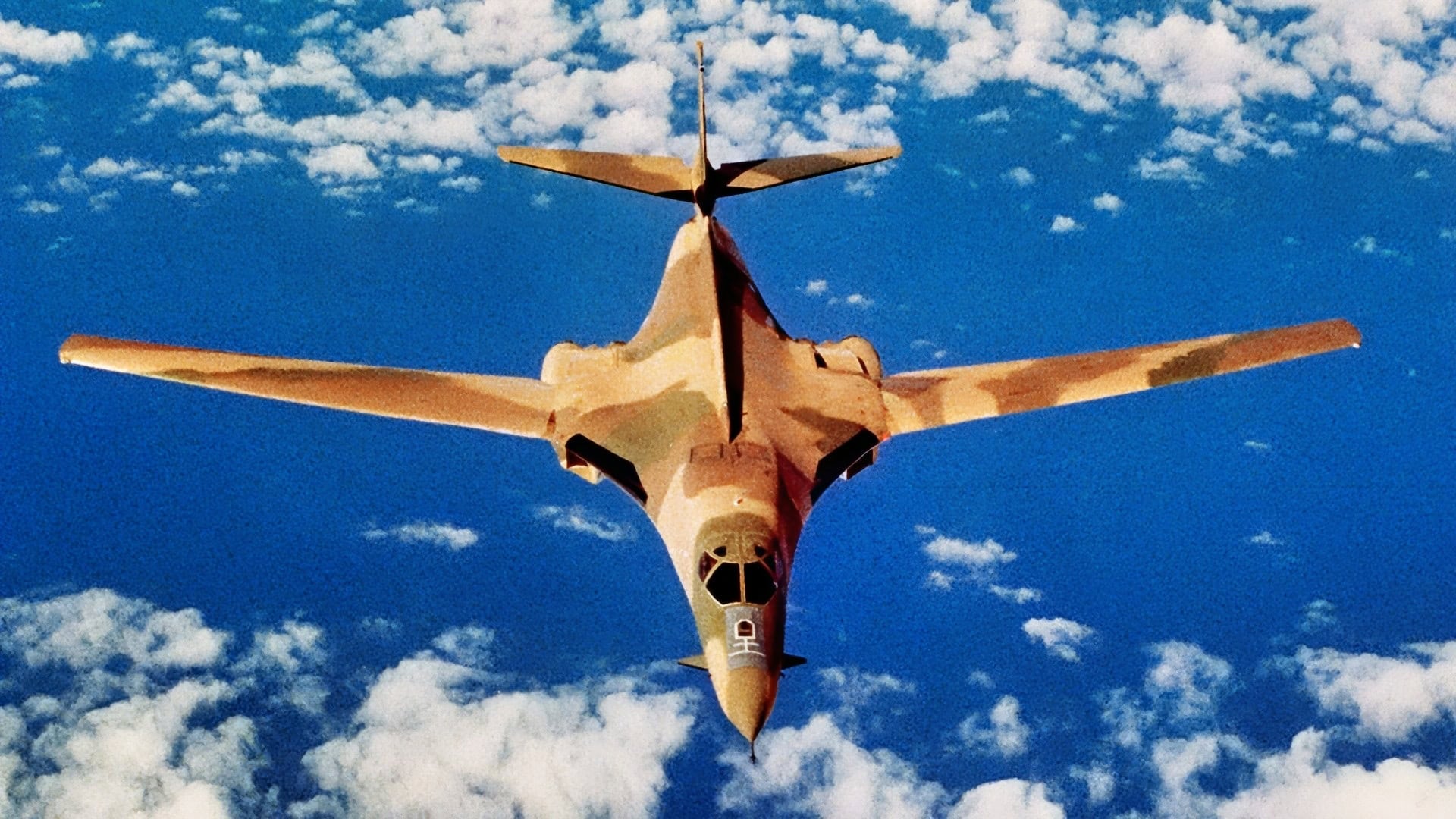
Back in July of last year, I literally stood under a B-1B Lancer bomber at the National Museum of the U.S. Air Force in Dayton, Ohio. Nothing could ever make one understand just how powerful and massive this bomber is, and how it has been the spine of the U.S. Air Force bomber force for decades. However, this old bomber can’t beat fathertime, no matter how many upgrades they get.
The Air Force Spent Years Trying To Retire The B-1B. Now It’s Bolting Hypersonic Missiles To The Outside And Keeping It Until 2037.
The B-1B Lancer was supposed to be gone by now. The Air Force spent years planning to send the supersonic bomber to the boneyard, retired 17 of them in 2021 to clear the way for the incoming B-21 Raider, and set a retirement date around 2030. Instead, the service is doing the opposite. It is reviving a set of external weapons hardpoints the jet has carried unused since the Cold War, developing pylons to hang standoff and hypersonic missiles off them, and extending the bomber’s life to at least 2037. The aircraft the Air Force kept trying to kill is being turned into one of the most heavily armed conventional strikers it operates, and the reason is straightforward: the B-21 is arriving gradually, the Pacific needs a long-range missile carrier now, and the B-1 is the airframe on hand to provide it.
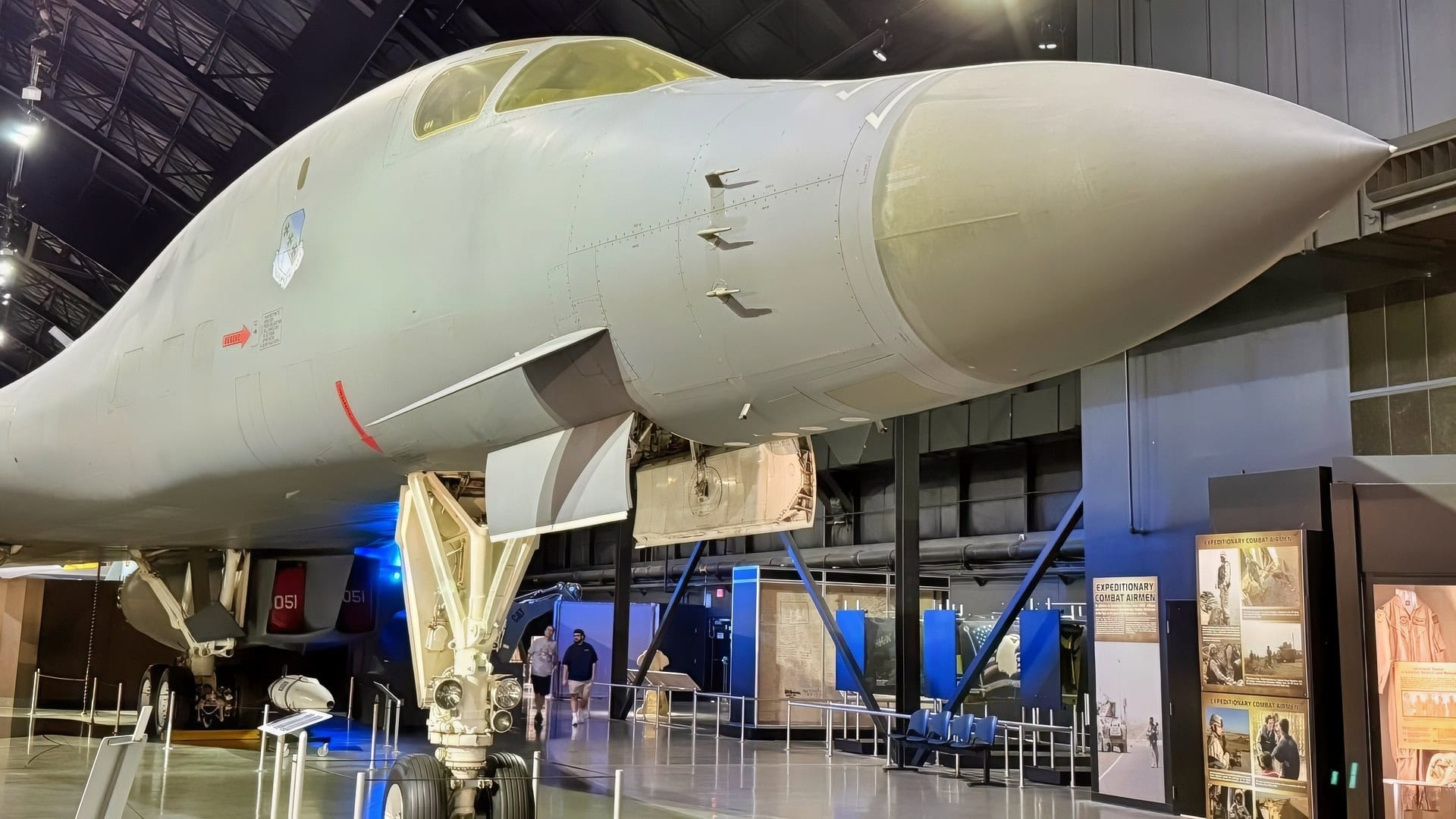
B-1B Lancer at National Museum of the U.S. Air Force. 19FortyFive.com Original Photo.
A Bomber Born In Trouble, Converted, And Flown To Exhaustion
The B-1’s path to this point is one of the strangest in American airpower. The original B-1A was canceled by President Carter in 1977, judged too expensive and overtaken by cruise-missile technology, only to be revived by the Reagan administration in the 1980s as the B-1B, a low-level penetrating nuclear bomber built to slip under Soviet radar. Its early service was rocky, marked by engine troubles, systems problems, and a series of crashes that dogged the fleet’s reputation. The aircraft entered service in 1986, having already survived one cancellation, and it spent its first years struggling to prove it belonged.
Then its entire purpose changed. Under the Strategic Arms Reduction Treaty, the Air Force eliminated the B-1B’s nuclear mission in 1994, converting it into a purely conventional bomber. That conversion is the quiet key to everything happening now: because the B-1 carries no nuclear weapons, adding hypersonic and standoff missiles to it expands America’s conventional strike power without touching its nuclear posture or running into arms-control limits.
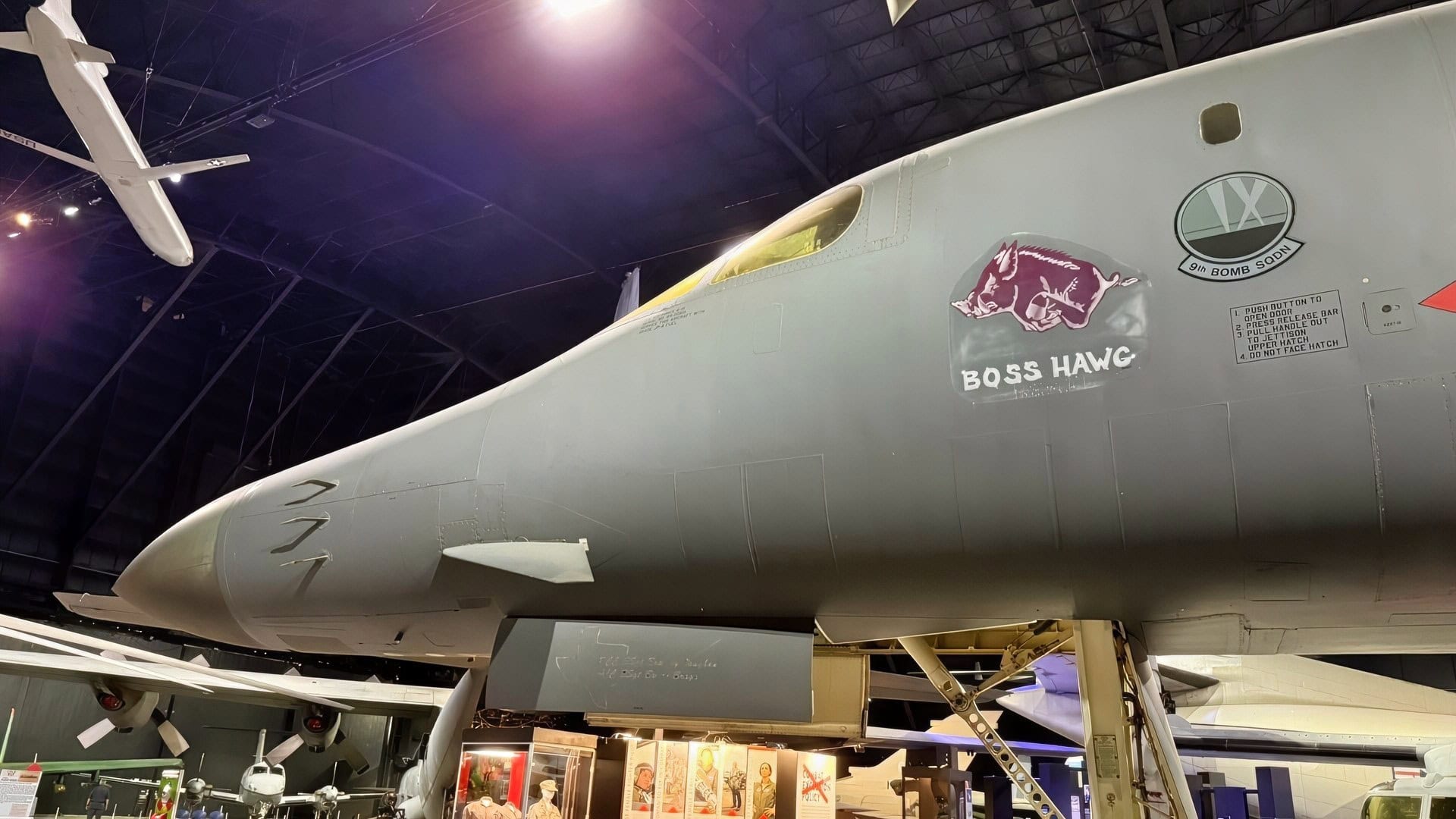
B-1B Lancer Bomber at National Museum of the Air Force. 19FortyFive.com Photo.
The reinvented Lancer found its calling in the Middle East, where it became the workhorse of two decades of air campaigns over Afghanistan, Iraq, and Syria, loitering over battlefields and dropping more ordnance than any other heavy bomber in the inventory.
It was flown hard, and it showed: by the early 2020s, the fleet was worn down by structural fatigue and readiness problems, and the Air Force began drawing it down, retiring the most fatigued airframes and pointing the rest toward eventual retirement. The plan was to let the B-1 finish its long, punishing career and hand the mission to the B-21.
The Reversal: The External Heavy-Stores Pylon Program
That plan has now been turned on its head. The Air Force’s fiscal 2026 budget includes $50.26 million for a new effort called the External Heavy-Stores Pylon program, intended to provide increased carriage of standoff munitions on the B-1B, with the budget documents stating plainly that this increased volume of fires can be fielded in the near term. The centerpiece is a piece of hardware called the Load Adaptable Modular pylon, or LAM, developed by Boeing — a modular external weapons mount that engineers have likened to a Lego attachment because its mounting points can be reconfigured to carry different weapons rather than requiring a custom pylon for each.
The program reached a real milestone this spring. Boeing announced on May 26, 2026, that its engineers in Oklahoma City had completed the preliminary design review for integrating the LAM pylon onto the B-1, working with Air Force Materiel Command, with flight-test activity already underway using a B-1B assigned to the 419th Flight Test Squadron at Edwards Air Force Base in California.
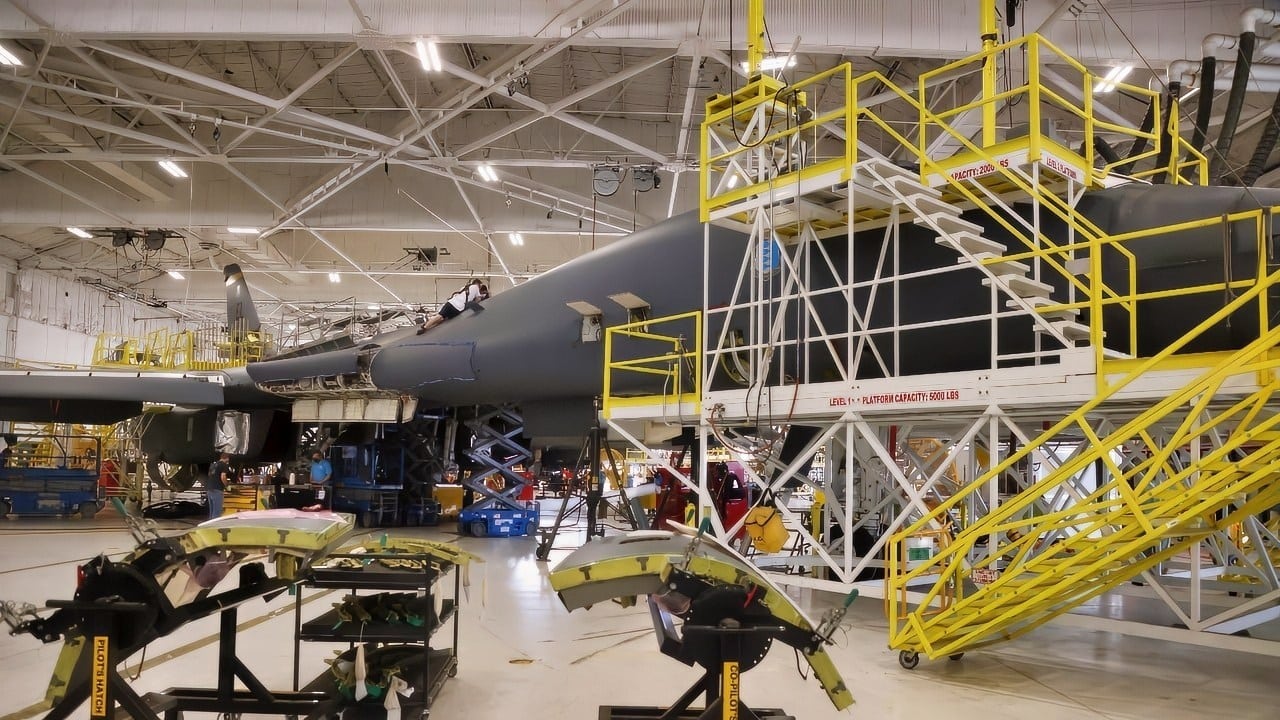
B-1B Lancer Back from The Boneyard. Image Credit: Creative Commons.
The preliminary design review is the stage at which a concept’s basic engineering is validated before it advances toward detailed design and aircraft modification, so the announcement marks genuine forward motion rather than a finished capability. Boeing’s B-1 program manager, Lynsay Brannock, framed it as a starting point, saying the effort is only the beginning of what the team can do to keep the bomber a pillar of the Air Force fleet.
What The Pylons Add: Reviving Cold War Hardpoints For A New War
The clever part of the program is that the attachment points already exist. The LAM pylons would mount to six hardpoints on the B-1 originally built to carry the AGM-86 nuclear air-launched cruise missile externally during the Cold War — fittings that have gone largely unused since the bomber’s nuclear role was stripped away in 1994, with one of the stations now carrying a Sniper targeting pod. The Air Force is, in effect, repurposing the structure the aircraft has carried for forty years rather than designing external carriage from scratch, which is part of why the capability can be added relatively quickly and cheaply.
The payload math is significant. A B-1 currently carries up to 24 JASSM or LRASM cruise missiles internally across its three weapons bays, already the largest internal guided-weapons capacity of any U.S. bomber.
The LAM pylon carries a 7,500-pound rating, enough to add roughly 12 more such missiles externally across the six stations, substantially increasing the total a single bomber can bring to a fight. The operational logic is that a bomber carrying more standoff weapons can launch from outside an enemy’s air-defense envelope, add mass to the opening salvo of a campaign, and force a defender to contend with more incoming missiles than it can intercept. For a service worried about whether it has enough magazine depth for a major war, turning each B-1 into a larger missile truck is a direct answer.
The Hypersonic Question: A Development Program, Not A Fielded Weapon
The most attention-grabbing claim for the LAM pylon is hypersonic carriage, and it should be understood as a development effort rather than an operational capability. The weapon most often named is the AGM-183A Air-Launched Rapid Response Weapon, or ARRW, a boost-glide hypersonic missile too large to fit inside the B-1’s internal bays, which is precisely why external carriage matters for it. In April 2026, the Air Force released, for the first time, a short clip of a B-1B flying with an ARRW carried externally, and the budget documents note that a hypersonic integration program demonstrated the B-1’s ability to perform a captive carry of a 5,000-pound-class store and release a proven weapon shape from a LAM pylon.
The caveats are substantial and worth stating clearly. ARRW has had a troubled history: the Air Force previously moved to shelve the program after mixed flight-test results, and funding for it re-emerged only in the 2026 budget proposal, so the weapon the pylon is meant to carry is itself on uncertain footing.
Integrating a large hypersonic missile on an external station requires extensive engineering — wind-tunnel and computational airflow testing, structural validation, flutter assessment, separation modeling, and certification — and the Air Force’s stated 2026 goals are to conduct that testing and begin hardware and software design, not to field the weapon. The widely repeated figures of carrying dozens of weapons, including projections of more than 30 hypersonic missiles, are secondary estimates that should be read as theoretical maximums based on weight rather than planned loadouts.
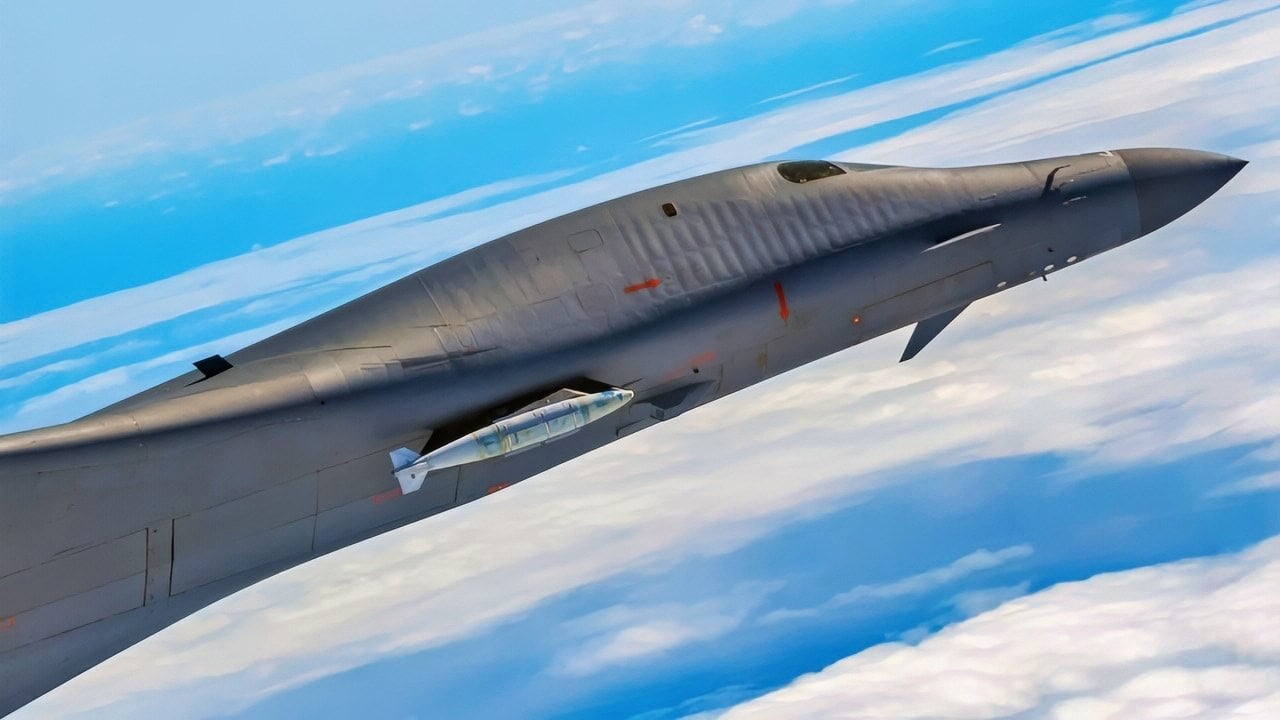
B-1B Lancer Bomber with External Weapons. Image Credit: U.S. Air Force.
The honest description is that the Air Force is testing whether the B-1 can carry large hypersonic and standoff weapons externally. The early results are promising, but a combat-ready hypersonic B-1 does not yet exist.
The Pacific Ship-Killer: Why The Lancer Matters Against China
The clearer near-term payoff is maritime, and it points straight at the Pacific. The B-1 is currently the only Air Force aircraft certified to carry the AGM-158C Long-Range Anti-Ship Missile, the LRASM, which makes the Lancer the service’s premier long-range ship-killer at a moment when anti-ship firepower is one of the most sought-after capabilities in the force.
War games of a Chinese invasion of Taiwan have repeatedly shown that American stocks of anti-ship missiles would be expended quickly, and that air-launched options like the LRASM are particularly valuable, putting pressure on the Pentagon to expand both the weapons and the platforms that carry them.
The 2026 budget moves to sharpen that edge. The Air Force is seeking funds to begin integrating the longer-range C-3 variant of the LRASM, which is set to roughly double the missile’s reach to around 600 miles, up from the current version’s 200-to-300 miles.
A B-1 carrying a large load of long-range anti-ship missiles, launched from beyond the reach of an adversary’s defenses, is exactly the kind of asset valuable in a fight across the vast distances of the Pacific, where a bomber’s range, speed, and payload let it strike ships far from any friendly base.
The external pylons amplify that role directly, allowing each Lancer to carry still more of the missiles that a maritime campaign against China would consume in quantity.
B-1B Lancer Upgrades: A Stopgap That Reveals The B-21 Transition
The B-1’s reprieve is best understood as a hedge against the calendar. The Air Force has reversed its earlier plan to retire the bomber, committing to keep the B-1 and the B-2 flying through 2037 and to invest nearly $1.7 billion in modernizing both fleets over the next five years, with about $342 million of that going to the B-1 from 2027 to 2031 to keep it relevant.
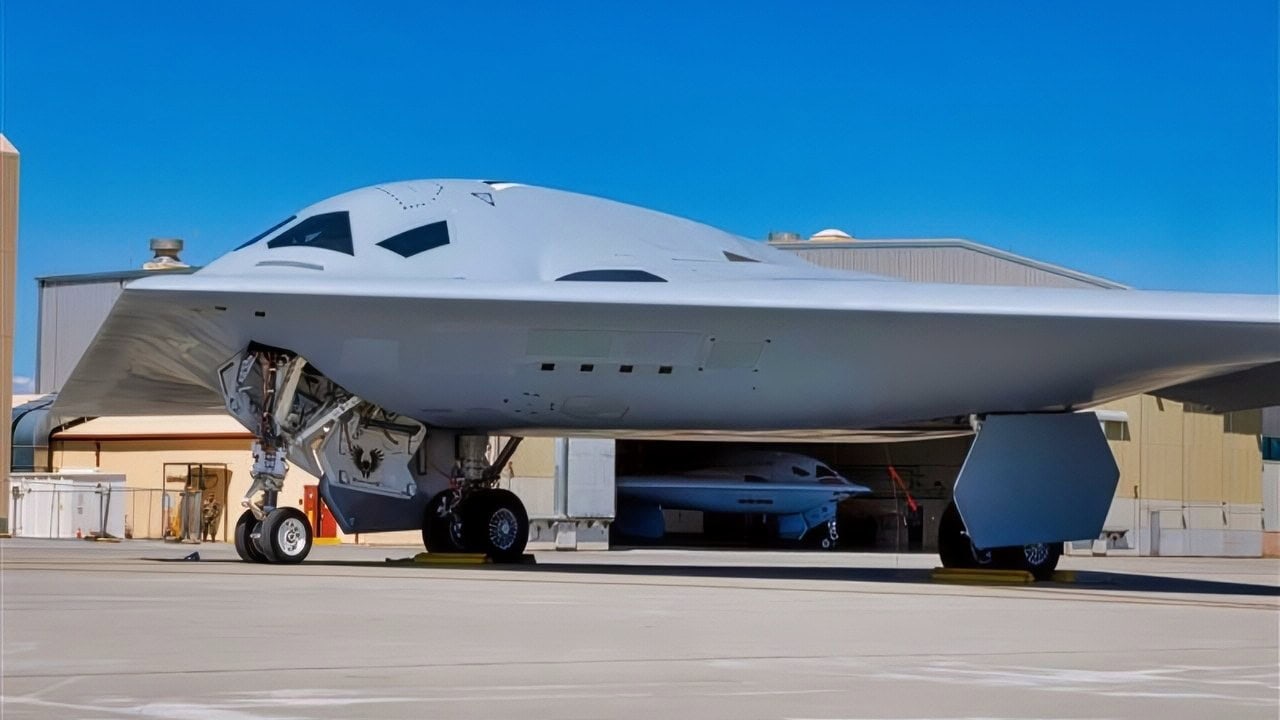
A second B-21 Raider, the world’s sixth-generation stealth bomber, test aircraft arrives at Edwards Air Force Base, Calif., Sept. 11, 2025. The addition of the second test aircraft expands mission systems and weapons integration testing, advancing the program toward operational readiness. (Courtesy photo)
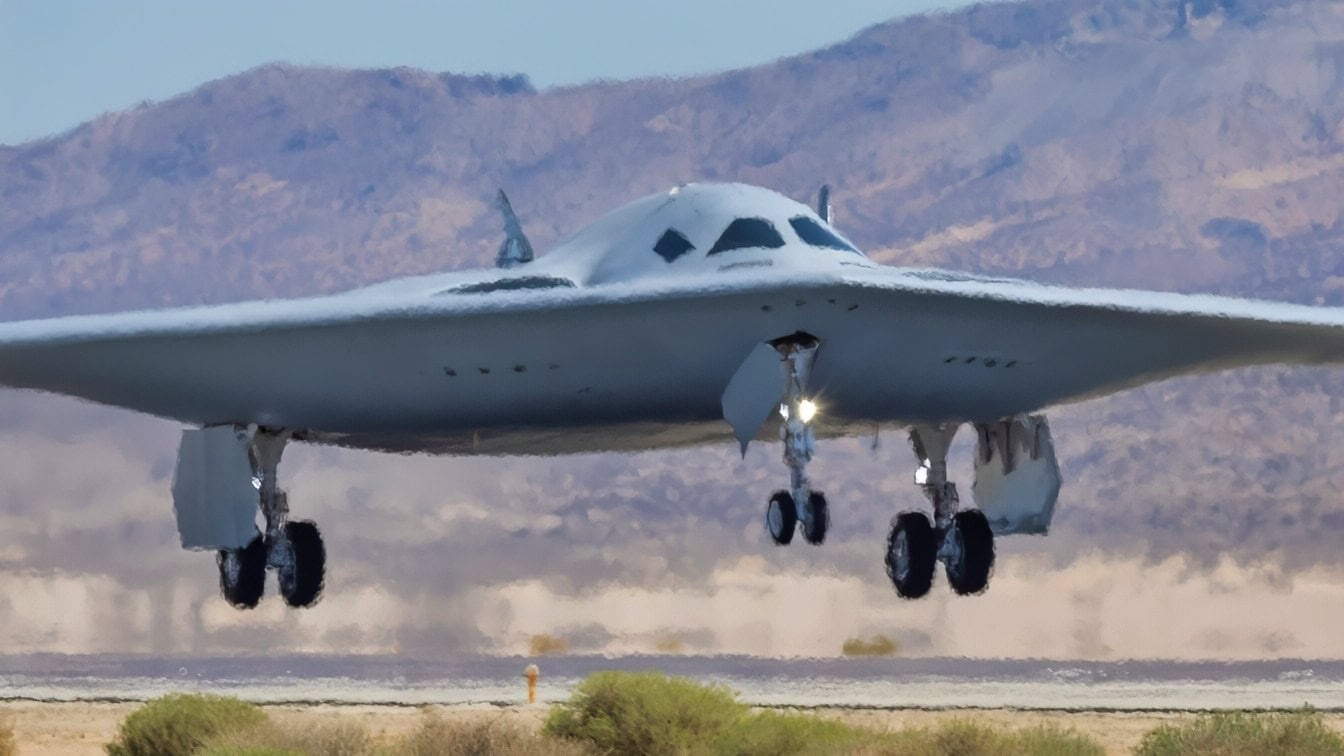
A B-21 Raider test aircraft lands at Edwards Air Force Base, Calif., during ongoing developmental flight testing, Sept. 11, 2025. The B-21 will be the backbone of the bomber fleet; it will incrementally replace the B-1 Lancer and B-2 Spirit bombers. (U.S Air Force photo by Todd Schannuth)
The budget language is explicit that maximizing the B-1’s standoff loadout mitigates the transition risk for the bomber fleet before the B-21 emerges as a combat bomber.
The roughly 45 remaining Lancers are being rearmed not because the Air Force has fallen back in love with a troubled aircraft, but because the demand for bomber capacity is rising faster than the B-21 can be delivered, and the deep-strike and maritime missions cannot wait.
That is the real significance of bolting missiles to the outside of an aircraft that the service spent years trying to retire. The B-1 extension is a near-term bridge; the B-21 remains the destination, and the two are complementary rather than competing — the Lancer fills the gap while the Raider arrives in numbers. But the decision says as much about the B-21 transition as it does about the B-1. A service confident that its next bomber was arriving fast enough would let its worn-out, twice-reprieved Cold War holdover finish its career on schedule.
Instead, the Air Force is spending hundreds of millions to revive forty-year-old hardpoints, extend the airframe’s life by the better part of a decade, and load it with the heaviest conventional missile capacity it has ever carried.
The bomber that nobody could quite kill is being rearmed precisely because its replacement is not yet here in force, and the Lancer will fly on into the late 2030s as the workhorse it has been for most of its improbable life.
About the Author: Harry J. Kazianis
Harry J. Kazianis (@Grecianformula) was the former Senior Director of National Security Affairs at the Center for the National Interest (CFTNI), a foreign policy think tank founded by Richard Nixon based in Washington, DC. Harry has over a decade of experience in think tanks and national security publishing. His ideas have been published in the NY Times, The Washington Post, The Wall Street Journal, CNN, and many other outlets worldwide. He has held positions at CSIS, the Heritage Foundation, the University of Nottingham, and several other institutions related to national security research and studies. He is the former Executive Editor of the National Interest and the Diplomat. He holds a Master’s degree focusing on international affairs from Harvard University.

