

The Los Angeles (SSN 688)-class submarine retirements are causing havoc in the U.S. Navy because they are outpacing the delivery of newer Virginia-class replacements, leading the U.S. attack submarine fleet to fall to around 46 boats by 2030, which is well below the Navy’s long-standing requirement of 66.
The combination of aging vessels reaching the end of their service lives and severe backlogs in US shipyards has created a critical readiness crisis.
This critical shortage of attack submarines threatens to erode U.S. deterrence in the Indo-Pacific, potentially emboldening Chinese adversaries and shaking the confidence of key allies like Japan and Australia at a critical time.
While the Los Angeles-class subs are still viable, as evidenced by one sinking an Iranian warship in the early days of the Iran conflict, they are reaching the end of their lifespan.
The Los Angeles-class submarine has been the Navy’s Backbone
The Los Angeles-class submarine is considered the best and most successful in the United States’ history.
The most famous Los Angeles-class submarine is probably the USS Dallas, SSN 700, which figured prominently in Tom Clancy’s book The Hunt for Red October.
The feature film of the same title starred Scott Glenn as Commander Bart Mancuso.
The Los Angeles class is a larger, faster successor to the Sturgeon-class submarines built in the 1960s. It features enhanced stealth capabilities and is equipped with advanced sensors, sonar, and a vertical-launch missile system. The Los Angeles class could engage in surface warfare, undersea warfare, and support carrier battle groups.
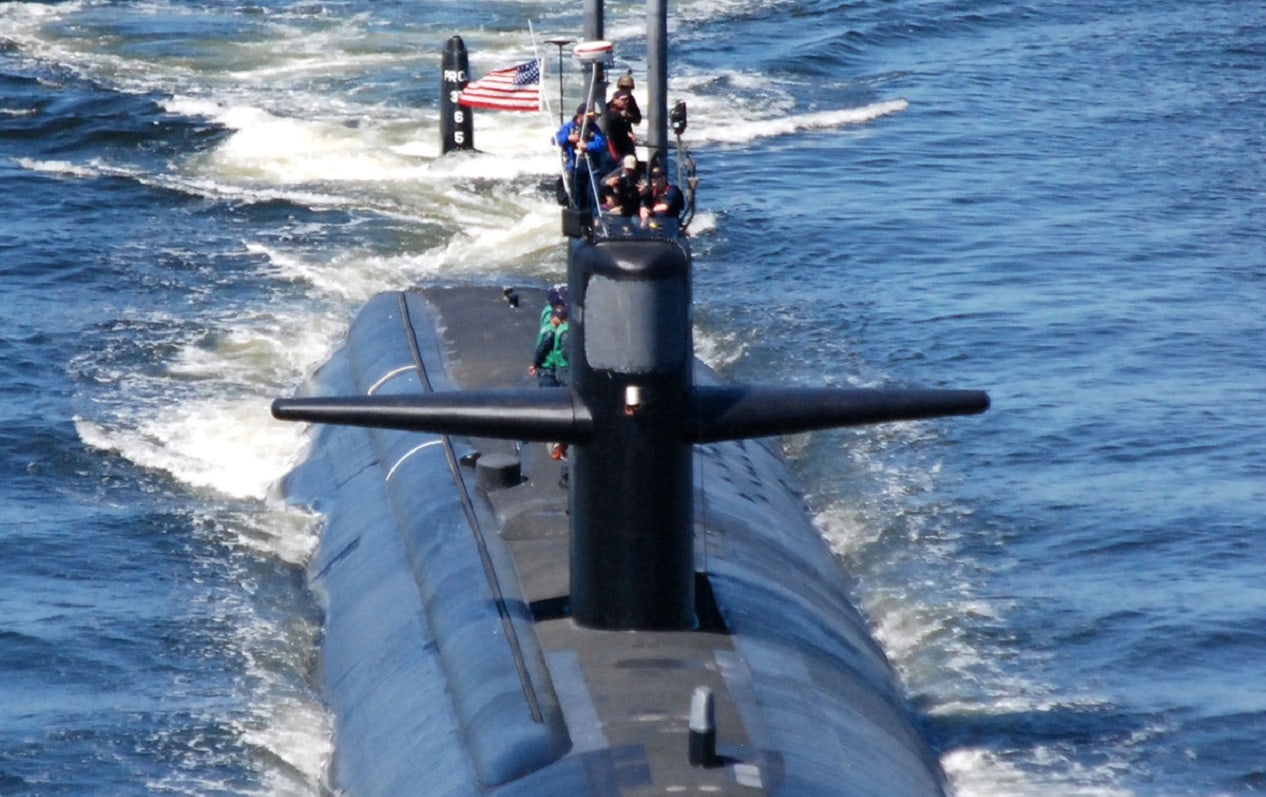
Los Angeles-Class Attack Submarine. Image Credit: Creative Commons.
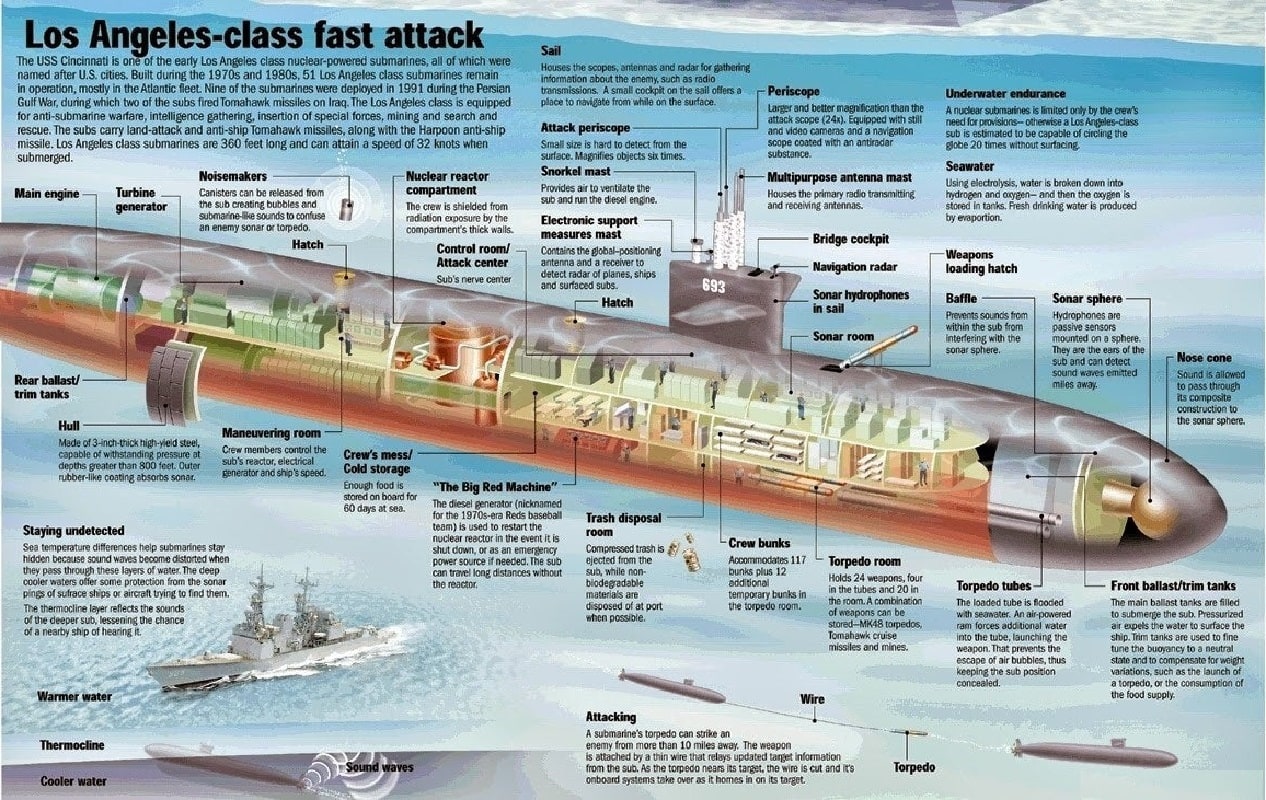
Los Angeles-Class diagram. Image Credit: US Navy.

SOUDA BAY, Crete, Greece (Oct. 15, 2007) – Los Angeles-class submarine USS Oklahoma City (SSN 723) arrives in Souda Harbor for a port visit. The submarine was operating in the Central Command area of responsibility for the past five months since departing their homeport of Norfolk, Va. U.S. Navy photo by Mr. Paul Farley (RELEASED)
Its capabilities include wartime functions such as undersea warfare, surface warfare, strike warfare, mining operations, special forces delivery, reconnaissance, carrier battle group support and escort, and intelligence collection.
The Los Angeles-class submarines, built after 1982, are called “Improved 688s” (I688S). They are quieter, incorporate an advanced combat system, and are configured for under-ice operation.
The diving planes were moved from the sail to the bow, and the sail was strengthened to break through ice. The I688S also has twelve vertical launch tubes for Tomahawk Cruise Missiles.
The US Shipbuilding Business & Industry Crisis Is The Cause
The U.S. shipbuilding crisis is a critical national security and economic vulnerability defined by the near-total collapse of commercial shipbuilding and severe delays in naval vessel production.
While China produces over 1,000 oceangoing commercial ships annually, the U.S. builds only about three.
This manufacturing atrophy has resulted in sluggish fleet expansion and a massive backlog of Navy maintenance and repairs.
The U.S. Navy fleet stands at fewer than 300 ships, falling significantly short of the planned 355-ship fleet. Meanwhile, China’s navy has rapidly expanded to become the largest fleet in the world by number of hulls.
In terms of shipbuilding, the United States has only two shipyards that produce submarines: Newport News, VA, and General Dynamics Electric Boat, in Groton, CT. Both are operating at capacity, given the lack of skilled tradesmen—nuclear-certified welders, machinists, electricians, pipefitters —and the years of training and supervised experience required to attain proficiency.
US shipyard capacity is so constrained that the Navy is operating years behind in maintenance and repair work.
Vital ships are sometimes decommissioned prematurely because shipyards are too overwhelmed to complete necessary overhauls and service-life extensions.
The Los Angeles-Class Are Supposed To Be Replaced One For One
The Los Angeles-class submarines have had more than a 40-year career, and in the late 1990s, they were slated for replacement by the Seawolf-class.
But the Navy built only three of the advanced Seawolfs. But it wasn’t until 2004 that the Navy commissioned its first Virginia-class submarine.
The Navy has thus far produced 22 of the newest Virginia-class boats.
And with each one commissioned, the Navy is supposed to retire a Los Angeles-class submarine. But production cannot keep up with retirements.
Virginia-class subs feature improved stealth, advanced sonar systems, enhanced electronic warfare capability, and increased land-attack missile capacity; the Virginia is, in effect, a better platform, better suited to the modern threat environment, which includes competition with China.
The United States Navy’s requirement is to deliver two Virginia-class attack submarines every year, alongside one Columbia-class ballistic missile sub, the “2+1” formula the Navy calls its top industrial-base priority.
US Shipyards Can’t Keep Up With Demand
But the Navy produces only 1 to 1.2 Virginia-class boats per year. In 2026, the Navy will retire three Los Angeles-class submarines: the USS Newport News, USS Alexandria, and USS Scranton.
A fourth Los Angeles-class submarine, and actually one of the youngest, the USS Boise, is being retired early.
The USS Boise has been in dry dock at HII Newport News Shipbuilding in Newport News, VA, for more than a decade, awaiting an overhaul.
Now, after 11 years, the Navy will retire the attack submarine and focus its resources on other new construction and repair projects.
Faced with a ship that has been idle for more than a decade, the cost of the repair versus other efforts wasn’t worth it, the Navy said.
The Navy’s requirement is to have 66 attack submarines in the fleet. The service is currently not even close to that, currently operating 49 attack boats.
That number is dwindling to 46 by 2030. That is an unacceptable state of affairs, but it is, sadly, the reality.
About the Author: Steve Balestrieri
Steve Balestrieri is a National Security Columnist. He served as a US Army Special Forces NCO and Warrant Officer. In addition to writing on defense, he covers the NFL for PatsFans.com and is a member of the Pro Football Writers of America (PFWA). His work was regularly featured in many military publications.