
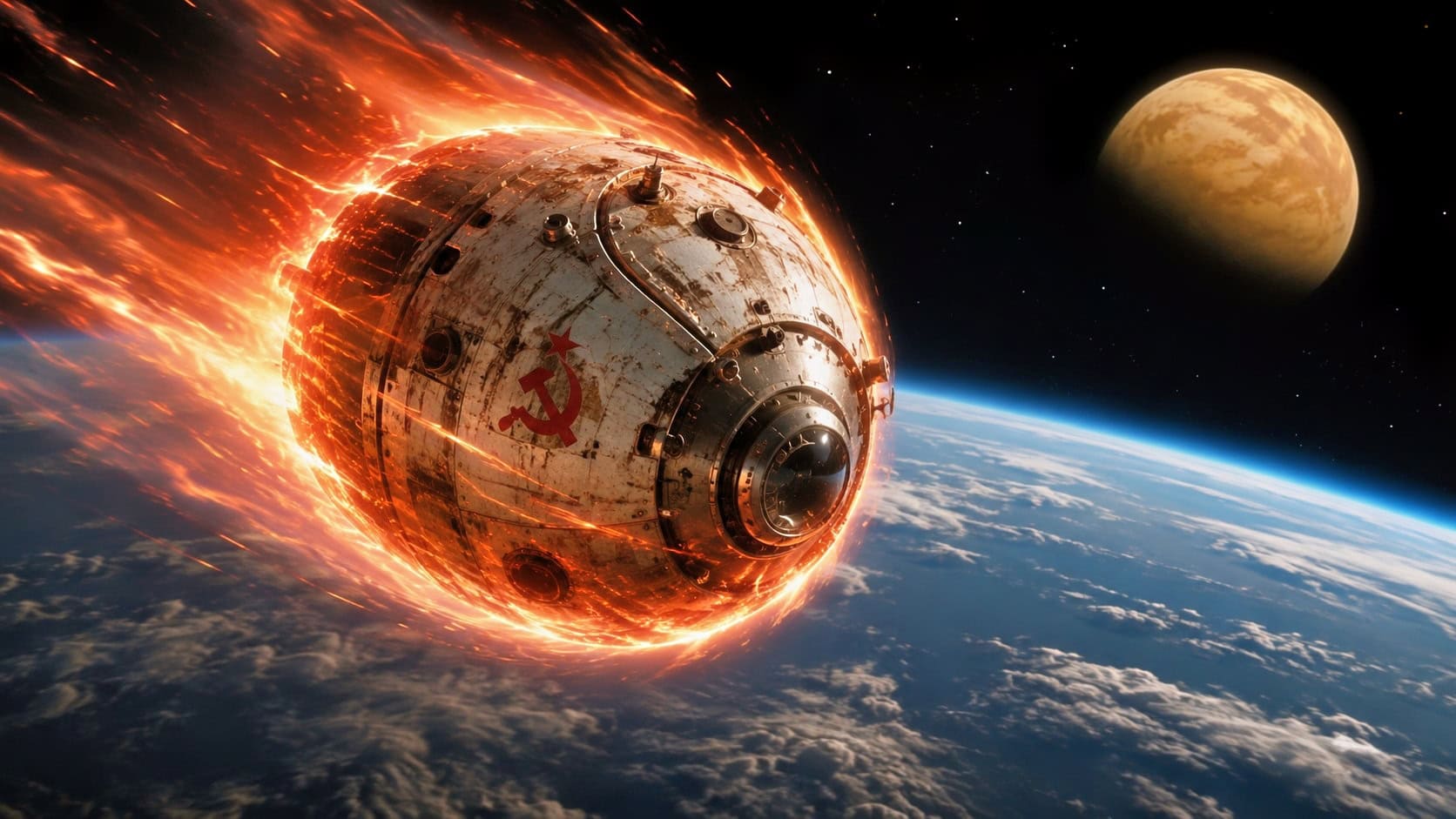
A spacecraft built to land on a planet finally did, except it landed on the wrong one, and it arrived 53 years late. The Soviet Union designed Kosmos 482 to survive the surface of Venus, the most hostile place humanity has ever tried to reach, sealing its instruments inside a titanium sphere engineered to withstand 880-degree heat, crushing pressure, and clouds of sulfuric acid. The probe never got there. A timer set wrong cut its rocket short, stranding it in orbit around Earth, where it circled for half a century before the same toughness meant to let it survive on Venus did something its builders never intended. It refused to burn up. On May 10, 2025, the capsule came home, falling out of the sky onto the planet it had left in 1972.
The Cold War Race To Venus
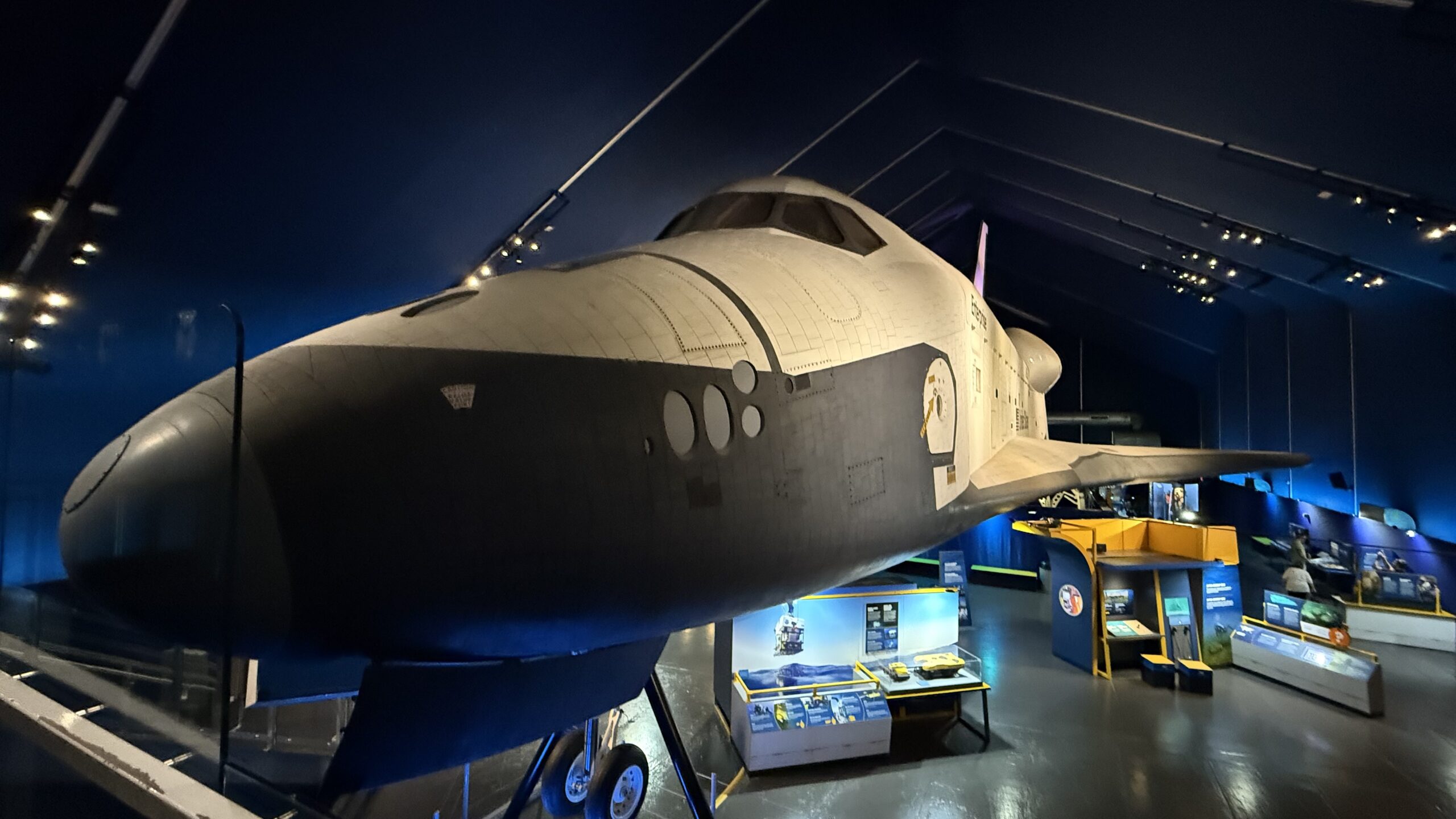
NASA Space Shuttle Onboard USS Intrepid. 19FortyFive.com Image.
Venus was a prize in the space race, and for the Soviet Union, it was the prize. Throughout the 1960s and 1970s, the USSR launched spacecraft at the planet relentlessly, sending 29 probes toward Venus over roughly two decades. Some flew past and slipped into orbit around the Sun, sixteen reached the planet to orbit or land, and ten never escaped Earth at all. The program was called Venera, and it was an astonishing run of firsts: Venera 1 launched in 1961, only four years after Sputnik, Venera 7 made the first soft landing on another planet in 1970, Venera 9 returned the first images from the surface in 1975, and Venera 13 and 14 sent back the first color photographs of that alien landscape.
The science was real, but so was the message. Venus was wrapped in thick clouds and might, scientists then hoped, be hiding something beneath them, but the probes were also instruments of Cold War prestige, built to demonstrate that socialist science could conquer the cruelest world in the solar system when the Americans were aiming at the Moon and Mars. Reaching Venus and surviving its surface, even for a few minutes, was a way of proving a system worked. That ambition is the reason a half-ton titanium sphere ended up circling Earth for five decades.
A Timer Fails, And A Venus Probe Is Stranded
The Soviets flew their Venus probes in pairs, launched a few days apart, so that if one failed, the other might still make it. On March 27, 1972, Venera 8 lifted off and went on to reach Venus 117 days later. Four days after that, on March 31, its twin left the pad atop a Molniya rocket from Baikonur, and everything went right until the last step. The spacecraft reached a parking orbit around Earth, then fired to push itself onto a path to Venus. The Blok L upper stage shut down early because its timer had been set incorrectly, the burn ended before the probe reached escape velocity, and the Venus mission was over before it had truly begun.
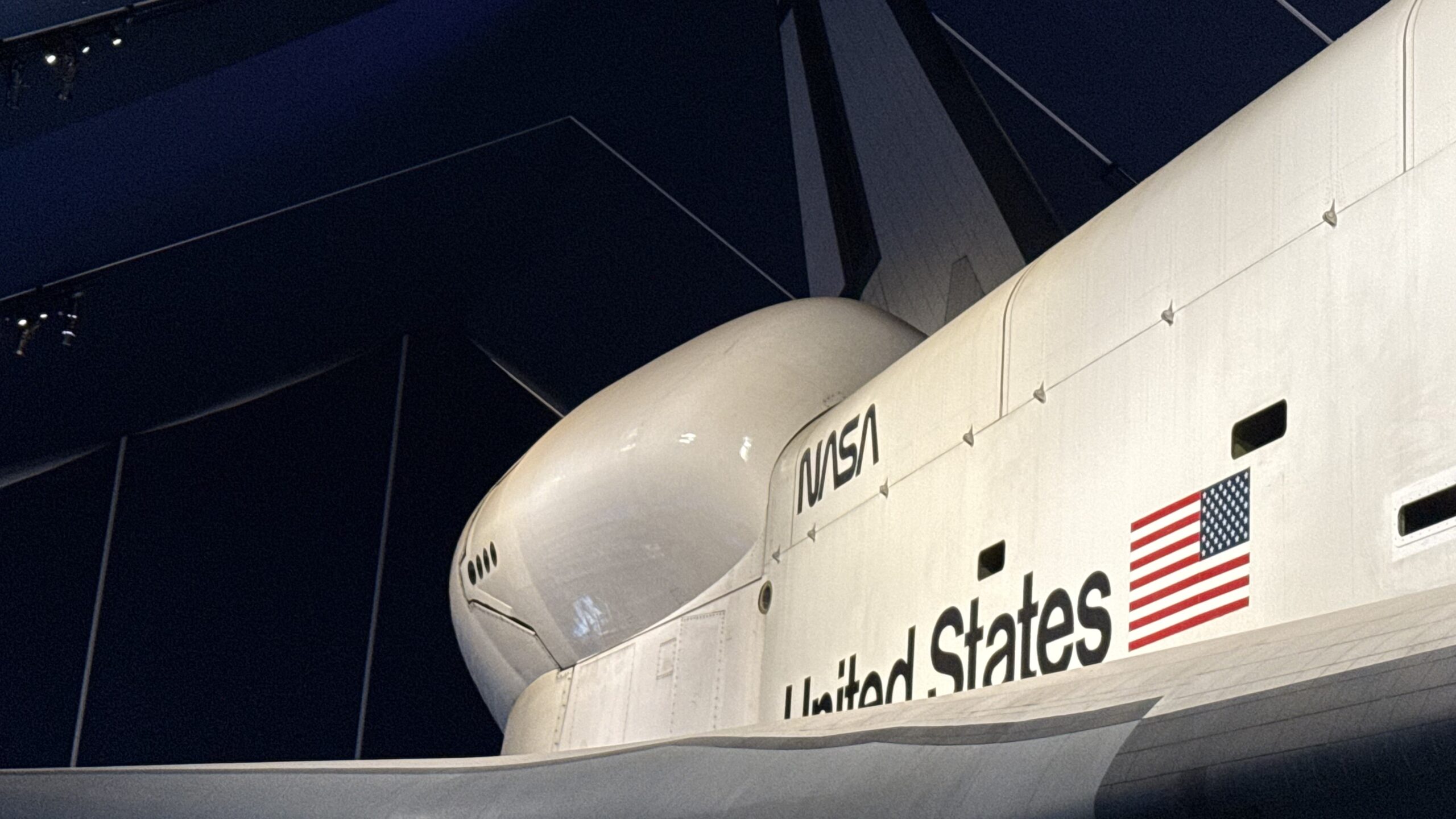
NASA Space Shuttle Onboard USS Intrepid. 19FortyFive.com Image.
What happened next is a small masterpiece of Cold War concealment. The Soviet space program said almost nothing about its missions until they succeeded, and it never acknowledged this failure at all. Rather than announce the loss of a Venus probe, the authorities filed the stranded spacecraft under the generic “Kosmos” designation reserved for Earth-orbiting satellites, the same label slapped on hundreds of routine military and scientific payloads. The name itself was the cover story. To anyone reading the official record, Kosmos 482 was just another anonymous satellite, not the wreck of a failed interplanetary mission, and the designation quietly stuck for the next 53 years.
Built To Survive Hell
The reason Kosmos 482 became more than a forgotten failure is the way it was built. Its descent craft was a titanium sphere about a meter across, weighing roughly 495 kilograms (about 1,090 pounds) and engineered to withstand conditions that would destroy almost anything.
The surface of Venus sits under about 90 times Earth’s atmospheric pressure at a temperature near 880 degrees Fahrenheit, in an atmosphere laced with sulfuric acid, and the lander was rated to take all of it, along with some 300 times the force of gravity in deceleration and 100 atmospheres of pressure on the way down.
That overbuilt shell is exactly what made the probe so unusual when it finally came home. Ordinary satellites and spent rocket bodies tear themselves apart and vaporize during reentry, when atmospheric friction drives temperatures toward 2,900 degrees Fahrenheit. Titanium alloy, though, melts at around 3,000 degrees, just above that peak, so a sphere designed to endure Venus could plausibly ride through an Earth reentry that would erase a normal spacecraft. The engineering meant to protect the capsule on one planet became the reason it could survive falling onto another.
The Red-Hot Spheres That Fell On A New Zealand Farm
There was an early, vivid preview of all this, and it landed in a farm field. When the rocket stage broke apart after the failed burn, pieces of it came down over New Zealand within days of the launch. At about one in the morning on April 3, 1972, four red-hot titanium spheres weighing about 13.6 kilograms, roughly 30 pounds, and measuring around 38 centimeters across, slammed into farmland within a 16-kilometer radius near Ashburton, on New Zealand’s South Island. They scorched holes in crops and punched deep dents into the soil, but hit no one.
These were pressure vessels from the rocket’s fuel system, and they survived reentry for the same reason the lander later would: titanium does not burn easily. New Zealand scientists examined the spheres and concluded, based on the high-grade welding and machining marks, that they were Soviet-made. When officials sought to return the debris to its owner, as required by space law, the USSR denied any knowledge of the objects. Since no nation would claim them, ownership passed to the farmer whose land they had cratered, and a Soviet space failure became, by default, the property of a New Zealand farmer. A similar object turned up near Eiffelton in 1978.
Fifty-Three Years Alone In Orbit
The rest of the spacecraft lingered. The carrier bus and the rocket stages reentered over the following years, with the bus coming down in 1981, but the titanium lander remained aloft in a steep elliptical orbit that reached as far as about 9,000 kilometers from Earth and swung as close as 210 kilometers. Over the decades, the faint drag of the upper atmosphere bled energy from that orbit, and the high point gradually fell from roughly 9,000 kilometers to 2,000, dragging the capsule closer to the planet a little more each year.
For most of that time, almost no one was watching. As the orbit decayed in its final years, amateur satellite trackers picked it up and followed it down, among them the Dutch observer Marco Langbroek, who photographed the tumbling capsule and noted that, because it was built to survive Venus, it might survive reentry intact, while cautioning that the long, shallow path and the sheer age of the object left the outcome genuinely uncertain.
A relic of a vanished country, engineered for a planet it never reached, was making its slow way back under the eyes of camera-wielding hobbyists.
The Wrong Planet, Half A Century Late
The end came on the morning of May 10, 2025, when the capsule returned to Earth after 53 years. The capsule made its last tracked pass over Germany, where a radar facility caught it at 08:04 local time, and when it failed to appear on the next orbit roughly 90 minutes later, observers knew it had come down in between. Beyond that, the picture stays deliberately fuzzy.
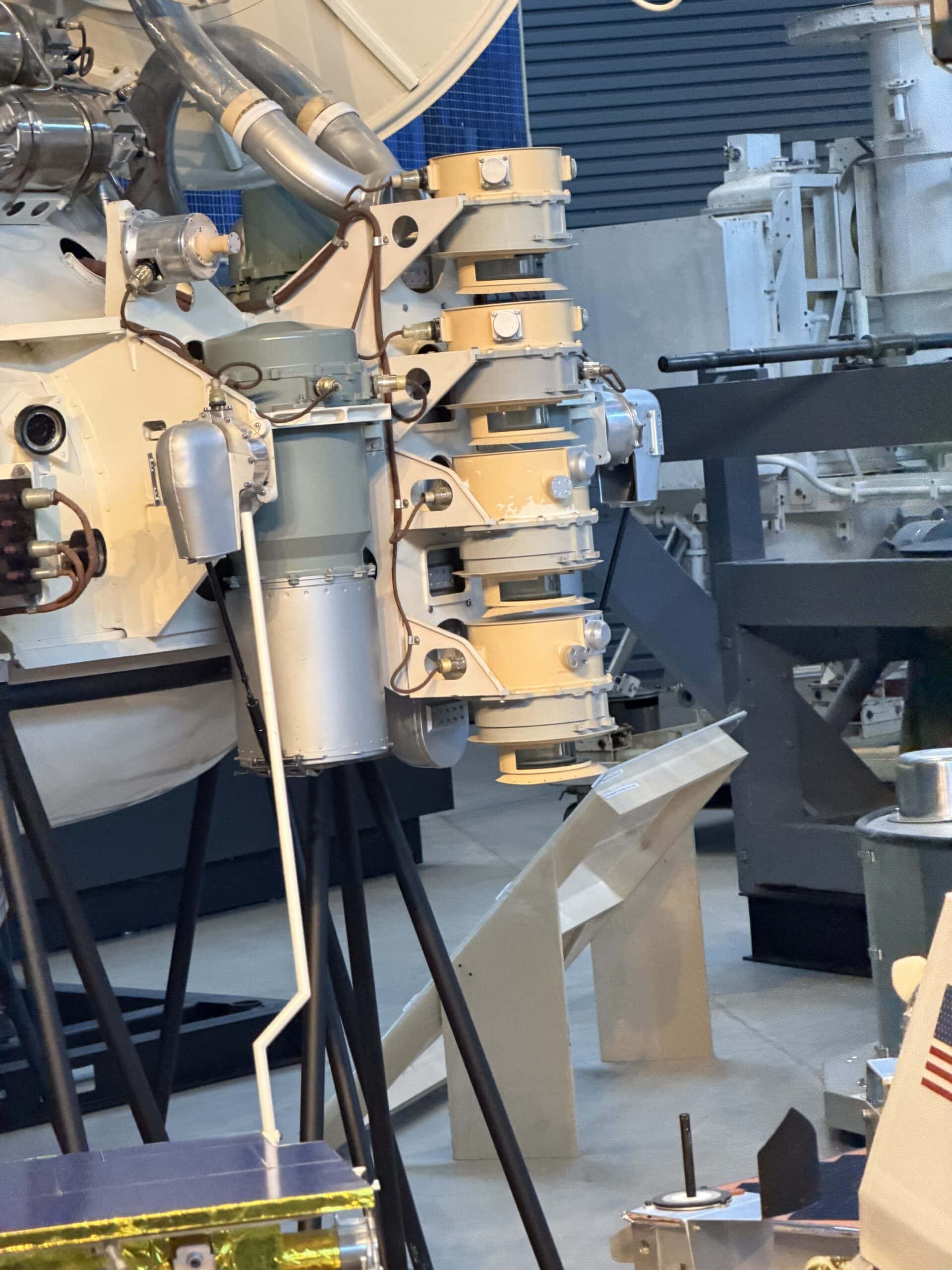
Vega Space Probe 19FortyFive Photo From Smithsonian Taken on June 30 2026
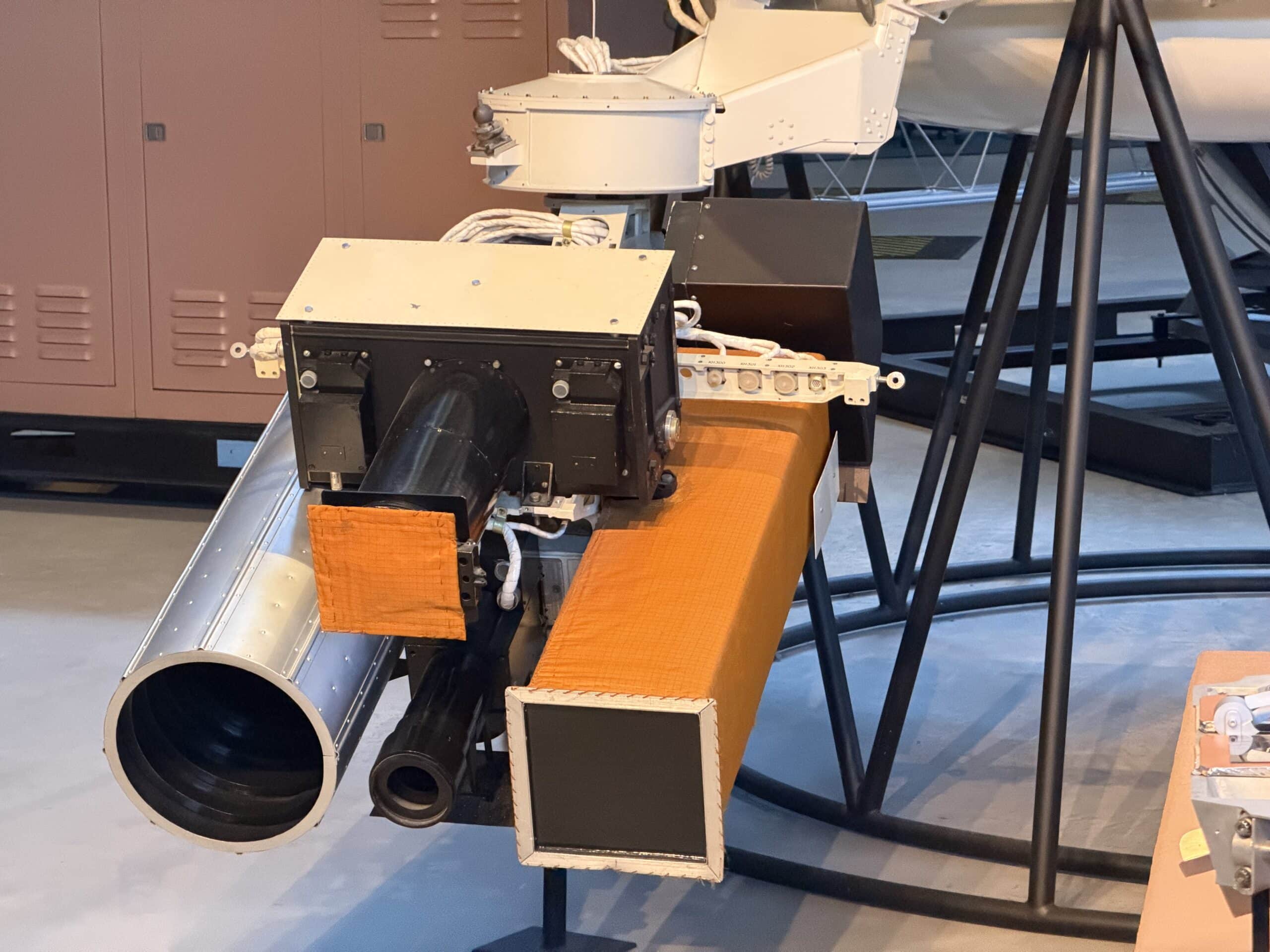
Vega Space Probe 19FortyFive Photo From Smithsonian Taken on June 30 2026
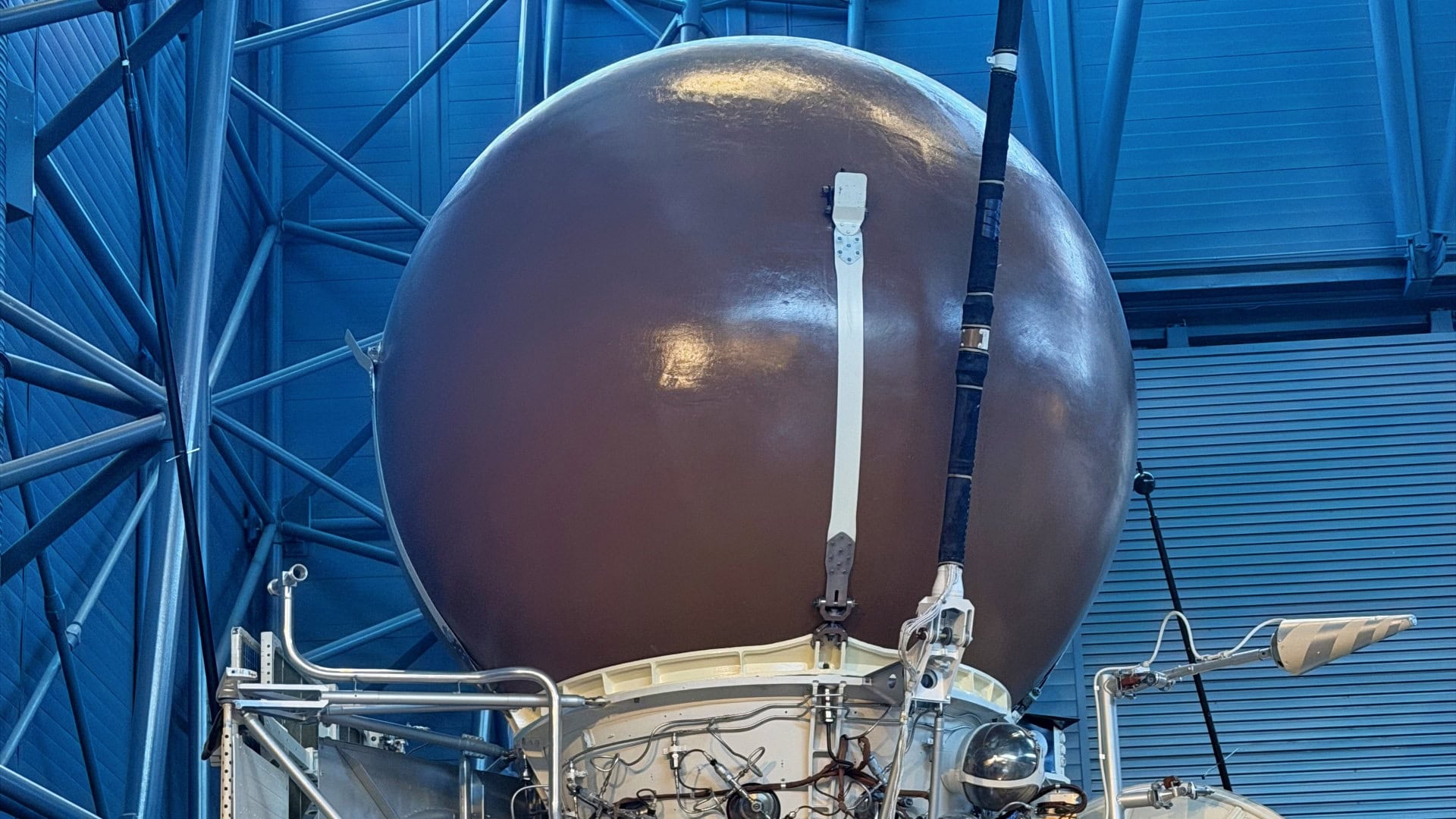
Vega Space Probe 19FortyFive Photo From Smithsonian Taken on June 30 2026
The European Space Agency stated plainly that a precise time and location were never identified, and that no one reported seeing the reentry or finding any impact on the ground. Russia’s space agency said the capsule fell into the eastern Indian Ocean at 06:24 UTC, but that account has not been independently confirmed, and the true site, most likely open water, remains disputed.
Whether the lander reached the surface intact is also uncertain. Its build made survival plausible, and assessments judged it likely to have come down largely intact, hitting hard at an estimated 150 miles per hour with no working parachute, no refrigeration, and no aerobraking left to slow it after 53 years, just the bare titanium shell.
But the shallow angle of descent and the possibility that the tumbling capsule struck the atmosphere at the wrong angle may have reduced its odds. After everything, the spacecraft that was designed to track all the way to the surface of Venus instead vanished quietly somewhere over an ocean, its final moments unwitnessed.
The Ghost Of The Soviet Venus Program
Kosmos 482 was the last piece of the Soviet Venus program still in orbit, and its fall closed the book on one of the Cold War’s great scientific campaigns. Of the ten Venera-related craft that got stuck in Earth orbit, every one came down the same year it launched, except this one, which stayed aloft for another 53 years.
It outlasted the program that built it, the rivalry that funded it, and the country that launched it, the Soviet Union, which had dissolved in 1991, more than three decades before its lost probe finally came home.
The capsule never sent back a single reading from Venus, never opened its instruments in that sulfuric sky, never did the one thing it was made to do.
MORE – Russia Put a Dog In Space, and It Never Came Home
What it did instead was endure, built so thoroughly for the wrong planet that it could not be destroyed by falling toward the right one.
A machine designed to land on Venus in 1972 finally made its landing in 2025, on Earth, half a century late and entirely by accident, the patient ghost of a space race that ended long before it did.
About the Author: Harry J. Kazianis
Harry J. Kazianis (@Grecianformula) was the former Senior Director of National Security Affairs at the Center for the National Interest (CFTNI), a foreign policy think tank founded by Richard Nixon based in Washington, DC. Harry has over a decade of experience in think tanks and national security publishing. His ideas have been published in the NY Times, The Washington Post, The Wall Street Journal, CNN, and many other outlets worldwide. He has held positions at CSIS, the Heritage Foundation, the University of Nottingham, and several other institutions related to national security research and studies. He is the former Executive Editor of the National Interest and the Diplomat. He holds a Master’s degree focusing on international affairs from Harvard University.

