
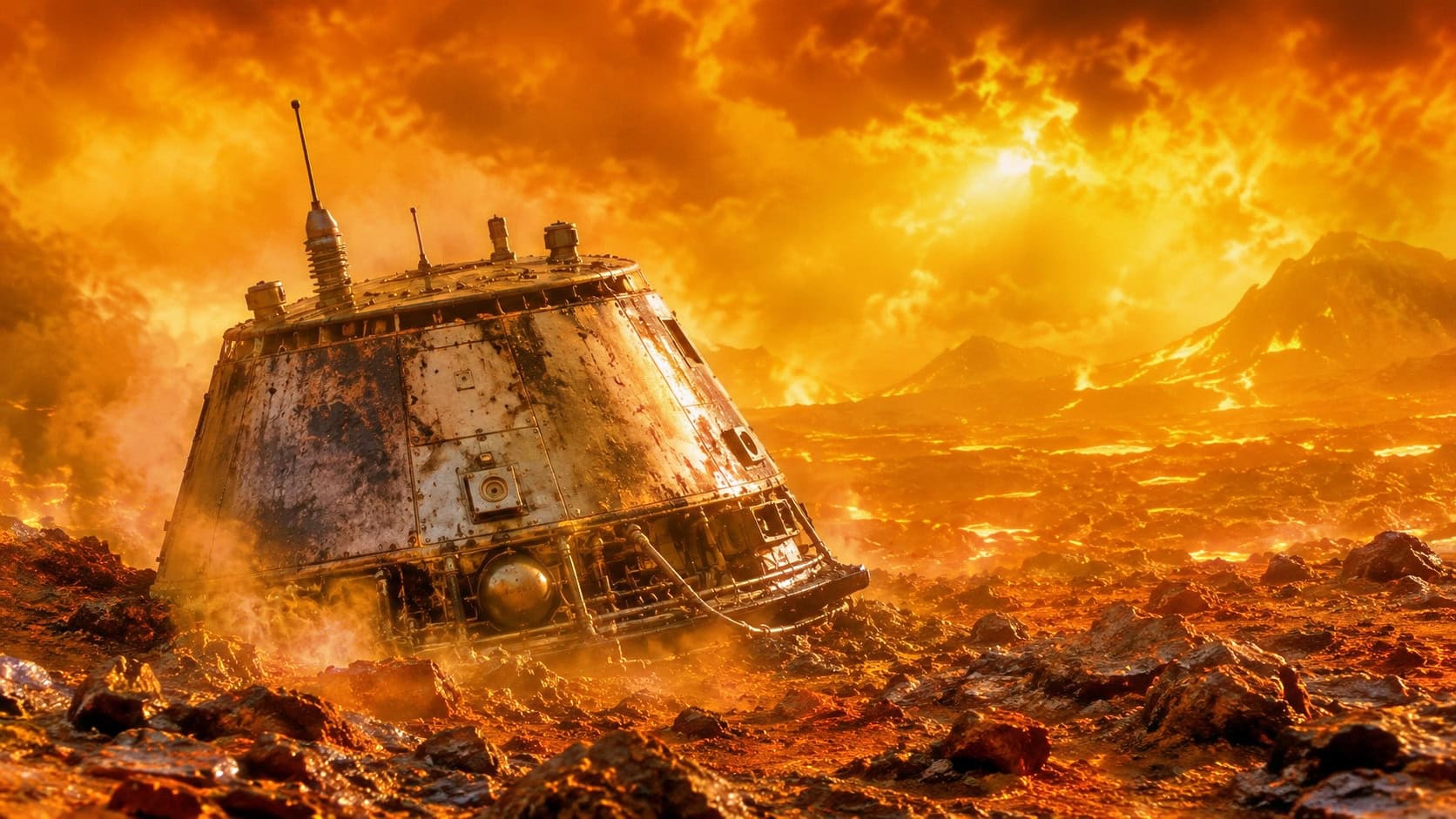
The Soviet Union spent the 1960s and 1970s building Venus landers, titanium tanks engineered to survive the solar system’s most hostile surface. The United States never built one at all. Every American Venus probe was designed to do its work on the way down and then die when it hit the ground. In 1978, NASA dropped four such probes into the Venusian atmosphere, cones built to take readings during a descent that would end at the surface with no parachute, no landing gear, and no expectation of survival. Three of the four did roughly what was planned. One of them hit the ground, kept going, and transmitted from the surface of Venus for 67 minutes and 37 seconds before the heat and pressure finally killed it.
America’s only landing on Venus was an accident, made by a throwaway probe that outlived a crash it was designed to die in.
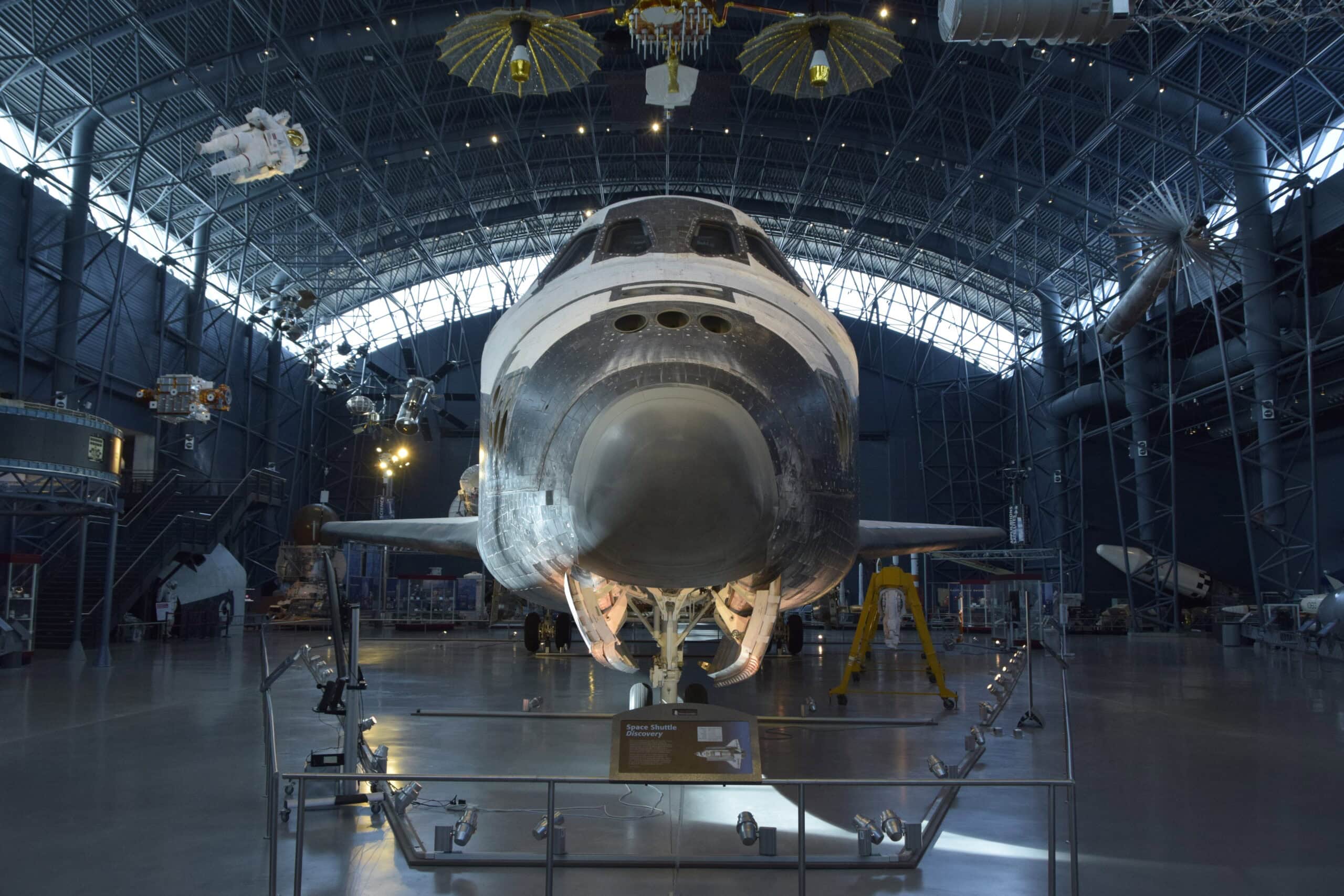
NASA Space Shuttle Discover in 2025. 19FortyFive.com Photo.
Two Ways To Reach Venus
By the late 1970s, the Soviet Union had already done what no one else had. Venera 7 made the first soft landing on another planet in 1970, and Venera 9 returned the first photograph from the surface of Venus in 1975, both using heavy landers built as armored pressure vessels meant to keep working in conditions that destroy ordinary machines within minutes. The Soviet approach was to build for the surface and survive it.
The American approach was the opposite. NASA never built a Venus lander designed to operate on the ground. Its strategy ran through flybys, orbiters, and atmospheric-entry probes, spacecraft meant to study Venus from above or to sample its air on the way down, not to endure its surface. That choice is the whole reason why what happened in December 1978 was a surprise.
The spacecraft that became America’s first and only Venus lander was never built to land. It was built to fall, take measurements, and stop.
The Pioneer Venus Multiprobe
The mission was Pioneer Venus, and it was two spacecraft. The Pioneer Venus Orbiter launched in May 1978 to circle the planet, and the Pioneer Venus Multiprobe launched on August 8, 1978 atop an Atlas-Centaur rocket from Cape Canaveral. Both were built by the Hughes Aircraft Company in El Segundo, California, and managed by NASA’s Ames Research Center.
NASA Space Shuttle Discover in 2025. 19FortyFive.com Photo.
The Multiprobe carried four separate entry probes on a single bus: one Large Probe weighing about 315 kilograms and three identical Small Probes, each weighing roughly 90 kilograms, named North, Day, and Night for the parts of the planet they were aimed at.
The probes were all built to do the same basic job: to fall through the atmosphere, take in situ measurements of pressure, temperature, cloud structure, and composition, and transmit that data directly to Earth during descent.
The Large Probe was released on November 16, about 7 million miles from Venus, and the three Small Probes followed on November 20. All four probes, plus the spent bus that had carried them, reached the Venusian atmosphere on December 9, 1978, five separate objects hitting the air of another planet on the same day. The bus itself, with no heat shield and no parachute, returned data on the upper atmosphere before burning up at about 110 kilometers.
Built To Die On Impact
The key fact about these probes is that none of them was built to land. They were cone-shaped and not expected to survive impact with the surface. The Large Probe used a parachute for part of its descent, deploying it at 47 kilometers altitude and then jettisoning it to fall the rest of the way under air resistance alone. The three Small Probes did not even have parachutes.
NASA Space Shuttle Discover in 2025. 19FortyFive.com Photo.
Each was a titanium pressure vessel attached to a conical deceleration module with an ablative heat shield, and after the worst of the entry heating, the Small Probes simply free-fell toward the surface without any parachute at all, their aeroshells never separating.
That meant each Small Probe would strike the ground at roughly 20 miles per hour, and that impact was expected to be the end of it. There were no cameras, no landing legs, no surface experiments, and no plan for anything to happen after touchdown. The probes were designed to gather their science during the 50-some minutes of descent and then go quiet when they hit. The mission’s success did not depend on any of them surviving the landing, because no one expected them to.
The Probe That Wouldn’t Stop
What actually happened is that all four probes transmitted data the whole way down to the surface, and two of the three Small Probes survived the impact. One of the survivors, the Night Probe, kept transmitting for about two seconds after landing.
The other, the Day Probe, did something no American spacecraft had ever done. It hit the ground and kept working.
The precise record is preserved in NASA’s data. The Day Probe entered the atmosphere at 18:52:18 UT, descended for 56 minutes, and touched down at 31.3 degrees south, 317 degrees east at 19:47:59 UT, then continued to transmit for another 67 minutes and 37 seconds before the high temperatures, pressure, and power depletion overcame it. It had come down in the western part of a volcanic region now known as Dione Regio, with the Sun just 9.5 degrees above the horizon and the local time equivalent to about 6:42 in the morning.
NASA Space Shuttle Discover in 2025. 19FortyFive.com Photo.
One detail from those final minutes is the kind of thing that only a machine sitting on the ground could record. The probe’s nephelometer, an instrument for measuring particles in the atmosphere, showed that the dust kicked up by its own impact took several minutes to settle back down. That settling dust hinted at why the Day Probe survived at all. It appears to have come down in soft, dusty deposits that cushioned the impact, sparing the probe the full force of the landing and letting it live long enough to become NASA’s accidental first Venus lander.
860 Degrees And 92 Atmospheres
The conditions the Day Probe endured for over an hour are difficult to overstate.
The surface of Venus sits at roughly 460 degrees Celsius, about 860 degrees Fahrenheit, beneath some 90 bars of pressure from a dense, near-pure carbon dioxide atmosphere laced with sulfuric acid, conditions hot enough to melt lead. At the Day Probe’s landing site, the surface pressure was measured at 91.5 bars, and although the probe’s temperature sensor stopped working about 12 kilometers above the ground, the surface temperature was estimated at 456 degrees Celsius.
The reason the probe lasted as long as it did, beyond the lucky soft landing, was its construction. Each Small Probe was built from a pair of titanium alloy hemispheres bolted together to form a sealed pressure vessel, and the interior was filled with xenon gas rather than ordinary dry nitrogen, a choice intended to slow the flow of heat into the electronics. It was that toughness, built to ride out a violent descent rather than a long stay on the ground, that ended up keeping the Day Probe alive on the surface of Venus far past the moment it was supposed to fall silent.
The Orbiter That Outlived Everything
While the probes lasted minutes and one for a little more than an hour, the other half of the mission lasted for years. The Pioneer Venus Orbiter was inserted into orbit on December 4, 1978, becoming the first American spacecraft to orbit Venus, and it continued operating far longer than anyone had planned. It mapped the surface by radar, producing the first global topographic map of Venus, and operated until its last transmission was received on October 8, 1992, after 5,055 orbits, having flown a 14-year mission that was originally meant to last eight months before its fuel ran out and it burned up in the atmosphere.
By the time the orbiter died, NASA’s Magellan spacecraft had taken over, and it radar-mapped over 98 percent of Venus before NASA deliberately sent it into the atmosphere to burn up in 1994. After that, America effectively walked away from Venus.
The Magellan mission and the comprehensive picture it built with Pioneer Venus and the Soviet Venera orbiters marked the end of intensive US attention to the planet for roughly three decades.
Is The Day Probe Still There on Venus?
That long silence is only now ending, which makes a study published in May 2026 a fitting bookend. A team led by space archaeologist Luca Forassiepi analyzed 15 missions that reached Venus between 1965 and 1985 and concluded that at least seven may have endured the Venusian environment and still exist as relics on the surface today.
The team used the Pioneer Venus Day Probe, mostly titanium with beryllium shelves and aluminum equipment boxes inside, as its detailed case study, chosen partly because the records for the American probe are more accessible than those for the Soviet landers.
The findings rely on NASA’s Glenn Extreme Environments Rig, a laboratory that recreates Venus surface conditions. Those tests have shown that titanium has “excellent resistance” to the Venusian environment, so the Day Probe should have mostly held its shape in the nearly 50 years since it landed. It is one of about 20 human-made objects the study assessed on Venus, most of them Soviet, and the probable conclusion is that the wreck of America’s accidental lander is still sitting where it came down.
The United States is finally going back. NASA’s DAVINCI, an atmospheric descent probe, and VERITAS, a radar orbiter, will be the first U.S.-led missions to Venus since Magellan, both now targeting launches around 2031.
When they arrive, they will study a planet that, by accident, already holds a piece of American hardware on its surface.
The Day Probe was a throwaway instrument built to take readings and then die on impact, and instead it transmitted from the surface of the solar system’s most hostile world for 67 minutes and 37 seconds, and very likely remains there still, the only American spacecraft ever to land on Venus, and one that was never meant to.
About the Author: Harry J. Kazianis
Harry J. Kazianis (@Grecianformula) was the former Senior Director of National Security Affairs at the Center for the National Interest (CFTNI), a foreign policy think tank founded by Richard Nixon based in Washington, DC. Harry has over a decade of experience in think tanks and national security publishing. His ideas have been published in the NY Times, The Washington Post, The Wall Street Journal, CNN, and many other outlets worldwide. He has held positions at CSIS, the Heritage Foundation, the University of Nottingham, and several other institutions related to national security research and studies. He is the former Executive Editor of the National Interest and the Diplomat. He holds a Master’s degree focusing on international affairs from Harvard University.

