
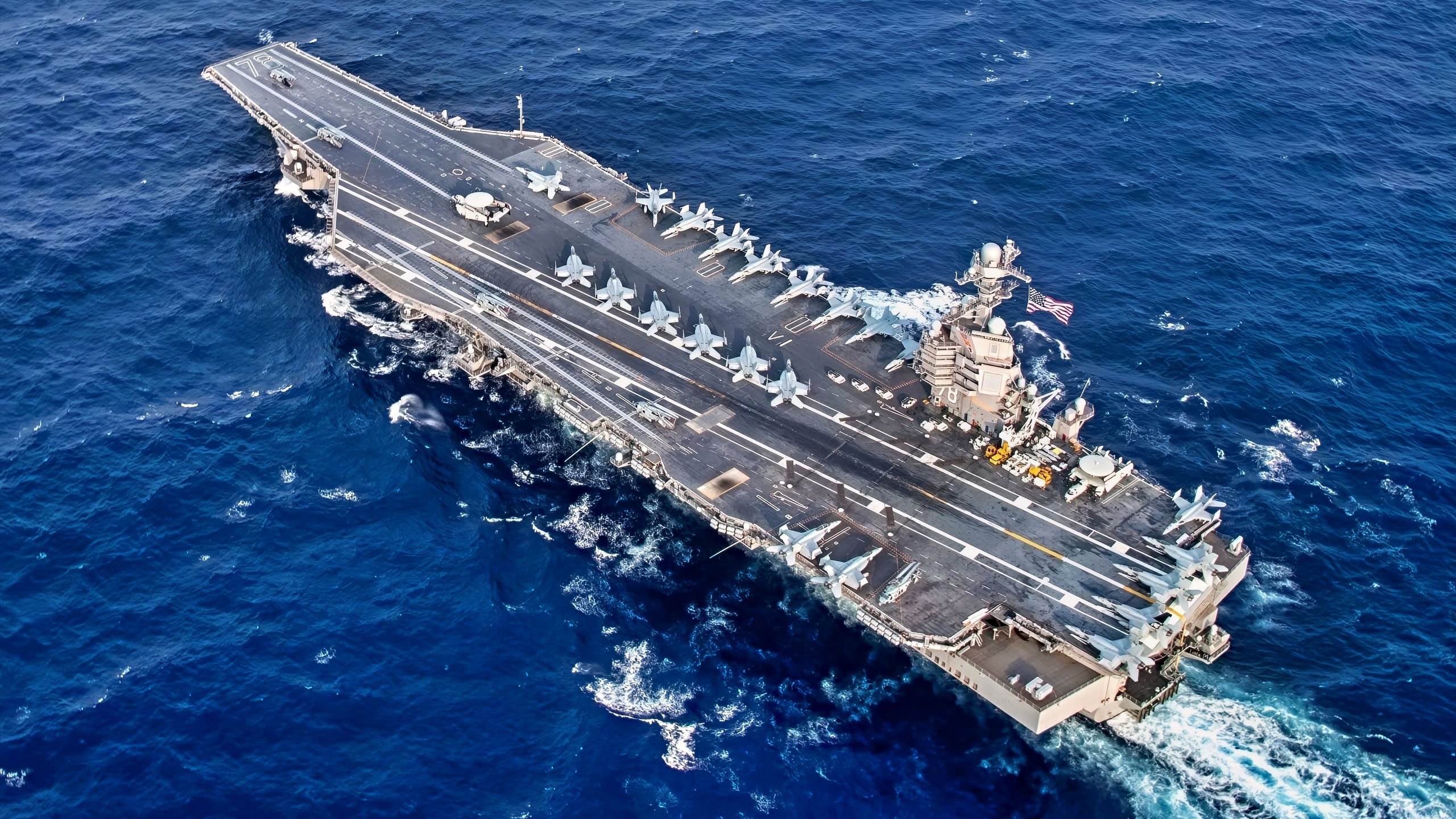
Iran keeps going back to the Strait of Hormuz because it still works to apply pressure on the Trump Administration. Every temporary return to normal traffic through the Strait should be treated with some caution.
Tehran does not need to close the Strait forever. It does not even need to close it especially well. It needs shipowners, insurers, Gulf monarchies, Asian refiners, and Washington to behave as though the next tanker might catch a mine, a drone, or a missile. Once that happens, Iran has converted geography into leverage.
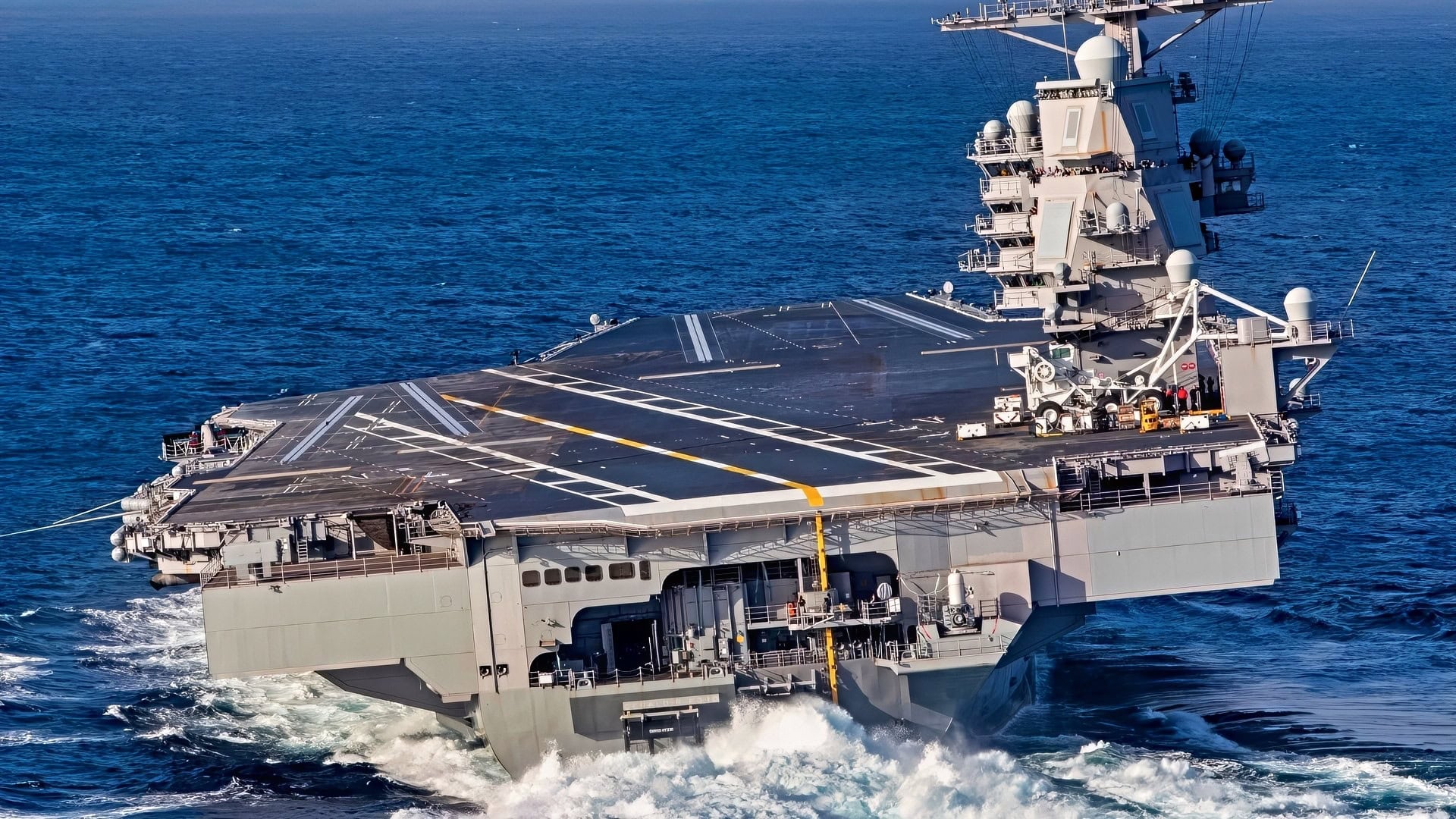
(Oct. 29, 2019) USS Gerald R. Ford (CVN 78) conducts high-speed turns in the Atlantic Ocean. Ford is at sea conducting sea trials following the in port portion of its 15 month post-shakedown availability. (U.S. Navy photo by Mass Communication Specialist 3rd Class Connor Loessin)
The obvious answer is to build around it. Pipelines help, and ports outside the Strait buy space. Storage and alternative export routes give governments options. All of this is sensible, and it assumes the problem lies in the water.
But it does not. Iran’s missiles and drones can chase the target set onto land. A pipeline does not make the problem disappear; it moves the problem to pumping stations, terminals, and ports. The waterway gets bypassed. The source of Iran’s leverage does not.
Iran’s Chokepoint Keeps Paying
Hormuz gives Iran a way to make weakness look larger than it is. Iran cannot beat the U.S. Navy in a straight fight. It cannot dominate the Gulf by conventional military power. It cannot compel Saudi Arabia, the UAE, or the United States to treat Tehran as the region’s rightful manager.
But a few warnings from the Revolutionary Guard can still be useful. Ships slow down. Insurers start recalculating. Oil traders price in a crisis that may or may not happen. Diplomats begin looking for a way to calm things down, often by asking what Iran wants in exchange for behaving less dangerously.
That is the attraction for Tehran. Not victory at sea. Leverage.
The tanker attacks near Fujairah and in the Gulf of Oman in 2019 showed how this works. Limited violence around the waterway did not have to produce a full closure to matter. It produced uncertainty, and uncertainty is enough when the cargo is oil and the route is narrow.
There is another reason the threat travels so far. The buyers are not only in the Gulf or in Washington’s alliance system. China, India, Japan, South Korea, and others all have interests tied to the movement of Gulf energy. China, in particular, depends on the flow while letting the United States underwrite much of the maritime order that keeps it moving. Beijing’s exposure raises the stakes, but it does not mean Beijing will help solve the problem on Washington’s terms. Iran knows a Hormuz scare does not stay local.
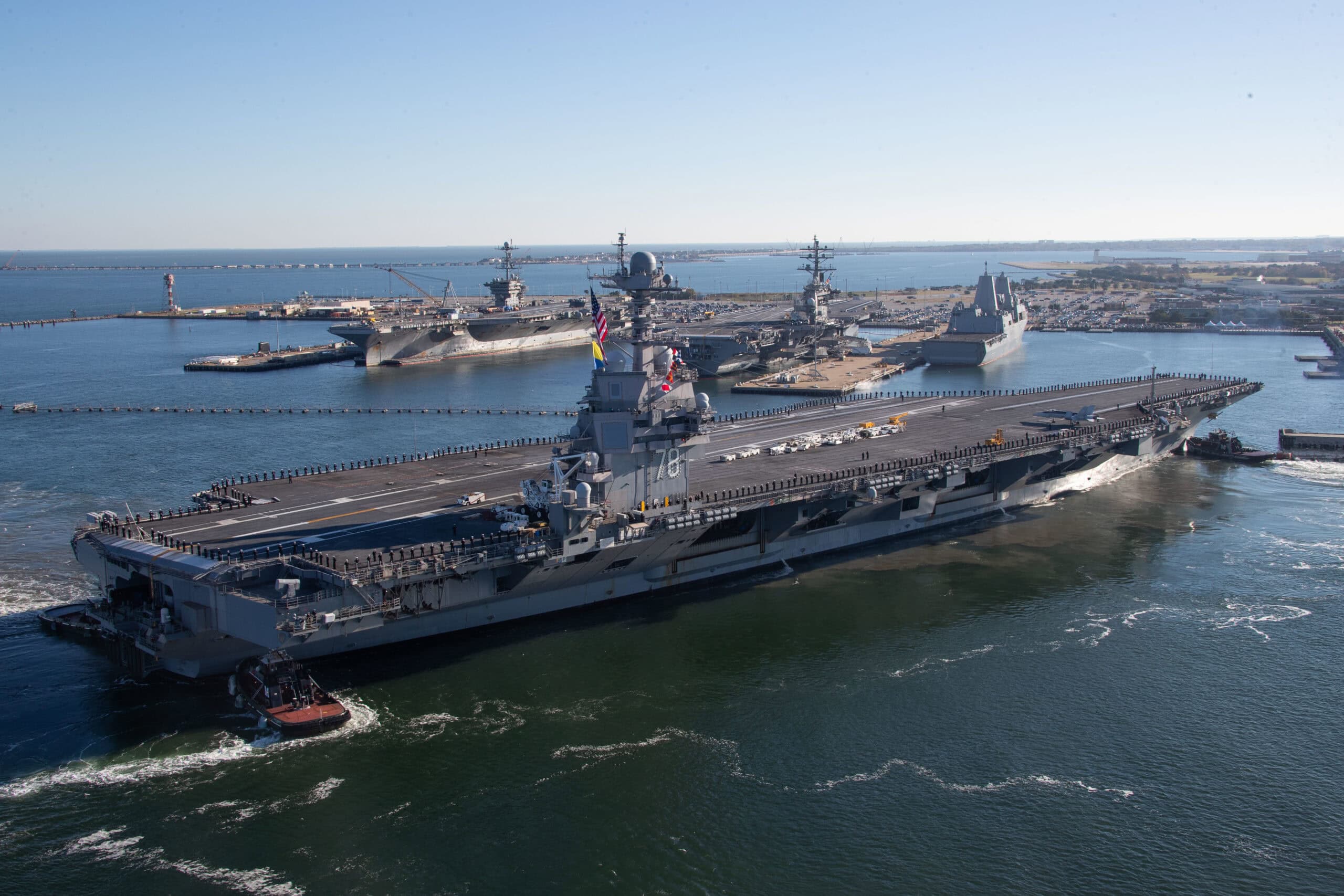
The crew of the first-in-class aircraft carrier USS Gerald R. Ford (CVN 78) man the rails as the ship returns to Naval Station Norfolk, Nov. 26, following the inaugural deployment with the Gerald R. Ford Carrier Strike Group (GRFCSG). More than 4,600 Sailors assigned to Ford operated in U.S. 2nd Fleet and 6th Fleet, increasing interoperability and interchangeability with NATO Allies and partners. Throughout the deployment, the GRFCSG sailed more than 9,200 miles, completed more than 1,250 sorties, expended 78.3 tons of ordnance, completed 13 underway replenishments and hosted more than 400 distinguished visitors. (U.S. Navy photo by Mass Communication Specialist 2nd Class Jackson Adkins)
Pipelines Are Not Magic
The obvious long-term answer is to build more ways around the Strait. This is sensible. Saudi export capacity toward the Red Sea, Emirati infrastructure at Fujairah, extra storage, and more flexible loading arrangements all reduce the hostage value of Hormuz.
The mistake comes when redundancy is treated as escape.
A pipeline is not a tunnel under geopolitics. It is a fixed piece of infrastructure, mapped in advance, ending at a port. If that port sits outside Hormuz, the waterway has been bypassed. Iran has not.
Abqaiq should have ended the illusion that the Gulf energy problem lives only at sea. The 2019 strike on Saudi oil-processing infrastructure showed how quickly a land target can become the center of a global energy crisis. Once the barrel leaves the Strait, it still has to move through compressors, tanks, control systems, ports, and loading arms. These are not abstractions. They are coordinates.
Fujairah shows the same problem in a different form. It gives the UAE a way to move crude without sending every barrel through the Strait of Hormuz. That is valuable. During a crisis, though, the very infrastructure that makes the bypass useful becomes more important to hit, threaten, or disable.
Iran does not need to sink every ship if it can make enough of the system feel fragile. It can threaten the sea lane one month and the terminal the next. Build the bypasses. Just do not talk as if concrete and steel can abolish strategy.
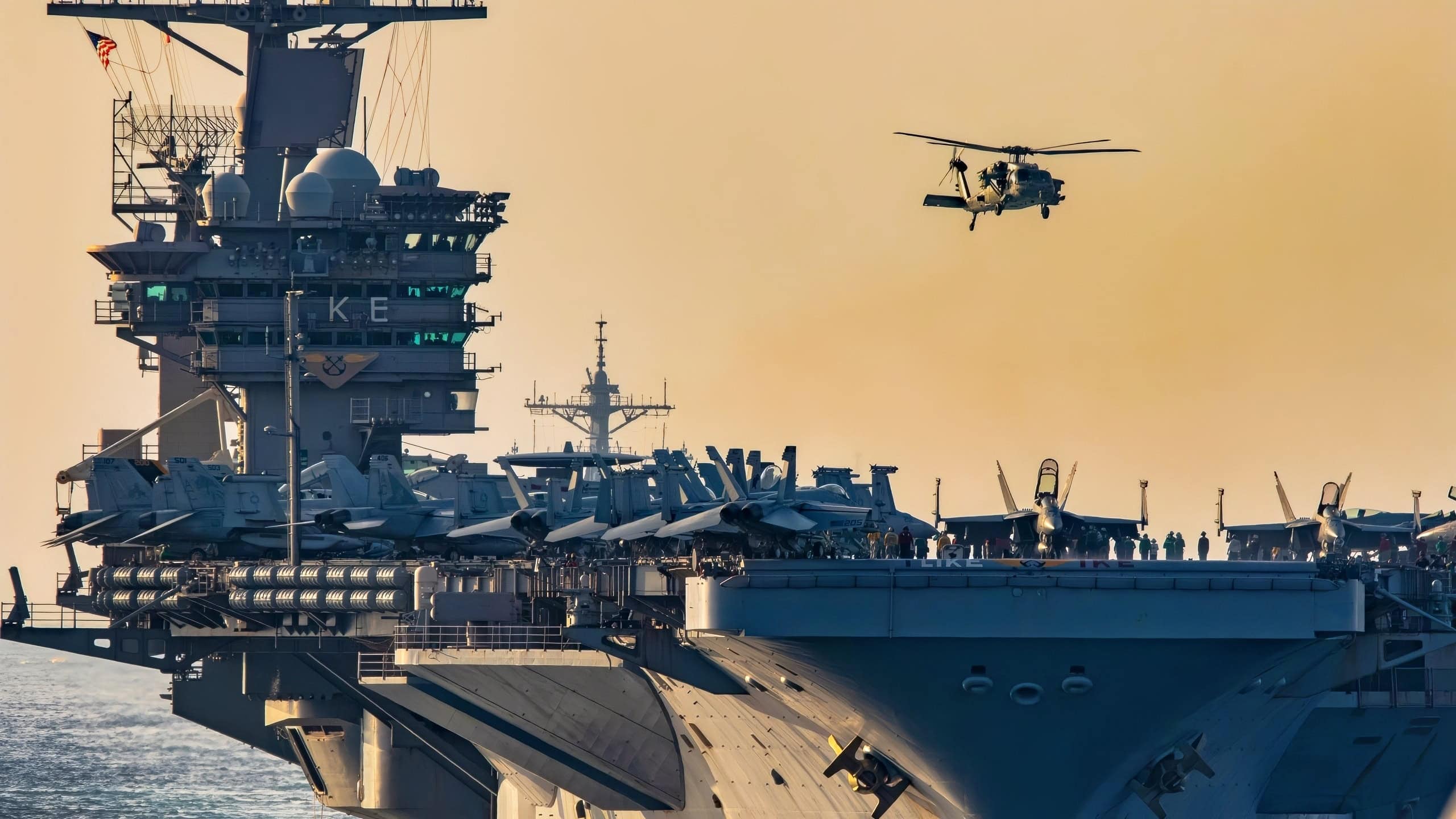
Components of the Dwight D. Eisenhower Carrier Strike Group (IKECSG), guided-missile destroyer USS Stethem (DDG 63) and French Navy frigate FS Languedoc (D 653) transited the Strait of Hormuz. IKECSG is deployed to the U.S. 5th Fleet area of operations to help ensure maritime security and stability in the Middle East Region. (U.S. Navy photo by Electronics Technician 2nd Class Daniel Goodin)
Risk Is Not the Same as Coercion
The United States can tolerate risk in the Strait of Hormuz. It has been doing so for decades. A narrow waterway bordered by Iran and Oman, carrying a major share of seaborne oil, will never be a normal commercial route.
The problem is not danger. The problem is Iran’s ability to turn danger into a recurring diplomatic asset.
That distinction matters because the wrong answer is easy to imagine. Every Iranian move should not trigger an American military response. That would give Tehran another kind of control. Iran could set the tempo whenever it wanted by choosing the next provocation and waiting for Washington to react.
Restraint still matters. The trick is not to confuse restraint with accommodation.
This is where threshold talk gets harder than it sounds. The Gulf has no shortage of warnings, statements, and private messages. Many of them sound larger than the political will behind them. A useful threshold is one that Washington and its partners are prepared to enforce when the target is not a U.S. warship, but a pumping station, a terminal, or a partner’s repair yard.
That is not a small problem. Gulf states want American protection, but they also want the room to manage Iran when necessary. They do not always share Washington’s appetite for escalation, and Washington does not always want to be pulled into their quarrels. A red line that cannot survive those politics is worse than silence.
Hormuz Needs Boring Answers
The fix is less dramatic than most Washington debates suggest. It begins with the dull things that decide whether a crisis spreads.
More routes help, but only if the routes can absorb pressure. Ports, terminals, pumping stations, storage sites, naval facilities, and desalination plants need defenses because the energy corridor is no longer just a line through the water. It is a chain of exposed nodes, some afloat and some on land.
Mine-clearing also matters more than it usually gets credit for. Markets do not wait for perfect operational clarity. If Washington and its partners can show, before the next crisis, that mines can be found, cleared, and worked around quickly, that changes how insurers and shippers behave. It also denies Iran the benefit of everyone assuming the worst for the first week.
Some of the answers are repair capacity. Spare parts, backup power, dispersed storage, emergency contracts, and alternative loading arrangements sound dull until the first missile hits something that cannot be replaced for six weeks. Then the dull things become the strategy.
Iran’s leverage is not limitless. Markets sometimes recover faster than officials expect. Tehran depends on Gulf energy flows too, and a prolonged closure could damage Iran as well as its rivals. That is why the most likely danger is not the Hollywood version in which the Strait is sealed, and the world economy stops. The more familiar danger is a cycle of threats, partial disruptions, hurried diplomacy, and quiet concessions that keep the instrument alive.
The Real Strait of Hormuz Test
A restrained American strategy does not require indifference to Hormuz. The United States does not need to police every Gulf argument. It does have an interest in preventing a hostile regional power from turning a vital chokepoint into a recurring political weapon.
The easy mistake is to look at tankers moving again and declare the problem managed. Traffic is not the same as reduced leverage. Iran can pause, talk, and accept a temporary arrangement while keeping the basic instrument intact.
The next crisis will probably not begin with a formal Iranian closure of the Strait. It will begin with a warning, a drill, a suspicious explosion, or a message delivered through one of the usual channels. If that is still enough to send diplomats scrambling, insurers retreating, and allies asking what Iran must be given to stand down, then nothing important has changed.
The ships can keep moving, and Washington can still have failed to fix the part that Iran actually uses.
About the Author: Dr. Andrew Latham
Andrew Latham is a professor of international relations and political theory at Macalester College in Saint Paul, MN. You can follow him on X: @aakatham.