
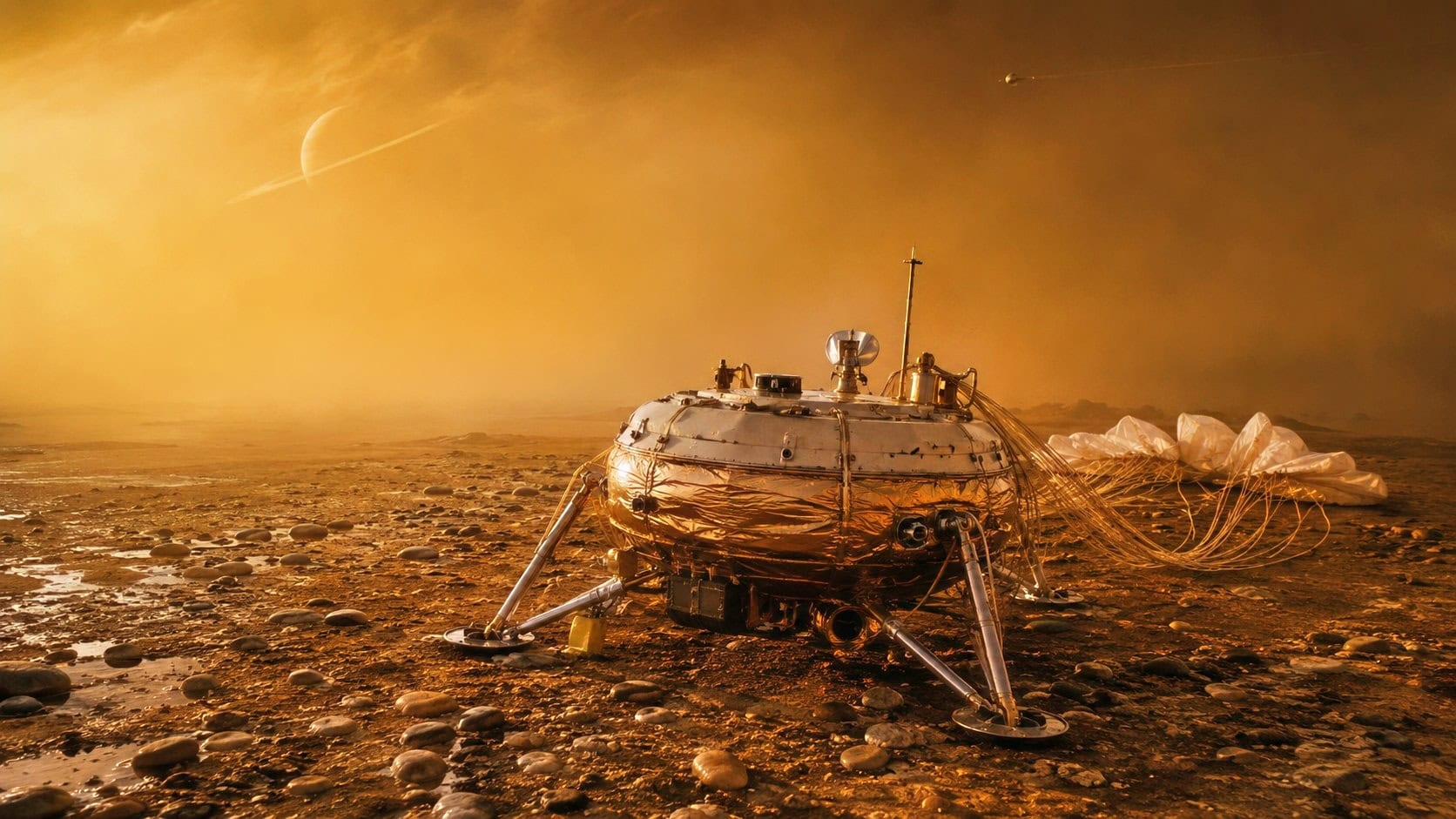
In January 2005, a European-built probe named Huygens parachuted through the thick orange haze of Titan, Saturn’s largest moon, and settled onto a frozen plain scattered with rounded ice pebbles, more than a billion kilometers from Earth. It remains the most distant landing humanity has ever made, and the only time any spacecraft has touched the surface of a world in the outer solar system. More than twenty years later, nothing has come close to repeating it. And it nearly gave up half of what it came for. Huygens sent its data home on two redundant radio channels, the whole point of two being that if one failed, the other would save the mission. But the command to switch on the receiver for one of those channels, Channel A, was never loaded into the Cassini orbiter overhead. So Cassini never listened to that channel. Roughly half the descent images, about 350 of an expected 700, and the entire onboard experiment built to measure Titan’s winds, were simply never caught. The redundancy intended to guarantee data integrity was defeated because the backup was switched off.
The Only Landing In The Outer Solar System
Titan Landing NASA Photo Handout
Huygens landed on Titan on January 14, 2005, and that landing is a record that still stands alone. According to NASA, it was the most distant landing from Earth ever made, and the first by any spacecraft in the outer solar system.
Everything humanity has sent beyond Mars since then has studied its targets from orbit or during flybys. Nothing has touched a surface out there again. More than two decades on, Huygens remains the only spacecraft ever to land on a world in the outer solar system, and its photographs are still the only images ever taken from the surface of Titan. It was a one-shot fall through an alien sky a billion kilometers away, and it has never been repeated.
A Lander Built To Float
Huygens was the lander half of Cassini-Huygens, a joint mission of NASA, the European Space Agency, and the Italian Space Agency. NASA supplied the Cassini orbiter, which launched on October 15, 1997, and ESA supplied the Huygens probe, which rode piggyback all the way to Saturn.
After the paired spacecraft reached Saturn in 2004, Cassini released Huygens on December 25, 2004, and the probe then coasted silently and unpowered for about three weeks before hitting the top of Titan’s atmosphere. Cassini’s job was to fly overhead, catch the probe’s transmissions, and relay them back to Earth, because at that distance it was the only spacecraft close enough to hear Huygens at all.
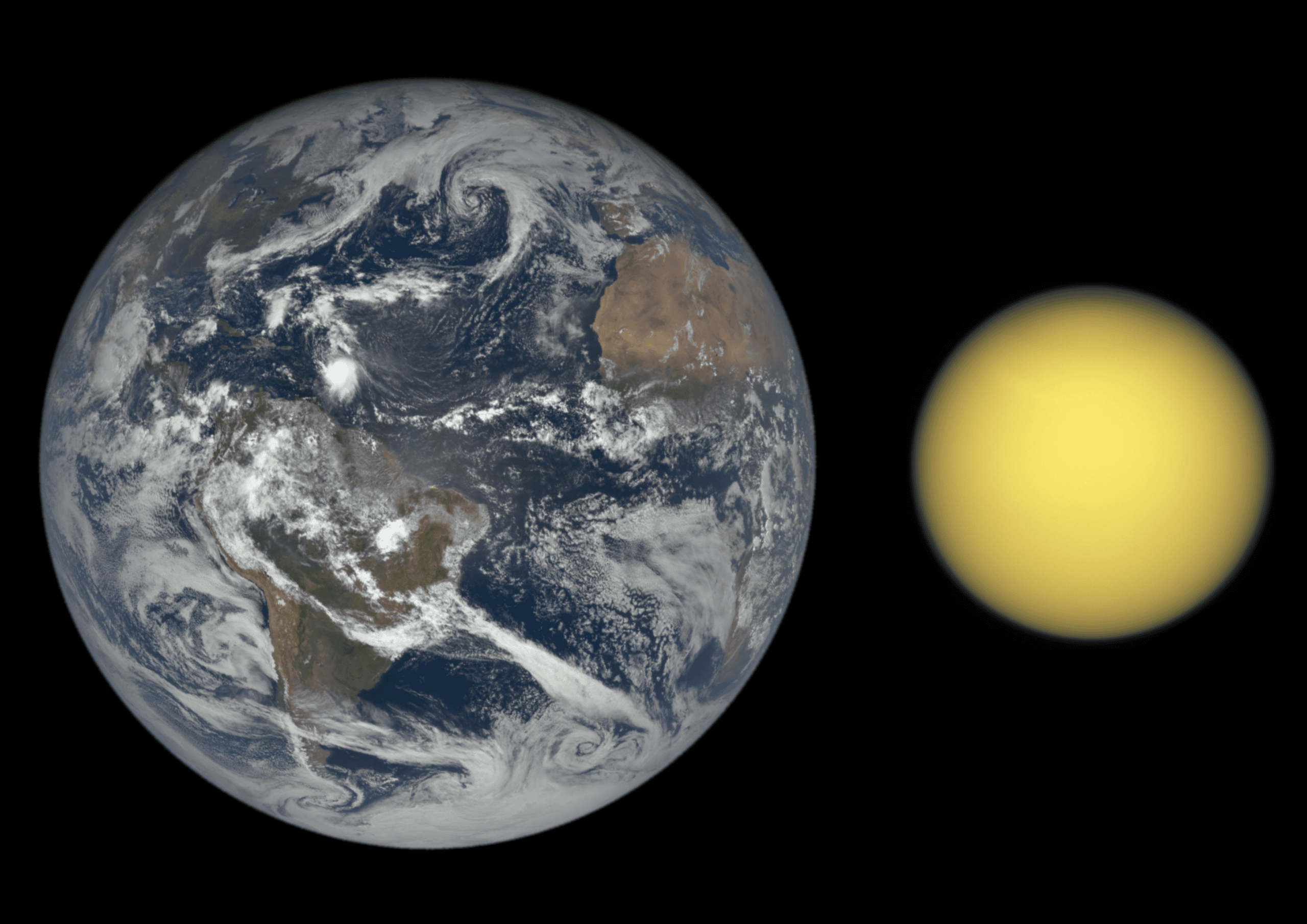
Earth image derived from DSCOVR/EPIC. Titan image derived from Cassini spacecraft narrow-angle camera (NAC). The relative sizes are calibrated using the known distances to each target at the time of image acquisition and the angular resolution of the respective instruments. Titan’s apparent size includes its extended atmospheric haze.
The probe was a gamble in its basic design. Before the mission, some scientists thought Titan’s surface might be entirely covered by an ocean of liquid methane or ethane, and no one knew whether there was dry land for Huygens to set down on.
That uncertainty made the probe more of a crasher than a lander, built with a parachute and able to float, but with little cushioning and no retrorockets. It was sent to fall through an atmosphere no craft had ever sampled and take its chances on whatever lay beneath, solid ground or liquid sea.
Two And A Half Hours Through The Haze
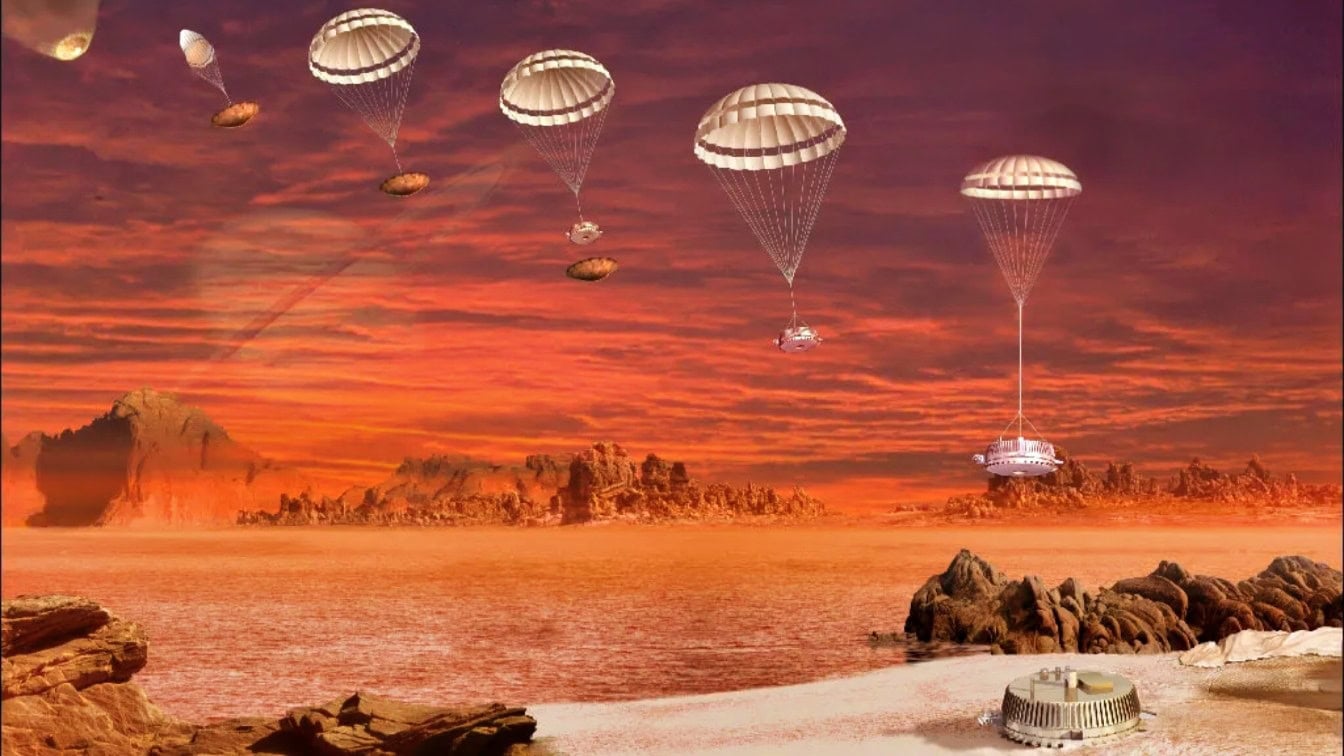
Huygens descended under parachute for about two and a half hours through Titan’s haze, in cold that fell to around minus 180 degrees Celsius, photographing as it dropped. What emerged from the murk looked unsettlingly like home.
Features resembling shorelines and river systems appeared out of the haze: drainage channels and what looked like riverbeds carved by flowing liquid, a landscape shaped by an active weather cycle. The twist is in the chemistry. On Titan, the fluid doing the carving is not water but liquid methane, and the bedrock it cuts through is water ice as hard as stone, so the place is Earth-like in its forms and wholly alien in its substance.
The probe came down on a flat plain in an equatorial region later named Adiri, and the view from the surface looked like a dried-up riverbed. It was strewn with rounded cobbles, roughly 10 to 15 centimeters across, probably composed of water ice and hydrocarbons, rounded as if tumbled by flowing liquid, resting on a darker, damp, sandy surface.
Huygens touched down at about five meters per second, settled in, and its instruments measured a sharp rise in methane after landing, a sign the soil was damp with the stuff, as if the probe had pressed into cold methane-wet sand. It kept transmitting from the surface for about another 72 minutes, until Cassini moved below Titan’s horizon and the relay link went quiet.
The Command That Was Never Sent
Huygens broadcast everything on two parallel radio channels, A and B, so that a failure on one would not cause data loss on the other. The protection failed in the simplest possible way.
The receiver for Channel A aboard Cassini was never able to lock on to the probe’s signal because the instruction to configure it had not been programmed into the critical relay sequence loaded onto the orbiter. The receiver was simply never switched on, so every bit of data carried on Channel A was lost. ESA, which built and ran the probe, acknowledged that the error was its responsibility.
The cost was higher than a simple duplication would have been, because of a choice the team had made. With two working channels, they could either send the same images twice for pure backup or send different images on each channel to double the total number of pictures. They chose to take two sets of pictures to maximize the haul, so the images were not duplicated across the channels.
When Channel A went unheard, the unique pictures it carried were gone, about 350 of an expected 700 descent images lost for good, leaving holes in the panoramas the team later stitched together. Channel A had also carried the entire onboard record of the Doppler Wind Experiment, the instrument designed to measure Titan’s winds by tracking the tiny frequency shifts in the probe’s radio signal, and that too was lost.
The Clever Fix And The Trivial Miss
What makes the failure sting is that the mission had already survived a far harder communications problem with a brilliant piece of engineering. Years before the landing, in flight, controllers discovered a genuine design flaw in the way Cassini’s receiver handled Doppler shifting of the incoming signal.
As Huygens fell and its velocity changed, the frequency of its transmission would shift enough to fall outside the receiver’s processing range, rendering the probe’s entire data stream nonsense.
The fix was elaborate and ingenious. Engineers rerouted Cassini through extra flybys of Titan to slow it down and release Huygens on a gentler trajectory that minimized the Doppler shift, and had the probe warm up earlier than planned, spending precious fuel and battery to make the geometry work. They solved the hard, subtle problem that threatened everything, and then lost half the data anyway to a single command that nobody loaded.
Earth Was Listening
The mission had one piece of luck waiting in reserve. Across more than a billion kilometers between Titan and Earth, a global network of telescopes, 18 primary radio dishes in Australia, China, Japan, the United States, and Europe, had been listening directly for Huygens’ faint carrier signal.
They could not decode the full science stream the way Cassini could, but the carrier tone was exactly what the wind experiment needed, since the wind data lived in the subtle shifts of that frequency.
By recording the Channel A signal from the ground at observatories such as Parkes and Green Bank, scientists salvaged the entire experiment, reconstructing the wind measurements the orbiter had failed to capture. As one Jet Propulsion Laboratory scientist, Sami Asmar, put it, sometimes it pays to eavesdrop. The wind science came back. The images on Channel A did not, and half of the descent gallery is gone forever.
Enough To Map A World, And A Return Coming
Despite losing half the pictures and the onboard wind data, what survived was enough. The roughly 350 images that came down on Channel B, together with the readings from the probe’s other instruments, met all of the mission’s primary objectives, and they did something remarkable in the span of a few hours.
They turned Titan from a fuzzy orange ball into a fully mapped, weirdly familiar world, with rain and rivers and shorelines and a surface shaped by flowing liquid, all of it running on methane instead of water. Cassini’s later radar mapping from orbit would go on to find the great seas and lakes of liquid hydrocarbons near Titan’s poles, confirming that the cycle Huygens glimpsed at its landing site played out across the whole moon.
Huygens belongs to a small, frustrating club of missions undone in part by tiny, ordinary mistakes rather than the violence of space.
NASA’s Mars Climate Orbiter was lost in 1999 because two teams used different units of measurement, and Huygens gave up half its data because one command was never written into a sequence, the kind of error that has nothing to do with the cold or the distance and everything to do with a checklist. It is also the landing half of the Cassini story, the probe that the orbiter carried to Saturn before Cassini itself was deliberately flown into the planet in 2017.
The one surface humanity has touched in the outer solar system is finally getting a second visit. NASA approved a mission called Dragonfly in 2024, an eight-bladed rotorcraft that will fly from place to place across Titan rather than land at a single spot, building directly on what Cassini-Huygens revealed.
The craft is set to launch in 2028 and arrive at Titan around 2034, where it will hunt for the chemistry that precedes life on the same kind of organic-rich terrain Huygens first photographed. When it gets there, it will become the first aircraft ever to fly under power on another moon, returning to the one distant surface a single European probe reached two decades earlier.
That probe still holds the record. The most distant and least repeatable landing in history, a one-shot fall through an alien sky a billion kilometers away, lost half its science not to the cold or the haze but to a setting nobody turned on.
The backup was switched off, and the only landing humanity has ever made in the outer solar system came home with half its eyes closed.
About the Author: Harry J. Kazianis
Harry J. Kazianis (@Grecianformula) was the former Senior Director of National Security Affairs at the Center for the National Interest (CFTNI), a foreign policy think tank founded by Richard Nixon based in Washington, DC. Harry has over a decade of experience in think tanks and national security publishing. His ideas have been published in the NY Times, The Washington Post, The Wall Street Journal, CNN, and many other outlets worldwide. He has held positions at CSIS, the Heritage Foundation, the University of Nottingham, and several other institutions related to national security research and studies. He is the former Executive Editor of the National Interest and the Diplomat. He holds a Master’s degree focusing on international affairs from Harvard University.