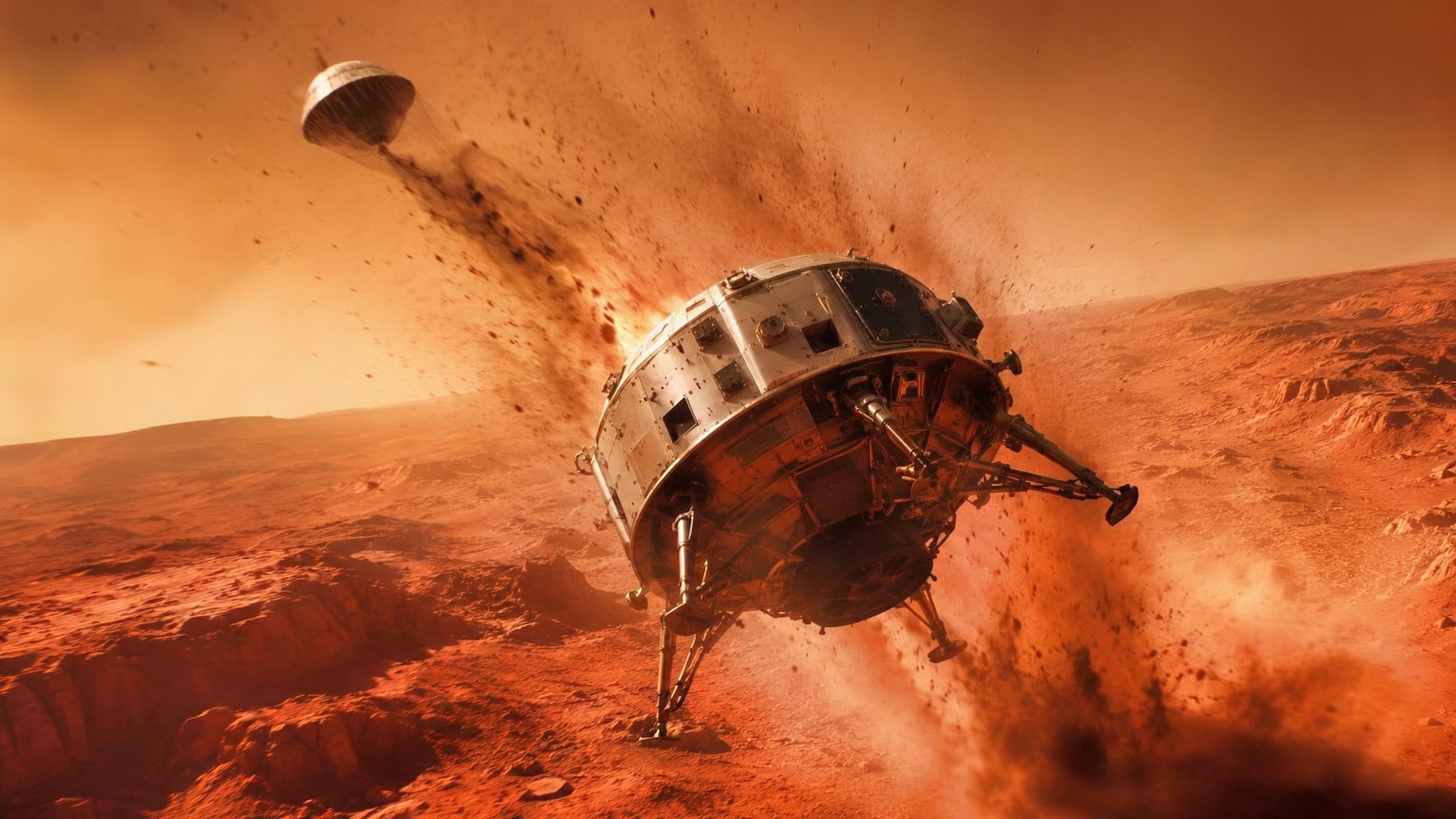
Getting to Mars is quite the achievement. That’s why every major power, not just the United States, or even an aspiring major power (like India), has tried to get to Mars.
Many have failed. Few have succeeded. For the Americans, getting unmanned systems to Mars is routine nowadays. But even for the Americans, not every mission has been a success.
Space Probe at the Smithsonian. Image Credit: 19FortyFive.com
The European Union (EU) dreamed of validating its greatness by sending a probe to Mars, just like the Americans do.
That’s where the European Space Agency (ESA) and Russia’s Roscosmos space agency come into play with their Schiaparelli Mars mission.
What Was Schiaparelli?
Schiaparelli was the Entry, Descent, and Landing Demonstrator Module (EDM) of the joint European-Russian ExoMars 2016 mission. Schiaparelli launched alongside the ExoMars Trace Gas Orbiter in March 2016.
The orbiter’s job was scientific–searching for trace gases such as methane–while Schiaparelli’s mission was primarily technological.
ESA wanted to prove it could successfully land on Mars before attempting a much larger rover mission later in the decade. The lander carried only a modest scientific payload because its primary purpose was to serve as a technology demonstrator.
Mercury Friendship 7. Image Credit: 19FortyFive.com Photo Taken on 6/24/2026 at the Smithsonian.
It needed to validate that the ESA could achieve successful hypersonic atmospheric entry, heat-shield performance, supersonic parachute deployment, radar-guided landing, throttleable retrorockets, and autonomous landing software.
But it was more than that.
The mission was as much about geopolitics as it was about technological development and scientific learning. The EU was desperate to prove it was in the big leagues of world powers (even though it was not a nation-state in the traditional sense).
If those systems on Schiaparelli had worked, Europe would have possessed an independent Mars-landing capability.
Everything Worked…Until the Last Minute
Ironically, almost the entire landing sequence succeeded. For nearly six minutes, the landing looked as though it were textbook perfect.
The system entered the atmosphere at roughly 21,000 km/hr. Schiaparelli survived the intense heating of the atmospheric entry.
The spacecraft even managed to deploy its parachute. Then, the lander safely jettisoned its front heat shield and activated its radar. What’s more, the system transmitted hundreds of megabytes of engineering data.
Apollo Lunar Module. Image Credit: 19FortyFive.com Original Photo from the Smithsonian.
But then disaster struck during its final moments.
The Fatal Error
When the parachute opened, the spacecraft began oscillating much more violently than engineers had anticipated.
Those motions saturated the inertial measurement unit (IMU), which maintained the spacecraft’s rotation.
For nearly one second, the sensor was overloaded. And that brief overload created an erroneous estimate of the lander’s orientation.
The onboard guidance computer then combined that bad attitude estimate with radar data and concluded something physically impossible: the spacecraft believed it had reached the Martian surface.
In fact, Schiaparelli was 2.3 miles above the Martian surface.
A Cascade of Bad Decisions
Once the computer believed it had landed, every remaining step was executed exactly as programmed.
The software released the parachute midflight, discarded the backshell, fired the landing thrusters for only about three seconds rather than 30 seconds, and switched into surface mode–all while 2.3 miles above the surface!
The spacecraft simply fell the remainder of the way down.
With almost no atmosphere left to slow it, Schiaparelli slammed into the surface at approximately 335 miles per hour.
NASA Found the Wreckage
Within days, NASA’s Mars Reconnaissance Orbiter photographed the landing site.
The images showed the front heat shield lying separately; the parachute and backshell were nearby; and a large, dark impact scar cut across the surface, with debris scattered around the crash site.
Investigators concluded that the lander likely struck the ground with most of its propellant still on board, possibly causing an explosion upon impact.
It wasn’t just one software bug
ESA’s investigation resisted the temptation to blame a single coding mistake. Instead, investigators identified several interacting failures.
First, engineers underestimated how violently the parachute could swing the vehicle.
Then the IMU saturation condition lasted far longer than expected. Navigation software clearly handled that saturation effect poorly.
Plus, failure-detection logic wasn’t able to recognize the impossible navigation data it had received. Lastly, systems engineering and subcontractor integration left insufficient margins for unexpected errors.
Thus, Schiaparelli failed because multiple small assumptions broke in sequence rather than because of a single catastrophic defect.
Why It Matters
At first glance, Schiaparelli was an embarrassment for Europe. In actuality, it accomplished much of what it was designed to do. It demonstrated that the ESA could conduct a mission to Mars.
And because the lander transmitted roughly 600 megabytes of descent data–far more than engineers usually receive after a crash–the Europeans were able to diagnose the failure with remarkable precision.
The hard lessons learned from the Schiaparelli crash on Mars in 2016 helped Europe redesign its systems to avoid another cascade of catastrophe on Mars.
Lessons for Future Mars Missions
Mars remains one of the hardest places in the Solar System to land.
Its atmosphere is thick enough to generate substantial heating but too thin to completely slow a spacecraft.
Every successful landing requires a carefully choreographed sequence of heat shields, parachutes, radar, computers, and rocket engines, with almost no room for error.
Schiaparelli demonstrated just how unforgiving that environment is.
A sensor saturated for roughly one second, a navigation solution drifted into an impossible state.
That software then faithfully executed its mission–but using the wrong commands and bad information. The spacecraft did exactly what its malfunctioning computer believed was correct.
The irony is that Schiaparelli’s failure strengthened Europe’s understanding of Mars landings.
By exposing weaknesses in sensor modeling, software robustness, and systems engineering, it provided lessons that informed later ExoMars development.
While the lander never became Europe’s first successful Mars touchdown, it became one of the most instructive engineering failures in planetary exploration.
About the Author: Brandon J. Weichert
Brandon J. Weichert is the Senior National Security Editor at 19FortyFive.com. He also manages The Weichert Brief on Substack. Weichert also hosts “National Security Talk” on Rumble. He is the author of four bestselling national security books, the most recent of which is A Disaster of Our Own Making: How the West Lost Ukraine (Encounter Books). Follow him via Twitter/X @WeTheBrandon.