
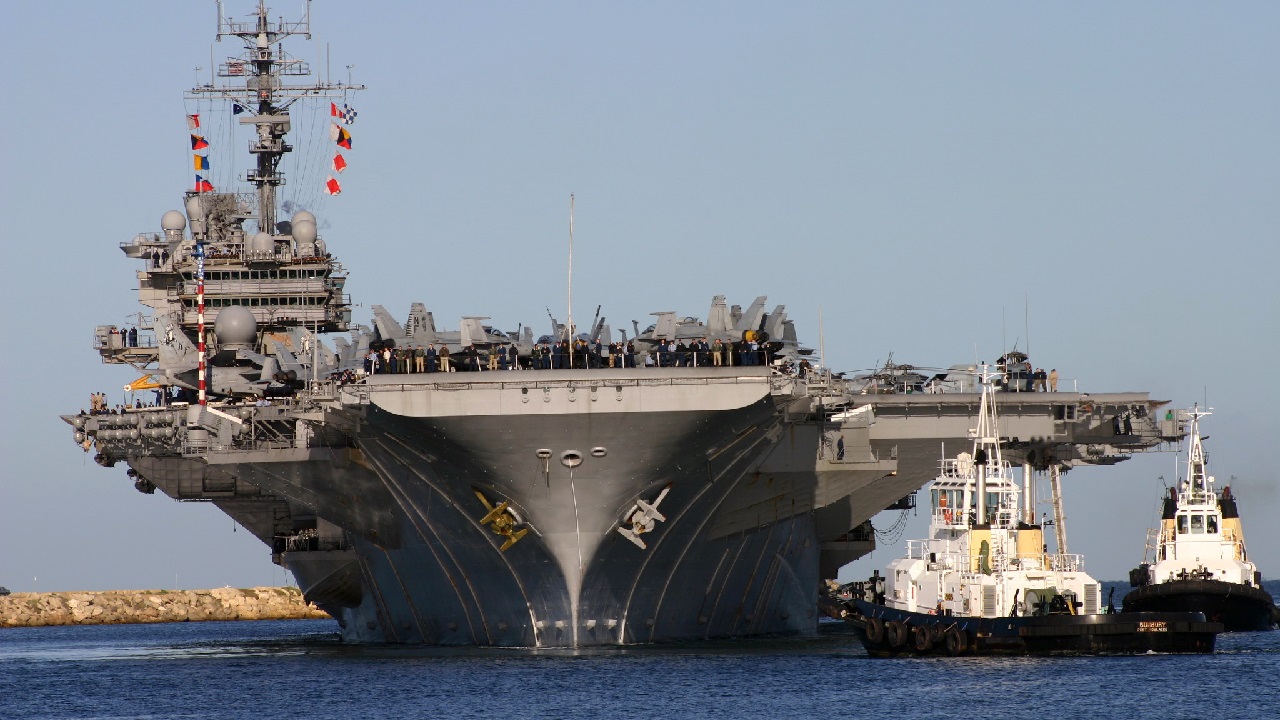
USS Kitty Hawk Perfected the Supercarrier Before Nuclear Power Took Over: Over the last twenty years or so, I have studied and written countless articles about aircraft carriers and aircraft carrier classes. And yet, the Kitty Hawk might be my favorite, for a lot of reasons. USS Kitty Hawk entered service on April 29, 1961, at a moment when the U.S. Navy was still defining what the modern aircraft carrier should become. The Forrestal class had already introduced the supercarrier concept. Nuclear power was arriving at sea with the USS Enterprise. Kitty Hawk stood between those two eras as the Navy’s mature conventional answer.
At her commissioning, Chief of Naval Operations Adm. Arleigh Burke called Kitty Hawk the “forerunner of a new and greatly improved line of carriers,” according to the Navy’s official ship history. That description was accurate. Kitty Hawk was not a small evolutionary step. She represented a refined version of the postwar supercarrier: larger, more efficient for flight operations, conventionally powered, and built to carry American naval airpower through the Cold War.
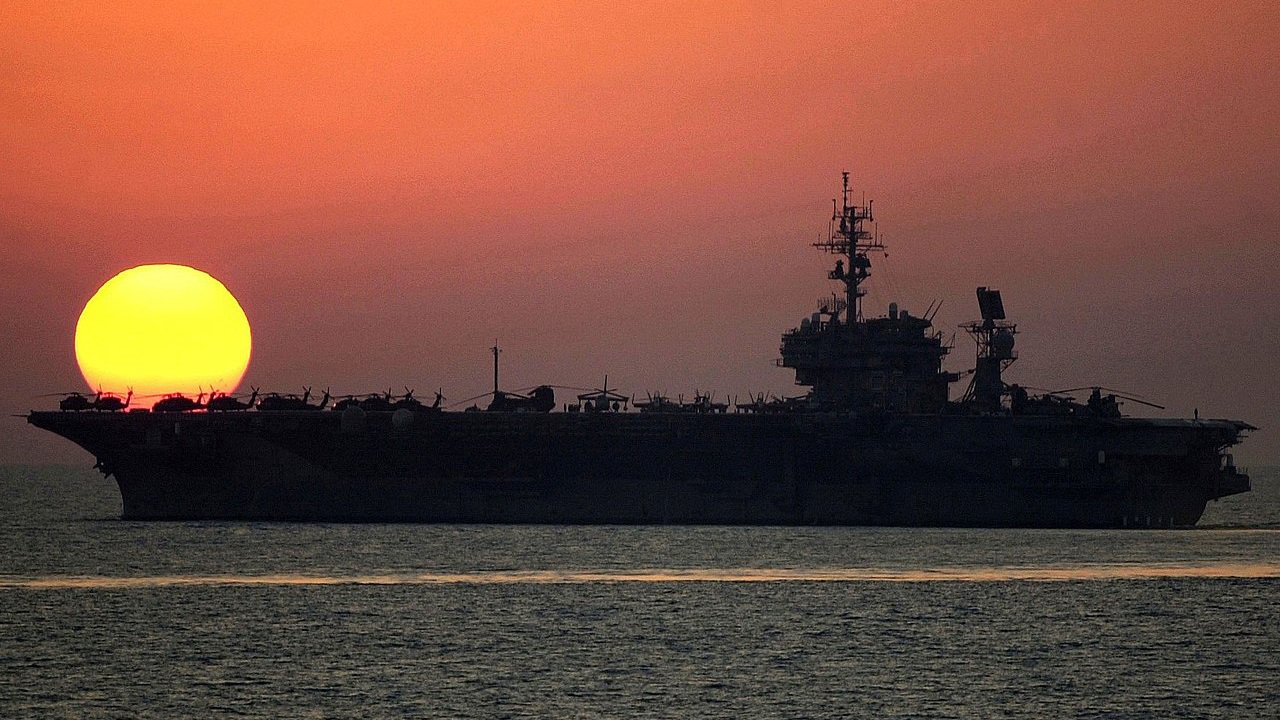
“The USS Kittyhawk (sic) underway in support of Operation Enduring Freedom-Afghanistan in 2001. 160th Special Operations Aviation Regiment helicopters are visible on the vessel’s flight deck.”
The class ultimately included Kitty Hawk, Constellation, America, and John F. Kennedy in the Navy’s own attack-carrier listing. These ships gave the Navy the last great line of conventional carriers before the Nimitz-class nuclear carrier became the long-term standard. Their story is the story of the Navy’s final oil-fired supercarrier generation.
USS Kitty Hawk Followed The Forrestal-Class Supercarrier
The Kitty Hawk class cannot be understood without Forrestal. USS Forrestal entered service in 1955 as the Navy’s first supercarrier, a ship large enough to operate the heavier jet aircraft and larger air wings that defined postwar naval aviation. The Naval History and Heritage Command identifies Forrestal as the service’s first supercarrier, and that title explains the design problem Kitty Hawk inherited.
Forrestal proved that the Navy needed larger decks, angled landing areas, steam catapults, greater aviation support capacity, and bigger ships to operate the new generation of carrier aircraft. Kitty Hawk refined that idea. The class improved flight-deck arrangement and aircraft handling while retaining conventional propulsion. That made the ships powerful and flexible without requiring the nuclear industrial base that would later dominate carrier construction.
The Navy’s attack-carrier list lists the Kitty Hawk-class ships as CVAs 63, 64, 66, and 67. The numbering itself shows where the class sat in career development. It followed Forrestal, Saratoga, Ranger, and Independence. It preceded the Nimitz class. Kitty Hawk was part of the bridge between the first supercarriers and the nuclear carrier age.
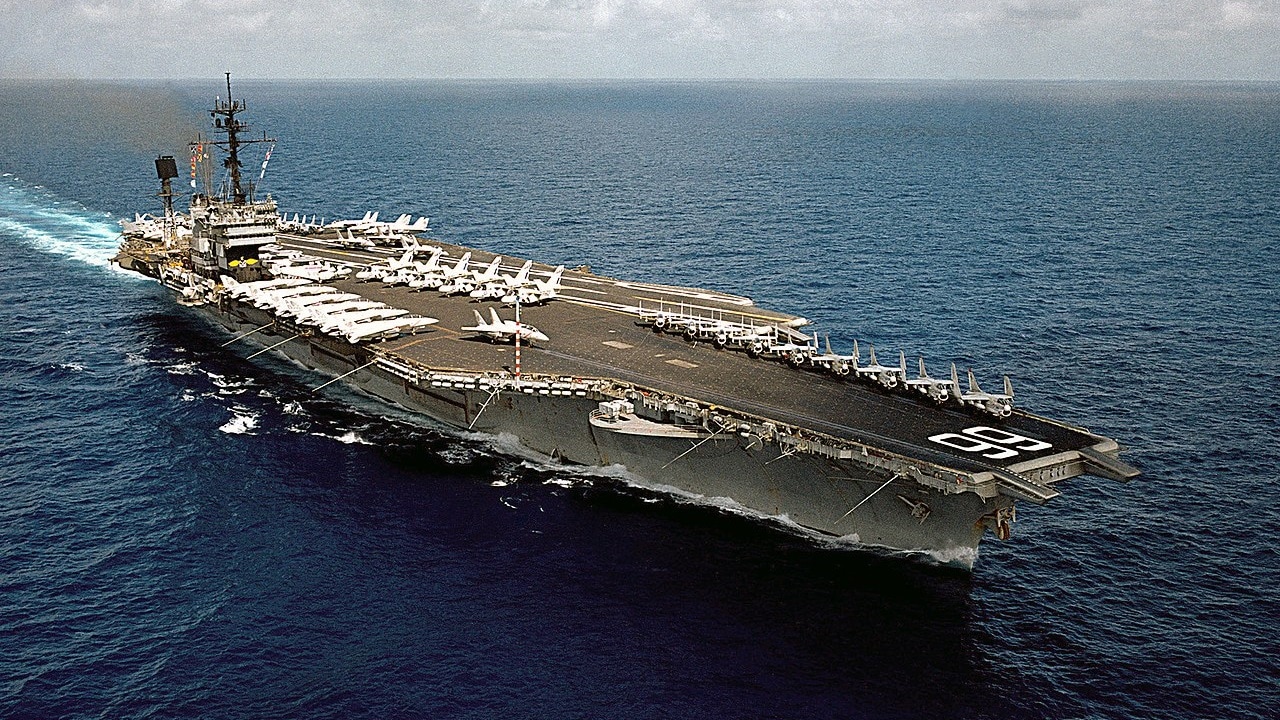
An aerial starboard bow view of the aircraft carrier USS AMERICA (CV-66) underway.
The Kitty Hawk-Class Carriers Were Built For Cold War Airpower
Kitty Hawk was built at the New York Shipbuilding Corporation in Camden, New Jersey. Constellation followed from the New York Naval Shipyard. America and John F. Kennedy came from Newport News. That industrial spread reflected a carrier-building world broader than today’s nuclear-carrier base, where only Newport News builds U.S. nuclear-powered aircraft carriers.
The ships were large conventional carriers powered by steam plants rather than nuclear reactors. That meant they depended on fuel logistics in a way nuclear carriers did not. However, it also meant the Navy could build a class of very large attack carriers without putting every hull through the nuclear-propulsion pipeline.
The class was built for the Cold War mission of sustained forward presence. Carrier aviation had become the Navy’s central instrument for crisis response, conventional deterrence, air superiority, strike operations, and power projection. Kitty Hawk-class carriers could put a large air wing near a crisis without asking for permission to use land bases. That made them valuable from Vietnam through the Persian Gulf and into the post-9/11 era.
The ships also carried the marks of their time. They were designed around jet aircraft, angled decks, large aviation fuel and ordnance demands, and the need to move aircraft efficiently across the flight deck. The carrier was no longer only a fleet scout or a strike platform. It was a mobile air base for a global Navy.
USS Kitty Hawk And USS Constellation Went To Vietnam
Vietnam gave the Kitty Hawk class its first major combat test. Kitty Hawk made repeated deployments to the Western Pacific and Vietnam. The Navy’s Vietnam deployment record lists Kitty Hawk’s first Vietnam-era deployment from Oct. 17, 1963, to July 20, 1964, with time at Yokosuka before operations connected to the conflict. The Navy’s carrier-deployment record tracks the long carrier rotation that placed ships like Kitty Hawk and Constellation on station during the air war.
Constellation’s Navy history records that her second deployment began on May 5, 1964, and that she relieved Kitty Hawk on station in the Gulf of Tonkin on June 8. That entry appears in the official Constellation history, which places the class directly inside the Navy’s Vietnam carrier campaign.
The war showed what the class was built to do. Kitty Hawk and Constellation launched strike aircraft, supported air operations over Southeast Asia, and kept American airpower operating from the sea. Their size and deck capacity mattered because Vietnam required sustained sorties, maintenance, ordnance movement, and long deployments far from the continental United States.
The class also absorbed the strain of combat operations. Aircraft carriers in Vietnam did not simply steam offshore as symbols. They generated daily flight operations under demanding conditions. The value of the Kitty Hawk design was measured in the ability to sustain those cycles over months.
USS America Showed The Class Beyond The Pacific
USS America broadened the class’s story. The third America was laid down on Jan. 1, 1961, at Newport News Shipbuilding and launched on Feb. 1, 1964, according to the Navy’s America record. She became one of the Navy’s major Atlantic and Mediterranean carriers during the Cold War.
America’s official DANFS history records a career that included Mediterranean deployments, crisis operations, and the normal rhythm of Cold War carrier presence. The ship was reclassified from attack aircraft carrier to aircraft carrier on June 30, 1975, as the Navy’s carrier designations shifted. That change appears in the official America history.
America mattered because the Kitty Hawk class was not a one-ocean design. These carriers supported a global posture. The Pacific needed carriers near Vietnam, Japan, Korea, Taiwan, and the Western Pacific. The Atlantic and Mediterranean needed carriers for NATO, the Middle East, and crisis response around Europe and North Africa.
A carrier class that works only in one theater has limited strategic value. The Kitty Hawk class worked because it could serve as part of a rotating global carrier force. That was the point of the conventional supercarrier: large enough to matter, numerous enough to support deployments, and adaptable enough to serve across decades.
USS John F. Kennedy Became The Final Conventional Supercarrier
USS John F. Kennedy is often treated separately because it differed enough to be described as a variant or its own class in some accounts. The Navy’s own attack-carrier listing includes CVA-67 under the Kitty Hawk class, and that is the most useful treatment for this broader carrier-history piece.
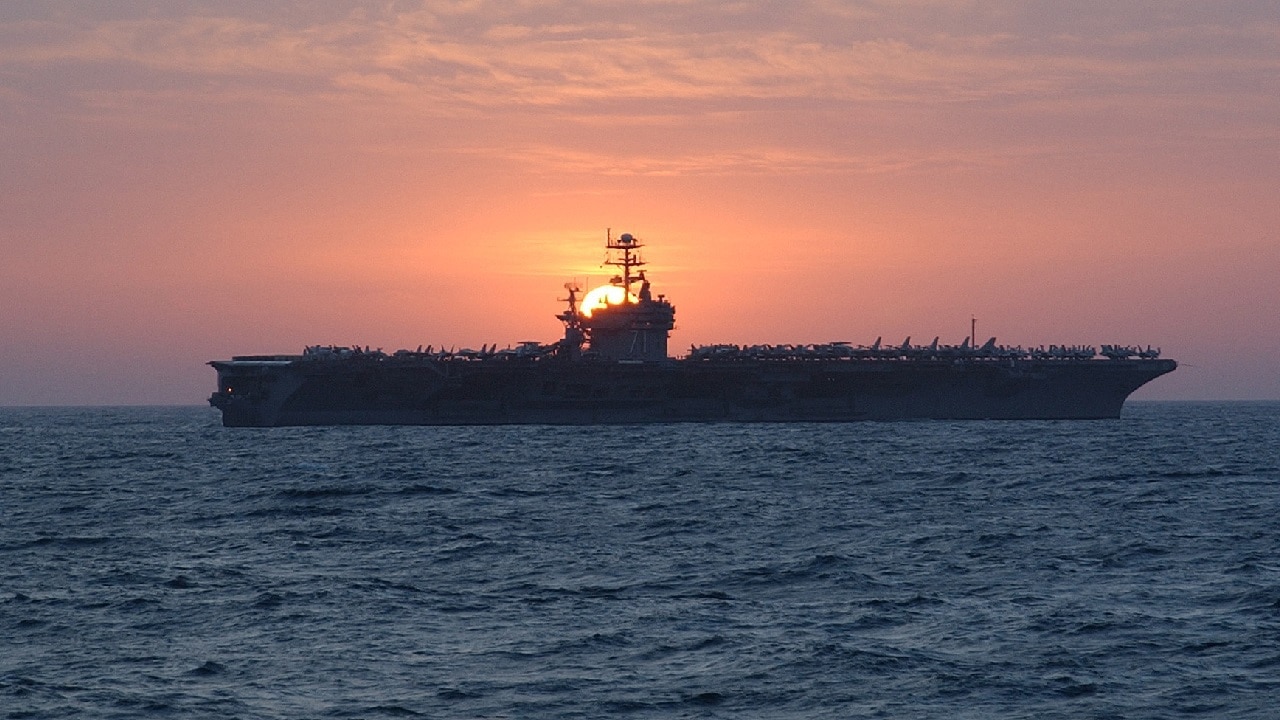
020306-N-6492H-510
At sea aboard USS John F. Kennedy (CV 67) Mar. 6, 2002 — The sun rises behind USS Theodore Roosevelt (CVN 71), as it prepares to turn over operations to the John F. Kennedy Battle Group. The Kennedy and her embarked Carrier Air Wing (CVW) are relieving the Roosevelt to conduct missions in support of Operation Enduring Freedom. U.S. Navy photo by PhotographerÕs Mate 1st Class Jim Hampshire. (RELEASED)
The first John F. Kennedy was laid down on Oct. 22, 1964, at Newport News Shipbuilding and commissioned on Sept. 7, 1968, according to her official Navy history. She became the last conventionally powered U.S. aircraft carrier, serving until decommissioning in 2007.
That status gives the class its historical closing point. Enterprise had already proved nuclear carrier propulsion. Nimitz entered service in 1975 and showed where the Navy was going. John F. Kennedy kept the conventional supercarrier line alive into the 21st century, but the future belonged to nuclear power.
The shift was not only about range. Nuclear power gave carriers endurance, electrical capacity, and operational freedom from propulsion-fuel logistics. Conventional carriers still needed fuel. They remained powerful, but they belonged to an older carrier-support model.
USS Kitty Hawk Became America’s Carrier In Japan
Kitty Hawk’s late career gave the class one of its most important strategic roles. After USS Independence left Yokosuka, Japan, Kitty Hawk became the Navy’s forward-deployed carrier there. The NHHC publication on postwar carrier deployments notes that Kitty Hawk’s final deployment concluded in San Diego, where the Navy’s last conventionally powered carrier turned over duties as the forward-deployed carrier to George Washington. That record appears in the Navy’s postwar carrier deployment history.
The Japanese role mattered because forward-deploying a carrier to Yokosuka gave the Navy faster access to crises in the Western Pacific. Kitty Hawk could operate near Korea, Taiwan, the South China Sea, and the broader Indo-Pacific without first crossing the Pacific from the West Coast. That made the ship more than a Cold War survivor. It made Kitty Hawk a working part of early 21st-century U.S. posture in Asia.
The ship also supported Operation Enduring Freedom. The Navy’s history of Enduring Freedom records Kitty Hawk returning to Yokosuka after 83 days at sea in support of the operation. That late-career deployment showed how far the carrier had come since its 1961 commissioning.
Kitty Hawk was still useful because a large-deck carrier remains useful even after newer designs appear. The Navy did not keep her in service out of sentiment. It kept her because the fleet needed deployable carrier capacity.
Nuclear Power Replaced The Kitty Hawk-Class Carrier Model
The Nimitz class changed the carrier equation. A nuclear carrier eliminated the propulsion fuel requirement and gave the Navy a broader long-term growth path. The Kitty Hawk class could do many things well, but it could not offer the same nuclear endurance.
That difference grew more important as carrier operations became more global and as air wings, sensors, communications, and ship systems became more demanding. Nuclear propulsion did not remove all logistical burdens. Carriers still need aviation fuel, ordnance, food, spare parts, and maintenance. It did remove a major propulsion constraint and gave the ship a different kind of operational flexibility.
The Kitty Hawk class, therefore, became the peak of the conventional supercarrier rather than the future of carrier design. The ships served long careers because they were well-suited to Cold War operations. They were replaced because the Navy’s future requirements favored nuclear power.
That is the class’s real place in history. Forrestal created the supercarrier model. Kitty Hawk refined the conventional version. Nimitz made nuclear propulsion the standard for America’s large-deck carrier force.
USS Kitty Hawk Closed The Book On Conventional U.S. Navy Carriers
Kitty Hawk was decommissioned in 2009 after 48 years of service. USNI News reported that the former carrier arrived in Brownsville, Texas, for scrapping in 2022, after leaving Puget Sound under tow and making the long trip around South America. The report described her as one of the last conventionally powered carriers and noted her service from the Vietnam War to Operation Iraqi Freedom. That final chapter is documented in USNI’s report on Kitty Hawk’s arrival for scrapping.
John F. Kennedy later followed the same broad path. A Houston Chronicle report in 2025 said the decommissioned carrier had departed Philadelphia for dismantling in Texas after years in the inactive fleet, while noting the 2021 contract to dismantle both John F. Kennedy and Kitty Hawk. That account appeared in the paper’s report on the former carrier’s final voyage.
Those endings closed the conventional supercarrier chapter. The Navy still operates carriers, but not carriers like Kitty Hawk. The modern fleet is nuclear-powered at the large-deck carrier level, with the Nimitz and Ford classes defining U.S. naval aviation.
Kitty Hawk’s importance lies in the fact that she showed how capable the last conventional supercarrier generation could be. The class fought in Vietnam, patrolled the Mediterranean, supported operations in the Persian Gulf, deployed from Japan, and remained relevant into the 21st century.
The Kitty Hawk class gave the Navy its final mature conventional carrier design. Nuclear power took over because the Navy wanted more endurance, more growth margin, and a different long-term operating model. The ships of the Kitty Hawk era proved how far conventional carriers could go before that change became permanent.
About the Author: Harry J. Kazianis
Harry J. Kazianis (@Grecianformula) was the former Senior Director of National Security Affairs at the Center for the National Interest (CFTNI), a foreign policy think tank founded by Richard Nixon based in Washington, DC. Harry has over a decade of experience in think tanks and national security publishing. His ideas have been published in the NY Times, The Washington Post, The Wall Street Journal, CNN, and many other outlets worldwide. He has held positions at CSIS, the Heritage Foundation, the University of Nottingham, and several other institutions related to national security research and studies. He is the former Executive Editor of the National Interest and the Diplomat. He holds a Master’s degree focusing on international affairs from Harvard University.

