
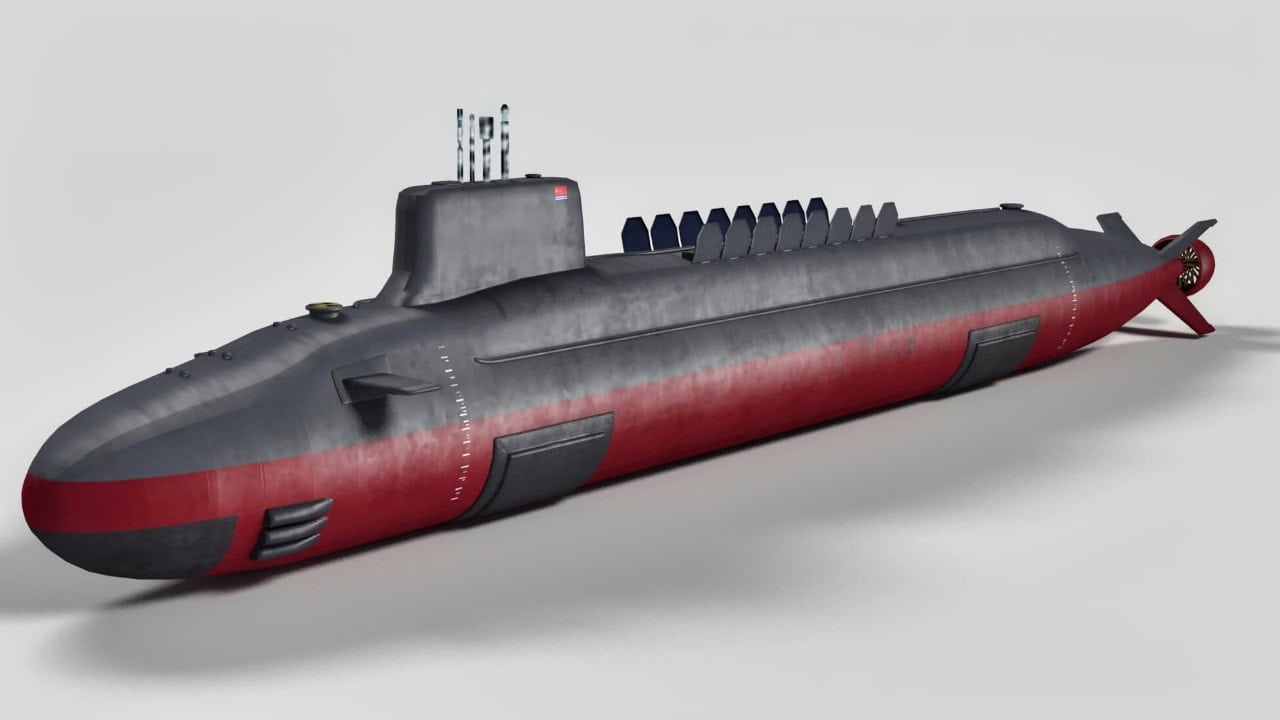
For decades, everything China wanted to do beneath the Pacific ran through a single facility, the Bohai shipyard at Huludao in Liaoning province. That constraint has now been removed. In late May and early June, commercial satellite imagery showed a roughly 120-meter submarine with an unusually small sail at a fitting-out basin at Jiangnan Shipyard in Shanghai, a yard known for destroyers and aircraft carriers, never before for nuclear boats. Naval News assessed it as the first nuclear-powered submarine launched at Jiangnan, an as-yet-unnamed attack submarine class, with an identical hull launched at Huludao just days apart. Wuchang Shipyard in Wuhan, the third leg, is building the small Type 041 Zhou-class. Three yards are now producing nuclear-powered submarines for the People’s Liberation Army Navy, and that industrial fact will shape the undersea balance longer than any single boat.
How Fast China Is Building Nuclear Submarines: The IISS Numbers are Industrial Powerhouse Stuff
The pace was documented in February by the International Institute for Strategic Studies in an analysis titled “Boomtime at Bohai.” Between 2021 and 2025, China launched 10 nuclear-powered submarines totaling roughly 79,000 tonnes. The United States launched seven boats totaling about 55,500 tonnes in the same window. That is a reversal of the preceding five years, when China launched three submarines to America’s seven, and a sharper break with the decade before that, when Chinese yards produced seven nuclear boats in total.
The output includes the seventh and eighth Type 094 ballistic missile submarines, launched in 2024 and 2025 by IISS’s imagery-based accounting, and a production run of Type 093B guided-missile attack boats that began in 2022 and now stands at eight or nine hulls, depending on the count, a sustained rate of roughly two per year. In both 2024 and 2025, China launched one ballistic missile submarine and two attack boats, a one-plus-two annual rhythm that matches the target the US Navy’s own shipbuilding plan hopes to reach by 2028.
In February of this year, imagery at Huludao showed fitting-out activity consistent with the first Type 095, the next-generation attack submarine, with the Type 096 ballistic missile boat expected to follow from the same design lineage.
The enabling investment came earlier: a second submarine construction hall and supporting facilities added at Huludao between 2019 and 2022, before Wuchang and Jiangnan joined at all.
Is China’s Nuclear Submarine Fleet 12 Boats or 32? Both Counts Are True
The figure circulating most widely puts China’s active nuclear submarine force at more than 30 boats, second only to the United States and ahead of Russia. The official baseline is far smaller.
IISS’s Military Balance 2025 counted 12 operational Chinese nuclear-powered submarines as of early last year, six ballistic missile boats, and six attack or guided-missile boats, compared with 65 in the US fleet.
The two numbers are measuring different things. The larger counts include hulls that have been launched but are still working through outfitting, sea trials, and crew certification, above all, the 093B run of the past four years.
A launch is the moment a completed hull first takes to the water, not the moment a submarine becomes a usable weapon.
The honest reading favors neither complacency nor panic. The operational fleet today remains a fraction of America’s, and the gap between the two counts is, in effect, a picture of China’s pipeline: roughly ten new nuclear boats moving from launch toward service at once. On the conservative count, the pace still holds, because every one of those hulls exists and the yards that built them are still running.
Why Beijing Is Doing It: Anti-Ship Missiles Now, a Survivable Deterrent Next
The loadout choices explain the strategy. The 093B carries a 12-cell vertical launch system, and IISS assesses that those cells will initially be fitted with the high-speed anti-ship missiles China displayed at its September 2025 Victory Day parade, rather than land-attack weapons of the kind American submarines carry.
That is a fleet built to fight the US Navy in the Western Pacific, to hold carriers and surface groups at risk in a Taiwan contingency, not to strike distant shores. The ballistic missile force serves as the other half of the design.
The Type 094s operate from protected waters near Hainan Island, and the JL-3 missile extends their reach far enough that they no longer need to transit deep into the Pacific to hold meaningful targets at risk, the foundation of a survivable second-strike capability that the planned Type 096 is meant to complete.
Even the Wuchang line fits the pattern of breadth: its Type 041, a small nuclear-powered design, sank pierside in 2024 during construction, as the Wall Street Journal first reported, and has yet to become operational, but the class signals experimentation across hull sizes and roles rather than a single-track program.
The Catch: Quality, Quieting, and America’s Own Shipyard Problem
The buildup has real limits, and the same sources documenting the pace are the ones flagging them.
IISS notes that Chinese designs “almost certainly lag behind US and European boats in terms of quality,” that American submarines are significantly larger and more complex to build, and that noise, not numbers, may be the tighter constraint on Chinese deterrent patrols, citing US Office of Naval Intelligence assessments that the 093 and 094 run louder than late Cold War Soviet designs.
A Naval War College China Maritime Studies Institute report on the submarine industrial base found that the same three-yard system still exhibits “surprising weaknesses” in propulsion and quieting technologies.
The American side of the ledger is what turns a manageable gap into a strategic problem. Congressional Research Service projections show the US attack submarine force dipping to 47 boats by 2030 as Los Angeles-class hulls retire faster than Virginias arrive, with a return to 50 not expected until 2032. Navy Secretary John Phelan put the production picture bluntly to lawmakers last summer: “All of our programs are a mess.”
As of July 1, the unnamed boat sits at Jiangnan’s fitting-out basin, the first Type 095 is being finished at Huludao, and steel is being cut for nuclear submarines at three Chinese yards against America’s strained two.
The crossover in operational fleets has not happened, and on the count that matters most, boats ready to fight, America’s lead remains wide. What now exists on the Chinese side, running at full tempo across three yards, is the industrial base built to close it.
About the Author: Harry J. Kazianis
Harry J. Kazianis (@Grecianformula) was the former Senior Director of National Security Affairs at the Center for the National Interest (CFTNI), a foreign policy think tank founded by Richard Nixon based in Washington, DC. Harry has over a decade of experience in think tanks and national security publishing. His ideas have been published in the NY Times, The Washington Post, The Wall Street Journal, CNN, and many other outlets worldwide. He has held positions at CSIS, the Heritage Foundation, the University of Nottingham, and several other institutions related to national security research and studies. He is the former Executive Editor of the National Interest and the Diplomat. He holds a Master’s degree focusing on international affairs from Harvard University.

