

Summary and Key Points: The U.S. Air Force just compressed a weapons program that normally takes the better part of a decade into a matter of months, fielding a cheap, mass-producible cruise missile called Rusty Dagger through a crash effort built around a single wartime purpose. That purpose was not, at first, American. The Extended Range Attack Munition program was launched primarily to arm Ukraine with affordable long-range strike weapons more quickly than any conventional acquisition process could manage. It is a striking demonstration of how fast the American defense enterprise can move when it decides speed matters more than process, and of how the war in Ukraine is rewriting the way the Pentagon buys weapons.
Rusty Dagger Means Business:
The headline number is the timeline. The program moved from the initial contract to a live-fire demonstration with a full warhead in under 16 months, with the decisive test conducted at Eglin Air Force Base in Florida on January 21, 2026. For comparison, the Air Force’s workhorse standoff weapon, the JASSM, took years to move from development into service, and at roughly $1.3 million per round, it is precisely the kind of exquisite, expensive munition that ERAM is meant to complement with something cheaper and more plentiful. Brigadier General Robert Lyons III, the service’s portfolio acquisition executive for weapons, said the effort represented “a new class of affordable, low-cost munitions,” and framed the milestone bluntly: moving from a contract to a live-fire demonstration in under two years proved the service could deliver cost-effective capability at the speed of relevance.
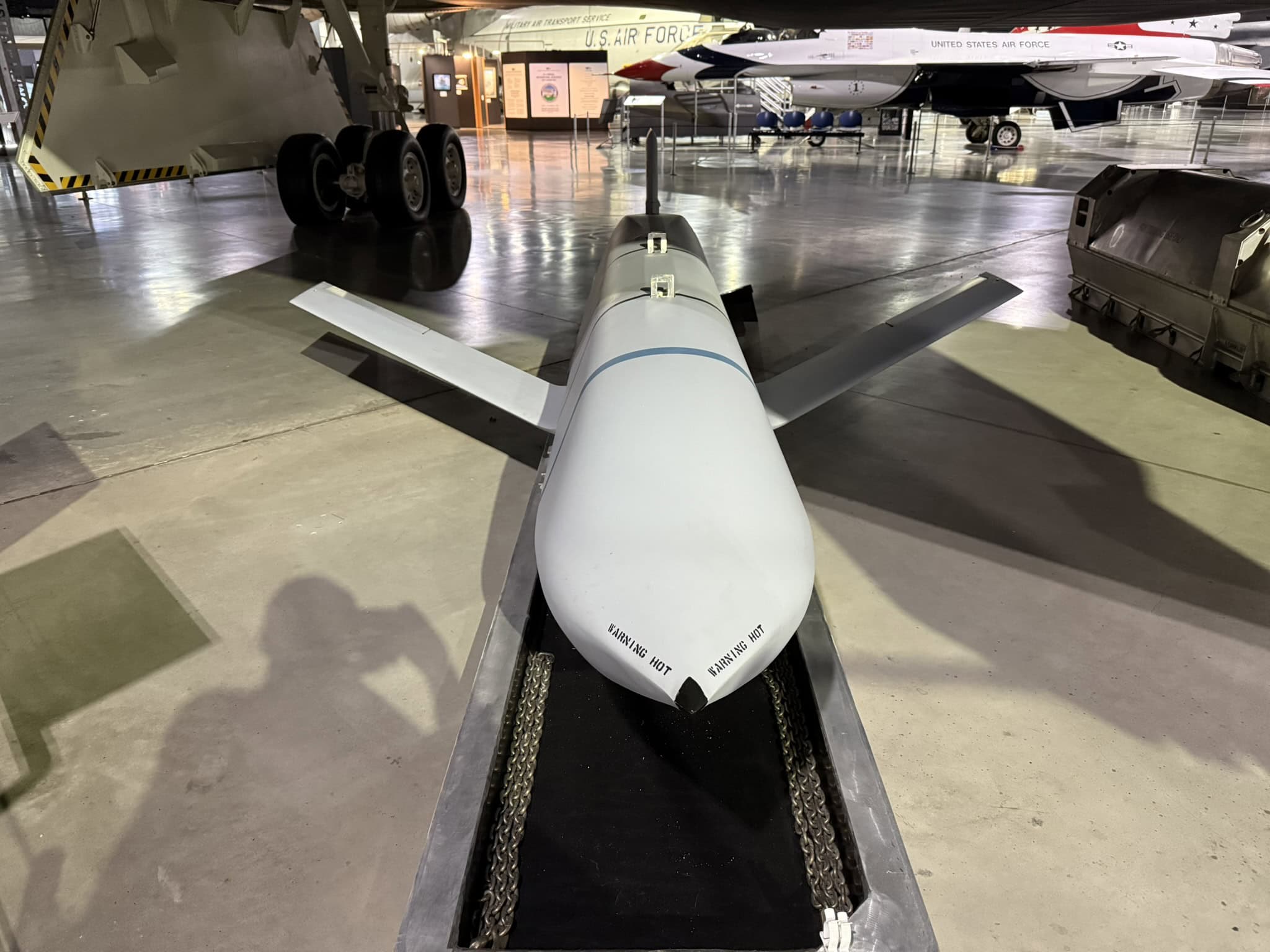
JASSM Missile. 19FortyFive Image.
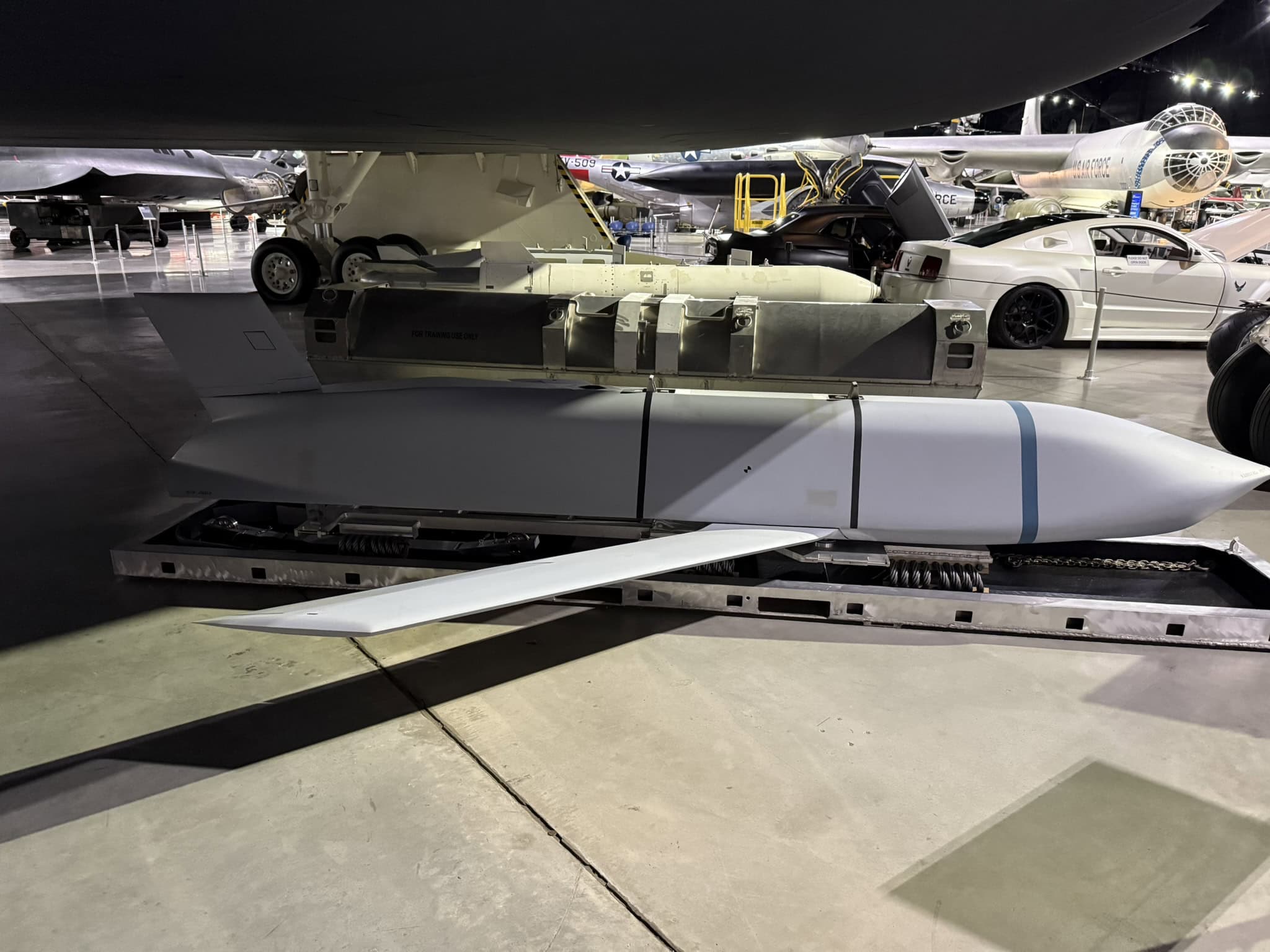
JASSM Missile. Image Credit: 19FortyFive
A Program Built for Ukraine, and a Two-Horse Race
The most important fact about ERAM is one that early coverage often blurs. This is not a single missile the Air Force built. It is a program with competing designs from non-traditional suppliers, run by the Air Force Life Cycle Management Center’s Armament Directorate on a modest budget, and its origin was explicitly foreign-facing. The program was launched to arm Ukrainian jets with simple, scalable, jam-resistant cruise missiles, throwing affordable air-launched mass against Russia at a fraction of the cost of existing weapons. The Air Force said as much when it first described the effort in 2024.
Two companies won contracts to build prototypes: Zone 5 Technologies, whose entry is the Rusty Dagger, carrying the designation AGM-188A, and CoAspire, whose design is the Rapidly Adaptable Affordable Cruise Missile, or RAACM. Both were tapped to develop competing prototypes, and the Air Force has been careful in its public statements to refer to the weapon by program name rather than confirming a single winner. When the service announced the live-fire test, its own statement did not name Rusty Dagger; the manufacturer confirmed its role afterward on social media, and the weapon was identifiable in the released photos. That reticence is itself a tell about how fast and how quietly this program has moved.
The Rusty Dagger Design: Cheap by Deliberate Constraint
What makes Rusty Dagger inexpensive is a design discipline built in from the start. The missile fits within the size and weight envelope of a standard 500-pound Mark 82 bomb, which means any aircraft already cleared to carry that ubiquitous bomb can potentially carry the missile without significant modification to the weapon station. It is turbojet-powered for sustained high-subsonic flight, and by reported figures, it weighs only about 200 kilograms, including a roughly 45-kilogram warhead. That warhead sounds small until you recall that many of the Shahed drones Russia launches at Ukrainian cities carry a comparable charge and still inflict serious damage.
On range, the picture is worth stating carefully, because the sources diverge. The Air Force’s own program requirement called for a reach in the 150-to-280-mile band, but the Rusty Dagger is reported by defense-tracking outlets to substantially exceed that range, at more than 930 kilometers, which would be more than double the baseline requirement. Guidance combines inertial navigation with GPS, backed by an eight-element controlled-reception-pattern antenna designed to resist jamming, and the missile is advertised with an autonomous visual-navigation mode that lets it keep working in environments where satellite signals are contested, the electronic-warfare-saturated skies over Ukraine being the obvious design case.
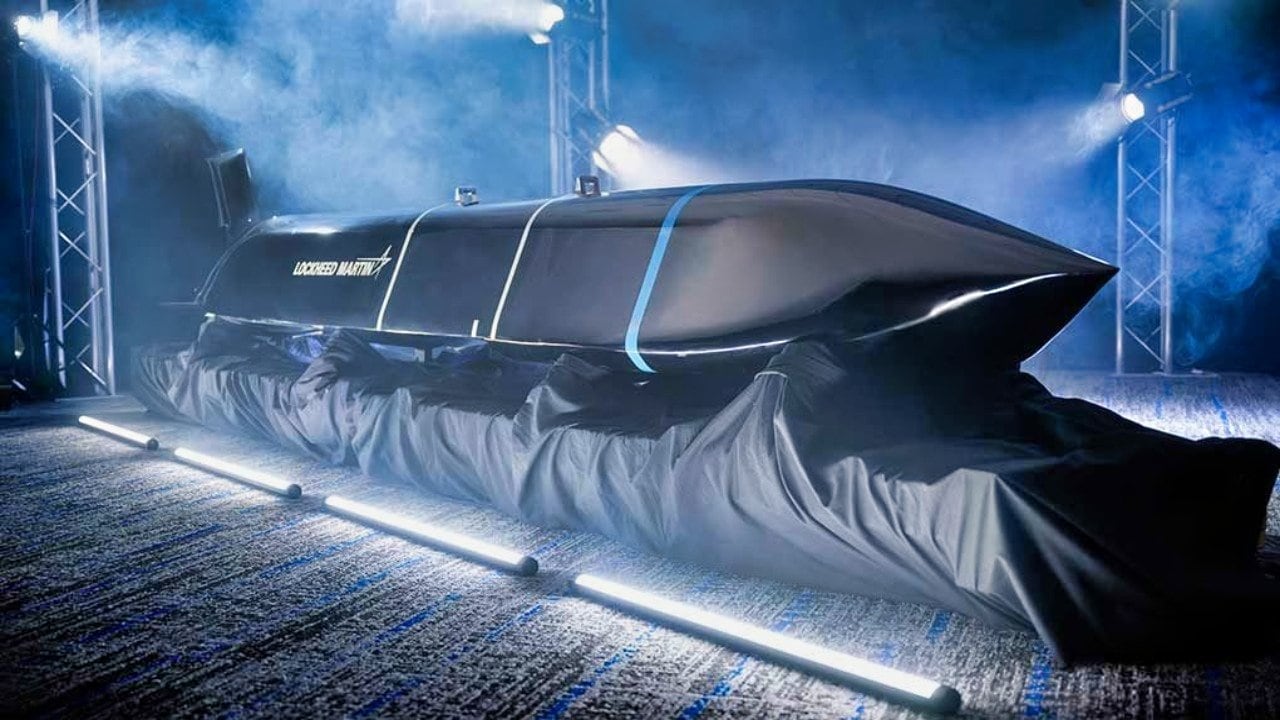
JASSM XR. Image Credit: Lockheed Martin.
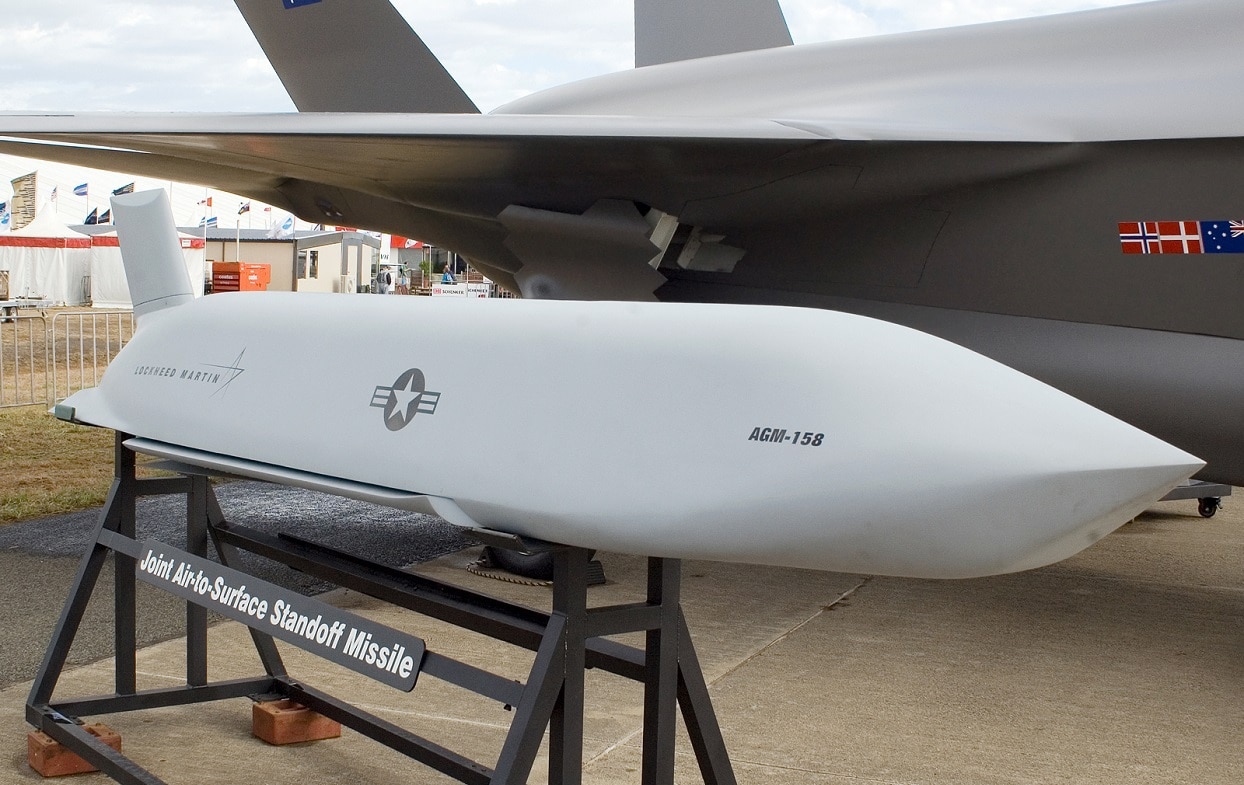
Image: Creative Commons.
The payoff of the Mark 82 form factor is a saturation-attack arithmetic that conventional expensive missiles cannot match. Because the weapon is so compact and widely carriable, a single squadron of 12 F-16 fighters could theoretically launch as many as 144 of these missiles in one sortie, the kind of volume that overwhelms a defender’s ability to track and engage every incoming threat. This is what “affordable mass” means in practice, and it is the whole point of the program.
The Sprint That Shows the Culture Shift
Nothing illustrates the compressed pace better than a single test episode this year. When the 96th Test Wing at Eglin needed structural loads data to confirm that an F-16 could safely carry the new weapon, it sent an urgent request to the Arnold Engineering Development Complex in Tennessee, and the response became a case study in wartime tempo. Engineers there needed a physical wind-tunnel test model built in under 48 hours, so they launched three manufacturing paths at once: an in-house model shop, a contracted local business, and 3D-printed metal articles produced with the Army’s aviation and missile center at Redstone Arsenal, so that no single point of failure could stop the clock.
All three paths delivered a usable model within two days. Air-on wind-tunnel testing began just 46 hours after the request; the team recovered from a mid-test cooling-system water leak in under four hours without missing its deadline, and quick-look data reached Eglin only 67 hours after the request first landed. Lieutenant Colonel Joe Sabat, who led the squadron involved, returned repeatedly to a single word, unprecedented, and credited more than 180 people across the complex and the surrounding community. A veteran engineer noted he had seen only one comparable sprint in 45 years of testing, a Desert Storm-era effort that still ran far slower than this one. The March integration tests that followed put two Rusty Daggers on an F-16D alongside its air-to-air missiles and targeting pod, validating that the jet could carry and release the weapon.
The Demand Signal, and a Word of Caution
The urgency is not abstract. American and allied stockpiles of standoff munitions have been drawn down hard, and the drive for cheap, mass-producible weapons reflects a hard lesson driven home by five weeks of intensive air operations over Iran that consumed precision munitions faster than industry can replace them: precision missiles work brilliantly and cost too much to replace at the rate modern combat consumes them. Russia has reached the same conclusion from the other side, fielding its own cheaper, smaller air-launched cruise missiles like the Banderol to sustain strike volume without burning through expensive rounds. The entire munitions economy is bending toward volume, and both sides in Ukraine are racing to get there first, even as America simultaneously worries about whether its interceptor and missile inventories are deep enough for a Pacific fight.
One claim demands caution. Reports circulated that Ukraine used Rusty Dagger in a June 22 strike on a Russian semiconductor plant in Voronezh, a claim originating with a single Russian military-affiliated channel and flagged by open-source trackers on the strength of recovered debris said to include the missile’s distinctive antenna. Neither Kyiv nor Washington has confirmed it, and the channel making the claim has an interest in attributing strikes to American-supplied weapons. It should be treated as unverified. What is not in dispute is that Ukraine is cleared to buy these missiles in bulk, with public reporting placing the approved sale in the range of several thousand rounds worth on the order of $825 to $850 million, funded largely by European allies, with first deliveries expected later this year.
That is the real measure of ERAM. Whether or not it has already seen combat, the Air Force has proven it can take a cruise missile from contract to warhead detonation in less time than many programs spend on paperwork, and it did so to put affordable, long-range firepower in the hands of a nation fighting now. The process, as much as the missile, is the weapon.
About the Author: Harry J. Kazianis
Harry J. Kazianis (@Grecianformula) was the former Senior Director of National Security Affairs at the Center for the National Interest (CFTNI), a foreign policy think tank founded by Richard Nixon based in Washington, DC. Harry has over a decade of experience in think tanks and national security publishing. His ideas have been published in the NY Times, The Washington Post, The Wall Street Journal, CNN, and many other outlets. He has held positions at CSIS, the Heritage Foundation, the University of Nottingham, and several other institutions related to national security research and studies. He is the former Executive Editor of the National Interest and the Diplomat. He holds a Master’s degree focusing on international affairs from Harvard University.

