
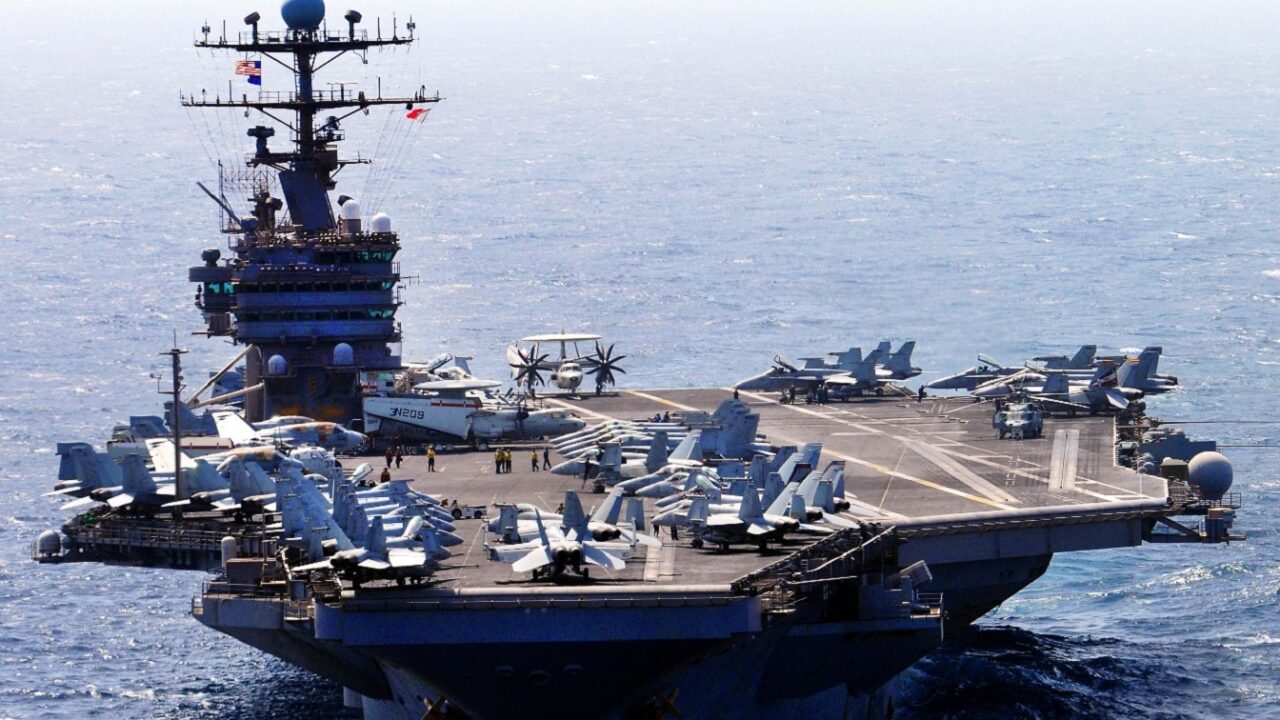
USS Nimitz Is Staying Until 2027 Because America Cannot Build or Repair Carriers Fast Enough: The Navy planned to deactivate USS Nimitz in May 2026.
It moved that date to March 2027, keeping the 51-year-old carrier in commission for another ten months while its intended replacement remains at Newport News Shipbuilding.

A U.S. Sailor observes an F/A-18E Super Hornet, attached to Strike Fighter Squadron (VFA) 151, prepare for flight operations on the flight deck of Nimitz-class aircraft carrier USS Abraham Lincoln (CVN 72) during Operation Epic Fury, March 30, 2026. (U.S. Navy photo)

An F/A-18E Super Hornet, attached to Strike Fighter Squadron (VFA) 151, launches from the flight deck of Nimitz-class aircraft carrier USS Abraham Lincoln (CVN 72) during Operation Epic Fury, March 31, 2026. (U.S. Navy photo)
The immediate problem is the future USS John F. Kennedy. The second Ford-class carrier was once scheduled for delivery in July 2025. Navy budget documents shifted delivery to March 2027 so the shipyard could finish Advanced Arresting Gear certification and additional work on the Advanced Weapons Elevators.
Retiring Nimitz before Kennedy arrived would have reduced the fleet from 11 to 10 carriers. Federal law requires at least 11 operational aircraft carriers, while the Navy’s 2023 force-structure analysis called for 12. The legal definition includes ships temporarily unavailable for scheduled maintenance, but it does not create another flight deck when several carriers are in shipyards.
Nimitz reached its final homeport at Naval Station Norfolk on July 9. The Navy says the ship will train naval aviators during the remainder of its service. Its last deployment certified for national tasking ended in December 2025, so the extension preserves a carrier and training deck without placing Nimitz back into a normal long-term deployment cycle.
The Aircraft Carrier Fleet Has No Spare Hull
An 11-carrier inventory leaves little margin because a nuclear carrier moves through deployment, training, and maintenance phases. At least one ship is normally in a multiyear refueling overhaul, while others undergo shorter repair periods or prepare their air wings for deployment. The result is an aircraft carrier shortage even before a hull is counted in the official force.
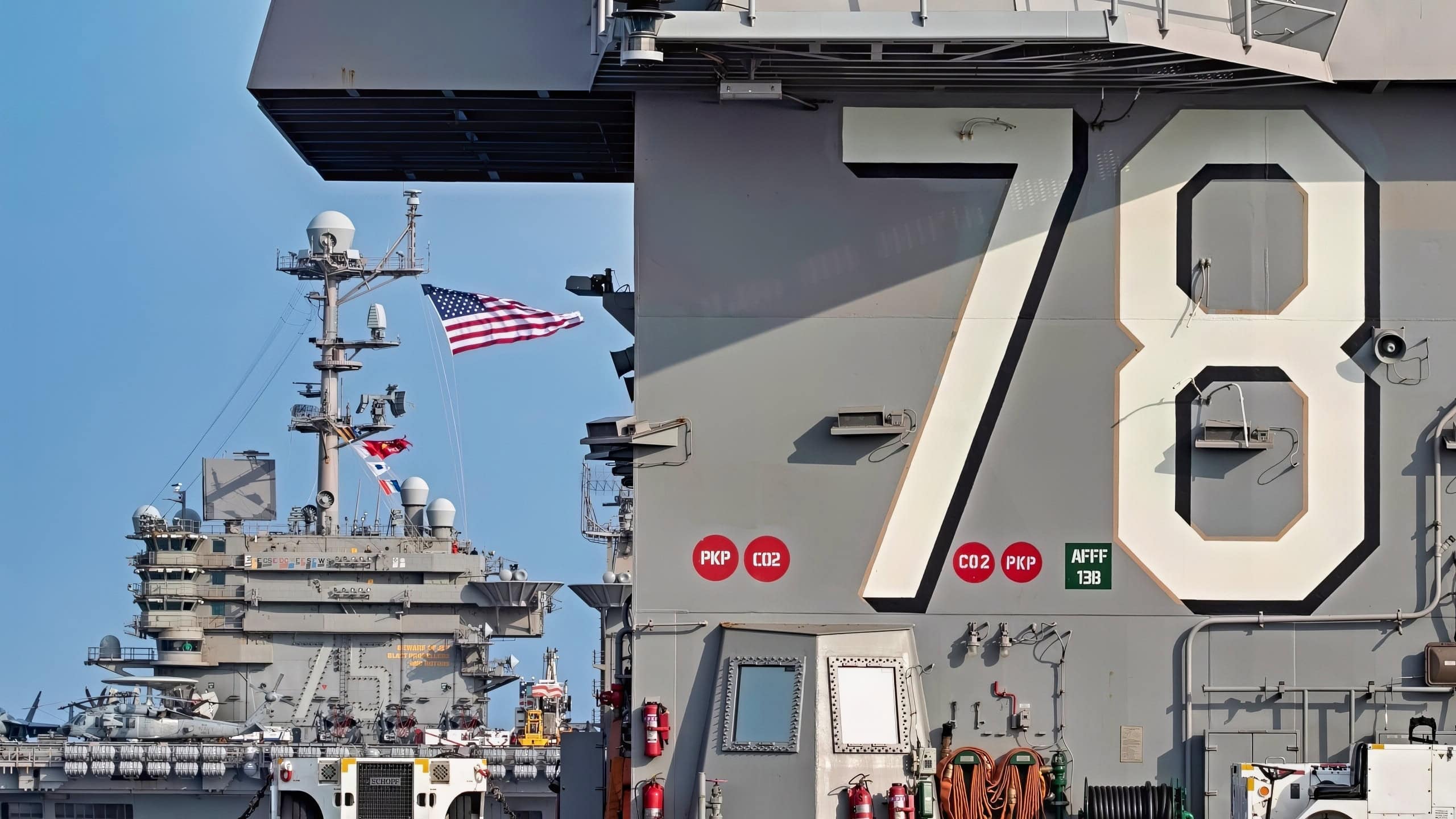
The Ford-class aircraft carrier USS Gerald R. Ford (CVN 78) and the Nimitz-class aircraft carrier USS Harry S. Truman (CVN 75) transit the Atlantic Ocean June 4, 2020, marking the first time a Ford-class and a Nimitz-class aircraft carrier have operated together underway. Ford is underway conducting integrated air wing operations, and the Harry S. Truman Carrier Strike Group remains at sea in the Atlantic as a certified carrier strike group force ready for tasking in order to protect the crew from the risks posed by COVID-19, following their successful deployment to the U.S. 5th and 6th Fleet areas of operation. (U.S. Navy photo by Mass Communication Specialist 2nd Class Ryan Seelbach)
USS John C. Stennis shows how quickly the schedule breaks down. The carrier entered its midlife Refueling and Complex Overhaul in May 2021 under a $3 billion contract. The Navy originally expected the work to finish in 2025, but the current redelivery target is October 2026. The overhaul grew to roughly five and a half years after inspections uncovered additional work and the industrial base struggled with labor and material constraints. The ship will still need trials, certification, and workups before returning to operational availability.
USS George Washington had already established the warning. Its overhaul lasted 2,120 days, nearly six years, before redelivery in May 2023. Damage discovered in a turbine generator added unplanned work to both the Washington and Stennis overhauls. A delayed repair period removes a carrier from operations far longer than the Navy’s force plans assume.
Newport News Carries Too Much of the Carrier Workload
Newport News Shipbuilding is the only American yard that builds nuclear-powered aircraft carriers and performs their midlife refueling overhauls. The same industrial system is finishing John F. Kennedy, building Enterprise and Doris Miller, completing the Stennis overhaul, and preparing for future carrier work.
The Navy also awarded Newport News $96 million for advance planning and long-lead materials before Nimitz enters inactivation. Nuclear defueling, construction, and refueling are different jobs, but they draw on a limited pool of nuclear-qualified workers, engineers, suppliers, waterfront space, and specialized facilities. The fact that one yard carries the refueling workload means a delay on one carrier occupies resources needed by the next.
The Government Accountability Office reported in March 2026 that deteriorating infrastructure, aging equipment, and maintenance backlogs have reduced the number of carriers and submarines available for training and operations. GAO has also found that private shipbuilders lack enough physical capacity and skilled workers to meet the Navy’s schedules.
Ford-Class Construction Is Not Replacing Carriers on Time
John F. Kennedy completed builder’s sea trials on February 4, 2026, but the Navy said its acceptance-trial schedule remained under review. Delivery is one step in a longer process involving certification, crew training, air-wing integration, and operational workups. A new carrier does not leave the shipyard ready for an immediate combat deployment.
The ships behind Kennedy are also slipping. Navy budget documents moved Enterprise from July 2030 to March 2031 because critical construction work needed for launch fell behind. Doris Miller moved from February 2032 to February 2034 because the shipyard lacked enough construction footprint to build its modules on the earlier schedule. The new timetable gives Doris Miller a 15-year construction period, showing why the Navy now needs more than a decade to add one carrier.
Those dates expose the larger weakness in the replacement plan. The Navy retires Nimitz-class carriers near the end of their 50-year service lives, yet Ford-class production delivers one replacement after more than a decade of construction. There is no second American yard able to assemble another nuclear carrier when Newport News falls behind.
The Nimitz Extension Buys Time Rather Than Combat Mass
Keeping Nimitz through March avoids an immediate ten-carrier fleet and leaves the Navy another deck for pilot qualifications. It also delays the point when the service loses the ship entirely. The extension does not finish Stennis, speed construction on Enterprise, or add workers to an already strained carrier maintenance system.
The aging Nimitz-class fleet remains the Navy’s daily carrier force, but older ships require more maintenance as Ford-class replacements arrive slowly. Even the country with more carriers than any other navy has little room for an overhaul or construction schedule to slip.
The timing carries another complication. Nimitz is scheduled to begin inactivation in the same month John F. Kennedy is expected to be delivered. Even an on-time delivery would transfer a new ship to the Navy before it completes the training and certification needed for deployment.
John F. Kennedy’s acceptance-trial date remained under review after its February sea trials. USS Nimitz remains scheduled for inactivation in March 2027.
About the Author: Harry J. Kazianis
Harry J. Kazianis (@Grecianformula) was the former Senior Director of National Security Affairs at the Center for the National Interest (CFTNI), a foreign policy think tank founded by Richard Nixon based in Washington, DC. Harry has over a decade of experience in think tanks and national security publishing. His ideas have been published in the NY Times, The Washington Post, The Wall Street Journal, CNN, and many other outlets worldwide. He has held positions at CSIS, the Heritage Foundation, the University of Nottingham, and several other institutions related to national security research and studies. He is the former Executive Editor of the National Interest and the Diplomat. He holds a Master’s degree focusing on international affairs from Harvard University.

