
On July 20, a China Coast Guard team in a small boat closed on Philippine sailors near Second Thomas Shoal and repeatedly struck one of them on the head with a wooden baton, leaving him injured and requiring his removal for medical treatment.
Manila says China struck first.
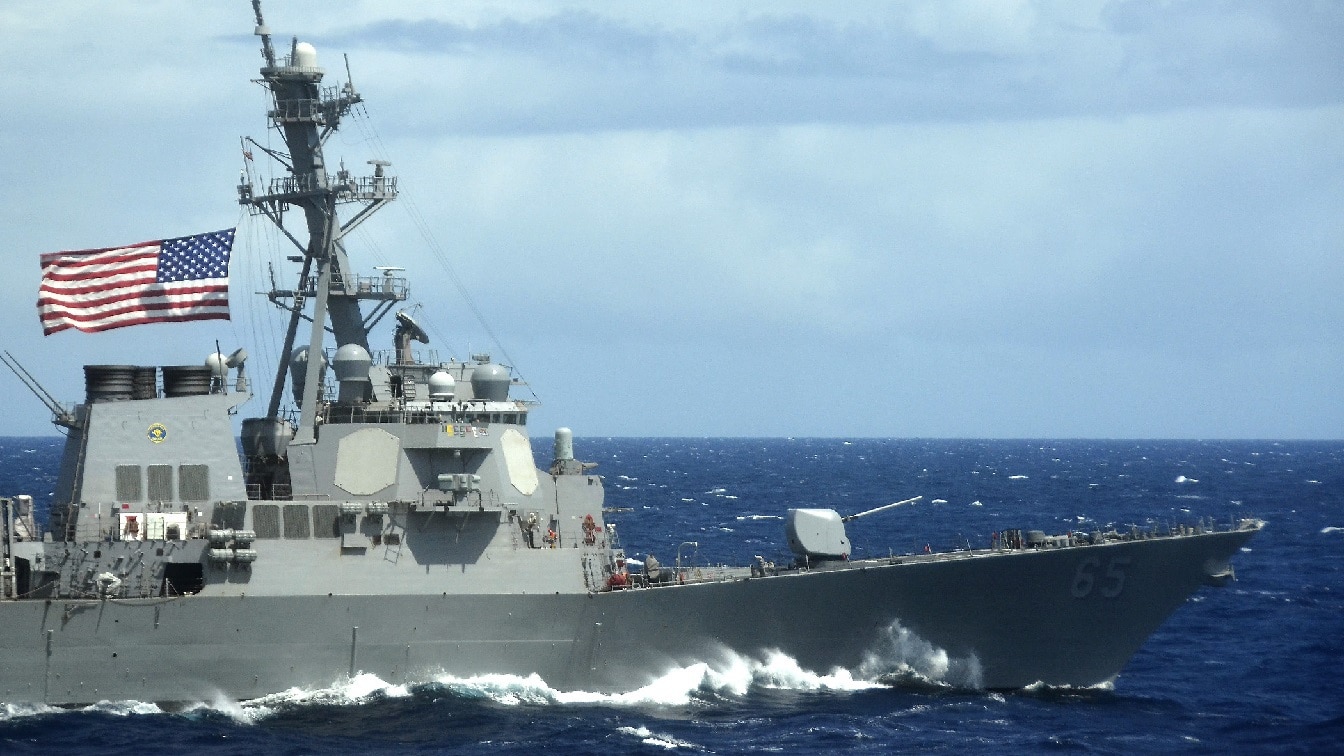
PACIFIC OCEAN (April 6, 2012) The guided-missile destroyer USS Benfold (DDG 65) flies the battle ensign during maneuvers off the coast of Kauai as part of maritime exercise Koa Kai 12-2. Koa Kai is a semiannual exercise in the waters around Hawaii designed to prepare independent deployers in multiple warfare areas and provide training in a multi-ship environment. This is the first year San Diego-based ships are also participating. (U.S. Navy photo by Mass Communication Specialist 2nd Class Daniel Barker/Released)
Beijing says Philippine personnel did. A nearby US Coast Guard vessel is reported to have helped keep the two sides apart while the injured man was removed for treatment.
Four days later, Chinese ships turned water cannons on Philippine vessels near Scarborough Shoal. They did it again the next day.
Most commentary on this treats it as a question of whether the spark for a US-China war has finally arrived. The more useful question is why Beijing keeps producing incidents that are never meant to be a spark at all.
None of it has yet forced a treaty-based military decision.
That’s the point.
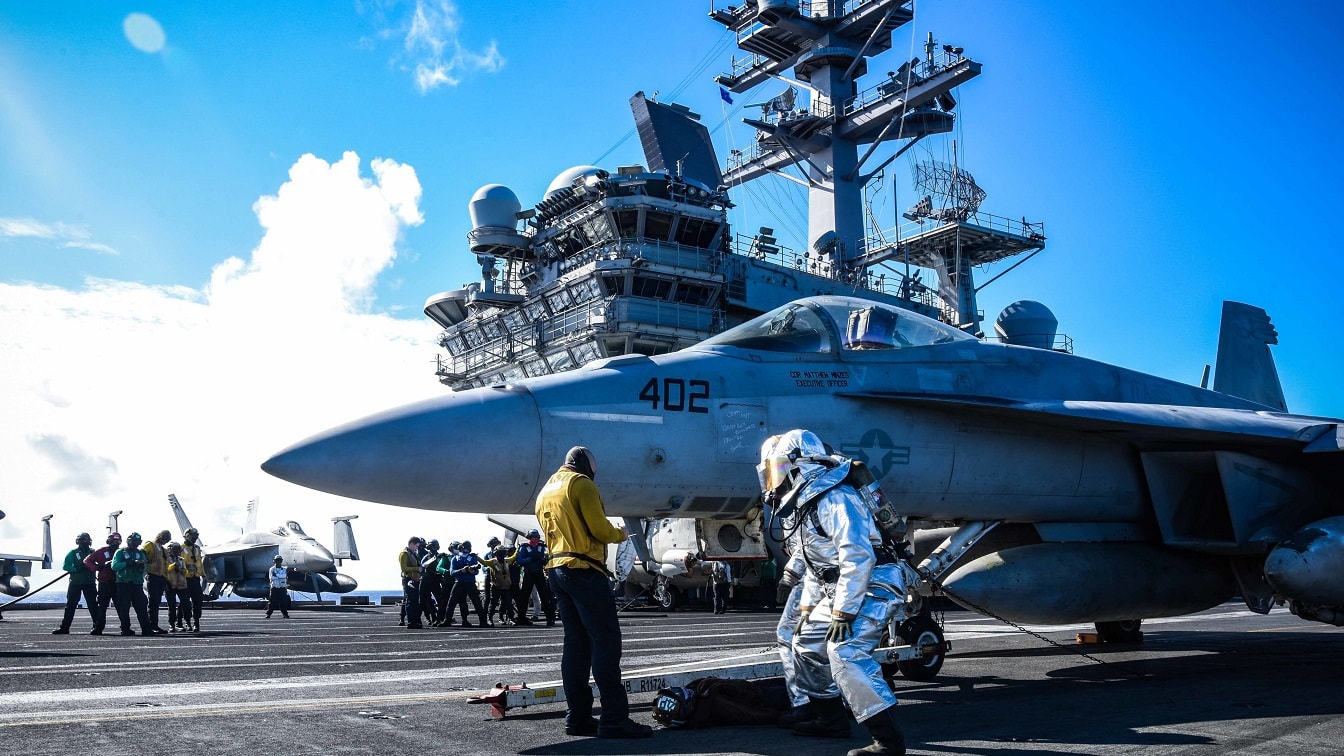
201019-N-ZF088-1100 SOUTH CHINA SEA (Oct. 19, 2020) A crash-and-salvage team prepares to rescue a simulated patient during a flight deck fire drill on the Navy’s only forward-deployed aircraft carrier USS Ronald Reagan (CVN 76). Ronald Reagan, the flagship of Carrier Strike Group 5, provides a combat-ready force that protects and defends the United States, as well as the collective maritime interests of its allies and partners in the Indo-Pacific. (U.S. Navy photo by Mass Communication Specialist 3rd Class Gabriel A. Martinez)
A Baton Is Not an Accident
Washington and Manila have been fairly clear about the outer boundary of their alliance commitment. The Mutual Defense Treaty applies to armed attacks on either country’s armed forces, aircraft, and public vessels, including its coast guard, anywhere in the South China Sea, according to their bilateral defense guidelines.
What the two governments have not publicly defined is where a baton strike sits on the way to an armed attack. A water cannon that floods an engine room. A “collision” that turns out not to be accidental.
Beijing has spent the better part of a decade discovering how enormous that undefined space is, and how long it can be occupied without ever crossing the line.
That is why the Coast Guard, not the PLA Navy, does this work. A PLA Navy frigate deliberately ramming a Philippine vessel would be much harder to describe as a law enforcement dispute.
A Coast Guard cutter doing the same thing can still be characterized that way. The ambiguity is not a gap in Chinese strategy.
It is the strategy.
How a Coast Guard Dispute Turns Into a War
Imagine the injury on July 20 had been fatal. Or imagine the next attempt to resupply the Sierra Madre ends with a Philippine vessel disabled and taking on water.
At that point, Manila has to decide whether to call the incident an armed attack and request American assistance.
Washington has to decide what its treaty commitment actually requires in response. Article IV commits each side to act “in accordance with its constitutional processes,” which is a careful way of saying there is no automatic mechanism here.
Nothing fires on its own. People decide, later, under pressure.
Say Washington and Manila decide the incident qualifies and settle on an escorted resupply run to the Sierra Madre, the grounded landing ship the Philippines uses to hold its position on the shoal.
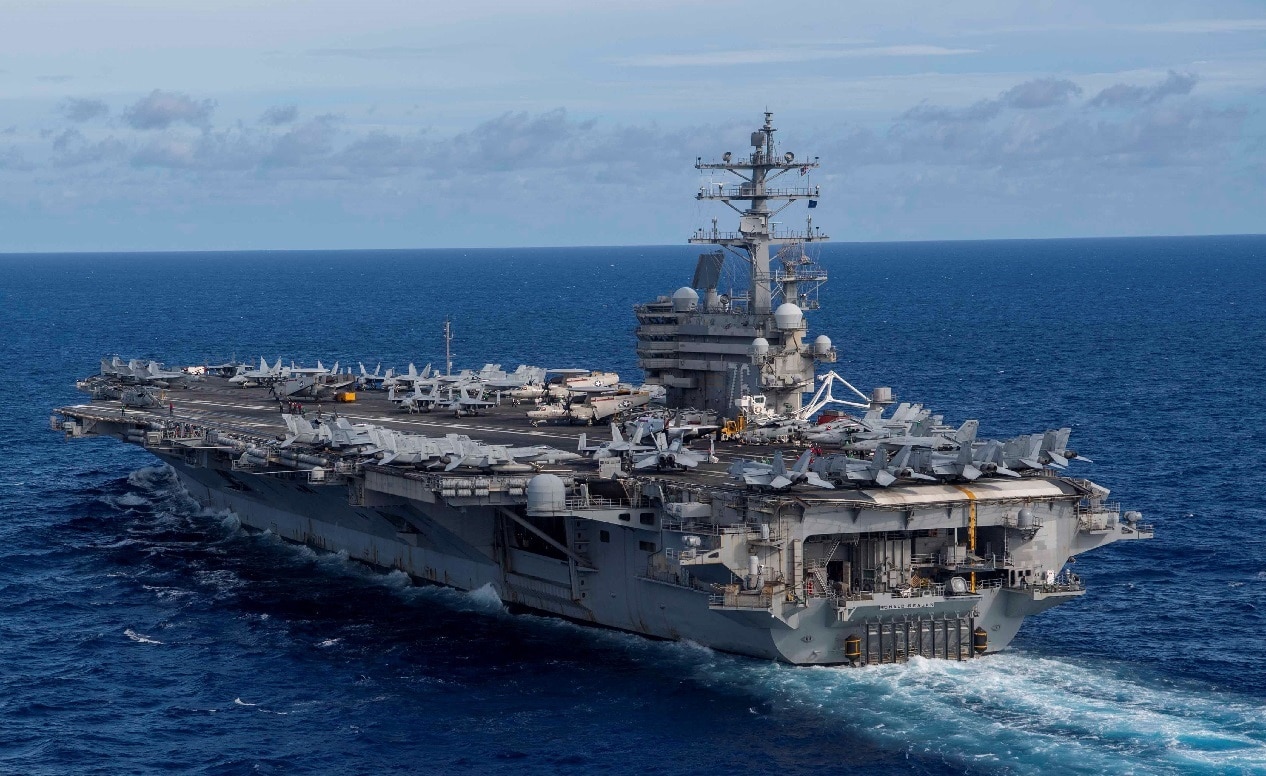
SOUTH CHINA SEA (June 16, 2021) The NavyÕs only forward-deployed aircraft carrier USS Ronald Reagan (CVN 76) transits the South China Sea. Reagan is part of Task Force 70/Carrier Strike Group 5, conducting underway operations in support of a free and open Indo-Pacific. (U.S. Navy Photo by Mass Communication Specialist 1st Class Rawad Madanat)
The USS George Washington carrier strike group, already operating in the region, could provide air cover and support from farther offshore.
Chinese vessels operating from fortified positions in the Spratlys, with air and missile cover close at hand, are not likely to just wave the convoy through.
The first American casualties might arise not from a deliberate decision to begin a war, but from an escort operation neither side was prepared to abandon once it started.
The war starts as an operational problem before anyone has agreed it is a war at all.
China’s Advantage Is Greatest at the Start
People who call this a home-field advantage for China are not wrong, but the phrase understates how deliberate it is. Second Thomas Shoal sits inside the Philippines’ exclusive economic zone, roughly 1,200 kilometers from Hainan.
That is not China’s home field by any natural definition.
China built the field.
Artificial islands with airstrips, hardened shelters, radar, and missile batteries now sit inside a chain of Spratly outposts constructed over a decade for confrontations like this, so that a confrontation two days’ sail from Hainan unfolds as though it were taking place just off China’s coast.
If a shooting war actually started over an escort mission, it would not stay a dispute over one shoal for very long.
China’s most sensible move would be to try to isolate the Philippine position, push American surface ships back with land-based missiles and aircraft it can generate faster than the US can surge forces into the theater, and put pressure on the bases in the Philippines and Guam that any sustained American operation would depend on.
The 2026 National Defense Strategy’s call for a denial defense along the First Island Chain, rather than assuming the US Navy can simply sail wherever it wants, reflects that reality. Washington’s real strength in this fight is not a carrier that happens to be nearby.
It is submarines, dispersed air power, and land-based anti-ship fires operating from Philippine territory. All of it depends on the Philippines actually granting the access and depth the alliance would need on short notice, which is an open question in itself.
And even that strength runs into limits that get less attention than they deserve: American stocks of long-range precision weapons and air-defense interceptors are thin, and the handful of bases the US would rely on in the Philippines and Guam are not hard to find or hit.
China’s advantage is largest in the first days, before the United States can disperse and reinforce and before Manila and Washington have worked out what they are actually trying to achieve.
That gives Beijing a powerful incentive to make any confrontation short and decisive, even if it does not make war attractive.
What the Alliance Cannot Leave Undecided
The mistake would be to conclude from all this that Washington and Manila simply need to state, publicly, exactly how much force converts a coast guard incident into an armed attack. That would be a gift to Beijing, not a deterrent.
Publish the threshold, and you have handed the other side a number to stay under, and Chinese coast guard commanders are evidently good at staying under numbers.
What the alliance needs is not public clarity.
It needs a private agreement on what happens after a serious injury, a death, a deliberate sinking, or an attempt to seize Philippine personnel.
Those decisions should be made now, calmly, rather than improvised the next time a sailor is bleeding on a reef most Americans couldn’t find on a map.
Nothing in the last two weeks suggests Beijing will ease off this approach.
The test that matters, once this particular news cycle passes, is whether the two allies have quietly done that work, or whether the next incident forces Washington to figure out, in real time, whether a baton counts.
About the Author: Dr. Andrew Latham
Andrew Latham is a professor of international relations and political theory at Macalester College in Saint Paul, MN. You can follow him on X: @aakatham.