
The US Navy Is Losing 1,316 Tomahawk-Capable Launch Positions Before Its New SSGNs Arrive – The US Navy formalized its long-term answer to the undersea strike gap on August 3, 2026, when it reclassified 19 planned Virginia Payload Module submarines as SSGNs. The new designation reflects their larger missile capacity. It does not bring the first boat any closer than fiscal 2029.
The Tomahawk Missile Crisis
As of today, August 8, seven Ticonderoga-class cruisers and three Ohio-class SSGNs remain in the operational force.
Together, they provide as many as 1,316 Tomahawk-capable launch positions: 854 Mk 41 cells aboard the cruisers and 462 missile positions aboard USS Ohio, USS Florida, and USS Michigan. USS Georgia began inactivation at the end of July, removing another potential 154-round undersea magazine.
Across the original vertical-launch Ticonderoga force and all four converted Ohio submarines, the theoretical maximum reached 3,300 launch positions: 2,684 cruiser cells and as many as 616 Tomahawks aboard the SSGNs. That does not mean the Navy is physically throwing away 3,300 missiles. Cruiser cells carry a mix of Tomahawks, Standard Missiles, ESSMs, and anti-submarine rockets. The retirements remove the capacity to deploy weapons at sea.
The Iran War
The timing became more serious during the Iran War. The United States fired more than 850 Tomahawks during the first four weeks, according to people familiar with the expenditure.

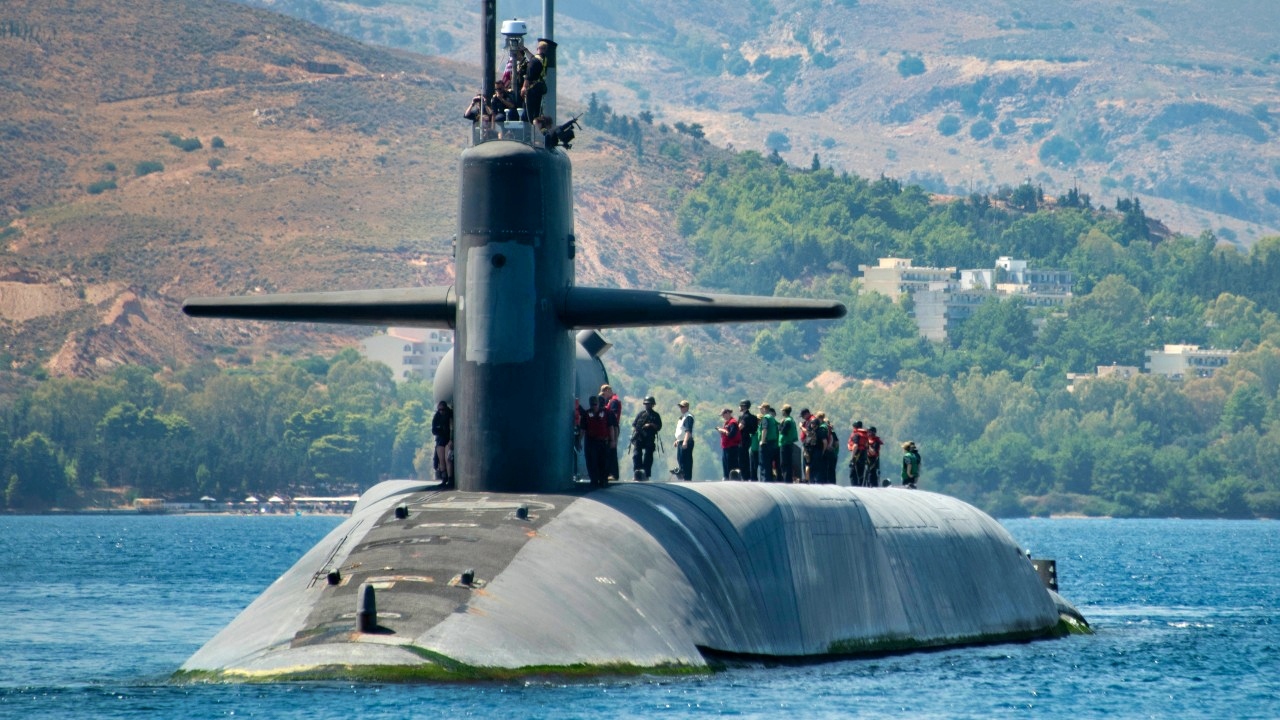
The Ohio-class guided-missile submarine USS Florida (SSGN 728) departs Naval Submarine Base Kings Bay. Florida will perform routine operations while at sea. (U.S. Navy photo by Mass Communication Specialist 1st Class James Kimber/Released)
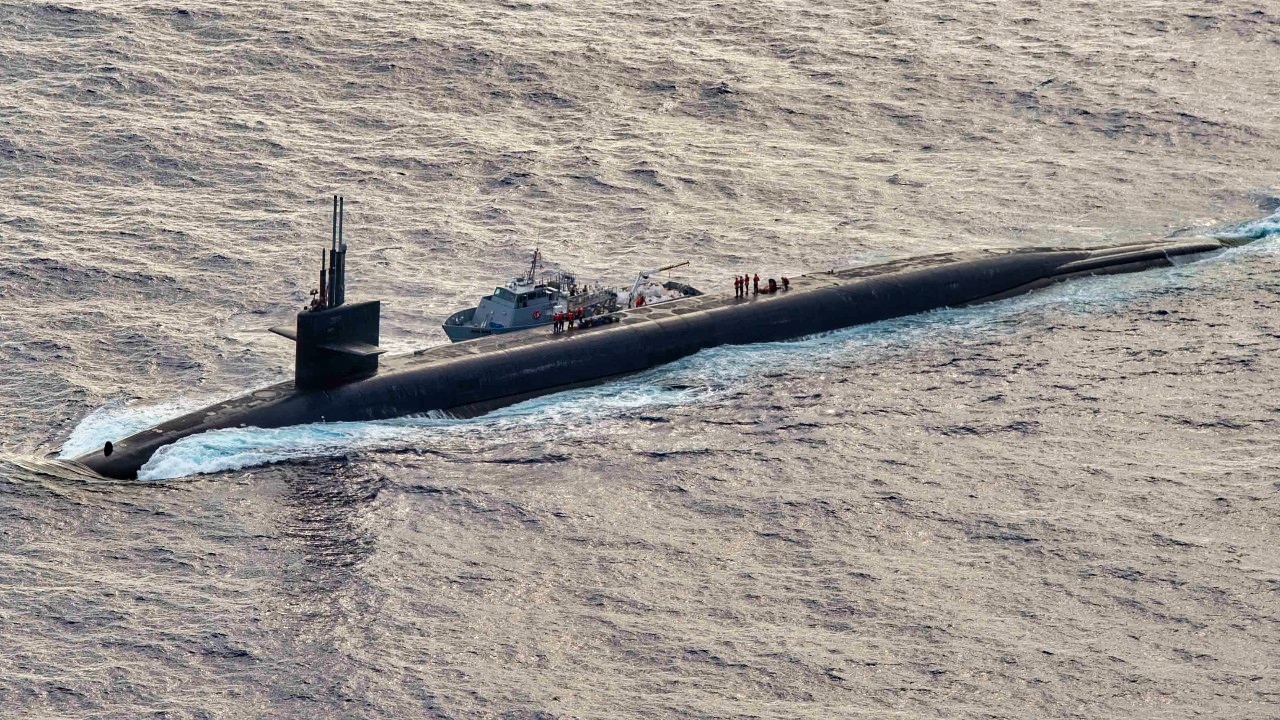
The Ohio-class ballistic missile submarine USS Kentucky (SSBN 737) sails alongside a submarine support vessel during a routine armed air escort (AAE) exercise, April 24, 2025. AAEs are designed to improve interoperability between our services, increasing lethalitythrough multi-domain integration.. Commander, Submarine Group (SUBGRU) 9, exercises administrative control authority for assigned submarine commands and units in the Pacific Northwest providing oversight for shipboard training, personnel, supply and material readiness of submarines and their crews. SUBGRU-9 is also responsible for nuclear submarines undergoing conversion or overhaul at Puget Sound Naval Shipyard in Bremerton, Washington. (U.S. Navy photo by Mass Communication Specialist 1st Class Ryan Riley)
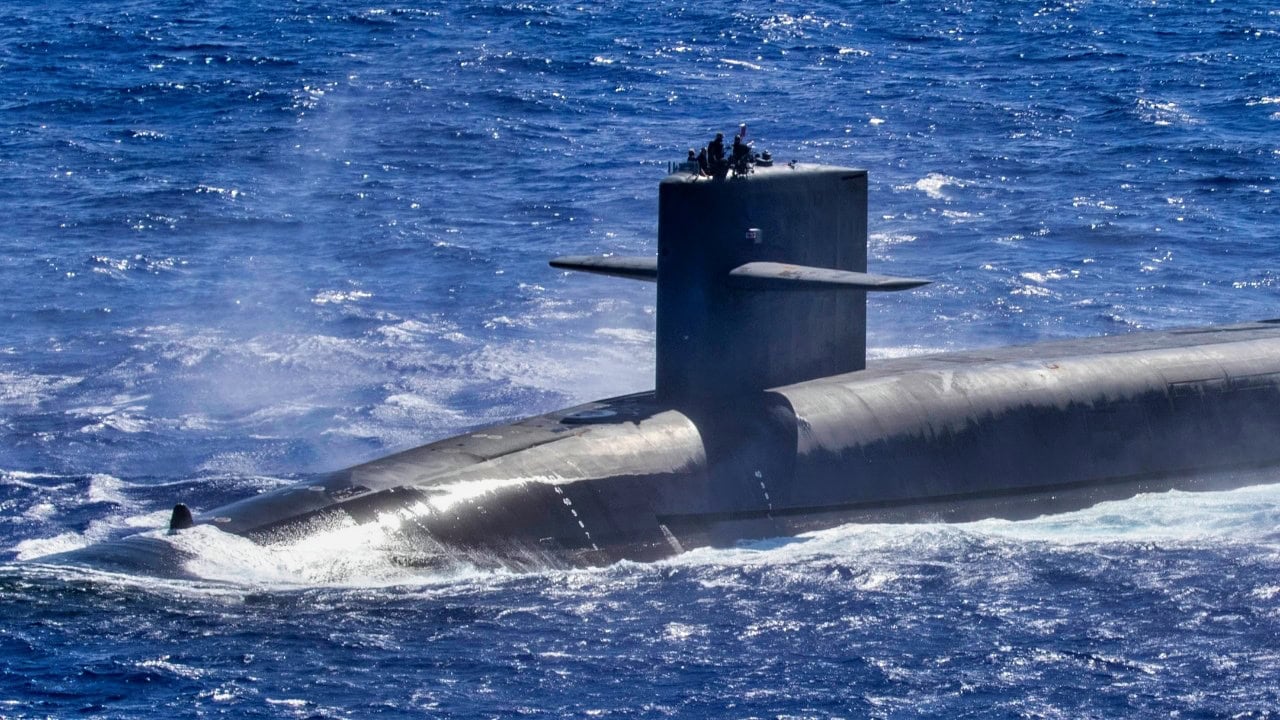
PACIFIC OCEAN (June 28, 2024) – An AS-332 Super Puma assigned to the Lewis and Clark-class dry cargo ship USNS Cesar Chavez (T-AKE 14) delivers supplies to the Ohio-class ballistic missile submarine USS Louisiana (SSBN 743) during a vertical replenishment at sea, June 28, 2024. The presence of the SSBN in the Pacific demonstrates the flexibility, survivability, readiness, and capability of the U.S. Navy submarine forces and complements the many exercises, training, operations, and other military cooperation activities conducted by Strategic Forces to ensure they are available and ready to operate around the globe at any time. Homeported in Bangor, Washington and currently assigned to Submarine Squadron 17, Louisiana is an undetectable launch platform for submarine-launched ballistic missiles, providing the United States with its most survivable leg of the nuclear triad. (U.S. Navy Photo by Mass Communication Specialist Seaman Andrew McPeek)
Reuters later reported that one source placed total use at a little less than half the global stockpile, a figure the news service could not independently verify. Pentagon and White House officials disputed claims that the United States had exhausted its usable supply.
The Navy still faces pressure on both the number of missiles available and the number of launchers able to carry them.
Seven Ticonderoga Cruisers Still Account for 854 Cells
Starting with USS Bunker Hill, each vertical-launch Ticonderoga received two 61-cell Mk 41 launchers. Twenty-two ships produced 2,684 cells across the VLS-equipped portion of the class. The cells gave the cruisers substantial land-attack capacity while preserving enough space for air defense and anti-submarine weapons.
USS Shiloh and USS Lake Erie are scheduled to leave on September 30, 2026. The Navy’s shipbuilding plan places Princeton, Robert Smalls, Gettysburg and Chosin in fiscal 2027, followed by Cape St. George in fiscal 2028. Those seven ships represent the remaining 854-cell surface magazine behind the wider Ticonderoga missile-capacity decline.
Flight III Arleigh Burke destroyers carry 96 Mk 41 cells. Even a one-for-one replacement of seven cruisers with seven destroyers would leave 182 fewer positions. The comparison is more restrictive in practice because both classes must reserve cells for fleet air defense, ballistic-missile defense and anti-submarine warfare rather than load every position with Tomahawks.
Three Ohio SSGNs Still Hold 462 Tomahawks
The Ohio SSGNs concentrated far more conventional strike power in one hidden hull. This is why I would argue that these subs should be extended rather than retired.
Each boat carries up to 154 Tomahawks in 22 seven-round canisters. The four-boat force represented more than half of the submarine fleet’s vertical-launch payload capacity before Georgia began inactivation.
Georgia completed its final patrol on July 27 after participating in Operation Midnight Hammer and Operation Epic Fury against Iran. The current plan removes Ohio in fiscal 2027, Florida in fiscal 2028, and Michigan in fiscal 2029. That schedule eliminates the remaining 462 positions behind the Navy’s concentrated undersea strike magazine.
The loss is both operational and numerical. A single Ohio SSGN brings a large opening salvo close to defended territory, supports special operations forces, and remains deployed with alternating crews. Reproducing 154 missile positions with smaller submarines requires several hulls, several crews, and several maintenance schedules.
A Virginia SSGN Carries 40 Tomahawks, Not 154
The Virginia Payload Module adds four large tubes, each holding seven Tomahawks, to the submarine’s two bow payload tubes. The official maximum is 40 missiles per VPM-equipped boat: 12 forward and 28 in the inserted module. One Virginia SSGN therefore has 114 fewer Tomahawk positions than one Ohio SSGN. This isn’t even worthy of the name SSGN, in my book.
Four Virginia SSGNs would provide 160 positions, narrowly exceeding one Ohio’s maximum. The full 19-boat force announced in August would offer 760 theoretical positions, but those submarines will arrive over almost a decade and retain attack-submarine missions such as hunting enemy submarines, intelligence collection, and special operations.
There is another way to count the replacement. A standard Virginia already brings 12 forward positions, so the VPM itself adds 28. Nineteen modules add 532 positions, short of the 616 carried by the four Ohio SSGNs. Replacing all 616 as added payload requires 22 VPM boats.
The New Virginia SSGNs Cost Roughly $4 Billion to $5 Billion Each
On July 29, the Navy awarded $42.1 billion for nine Block VI Virginia submarines and material for a tenth. The package also includes previously awarded material and productivity investments, so dividing it by nine does not produce a clean unit price.
The Navy has estimated an average cost of $4.3 billion for a VPM-equipped Virginia, while the Congressional Budget Office estimates about $5.1 billion for Virginia-class boats. Applied mechanically to 19 submarines, those figures produce a rough range of $81.7 billion to $96.9 billion. That is an analytical estimate, not an official cost baseline for the newly designated SSGN force.
Money does not remove the schedule constraint. Shipbuilders are delivering about 1.3 Virginias per year and are not expected to reach two per year until around 2032. The same yards and suppliers are building Columbia-class ballistic-missile submarines, the Navy’s top acquisition priority. That industrial bottleneck continues to define the Virginia production problem.
The Navy Has a Missile Shortage and a Launcher Shortage
The fiscal 2027 budget requests 785 Tomahawks, an order far larger than recent annual buys. Navy officials acknowledged that producing the larger order will be difficult and said the service expects heavy industrial investment. RTX has entered agreements lasting as long as seven years to raise annual Tomahawk output above 1,000 missiles.
Those plans address the stockpile exposed when more than 850 Tomahawks went into the Iran campaign. They do not restore the stealthy 154-round magazines leaving with the Ohio boats or the large mixed magazines disappearing with the Ticonderoga cruisers. New missiles refill surviving launchers; they do not create another submarine or cruiser.
The recently renamed Virginia SSGNs provide the long-term answer, but each Ohio retirement removes almost four Virginias’ maximum missile load. The Navy is paying tens of billions for a distributed replacement force while its shipyards remain years from the planned production rate.
The First Replacement and the Final Ohio Retirement Share Fiscal 2029
Shiloh and Lake Erie are scheduled to leave in September 2026. Four more cruisers and Ohio follow in fiscal 2027. Cape St. George and Florida are listed for fiscal 2028, while Michigan is scheduled for recycling in fiscal 2029 under the current shipbuilding plan.
The future USS Arizona, now designated SSGN-803, remains under construction. The Navy estimates delivery in fiscal 2029, with the other 18 Virginia SSGNs following through fiscal 2038. No public schedule shows Arizona completing trials and reaching an operational deployment before Michigan enters recycling.
About the Author: Harry J. Kazianis
Harry J. Kazianis (@Grecianformula) was the former Senior Director of National Security Affairs at the Center for the National Interest (CFTNI), a foreign policy think tank founded by Richard Nixon based in Washington, DC. Harry has over a decade of experience in think tanks and national security publishing. His ideas have been published in the NY Times, The Washington Post, The Wall Street Journal, CNN, and many other outlets worldwide. He has held positions at CSIS, the Heritage Foundation, the University of Nottingham, and several other institutions related to national security research and studies. He is the former Executive Editor of the National Interest and the Diplomat. He holds a Master’s degree focusing on international affairs from Harvard University.

