
In the 21st century, when one thinks of United States Navy aircraft carriers—affectionately slang-termed as “flattops,” not to be confused with the military-style haircut of the same name— chances are it’s the big, hulking nuclear-powered supercarriers (CVNs) like the Nimitz-class aircraft carriers and the Gerald R. Ford-class warships that come to mind.
It might be easy for some to forget that back during World War II, the USN had plenty of itty-bitty escort carriers (CVEs), aka “jeep carriers;” these jeep carriers immortalized themselves by their heroic stand against seemingly impossible odds during the Battle of Samar phase of the Battle of Leyte Gulf on 25 October 1944. Meanwhile, America’s full-sized flattops of that era like the legendary USS Yorktown (CV-5) would be considered medium-sized by today’s standards.

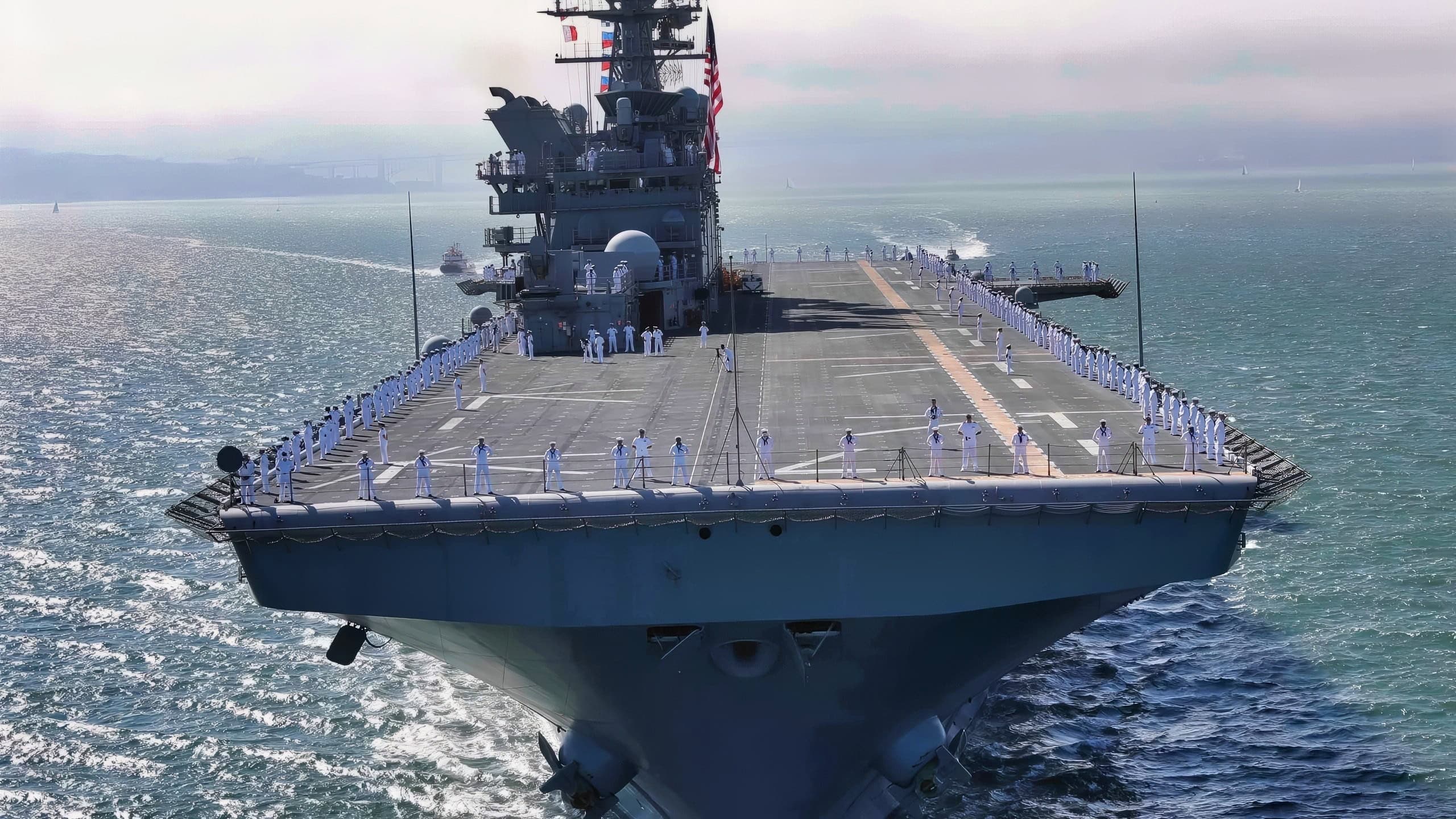
U.S. Sailors watch from a landing craft as they pull away from the forward-deployed amphibious assault ship USS Essex (LHD 2) off the coast of Cambodia in the Gulf of Thailand, March 2, 2011. Essex is the lead ship of the Essex Amphibious Ready Group and was participating in Maritime Exercise 11, a theater security cooperation visit to improve capabilities of the United States and Royal Cambodian Armed Forces. (DoD photo by Mass Communication Specialist 3rd Class Adam M. Bennett, U.S. Navy/Released).
Speaking of medium-sized carriers, why didn’t medium carriers become a reality in the post-WWII era, particularly during the Cold War? Well, they almost did, back in the 1970s.
Medium Carrier (CVV) Program Initial History and Premise
In the early part of that decade, then-Chief of Naval Operations (CNO) Admiral Elmo Russell “Bud” Zumwalt—one of the most beloved officers ever to serve as CNO—issued a doctrine calling for larger numbers of smaller and cheaper ships, which brings to mind the saying that “Quantity has a quality all of its own.”
Hence the Navy brain trust came up with the concept of a conventionally powered 50–60,000-ton medium aircraft carrier (CVV) that would confer the benefits such as: faster, cheaper conventional construction using existing know-how; forming additional carrier groups for ASW, ISR, and flank protection; dispersing presence to insufficiently covered geographic regions; and bridging the 1940s vintage Midway-class flattops to the Nimitz era without necessitating extremely time-consuming nuclear refuelings.
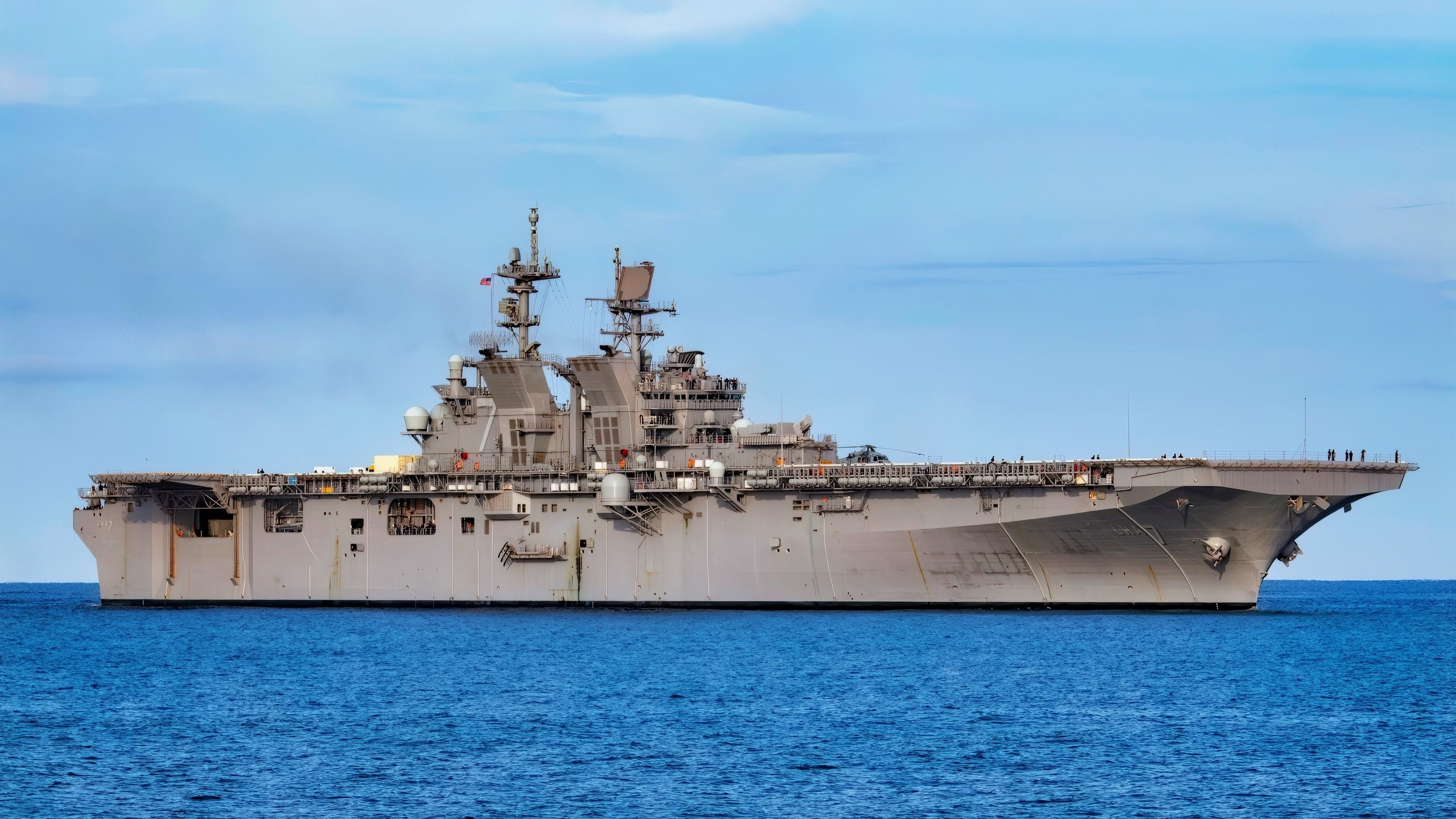
GUANTANAMO BAY, Cuba (Aug. 3, 2020) The amphibious assault ship USS Tripoli (LHA 7), the second America-class amphibious assault ship, transits toward Naval Station Guantanamo Bay, Aug. 3, 2020. Tripoli commissioned July 15 and is en route to homeport in San Diego. Naval Station Guantanamo Bay is the forward, ready, irreplaceable U.S. sea power platform in the Caribbean. (U.S. Navy photo by Mass Communication Specialist 2nd Class Samantha Oblander)
Sounded like a wonderful concept, and both the Ford and Carter Administrations alike warmed to the idea; although they were on opposite sides of the partisan divide, both Jerry Ford and Jimmy Carter shared a common bond as former Navy officers, which, among other things, helped explain how both of these former U.S. Presidents have USN warships named in their honor.
To wit:
-In 1976, Mr. Ford canceled an order for a fourth Nimitz-class flattop in favor of building two CVVs; the Ford Administration kept the faith in the CVV concept even after anticipated vertical/short takeoff and landing (VSTOL) fighters—presumably the Harrier jump jet—did not materialize as expected, as the design was instead refined to ensure that it could operate existing conventional carrier aircraft.
-Somewhat mirroring his predecessor’s actions, Mr. Carter, with the backing of then-Secretary of Defense Harold Brown, even went so far as to veto a fiscal year 1979 defense appropriations bill because it included funding for a Nimitz-class warship that year.
So, What Went Wrong?
As noted by a Naval History and Heritage Command (NHHC) document published in 2020, “Admiral Holloway advocated for a 600-ship Navy, while the DON secretariat initiated the Sea Plan 2000 study, which built on Admiral Hayward’s ‘Sea Strike’ and argued, among other things, that the Navy’s proper role in a Soviet war was global and offensive. Naturally, a global offensive required more CVN construction, putting DON at odds with Carter administration policy to place a CVV in the FY 1980 budget.
With support from Congress, the Navy’s preference won out over Secretary of Defense Brown’s preference for a CV and the White House’s for a CVV, leading to the construction of CVN-71, Theodore Roosevelt.”
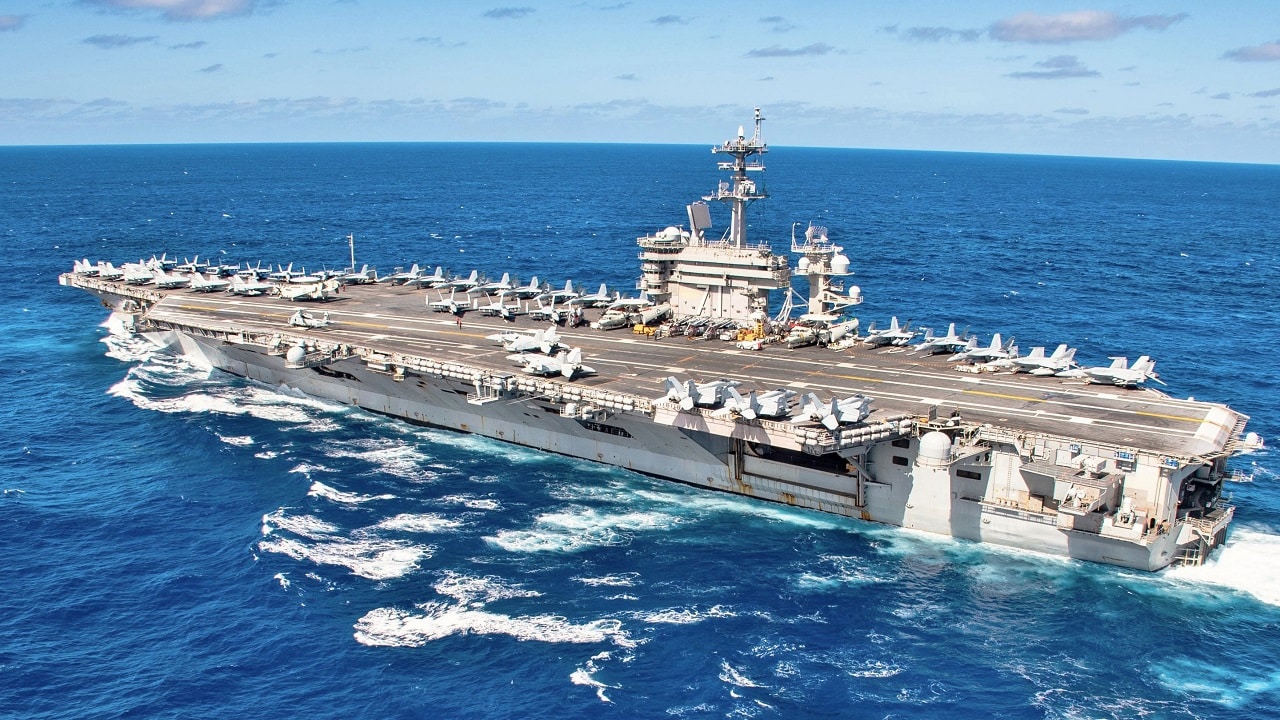
(Jan. 25, 2020) The aircraft carrier USS Theodore Roosevelt (CVN 71) transits the Pacific Ocean Jan. 25, 2020. The Theodore Roosevelt Carrier Strike Group is on a scheduled deployment to the Indo-Pacific. (U.S. Navy photo by Mass Communication Specialist Seaman Alexander Williams)
NOTE: “Admiral Holloway” as in James L. Holloway III, Bud Zumwalt’s immediate successor as CNO; “Admiral Hayward as in Thomas B. Hayward, who in turn succeeded Holloway as CNO.
The CVVs’ fate was sealed when Ronald Reagan took up residence in the White House in 1981, as his Administration’s preferences for supercarriers aligned with those of the Navy brass. Indeed, Mr. Reagan ended up getting a Nimitz-class carrier named in his honor.
CVV Would-Be Tech Specs, Vital Stats, and Capabilities
Besides the aforementioned 50–60,000-ton displacement, these would-be medium carriers would have sported a hull length of 923 feet, a flight deck width of 256.5 feet, and a draft of 34 feet.
Presumptive max speed was 29 knots, and total complement—ship’s company and air wing alike—was 3,400–3,900 commissioned officers and enlisted seamen. As for the carrier’s raison d’etre, the CVV was expected to house up to 65 aircraft.
Those aircraft would’ve likely included:
–The F-4 Phantom II: This “supersonic brick” provided 25 years—from 1961 to 1986—of faithful service as the Navy’s long-range supersonic jet interceptor and fighter-bomber, particularly during the Vietnam War
–The S-3 Viking: The USN’s primary fixed-wing antisubmarine warfare (ASW) platform of the Cold War
–The F-14 Tomcat: Although this famous fighter gained that fame via fictitious movies and real-world combat alike in the 1980s, the Tomcat actually made its operational debut in 1974, which makes it a virtual certainty that it would’ve operated off the flight decks of the CVVs had the ships become a reality.
Legacy
The closest thing to medium carriers that the U.S. Navy has nowadays are the Amphibious Assault Ships (LHAs).
Though not officially classified as aircraft carriers, the USS America (LHA-6) and USS Tripoli (LHA-7) are sometimes informally referred to as “lightning carriers” because of their carrying capacity for 20–25 F-35B Lightning II STOVL stealth fighters. These ships have a displacement of 45,700 tons and a hull length of 844 feet.
About the Author: Christian D. Orr
Christian D. Orr is a Senior Defense Editor. He is a former Air Force Security Forces officer, Federal law enforcement officer, and private military contractor (with assignments worked in Iraq, the United Arab Emirates, Kosovo, Japan, Germany, and the Pentagon). Chris holds a B.A. in International Relations from the University of Southern California (USC) and an M.A. in Intelligence Studies (with a concentration in Terrorism Studies) from American Military University (AMU). He is also the author of the book “Five Decades of a Fabulous Firearm: Celebrating the 50th Anniversary of the Beretta 92 Pistol Series,” the second edition of which was recently published.