
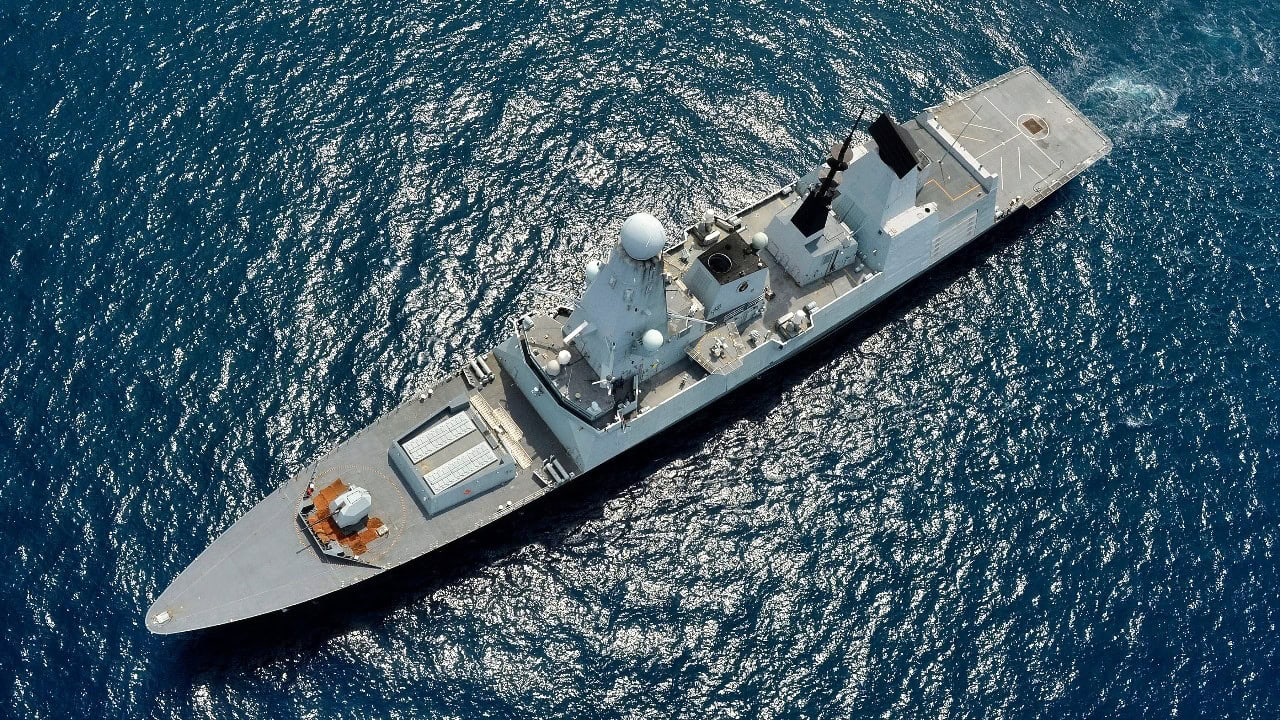
In 2017, the HMS Daring (D32), a Type 45 destroyer in the UK’s Royal Navy, pulled into Portsmouth to undergo a planned Power Improvement Project (PIP) to address some of the issues with the Type 45’s propulsion systems.
Little did anyone know that Daring would remain out of service for eight consecutive years.
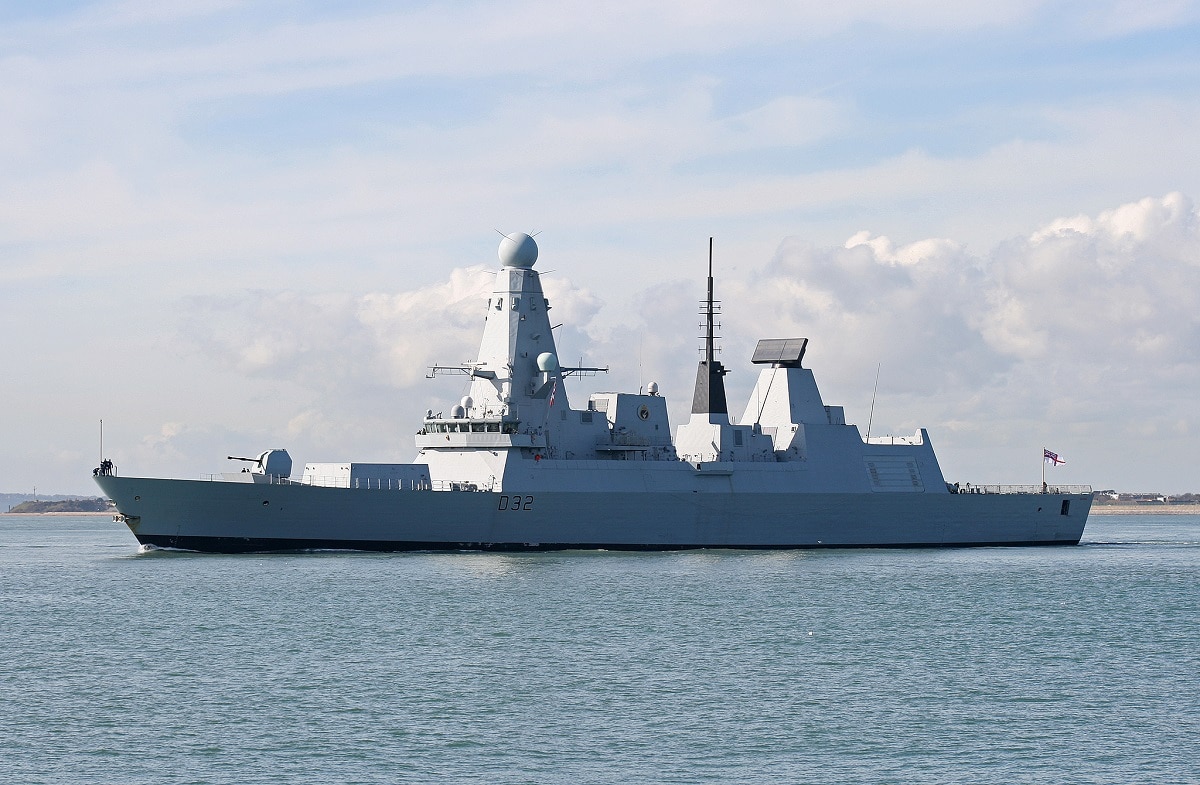
HMS Daring (D32), a stealth design of area defence anti-aircraft destroyer of the Royal Navy, outward bound from Portsmouth Naval Base, UK.
As with seemingly all Royal Navy maintenance projects.
Daring’s PIP faced delays because of the scale of the work and the state of the shipbuilding industry.
Once the work was complete, however, the destroyer still could not return to service because persistent manpower shortages prevented the ship from being fully crewed.
The Case of the HMS Daring
The tragic tale of HMS Daring began with her deployment to the Persian Gulf from 2016 to 2017.
She participated in Operation Inherent Resolve with the U.S. Navy before transiting the Bosporus Strait and participating in exercises with the Romanian Navy.
During the deployment, the destroyer reportedly experienced issues with its propulsion system.
Type 45 destroyers were designed with an integrated electric propulsion (IEP) system, which combines a steam turbine engine with an electric generator to power the ship.
The WR-21 is a decent engine, but it has a critical flaw: its cooler.
The engine coolant system was susceptible to hot weather, which frequently caused the engines to overheat.
In areas like the Persian Gulf, this oversight is especially critical.
After her deployment, Daring was sent to Portsmouth in 2017, where she began her PIP, which removed some of her diesel generators and replaced them with larger, more efficient engines for when the IEP system fails in hot weather.
When Daring finally reached port, however, she was met with the full UK treatment.
Her crew was reassigned to man the Royal Navy’s two Queen Elizabeth-class aircraft carriers and frigates, and work on the ship did not even begin until 2019.
3300 Days Out of Action
The scale of the work was too much for the UK’s already fledgling industrial base. Replacing Daring’s diesel generators proved much harder than originally planned.
They had to cut open her hull and manually remove the generators.
This portion of the work was carried out at the Cammell Laird shipyard in Birkenhead.
Once the generators were replaced, they sent her back to Portsmouth, where workers began the long, difficult process of bringing her back to life.
Since 2023, Daring has been in Portsmouth, undergoing refit.
They replaced many of her outdated onboard systems, and the new generators underwent rigorous testing to bring the destroyer back to life.
While the work was largely complete, one last hurdle remained before the ship could return to service: she needed a crew.
With rampant manpower shortages persisting throughout the Royal Navy, the UK has had to make some tough calls regarding its fleet size.
Over the last several years, the RN has had to deactivate several smaller frigates in order to free up enough personnel and funds to keep its vital aircraft carriers and submarines operational.
Consequently, Daring was left without a crew for multiple years, wasting away at Portsmouth at the expense of the British taxpayer.
Only recently has the Navy found and trained a new crew to operate the ship. Daring is expected to rejoin the fleet sometime soon.
The Right Ship for the Wrong Navy
While UK officials loudly boast about the RN’s readiness to confront Russian warships operating near their waters, cases like the HMS Daring exist to highlight the grim state of the British Royal Navy.
With persistent mechanical issues and the sorry state of the UK’s industrial base, the Type 45 destroyers, despite being highly capable at their best, have had a low operational readiness rate in practice.
Propulsion issues and IEP overheating in hot weather have proven critical flaws in the class, requiring major mechanical overhauls and millions of pounds’ worth of repairs.
Consequently, readiness is extremely low across the fleet, with some reports indicating that only three out of six destroyers are currently available.
The Type 45, propulsion issues aside, is a highly capable warship packed with advanced radar and sonar systems and loaded with advanced weaponry.
The ship is unfortunately constrained by the nation that manufactures and maintains it.
With only 6 planned and completed, the Type 45 was envisioned to replace the now-retired Type 42, of which 16 were built.
Constrained by manpower shortages and industrial stagnation, the Royal Navy’s surface fleet has shrunk considerably over the past several years.
In 1990, the UK operated a fleet of 37 destroyers and frigates.
Today, it operates only 17.
This is the result of a Navy that lacks the funds to build and maintain a large, globe-spanning fleet as it did before the World Wars.
Despite repeated calls to action against Russia, the Royal Navy is stuck in a state of managed decline, and the government in London is either unable or unwilling to do anything to change it.
About the Author: Isaac Seitz
Isaac Seitz, a Defense Columnist, graduated from Patrick Henry College’s Strategic Intelligence and National Security program. He has also studied Russian at Middlebury Language Schools and has worked as an intelligence Analyst in the private sector.