
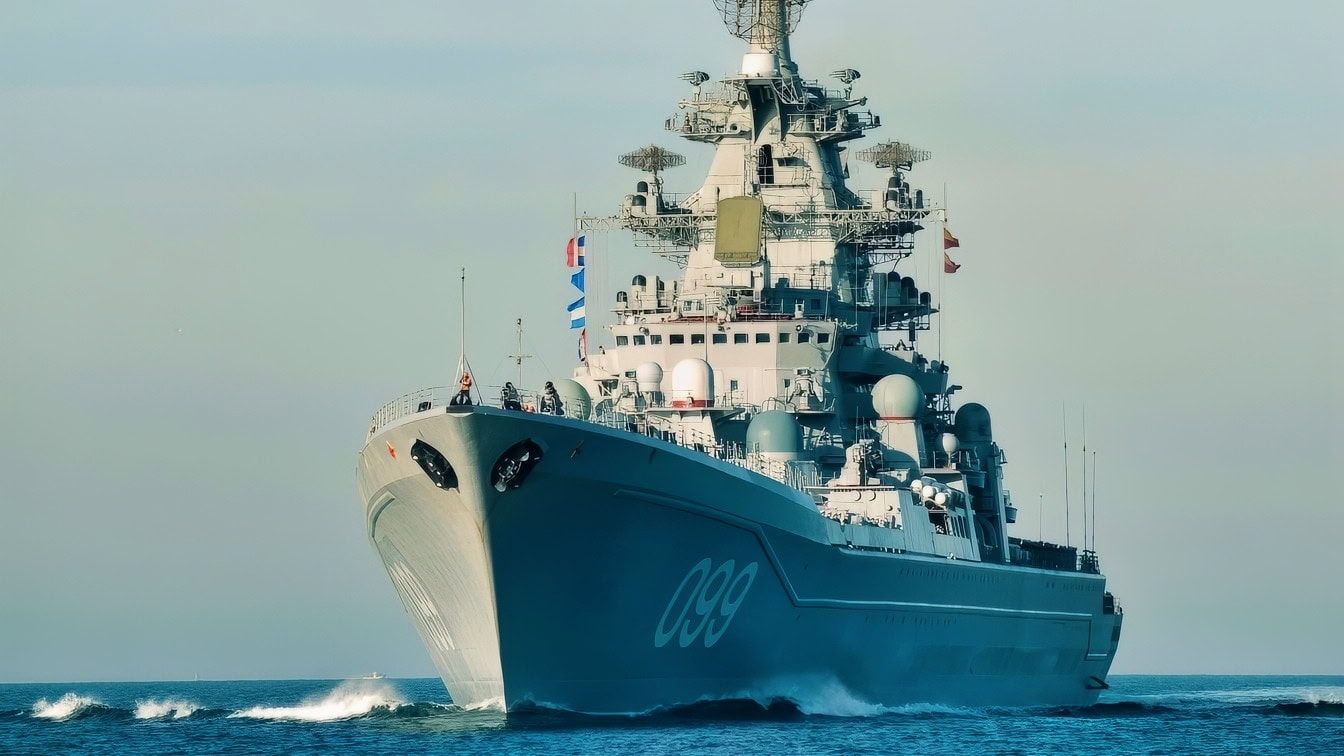
Summary and Key Points: The Soviet Union built four Project 1144 Orlan battlecruisers between 1973 and 1996 — Kirov, Admiral Lazarev, Admiral Nakhimov, and Pyotr Velikiy — each displacing about 28,000 tons on an 827-foot hull, and they were for years the largest and most heavily armed surface combatants afloat that were not aircraft carriers. Two have been scrapped. Pyotr Velikiy is slated for retirement. That leaves Admiral Nakhimov, which has absorbed roughly 25 years and an estimated $5 billion in refit work and will emerge with 176 vertical launch cells, Zircon hypersonic missiles, S-400 air defense, and a twin AK-130 130mm mount. The American counterpart, the BBG(X) or Trump-class battleship, would displace 35,000 tons on an 840- to 880-foot hull with 128 Mk 41 cells, 12 Conventional Prompt Strike hypersonics, and a 32-megajoule electromagnetic railgun firing tungsten at Mach 6. It also does not exist, has not been funded, and may never be built.
Trump-Class vs. Kirov-Class: Who Wins?
Trump-class battleship vs. Kirov-class battlecruiser, let’s get ready to rumble
The renewed area of Great Power/”near-peer” competition between the United States of America and Russia is, for all practical purposes, Cold War II, and just like the original Cold War, a major element is a tit-for-tat arms race.
One of the more intriguing elements of that arms race is the attempt by both U.S. President Donald J. Trump and Russian Federation President Vladimir Vladimirovich Putin to revive the concept of the battleship, or, in the latter’s case, the battlecruiser at the very least.
So, assuming that (1) both of these ambitious naval warfare projects become a reality, and (2) Cold War II does become a “hot war,” that could potentially mean the first battleship vs. battleship engagement—or battleship vs. battlecruiser engagement if you want to be truly technically nitpicky—since World War II.
So then, how would the Trump-class, aka BBG(X) battleships stack up head-to-head against the Kirov-class battlecruisers?
Semantic Sidebar: Defining a Battlecruiser
Before we compare the two warship types head-to-head, it’s useful to know what distinguishes a battlecruiser from a battleship.
In essence, going back to its conceptualization in the first half of the 20th century, the battlecruiser was a type of capital ship that was similar in displacement, armament, and cost to battleships, but differed in form and balance of attributes, such as thinner armor and a somewhat lighter main gun battery than contemporary battleships, installed on a longer hull with much higher engine power to enable greater speeds.
By this rationale, the Kirov-class warships—originally known in Soviet parlance as “Project 1144 Orlan”—aren’t true battlecruisers; as noted by the Naval Encyclopedia, “According to NATO classification, the project received the term ‘battlecruiser’ due to its huge size, armor and powerful armament, but it still remained a ‘large missile cruiser’ in the Soviet inventory.”
Nomenclatural nitpicks notwithstanding, Project 1144 did indeed turn out to be the largest and most powerful non-aircraft-carrier combat surface ships with nuclear power plants in the world, and for a good-sized chunk of the Cold War, they were also the world record-holders in terms of armament.
However, that record ended when the U.S. Navy recommissioned its World War II-vintage Iowa-class battleships.
Contender #1: Kirov-Class Battlecruiser
One distinct advantage the Kirovs have over the BBG(X) is that the latter have already been built.
However, that advantage is somewhat offset by the fact that the 21st century refurbishment efforts are a bit behind the power curve.
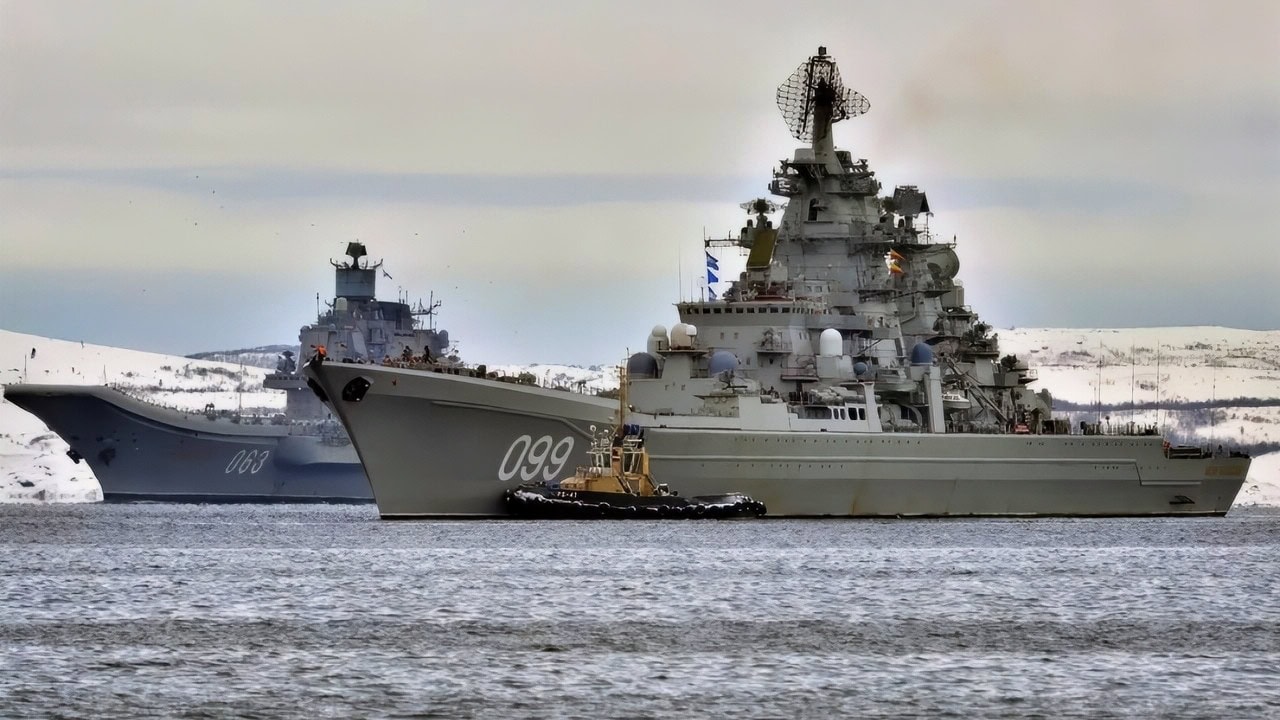
Under the stewardship of chief designer B.I. Kupensky, Project 1144 “Orlan” churned out a total of four of the warships, built at the Baltic Shipyard from 1973 to 1996:
Kirov-Class Nuclear Russian Cruiser Creative Commons Photo
the Kirov, Admiral Lazarev, Admiral Nakhimov, and Pyotr Velikiy (“Peter the Great”).
The Kirov bore a fully laden hull displacement of 28,000 tons, a hull length of 827 feet, and an armament consisting of two AK-100 100 mm /L60 DP guns and eight AK-630 hex Gatling 30 mm/L60 PD guns, twenty P-700 Granit (NATO reporting name SS-N-19 Shipwreck) antiship missiles, 12 × 8 SA-N-6 Grumble (S-300PMU) surface-to-air missiles (SAMs), and SS-N-14 Silex anti-submarine missiles.
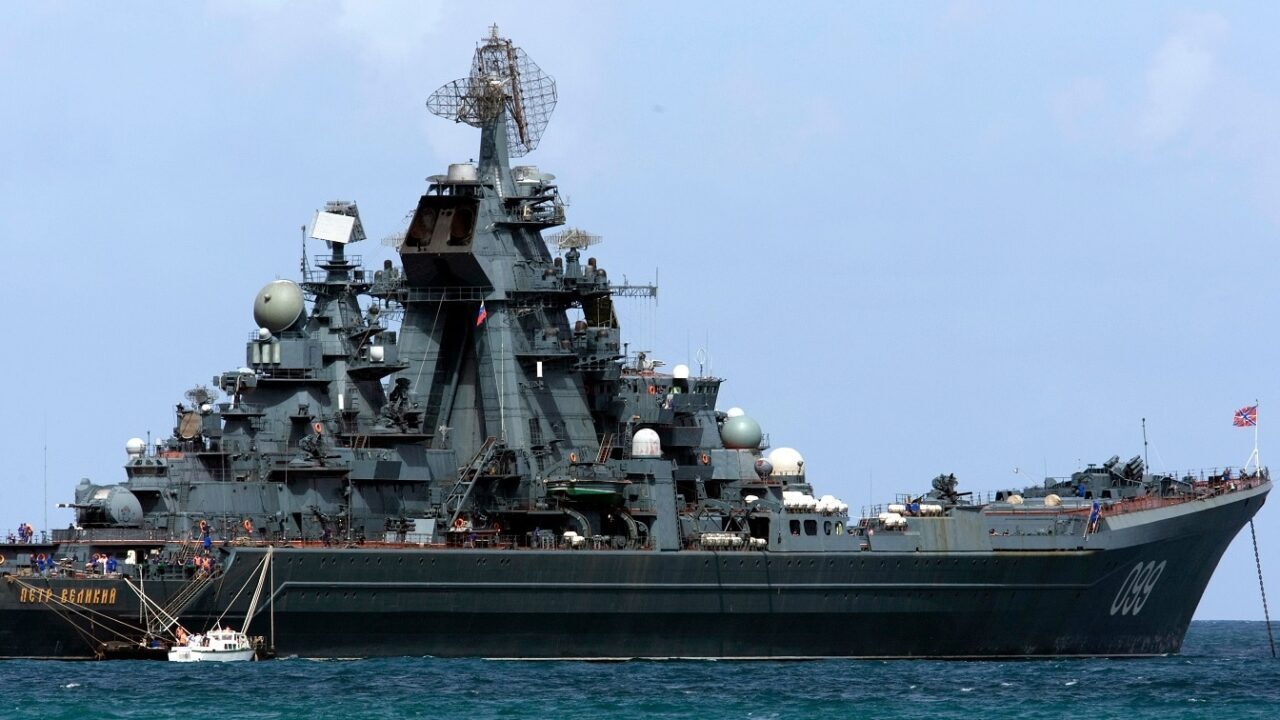
Only the Nakhimov has been selected for refurbishment—Kirov and Lazarev have already been scrapped, whilst Pyotr Velikiy has been slated for retirement—and accordingly, the Russian Navy has spent as much as an estimated $5 billion USD to modernize that sole survivor, a modernization project that includes Zircon hypersonic missiles alongside S-400 air-defense systems.
Her modernized vertical launch systems (VLS) will be unrivaled in sheer number of cells, a whopping 176. The main gunnery now consists of a twin AK-130 130 mm/L70 dual-purpose gun
Okay, but why?
Kirov-class Battlecruiser. Image Credit: Creative Commons.
As H.I. Sutton of Naval News elaborates in a February 11, 2026, article, “The program now has all the hallmarks of a vanity project, being as much about the perception of might as practical military value. The ship’s significance in this respect may grow as the current pride of the Russian Navy, their sole aircraft carrier, the Admiral Kuznetsov, becomes ever more expensive to maintain and may be decommissioned…Possibly it’s intended only for show, for waving the flag abroad and in naval parades.”
What’s more, the restoration of the Nakhimov will be easier said than done; the Russian naval budget has already been stretched thin, and to make matters worse, Sevmash, the shipyard tasked with the rework, has struggled with manpower shortages.
Contender #2: Trump-Class/BBG(X) Battleship
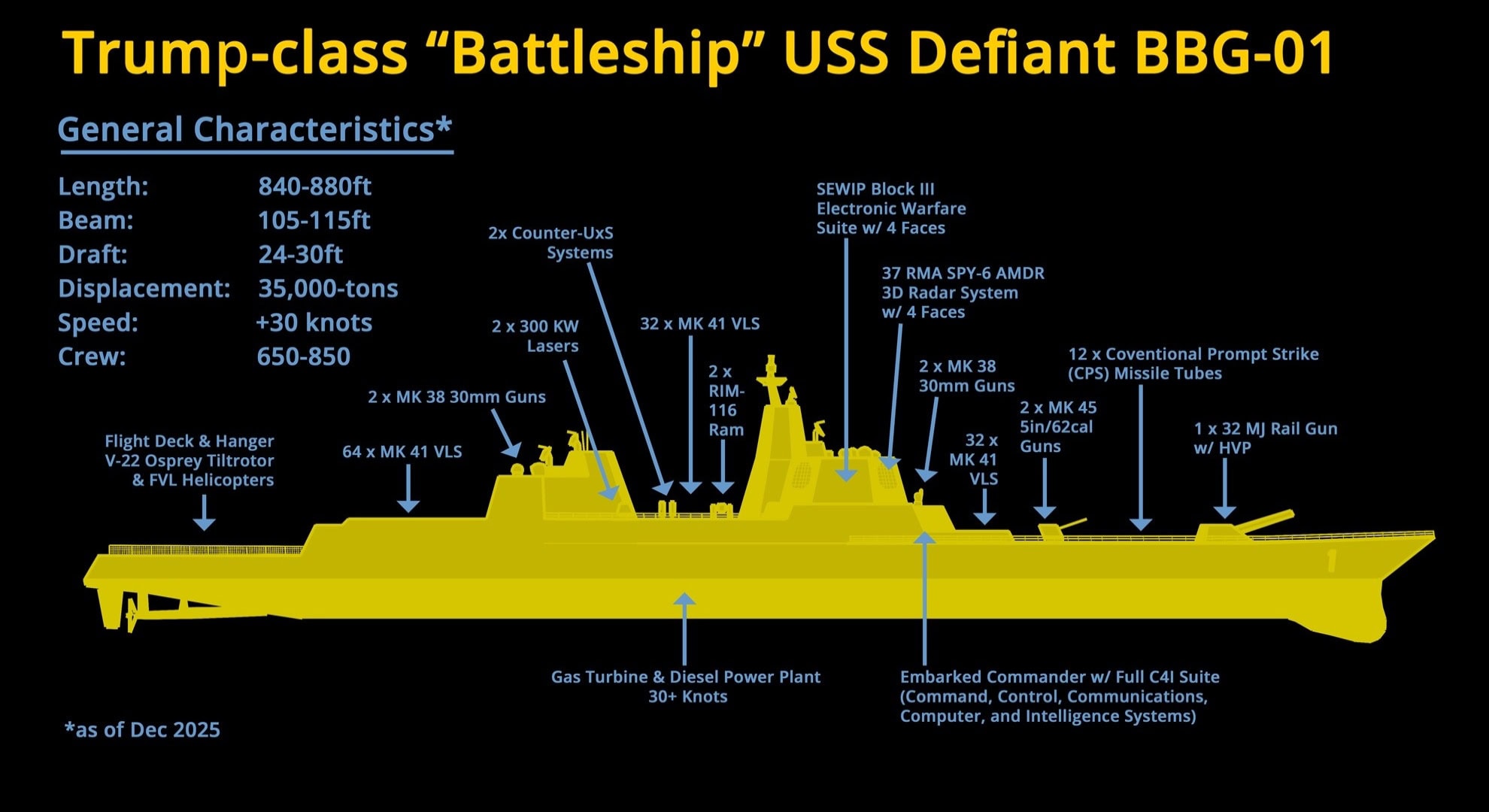
The political pundits’ prognostications as to whether the BBG(X) battlewagons will even be built are a debate for another time. Assuming, for argument’s sake, they become a reality, they will be bigger and badder than the Kirovs, thanks to:
Trump-Class Battleship Creative Commons Photo
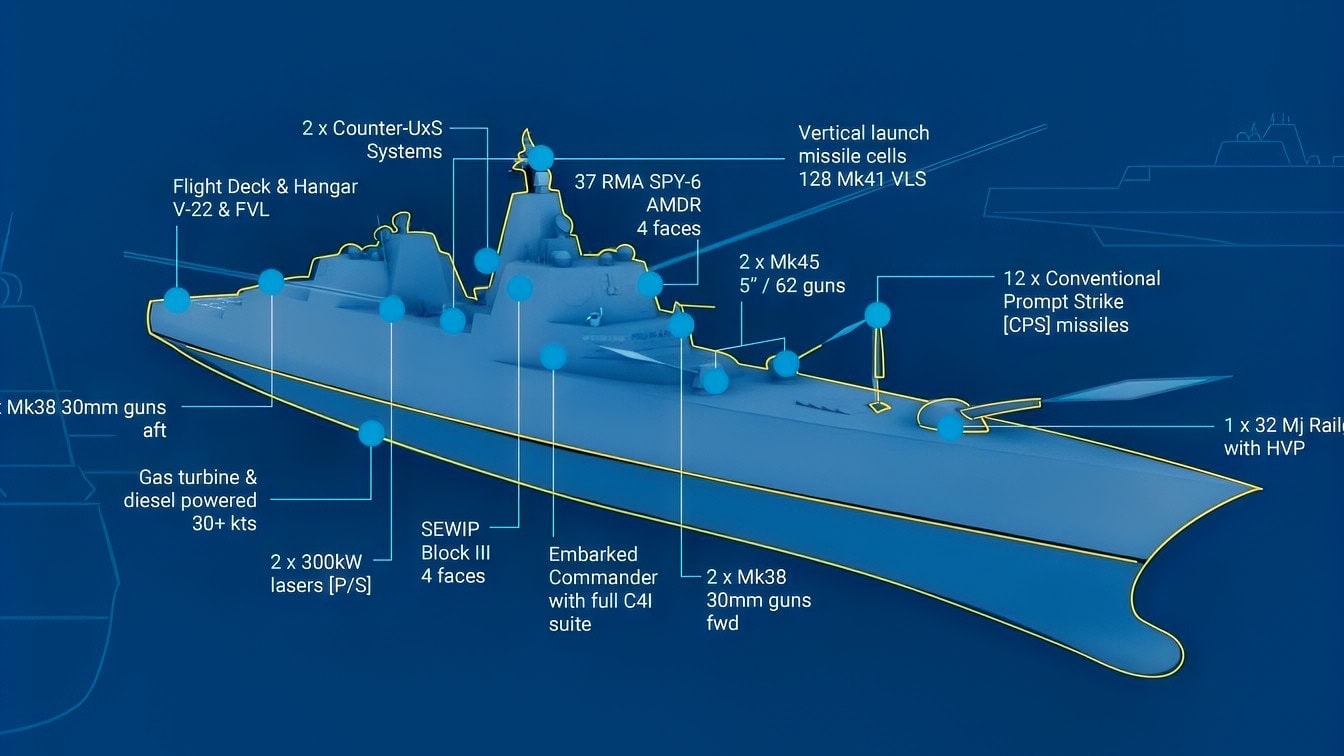
Trump-Class Battleship Creative Commons Image
-A 35,000-ton displacement, a 25 percent increase over the Russian rival
-A slight increase in hull length, 840–880 ft
-A 32-megajoule electromagnetic railgun that hurls tungsten projectiles at Mach 6
-128 x MK-41 vertical launch system (VLS) cells, which are described as “the only launching system that can simultaneously communicate with weapon control systems and missiles of every warfighting mission area: anti-aircraft, anti-surface, anti-submarine, ballistic missile, defense and land attack.”
-12 x Conventional Prompt Strike (CPS) missiles, which pair advanced hypersonic missiles with submarines and surface ships to strike high-value targets anywhere on the globe within minutes instead of hours
So, in terms of age, sophistication, and brute force alike, the Trump-class battleships would have a distinct edge over Mr. Putin’s vanity vessel.
About the Author: Christian D. Orr
Christian D. Orr is a Senior Defense Editor. He is a former Air Force Security Forces officer, Federal law enforcement officer, and private military contractor (with assignments worked in Iraq, the United Arab Emirates, Kosovo, Japan, Germany, and the Pentagon). Chris holds a B.A. in International Relations from the University of Southern California (USC) and an M.A. in Intelligence Studies (with a concentration in Terrorism Studies) from American Military University (AMU). He is also the author of the book “Five Decades of a Fabulous Firearm: Celebrating the 50th Anniversary of the Beretta 92 Pistol Series,” the second edition of which was recently published.