
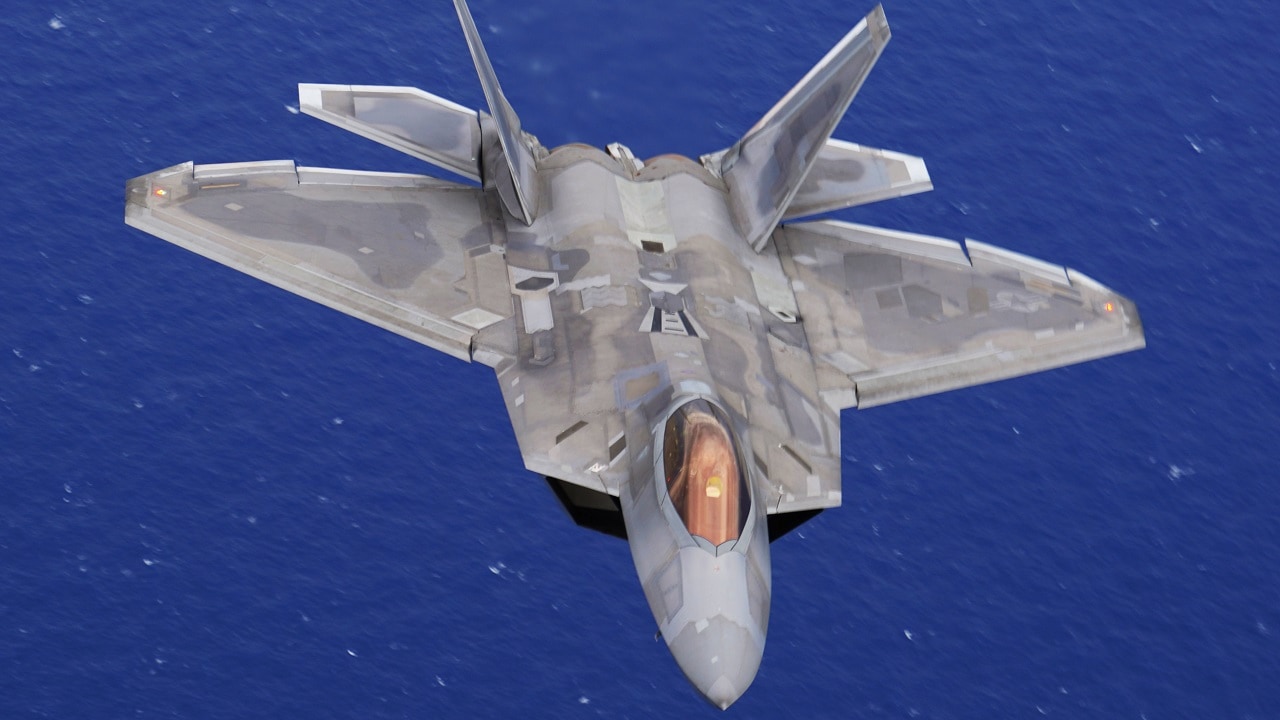
Key Points and Summary: Despite being the premier 5th-generation fighter, the F-22 Raptor was never designed for—and is physically incapable of—carrier operations.
The Weight: At 45,000 lbs, the F-22 is significantly heavier than the F/A-18 Super Hornet (32,000 lbs empty), making it too heavy for standard carrier arresting gear.
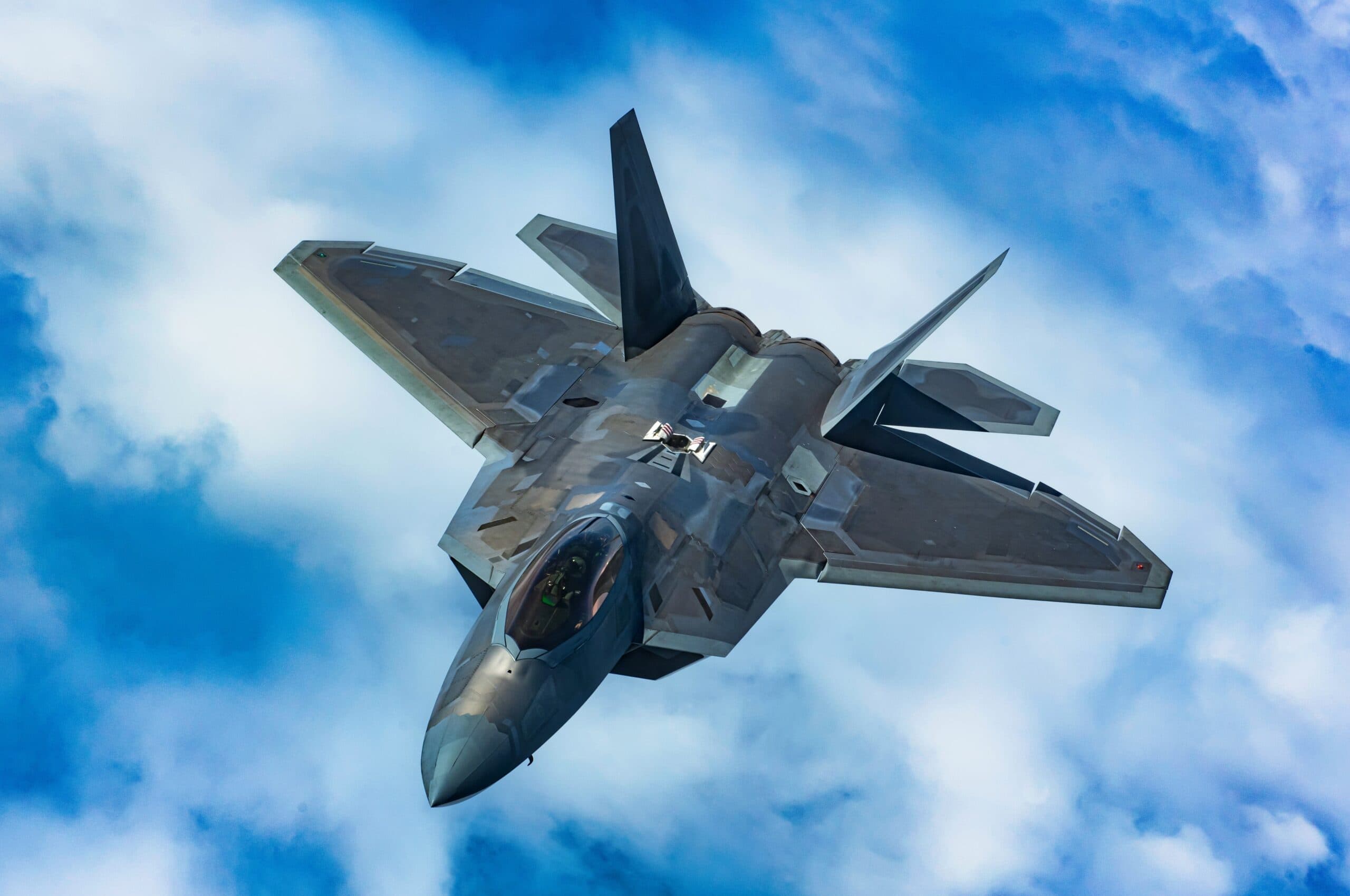
A Hawaii Air National Guard F-22 Raptor pulls away from a KC-135 Stratotanker after receiving fuel April 21, 2021, near Oahu, Hawaii. The fifth-generation aircraft, operated by Airmen from the 199th and 19th Fighter Squadrons, integrated with a Royal Australian Air Force command-and-control aircraft during exercise Pacific Edge 21. The exercise was held to enhance air-combat proficiencies through the integration of allied units and further the interoperability between the two countries’ aircraft. (U.S. Air National Guard photo by Staff Sgt. John Linzmeier)
The Structure: Its landing gear is designed for long runways, not the violent 100-knot slam of a carrier landing, which would likely cause the gear to collapse.
The Design: The Raptor’s diamond-shaped delta wing prioritizes high-speed stealth over the low-speed handling required for carrier approaches.
Why the 45,000-lb F-22 Raptor Is Too Heavy for a Navy Aircraft Carrier Deck
Aircraft carrier landings and launches are some of the most difficult, intricate, and complex operations in the entire military.
These are dangerous actions.
Airplanes come in at high power unless they miss the arresting wire and must take off again. Night landings are exceedingly challenging and require the utmost skill of everyone involved. Additionally, the flight deck crew must be highly trained and consistently confident in their roles.
Taking all of these factors into consideration, only specialized aircraft can complete a carrier launch and landing. But let’s look at one airplane that once had a chance at being carrier-borne even though we associate it with the U.S. Air Force so much today.
The F-22 Raptor was the do-it-all warbird when it came online in the late 1990s.
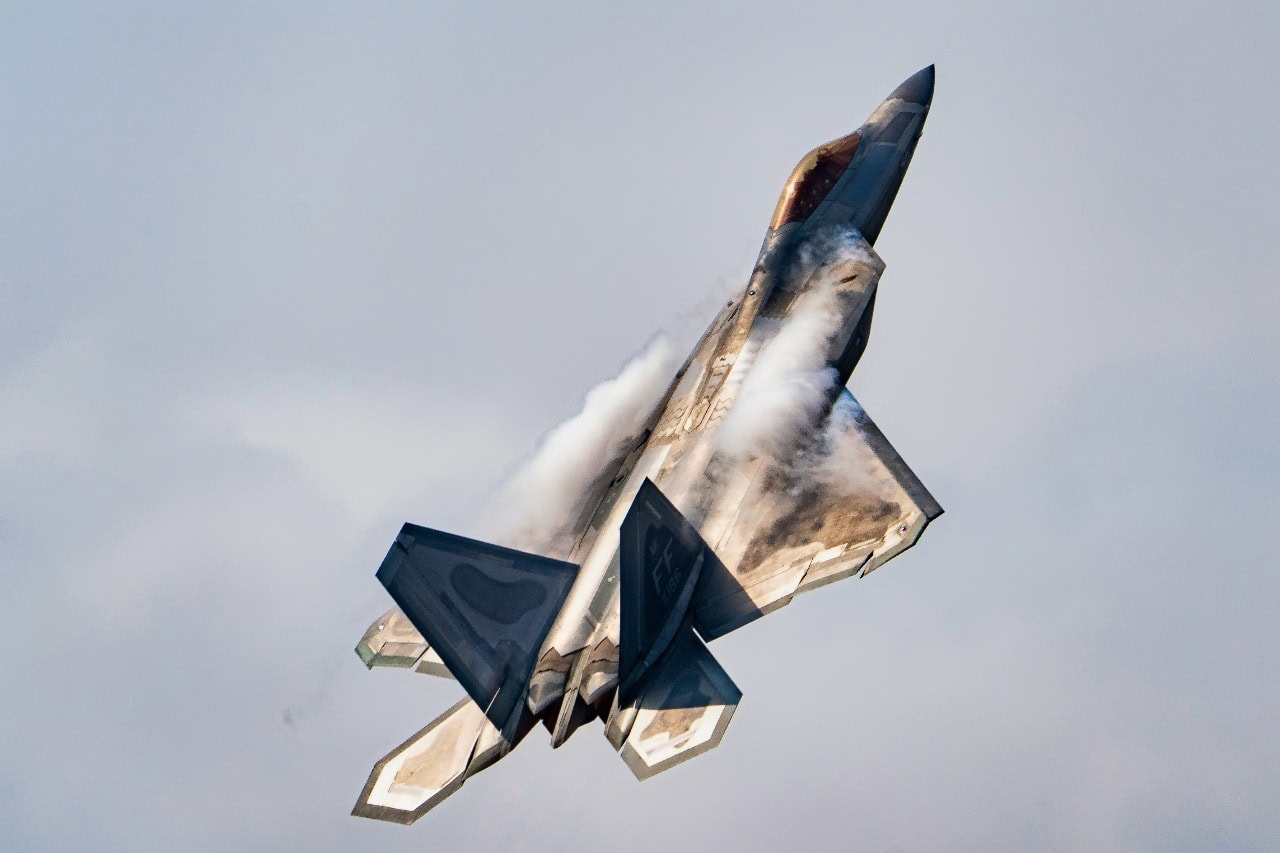
U.S. Air Force Maj. Josh Gunderson, F-22 Demo Team pilot and commander, pulls into a vertical climb during the Thunder Over New Hampshire Airshow, Sept. 12, 2021, at Portsmouth International Airport, Portsmouth, New Hampshire. The F-22 Raptor’s two Pratt and Whitney F119 Turbofan engines bring a combined 70,000 pounds of thrust, allowing the aircraft to takeoff straight into the vertical. (U.S. Air Force photo by Staff Sgt. Don Hudson)
Full of stealthiness and high performance, it was considered the first and best fifth-generation fighter jet at the time.
But could the F-22 pull off aircraft carrier duty, you ask?
Could Air Force Pilots Have Performed Naval Duty Too?
Nonetheless, the F-22 will never be able to land and take off from an aircraft carrier.
To make that happen, there would be one prime requirement. Air Force pilots would not only have to be trained to fly the Raptor, but they would also have to become carrier-qualified aviators.
This is not a realistic endeavor and would be costly and time-consuming.
Air Force pilots already have much on their plates, and it would take a highly-skilled pilot to be both conventionally-trained and carrier-competent.
The Need for Special Carrier-Qualified Design
These navalized warbirds are highly intricate aircraft that can defy the laws of physics.
Remember, the carrier is also moving through the waves during arresting and launching.
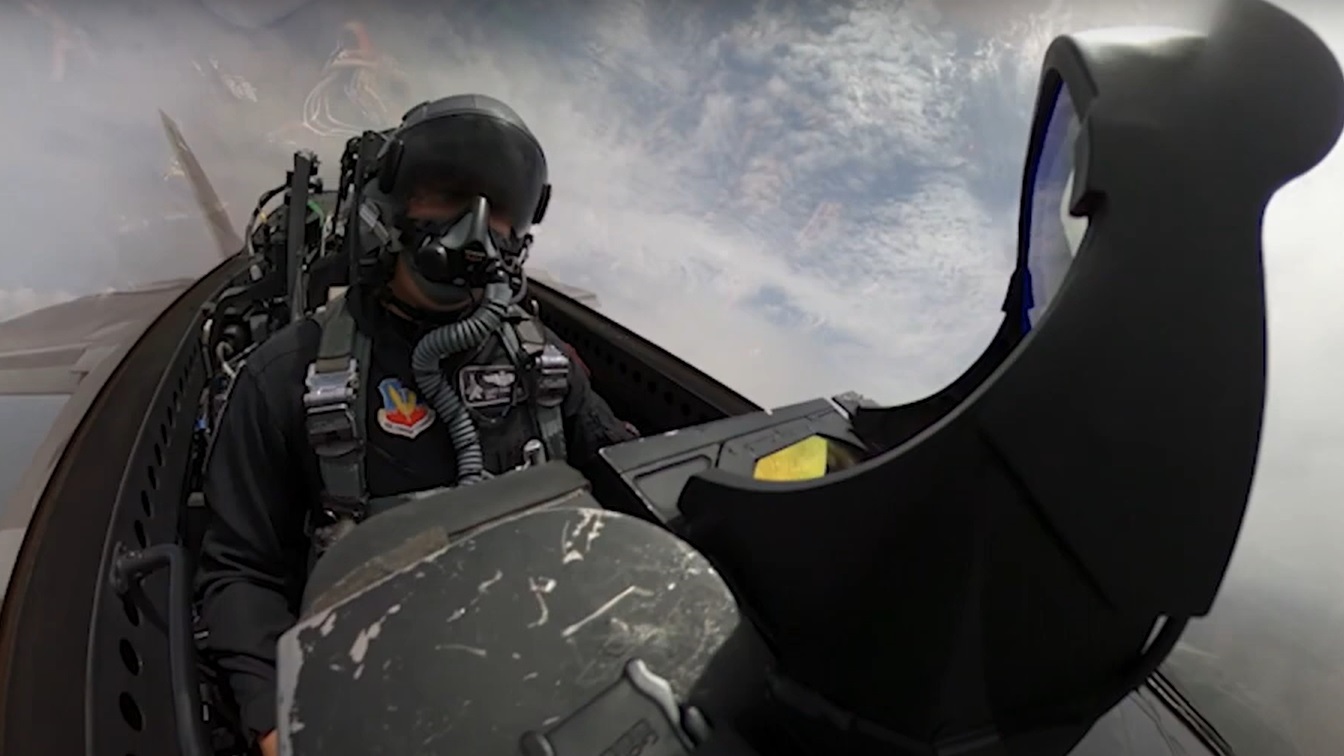
Maj. Joshua “Cabo” Gunderson, F-22 Demo Team pilot and commander, preforms a F-22 Raptor demonstration at the Space Coast Int. Air Show, May 22, 2022, with this video taken from inside the cockpit of an F-22.
This requires an airplane that has been explicitly constructed for carrier duty from the ground up. An Air Force airplane doesn’t have that type of construction to make it carrier-borne.
Naval aircraft can also quickly decelerate and descend at minimum airspeeds, making the landing a reality.
The Raptor’s Weight Is an Issue
Plus, the F-22 is simply too heavy for carrier operations.
The Navy airplanes are specially built to be lighter and more agile for the flat-top.
The F-22 Raptor weighs 45,000 pounds.
Flying empty, the F/A-18 E/F Super Hornet only weighs 32,000 pounds. The F-22 would have to slow down to 100 knots during the landing sequence, and the landing gear could not sustain that type of force when hitting the flight deck.
Then the worst would happen, once the Raptor landed, it would careen off the deck and then slide on its belly, likely going over the side and drowning the airplane and its pilot.
The F-22 Was Designed for Stealth Air Superiority, Not for Aircraft Carriers
The F-22 was never meant for the Navy. It was designed to replace the F-15 Eagle with a stealthy air superiority model, aiming to surpass the Su-27 Flanker and the MiG-29 Fulcrum.
The F-15 was a conventional take-off and landing warbird, and although there was once an effort to operate it on aircraft carriers, known as the F-15N Sea Eagle, this program never materialized.
Moreover, there were design choices that would keep the Raptor from landing and launching off carriers. The F-22 features a distinctive diamond-shaped delta wing that enables high speed but compromises accuracy at low speeds.
This is needed to slow down and land on the flat-top. The Raptor, to sustain performance, acceleration, thrust, and climbing ability, required a large and heavy engine – something that increased its overall weight.
But what power the F-22 has. The Raptor can reach MACH 2.25 at altitude and MACH 1.21 at sea level. It can accomplish +9G maneuvers, and it has a range of 460 nautical miles.
The F-22’s Numbers Were Restricted
However, geopolitical considerations reared their ugly head.
There was once a call for producing 750 Raptors. That was cut down since the Soviet Union had already broken up, and the Air Force needed fewer fighters.
Then, during the era of counterinsurgency and counter-terror after 9/11, the F-22 was in search of a mission. It is not really a ground strike fighter, and there was concern that it was a solution seeking an elusive problem.
Finally, the Air Force decided to build just 195 F-22s.
The F-22 was not meant for export due to its advanced stealth technology and other innovative systems. That meant international customers did not request a naval version.
The F-22 would only fly from airstrips, and these had to be long and improved.
Despite the need for conventional landing and take-off, there were still some who pondered whether a sea-borne Raptor could be achieved. The airplane would have needed to shed weight, and that may have compromised its stealth coating and its powerful engine size.
Without the speed and stealthiness, the F-22 would have lost what makes it such a great airplane.
Moreover, the F-22 “Sea Raptor” would have needed a new variable sweep-wing design. This would have created a significant engineering challenge that the U.S. military wanted no part of.
No F-22 Raptor on Aircraft Carriers
Therefore, the F-22 never became carrier-capable. It is too heavy. It does not perform well at low speeds.
The pilots needed to be cross-trained with the Navy, spending months on carriers and using their valuable training time on a new capability that was not required.
The Navy suffered from not having a stealth airplane until many years later. The F-35C finally checked all the stealth boxes in the 2020s, but no Sea Raptor would ever be a reality.
That was the correct decision made by the Navy and Air Force.
About the Author: Dr. Brent M. Eastwood
Brent M. Eastwood, PhD is the author of Don’t Turn Your Back On the World: a Conservative Foreign Policy and Humans, Machines, and Data: Future Trends in Warfare plus two other books. Brent was the founder and CEO of a tech firm that predicted world events using artificial intelligence. He served as a legislative fellow for U.S. Senator Tim Scott and advised the senator on defense and foreign policy issues. He has taught at American University, George Washington University, and George Mason University. Brent is a former U.S. Army Infantry officer. He can be followed on X @BMEastwood.