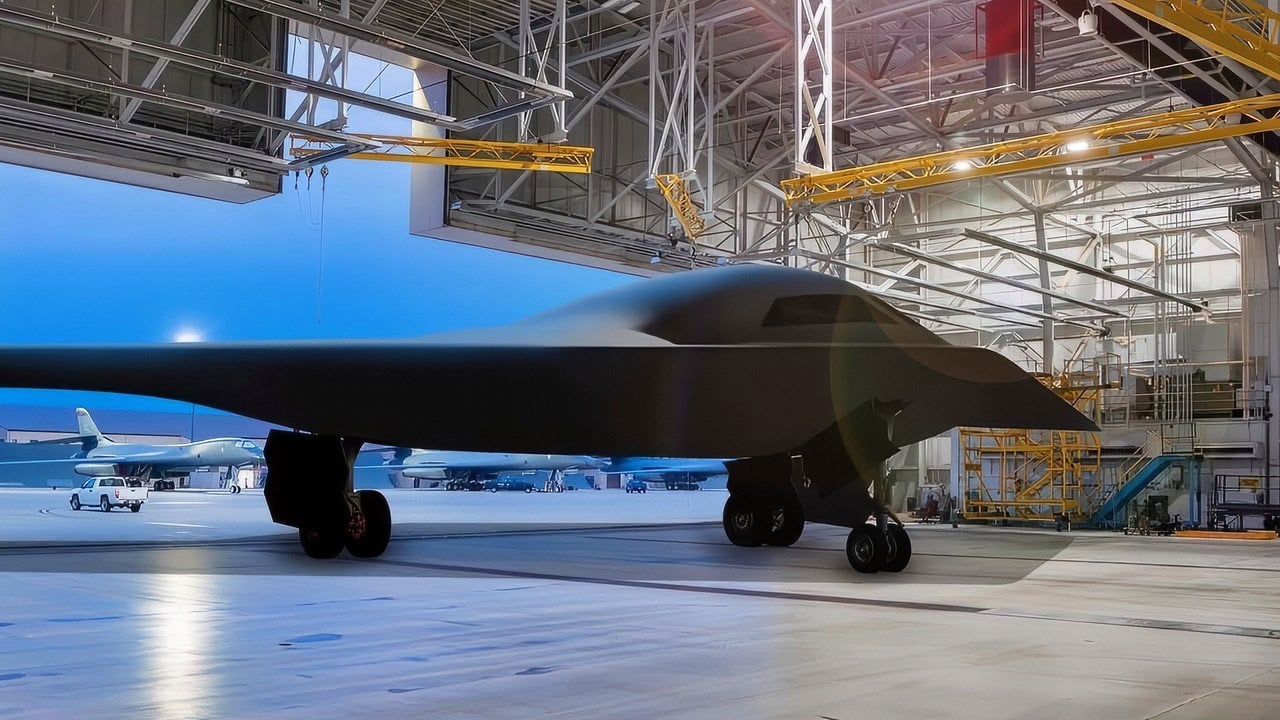
Key Points and Summary – Debate is growing over whether the United States should sell export variants of the B-21 Raider to close allies.
-The argument for sales centers on “mass”: a multinational B-21 force could cover more territory, generate more sorties, and accelerate production timelines while lowering unit costs through scale.
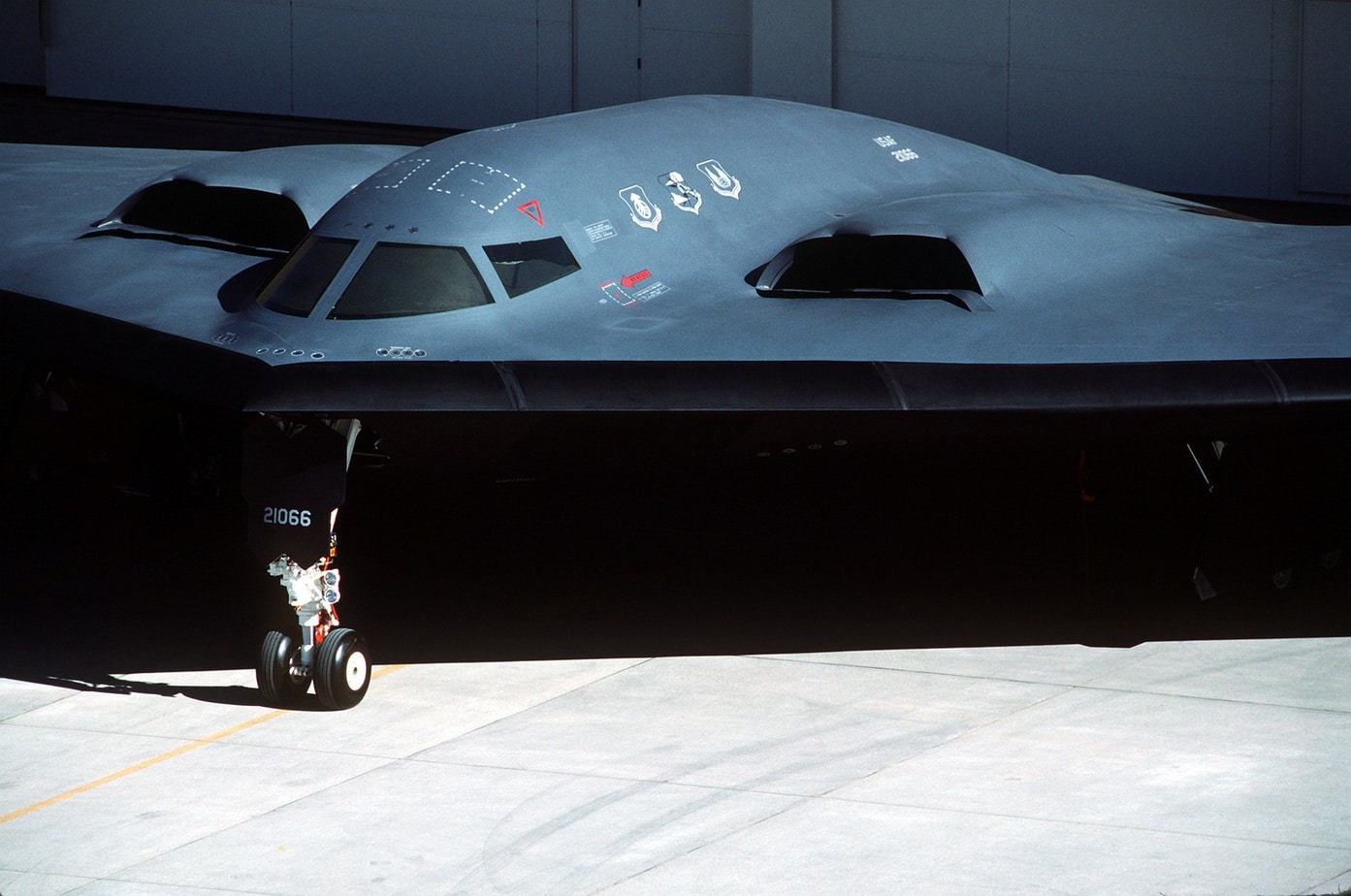
A front view of the B-2 advanced technology bomber at its rollout at Air Force Plant 42.
-Supporters also frame the B-21 as more than a bomber—an airborne sensing and command-and-control node that could network with fighters, drones, and space assets, multiplying allied combat power much like the F-35 ecosystem.
-Opponents counter that the Raider’s unique stealth and mission systems are too strategically sensitive to share.
Should America Export the B-21 Raider? The Case for a Global Bomber Force
The question of whether the US should sell export variants of its emerging B-21 is both complicated and nuanced, as there are compelling reasons to support either position.
The advantages of a large, multinational allied B-21 bomber force are substantial.
Yet, there are also great reasons to ensure the B-21’s unique set of technological attributes remains exclusively with the US military. Ultimately, the reasons for keeping it exclusive to the U.S. may not outweigh the many benefits associated with exporting the platform to allied nations.
In terms of why it might make strategic sense to sell the bomber, there is a straightforward question of “mass”: a multinational force of B-21s could cover a much broader combat envelope and operate with a better chance of prevailing in a large-scale, great-power conflict.
The ability to pinpoint several targets with a B-21 using broadband stealth has clear tactical advantages, yet a major conflict would arguably require a force of 50 to 100 bombers to blanket an area with attacks and cripple an adversary’s air defenses.
B-21 Raider Bomber Production
Even with an ambitious pace of B-21 production, Northrop could generate 4-to-7 new B-21s each year.
This means it will take nearly 10 years or more for the Air Force to field a sizable force of B-21s. However, should production be expanded on a multinational scale and the ability to massively “scale” B-21 production further be achieved, prices per aircraft would drop, and a larger fleet could arrive on a faster timetable.
There is a strong argument for this, given what is known about China’s ability to quickly “mass” produce platforms at scale.
Should China succeed in quickly building a large force of its new H-20, it could have a significant advantage in a large-scale conflict.
Without a massive US and allied multinational production effort, the US might struggle to rival a fast-emerging H-20 force.
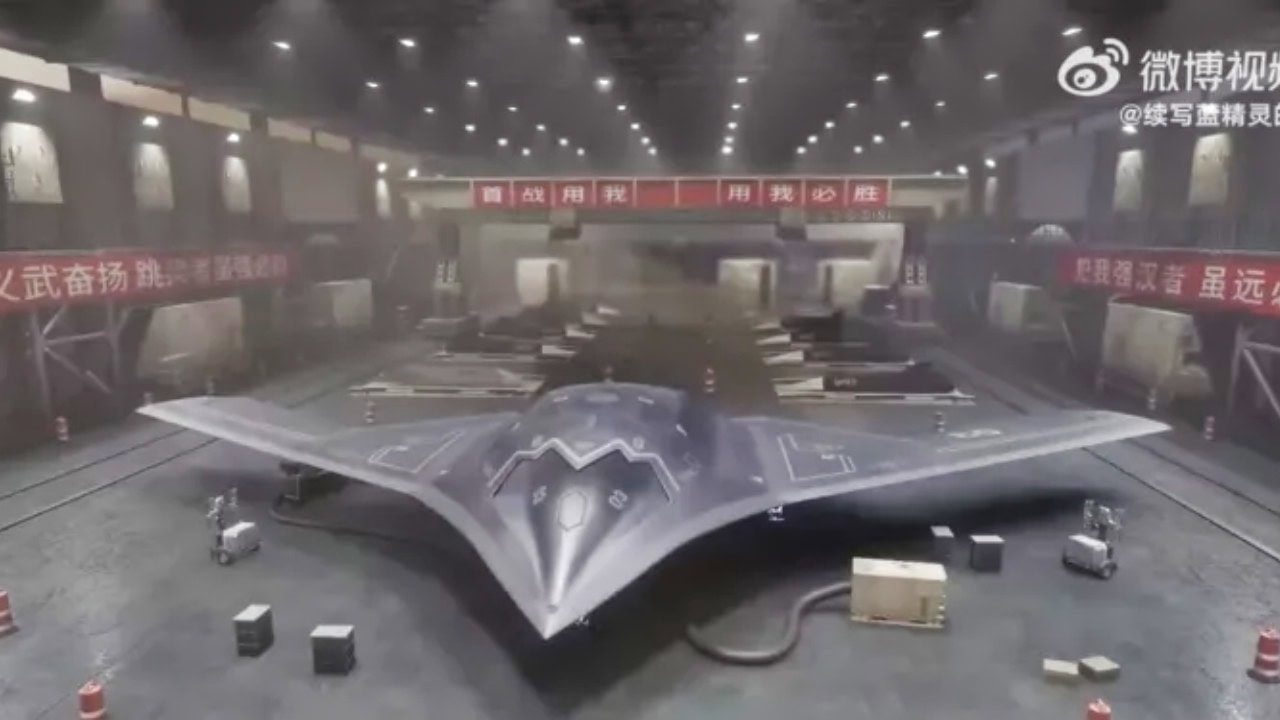
H-20 Bomber. Image Credit: X Screenshot.
Therefore, apart from whether the H-20 can rival or match the B-21 in any capacity, the PLA Air Force may have a much larger force of next-generation stealth bombers.
The Pentagon’s annual China report has repeatedly cited the threat posed by the H-20, and, among other things, its extensive combat range.
At the moment, it appears China’s H-20 production may be behind the U.S. B-21, as the H-20 has yet to occur and may be delayed.
However, much is known about the PLA’s ability to flex production, as evidenced by its now roughly 300-aircraft-strong fleet of J-20 5th-generation stealth aircraft.
U.S. Air Force B-21 Sensor in the Sky
Also, the B-21’s concept of operation as a bomber and “aerial” node performing sensing, multi-domain networking, and command and control at altitude seems to align with the argument for international sale.
The Raider is likely to be engineered with an F-35-like common data link that connects platforms and networks B-21s with drones, F-35s, 4th-generation aircraft, space assets, and, of course, ground command and control.
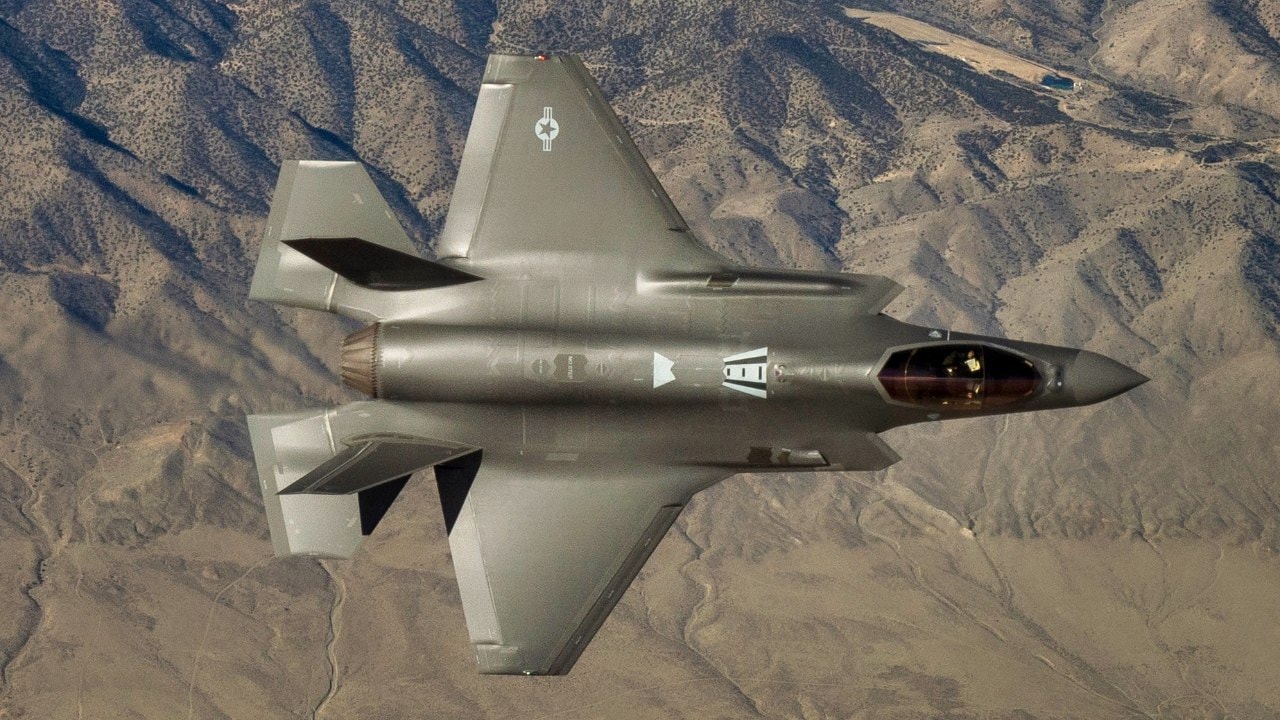
Two U.S. Air Force F-35A Lightning IIs, assigned to the 4th Fighter Squadron from Hill Air Force Base, Utah, conduct flight training operations over the Utah Test and Training Range on Feb 14, 2018. The F-35 is designed to provide the pilot with unsurpassed situational awareness, positive target identification and precision strike in all weather conditions. (U.S. Air Force photo by Staff Sgt. Andrew Lee)
This means a multi-national force of B-21s could blanket a massive operational area with new levels of advanced command and control in the air.
The argument in favor of a multinational B-21 force could parallel the success of the F-35, a platform now operated by more than 18 countries, which can connect seamlessly with one another in combat operations.
A comparable F-35-like multinational dynamic with the B-21 bomber would greatly multiply any strategic advantage the bomber may give the U.S.
About the Author: Kris Osborn
Kris Osborn is the President of Warrior Maven – Center for Military Modernization. Osborn previously served at the Pentagon as a highly qualified expert in the Office of the Assistant Secretary of the Army—Acquisition, Logistics & Technology. Osborn has also worked as an anchor and on-air military specialist at national TV networks. He has appeared as a guest military expert on Fox News, MSNBC, The Military Channel, and The History Channel. He also has a Masters Degree in Comparative Literature from Columbia University