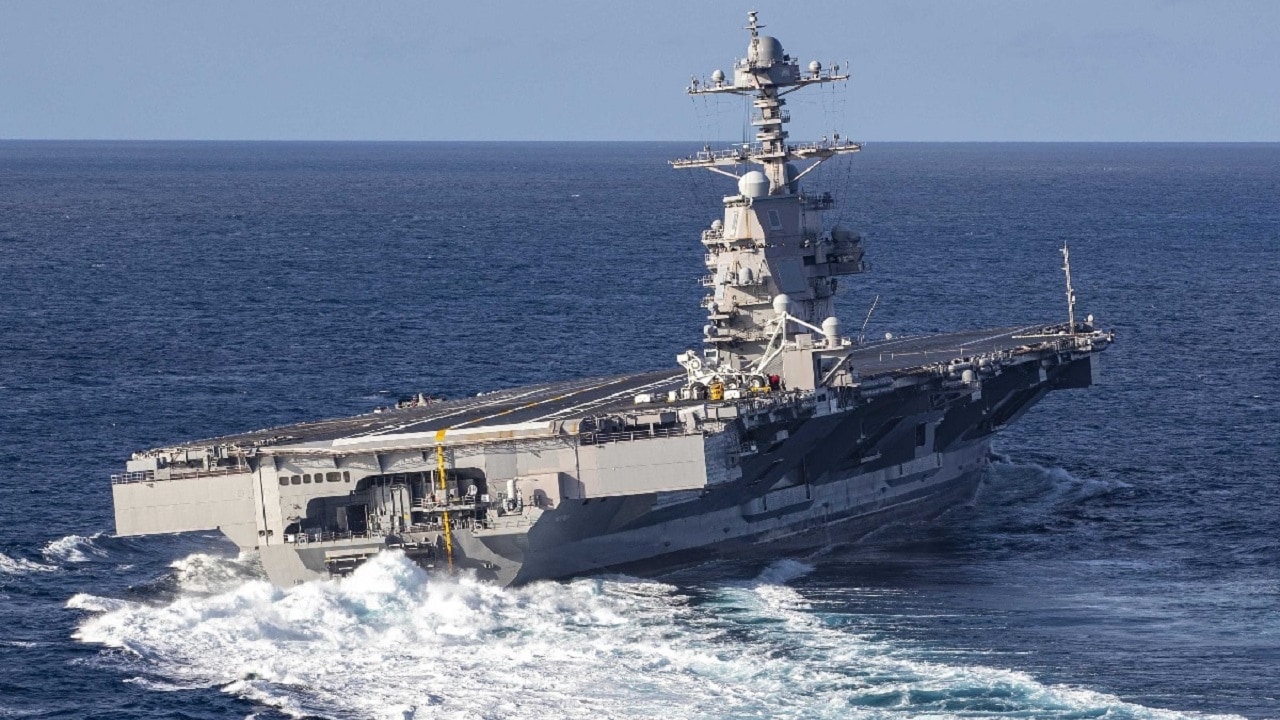
Summary and Key Points: The USS John F. Kennedy (CVN-79) is now underway for sea trials as the Navy’s second Ford-class carrier, bringing EMALS catapults, advanced weapons elevators, and a larger deck intended to generate more sorties.
-Built to replace USS Nimitz, CVN-79 also introduces the Enterprise Air Surveillance Radar, a three-face rotating phased array that draws on SPY-6 technology and gallium nitride processing to improve detection in cluttered littoral environments.
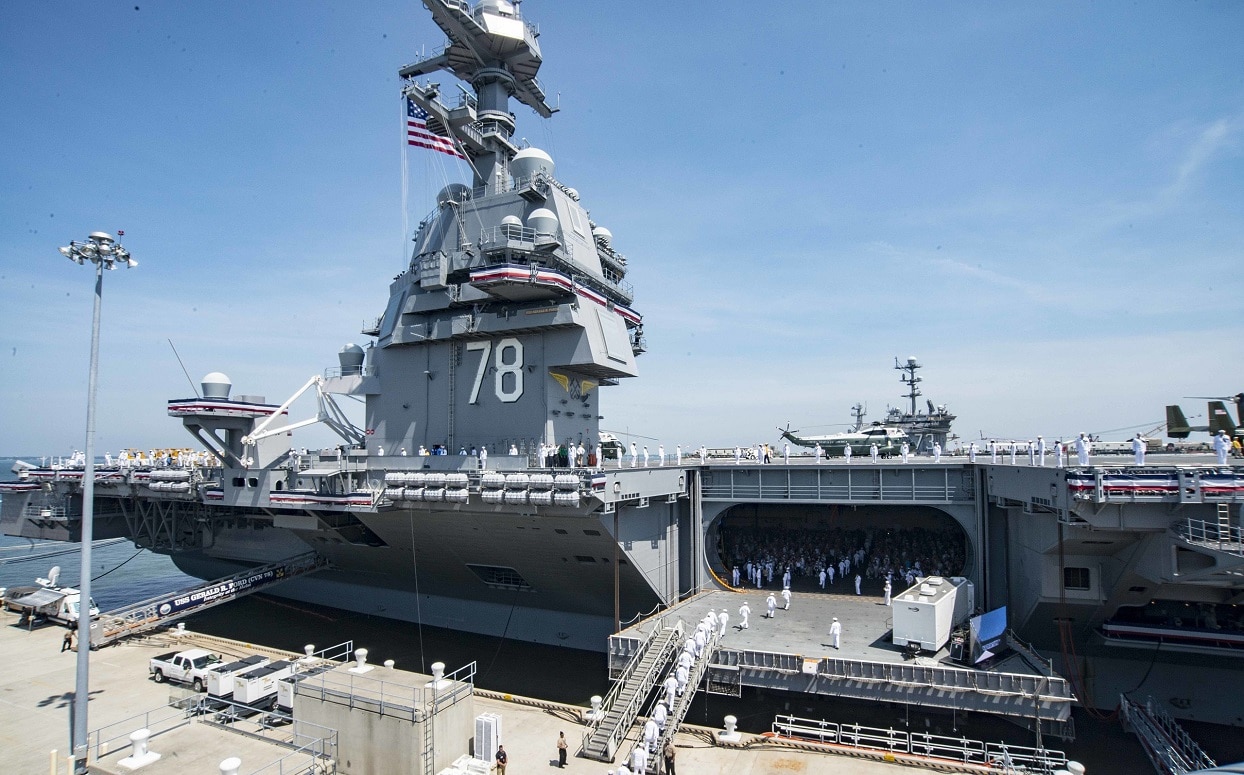
Gerald R. Ford-class. Image: Creative Commons.
-With escorts handling long-range intercepts, the carrier’s own sensors and construction quality matter. HII’s modular “superlift” approach aims to lock in Ford lessons and avoid early-class growing pains.
CVN-79 Heads To Sea: Supercarrier John F. Kennedy’s Ford-Class Sea Trials Are Underway
The USS John F. Kennedy (CVN-79) is undergoing sea trials as it moves toward introduction as the U.S. Navy’s second Ford-class carrier. The Kennedy is now at sea—its sea trials are a big step forward for the Navy’s power projection.
As the second Ford-class carrier, the Kennedy will further fortify carrier air wings with the next generation of naval aviation technology, including electromagnetic catapults, advanced weapons elevators, and a larger flight deck to enable a higher sortie rate.
The USS Kennedy will replace the USS Nimitz (CVN-68), which is due to retire by 2027. Ford-class carriers are slated to replace Nimitz-class carriers on a one-to-one basis.The Navy hopes the USS Kennedy will benefit from key lessons learned through the technological struggles associated with development of the USS Ford.
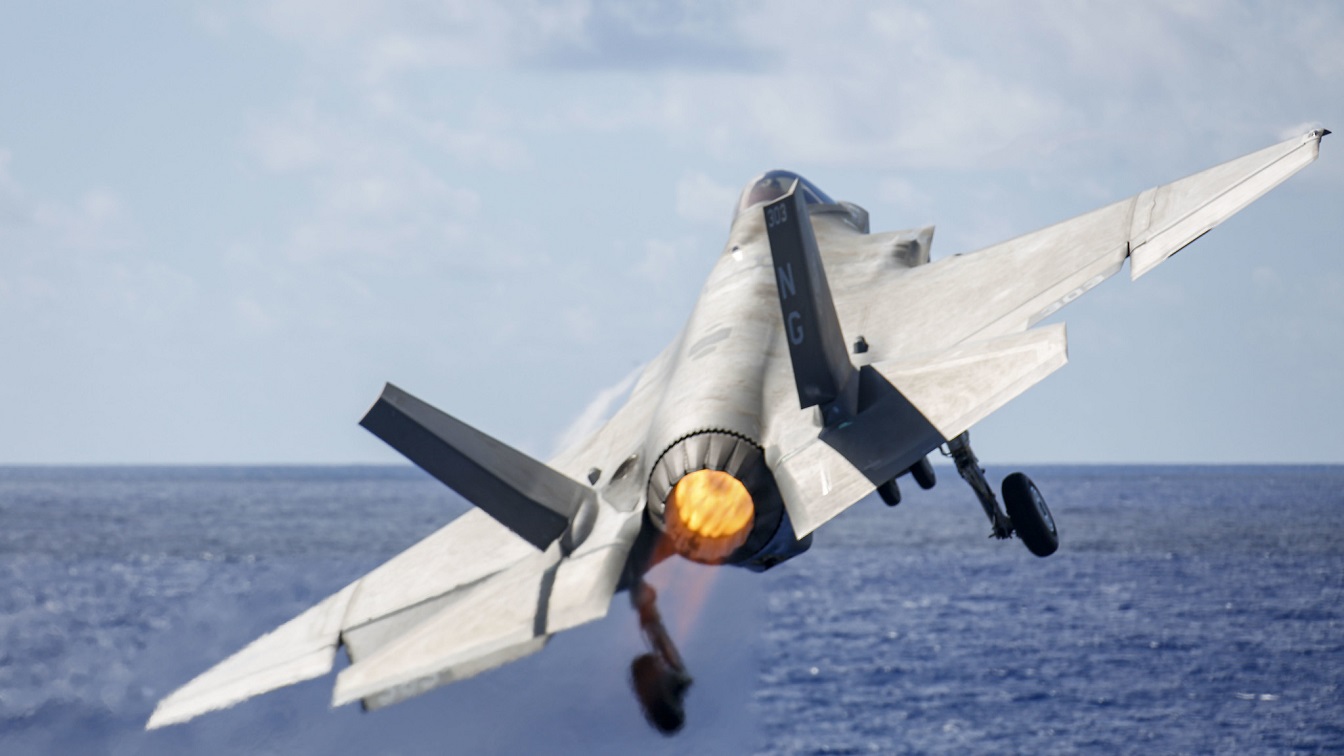
PHILIPPINE SEA (May. 13, 2022) An F-35C Lightning II assigned to the “Black Knights” of Marine Fighter Attack Squadron (VMFA) 314 launches from the Nimitz-class aircraft carrier USS Abraham Lincoln (CVN 72). The Abraham Lincoln Carrier Strike Group is on a scheduled deployment in the U.S. 7th Fleet area of operations to enhance interoperability through alliances and partnerships while serving as a ready-response force in support of a free and open Indo-Pacific region. (U.S. Navy photo by Mass Communication Specialist 3rd Class Michael Singley) 220513-N-MM912-1002
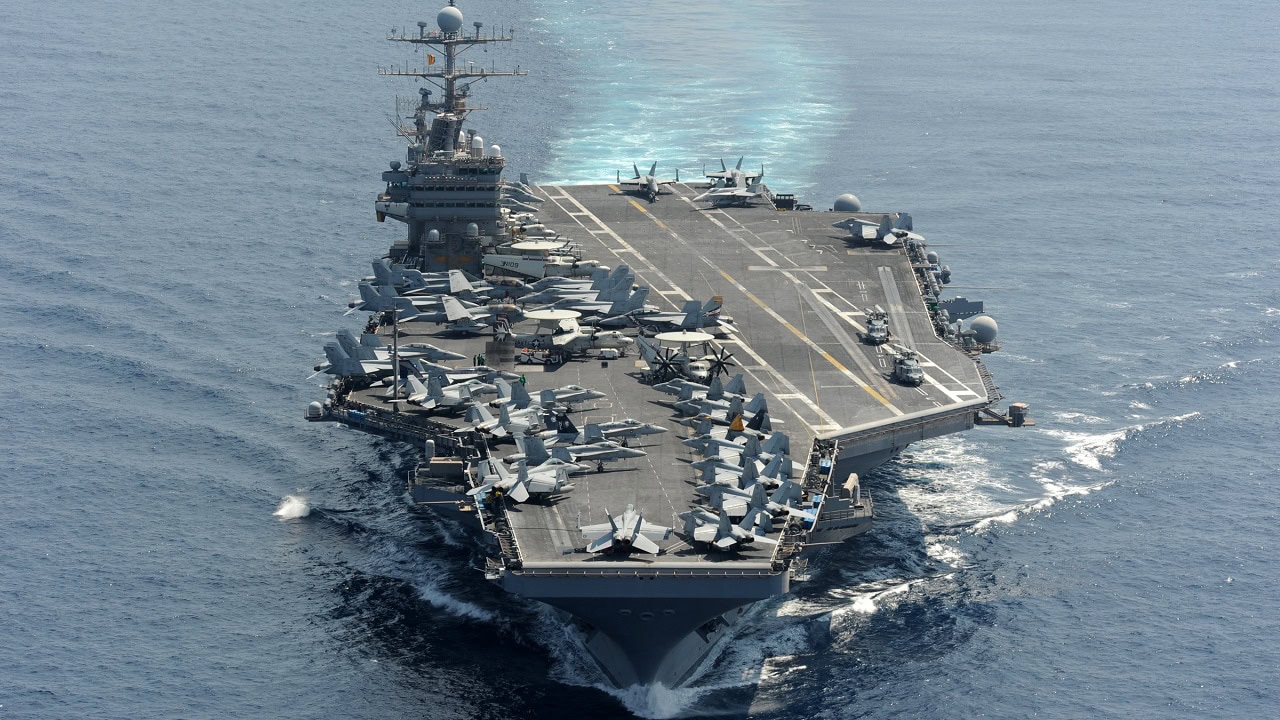
120118-N-QH883-003
INDIAN OCEAN, (Jan 18, 2012) The Nimitz-class aircraft carrier USS Abraham Lincoln (CVN 72) transits the Indian Ocean. Abraham Lincoln is in the U.S. 7th Fleet area of responsibility as part of a deployment to the western Pacific and Indian Oceans to support coalition efforts. (U.S. Navy photo by Chief Mass Communication Specialist Eric S. Powell/ Released)
The Ford is now successful and operational, and it provided lynchpin service in the operation to capture Venezuelan President Nicolas Maduro. But its advanced technologies, including the electromagnetic catapult and elevators, encountered numerous challenges as they matured.
Overall, the Navy has successfully endured these challenges and now deploys an extremely capable first-of-its-kind carrier.
New Radar on Ship
The USS Kennedy will have many of the same technologies and attributes engineered into the USS Ford, but there are a few key differences.
Years ago, the Navy decided to build a new ship-defense radar for its second Ford-class carrier to detect incoming enemy fire, anti-ship cruise missiles, and airborne threats such as attack drones, fixed-wing aircraft, and helicopters. The new radar, called the Enterprise Air Surveillance Radar, or EASR, is installed on the Kennedy as well as several of the service’s amphibious ships, such as the USS Bougainville (LHA-8).
The decision for the new radar emerged out of a special radar commonality and affordability study conducted by the Navy years ago, seeking technologies that would work across multiple platforms. The EASR is engineered as a three-faced phased array rotating radar.
EASR uses gallium nitride semi-conductor technology and builds upon common hardware, software and processing elements of the Navy’s next-generation AN/SPY-6(V) Air and Missile Defense Radar now on the service’s Flight III DDG-51 destroyers. EASR uses digital beam forming and advanced algorithms for operations in high-clutter, near-land electromagnetic interference environments, according to Raytheon.

U.S. Navy sailors view the Nimitz-Class aircraft carrier USS Carl Vinson (CVN-70) from the hangar bay of the aircraft carrier USS Theodore Roosevelt (CVN-71). Theodore Roosevelt was deployed in the U.S. 5th Fleet area of responsibility supporting Operation Inherent Resolve, strike operations in Iraq and Syria as directed, maritime security operations and theater security cooperation efforts in the region.
The AN/SPY-6 is described as being 35 times more powerful than current ship-based radar systems; developers say it enables detection of objects twice as far away and half the size compared with existing radars.
USS Kennedy vs USS Ford radar
EASR was chosen as the future radar for U.S. carriers and amphibious vessels, despite the fact that the first Ford-class carrier uses Dual Band Radar.
Dual Band Radar was originally slated to go on 27 new, high-tech DDG-1000 destroyers. However, when the Navy changed plans and only procured three DDG-1000s, the price of Dual Band Radar went up. This led Navy developers to think about the mission requirements for carriers, and the surveillance functions of EASR meet the requirements of the Kennedy.
Kennedy in Carrier Strike Group
The Kennedy, like the Ford and all other U.S. Navy carriers, will head a carrier strike group (CSG) under protection of heavily armed warships such as DDG-51 Flight III destroyers, among other warships with much more sensitive long-range radar that can track and intercept incoming missiles. Carriers do not operate with vertical launch systems and therefore do not use ballistic-missile interceptor weapons such as the Standard Missile (SM)-3 and SM-6.
Construction Strategy
The U.S. Navy and HII, the builder of the USS Kennedy, sought to harvest lessons learned from the successes and growing pains experienced during the construction of the USS Gerald R. Ford. Construction has included efforts to assemble compartments and parts of the ship together before moving them to the dock, greatly expediting construction by allowing builders to integrate larger parts of the ship more quickly.
This technique, referred to by HII developers as “modular construction,” was also used when building the Ford; workers weld smaller sections of the ship together into larger structural “superlift” units before lifting them into the dry dock. Construction begins on the bottom of the ship and works up with inner-bottoms and side shells before moving to box units, HII explains. There are also efforts to fabricate or forge some parts of the ship—instead of casting them—because it is less expensive.
About the Author: Kris Osborn
Kris Osborn is the President of Warrior Maven – Center for Military Modernization. Osborn previously served at the Pentagon as a highly qualified expert in the Office of the Assistant Secretary of the Army—Acquisition, Logistics & Technology. Osborn has also worked as an anchor and on-air military specialist at national TV networks. He has appeared as a guest military expert on Fox News, MSNBC, The Military Channel, and The HistoryChannel. He also has a Master’s Degree in Comparative Literature from Columbia.