
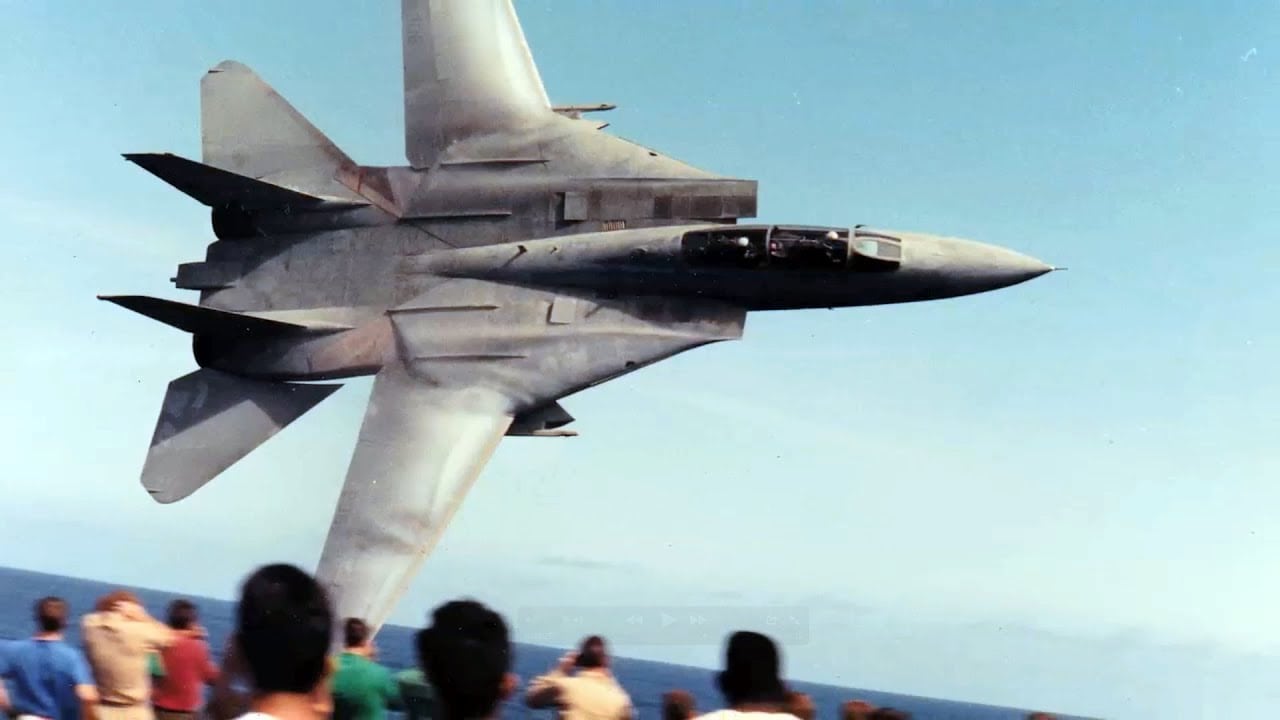
Key Points and Summary – The F-14 Tomcat was designed first as a fleet-defense interceptor—built to spot Soviet bombers early, fire AIM-54 Phoenix missiles at long range, and protect carrier strike groups before the fight ever turned close.
-Yet the Tomcat’s variable-sweep wings, strong cockpit visibility, two-crew workload split, and later-engine upgrades made it far more lethal in a dogfight than its mission brief suggested.
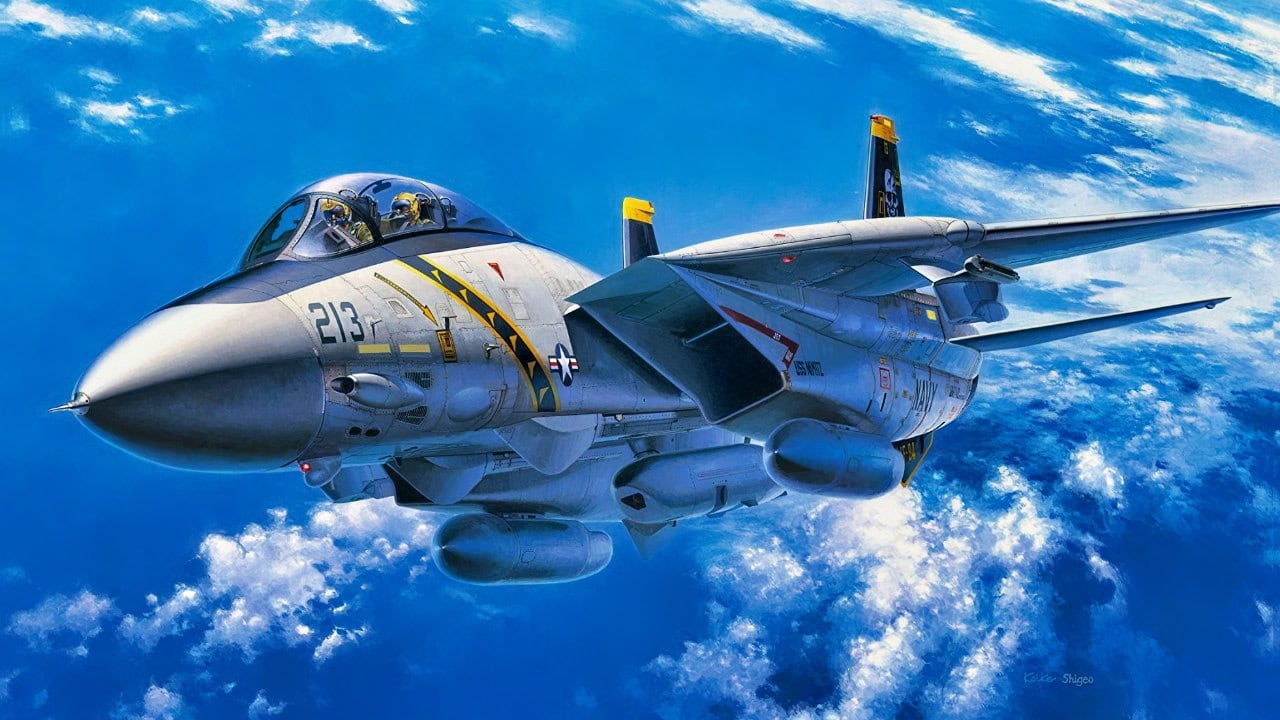
F-14 Tomcat
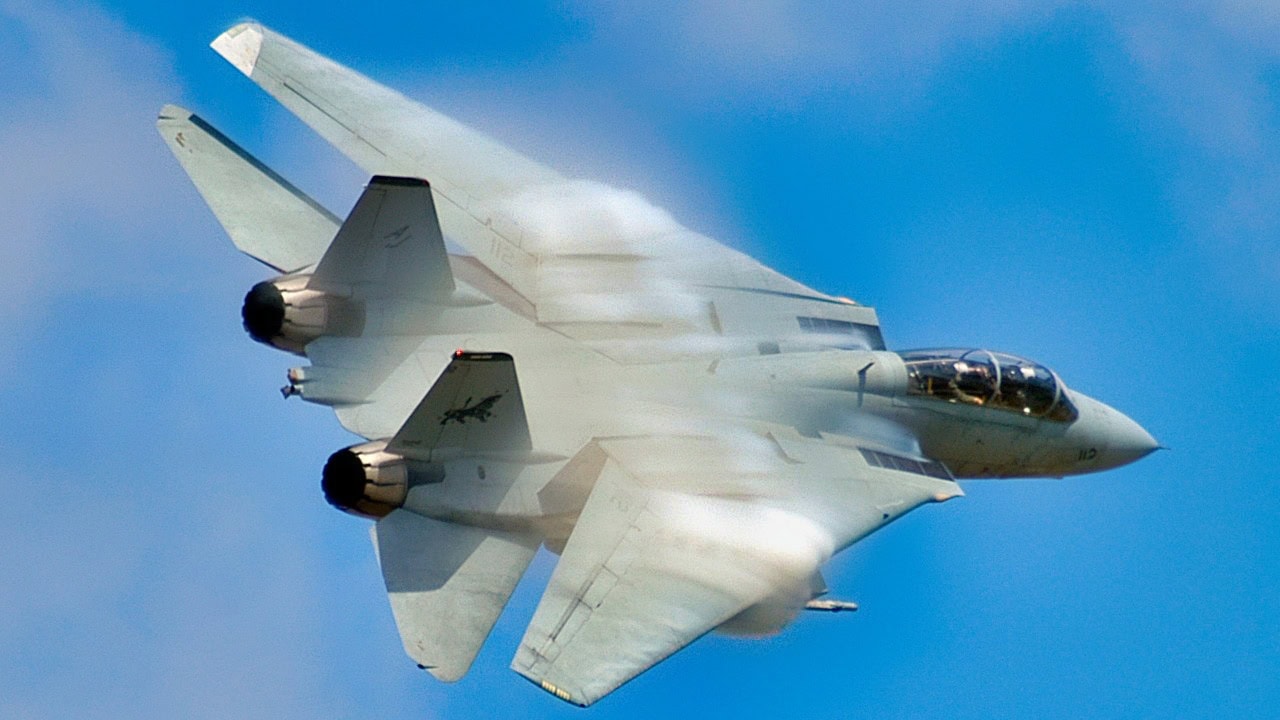
Naval Air Station Oceana, Va. (Sept. 25, 2004) – An F-14D Tomcat assigned to the “Black Lions” of Fighter Squadron Two One Three (VF-213), conducts a high-speed pass at the conclusion of the tactical air power demonstration at the 2004 “In Pursuit of Liberty,” Naval Air Station Oceana Air Show. The demonstration showcased multiple F-14 Tomcats and F/A-18 Hornets displaying various maneuvers and simulated bomb and staffing passes in front of the crowd. The air show, held Sept. 24-26, showcased civilian and military aircraft from the Nation’s armed forces, which provided many flight demonstrations and static displays. U.S. Navy photo by Photographer’s Mate 2nd Class Daniel J. McLain (RELEASED).
-Flown correctly, it could trade altitude for energy, fight in the vertical, and still bring serious radar and missile advantage to the merge.
-It wasn’t cheap to keep airborne, but it was rarely outclassed when it was.
-This article includes original photos and video of an F-14 Tomcat fighter we visited outside of Washington, DC, in 2022.
The F-14 Tomcat Was Not Built For Dogfighting, But It Excelled At It
The much-loved F-14 Tomcat was never built to be a dogfighter; it was designed to be an elite fleet defender, engaging and defeating threats to the Navy’s ships at extended ranges, long before they posed a threat to the fleet.
But regardless, it excelled as a dogfighter, especially in later variants with improved engines (such as the F110), leveraging its variable-sweep wings for high-speed performance, excellent radar, and a two-person crew for situational awareness.
The Tomcat featured excellent low-speed handling, though it struggled against lighter, dedicated gunfighters in sustained turning battles unless flown skillfully to exploit its strengths, such as vertical energy or its overwhelming BVR (Beyond Visual Range) missile capability.
Dogfighting Strengths
Naval aviators loved the F-14 Tomcat for its unmatched long-range fleet defense capabilities, its high-speed, high-altitude interceptor performance with powerful AIM-54 Phoenix missiles, and its versatile variable-sweep wings that provided both agility for dogfights and speed for high-speed flight.
Its powerful (AWG-9) radar, capable of tracking multiple targets simultaneously, and the two-man crew, allowing for enhanced situational awareness with a dedicated Radar Intercept Officer (RIO), made it a dominant air superiority fighter.
Cockpit visibility and structure were outstanding, providing excellent all-around visibility and a robust twin-engine design that enhanced survivability and enabled aggressive maneuvers. The twin GE F-110 engines each produced 29,000 pounds of thrust, propelling the aircraft to Mach 2.34 (1,795.4 mph).
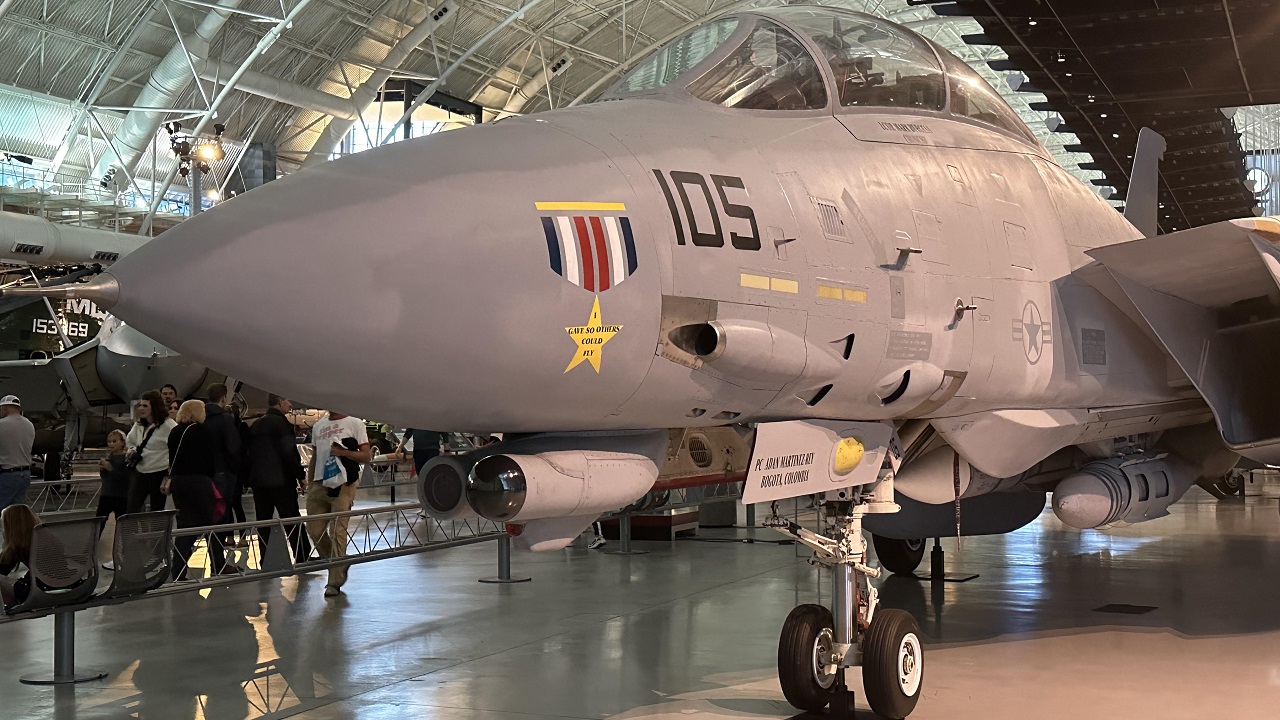
F-14 Tomcat. Image taken at National Air and Space Museum on October 1, 2022. Image by 19FortyFive.
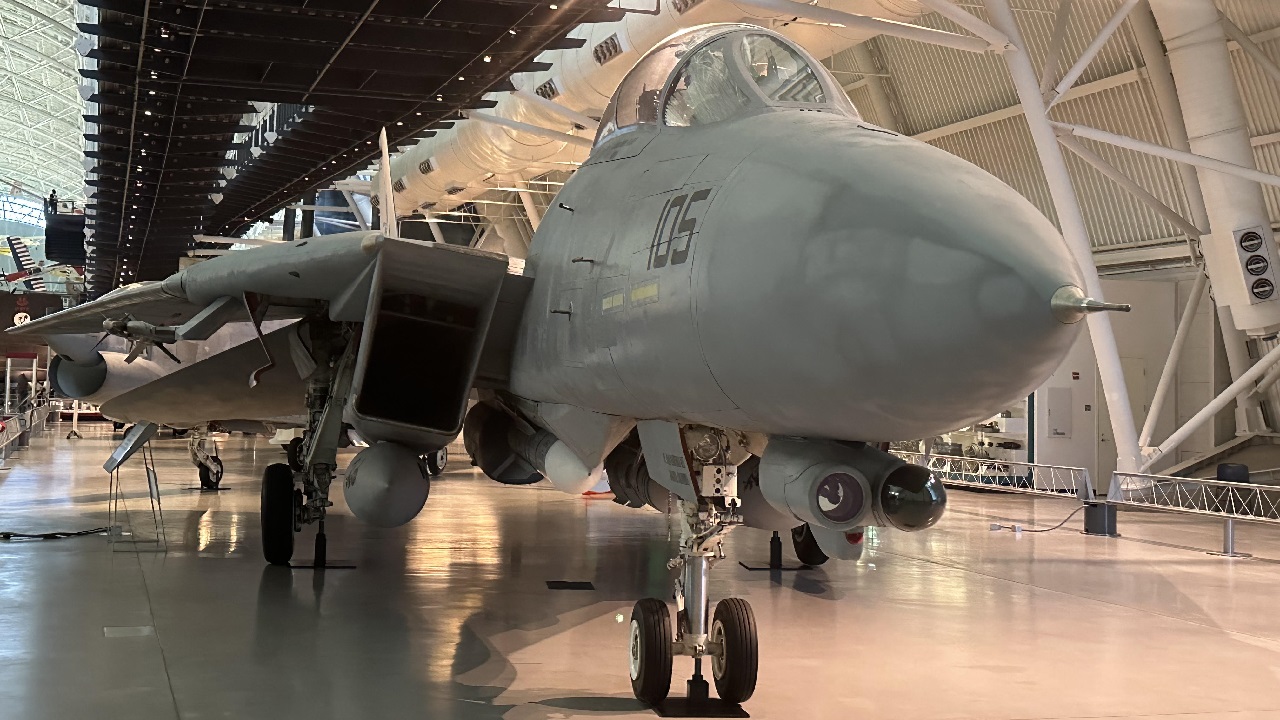
F-14 Tomcat. Image taken at National Air and Space Museum on October 1, 2022. Image by 19FortyFive.
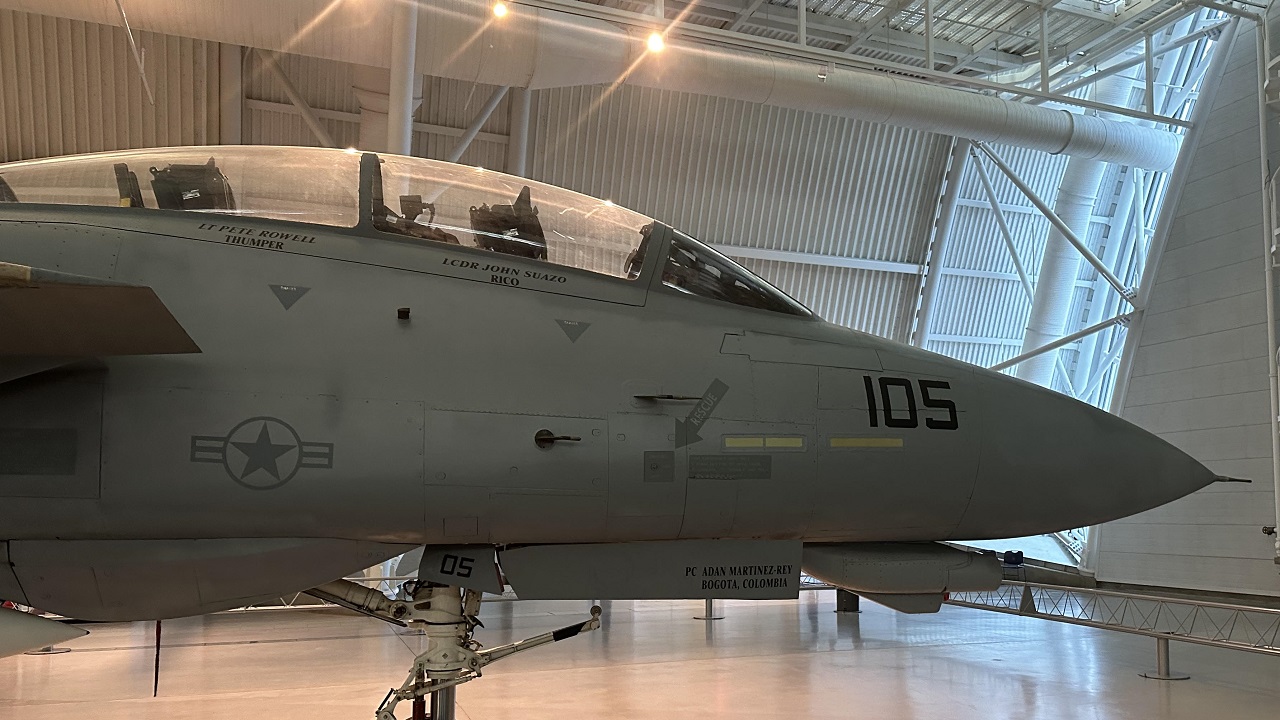
F-14 Tomcat. Image taken at National Air and Space Museum on October 1, 2022. Image by 19FortyFive.
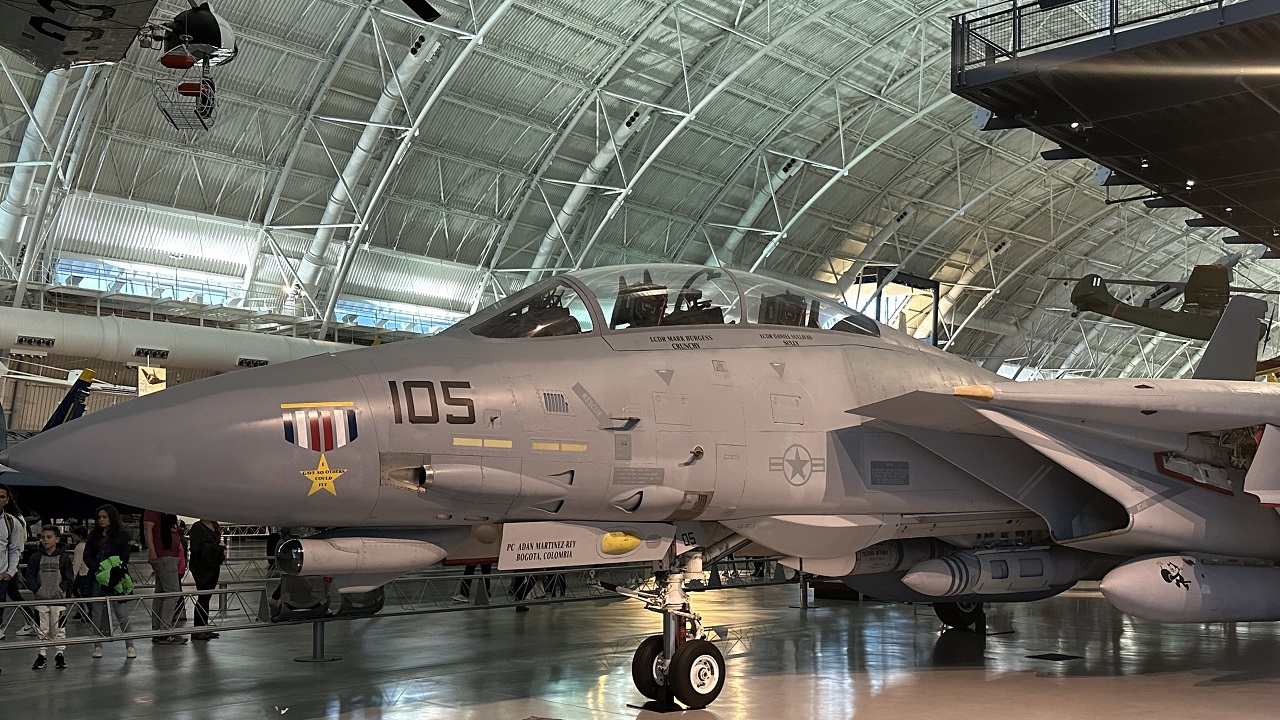
F-14 Tomcat. Image Taken at U.S. Air and Space Museum outside of Washington, D.C. Image Credit: 19FortyFive.com
The variable-sweep wing design, combined with advanced fire-control systems and the AIM-54 Phoenix missile, made the F-14 capable of engaging multiple targets at long distances while still performing close-in combat and engaging in dogfights.
The Tomcat was born from the Cold War, where the Navy expected the Soviets to unleash a torrent of bombers over the world’s oceans, firing a fusillade of missiles at the Navy’s carrier task forces.
The US missile defenses on the ships were very effective, but the ships needed advanced fighters to defend against the bombers and then engage the fighters accompanying them.
Meet The F-14 Tomcat
The 1970s have to be considered the golden age of US aviation. During that decade, the United States developed three outstanding fighter aircraft that are still in use fifty years later.
The US Air Force developed the F-15 Eagle and the F-16 Falcon, both of which it still operates, with variants that look indistinguishable from the originals. The Navy developed the F-14 Tomcat, which may or may not still have a few flyable versions left in Iran, although Israeli air strikes in June may have destroyed the final few models left.
When the discussions began for a replacement of the F-4 Phantom jets in the Navy’s carrier air wings, an evaluation was done on the F-111 Aardvark, the Air Force’s fighter-bomber. This would have maintained commonality between the Air Force and the Navy; however, the Aardvark was far too heavy for carrier operations.
The Navy instituted the VFX program to address the issue. Grumman designed its Model 303, which proposed a variable-geometry, two-seat, twin-engined design built around the Hughes AWG-9 weapons system.
Grumman had gained considerable experience with “swing-wing” technology from its earlier XF10F Jaguar, which was built only as a prototype. However, the A-6 Intruder’s wing design greatly influenced the F-14’s technology.
The F-14 Was The Navy’s Best Recruiting Tool
The F-14 Tomcat was fast enough to intercept Soviet bombers, had radar and missiles capable of detecting and shooting them down over long distances, and the maneuverability to engage in dogfights and defeat agile enemy fighters.
It was one of the world’s best fighters at the time.
It saw considerable duty in Libya, the Gulf War, Iraq, and Afghanistan. The last F-14 retired from active service with VF-213 in 2006.
One of the more intriguing aspects of the F-14 was that it saw the most combat of all US fighters since Vietnam, yet it shot down only five enemy fighters.
However, the Iranians, who owned 78 F-14s that were purchased from the United States back when the Shah was still in power, claimed that during the Iran-Iraq War, they had shot down dozens of Iraqi Soviet-made aircraft with the Tomcats.
The Hollywood film “Top Gun” centered around a brash, hotshot pilot, but the actual star of the film was the Tomcat. Navy recruiting skyrocketed due to the film, and it remains an icon of American military war films.
Why Was The Tomcat Retired?
The F-14 Tomcat was retired due to high maintenance costs, the obsolescence of its primary interceptor role after the Cold War, the emergence of the more versatile and cheaper F/A-18 Super Hornet, the difficulty and expense of obtaining replacement parts, and the fact that its advanced features, such as the variable-sweep wings, were complex and prone to issues.
Costly Maintenance Programs
The Tomcat was expensive to operate and maintain, requiring significantly more maintenance hours per flight hour compared to newer aircraft, such as the F/A-18 Hornet.
The F-14 was very expensive to maintain, requiring 40 to 60 maintenance hours for every hour of flight time. This high cost was due to its complex design, including the variable-sweep “swing wing,” and its reliance on older, less reliable technology before the advent of modern electronic components.
Operating costs were estimated to be between $35,000 and $40,000 per flight hour. For comparison, the F/A-18 Super Hornet was estimated to cost about $17,000 per flight hour.
Loss of Its Primary Mission
The F-14 was initially designed as a fleet defense interceptor against Soviet bombers during the Cold War, featuring a powerful radar system that could track enemy aircraft from over 90 miles away and fire the AIM-54 long-range missiles before the enemy even became aware of its presence.
The F-14 Tomcat was a supersonic aircraft and one of the most advanced jets in the world. However, it had a mission that became obsolete with the end of the Cold War.
Replacement by the F/A-18 Super Hornet
The F/A-18E/F Super Hornet offered greater versatility at a lower cost and with better logistical support, making it a more economical choice for the Navy’s future needs.
The Super Hornet wasn’t as fast, but it was more reliable, easier to maintain, and better suited for aircraft carrier operations. For the Navy, it made more sense to switch over than to keep investing in an older design.
The Super Hornet was a superior multirole aircraft compared to the Tomcat. And it performed better as a dogfighter at lower speeds. But the Tomcat was a superb dogfighter in its own right.
About the Author: Steve Balestrieri
Steve Balestrieri is a National Security Columnist. He served as a US Army Special Forces NCO and Warrant Officer. In addition to writing on defense, he covers the NFL for PatsFans.com and is a member of the Pro Football Writers of America (PFWA). His work was regularly featured in many military publications.