
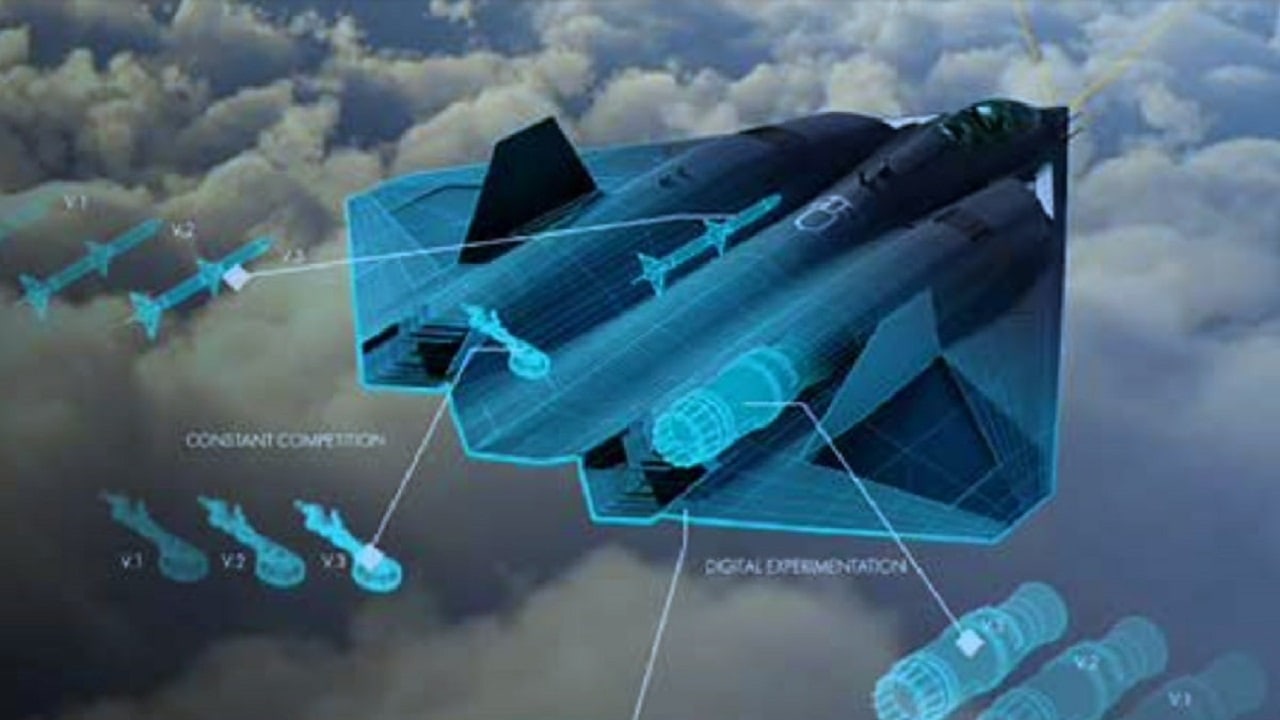
Summary and Key Points: The X-44 MANTA was a tailless experimental fighter concept built around one big idea: prove full yaw, pitch, and roll control without tailplanes by relying on 3D thrust vectoring.
-Developed as a joint effort involving the Air Force Research Laboratory, Lockheed Martin Skunk Works, and NASA, the plan envisioned converting an early F-22 prototype into a delta-wing, stealth-efficient testbed.
-Advocates argued the design could deliver extreme agility, lower drag, and cleaner low-observable shaping. But the program’s funding was cut in 2000 amid technical risk, competing priorities with the F-22 and F-35, shifting operational urgency, and the high cost of a one-off demonstrator.
Mach 1.95 And No Tail: Why The X-44 MANTA Was Defunded Before Takeoff
To marine biologists, the word “manta” signifies the majestic sea animal known as the giant oceanic manta ray (Mobula birostris), the largest type of ray in the world with a wingspan of up to 29 feet and a weight of up to 6,600 pounds. The manta ray is quite docile towards humans and feeds on zooplankton and krill.
Interestingly enough, despite the manta’s docile nature, novelist Peter Benchley made it the feature creature of his 1982 novel The Girl of the Sea of Cortez, a sharp contrast to the horrifying kill-crazy aquatic beasts of his better known novels such as Jaws and Beast.
In military parlance, you might think “Manta” would be the name of a submarine. The U.S. Navy in the time of World War II and the early Cold War had a tradition of naming submarines for sea creatures: the USS Stingray (SS-186), USS Shark II (SS-314), and, indeed, the USS Manta (SS-299). But the graceful sea creature also gave its name to an experimental aircraft: the X-44 MANTA.
X-44 MANTA Mnemonics (and Semantics)
“MANTA” is spelled in all-caps because it is an acronym for Multi-Axis No-Tail Aircraft. The “X” designates an experimental aircraft. Famous historical examples of X-planes include the Bell X-1 (the first aircraft to break the sound barrier); the North American X-15 rocket plane (which attained a mind-blowing airspeed of Mach 6.7); and the Boeing X-32 (one of the great “what might have been” stories of stealth-fighter development).
MANTA Basic Premise and Promise
The MANTA was a post-Cold War project—a joint venture between the U.S. Air Force’s Air Force Research Laboratory, Lockheed Martin “Skunk Works” division, and NASA that started in May of 1999 and received official approval the following month. MANTA’s intent was to test the feasibility of full yaw, pitch, and roll authority without tailplanes. Attitude control would rely purely on 3D thrust vectoring.
As Dennis R. Jenkins, Tony Landis, and Jay Miller elaborated in a NASA document, American X-Vehicles: An Inventory X-1 to X-50, Centennial of Flight Edition (published in 2003), “The plan is to convert an early prototype Lockheed Martin F-22 Raptor with a large delta wing (similar to that proposed for the FB-22) and advanced thrust vectoring nozzles for flight control. Thrust vectoring—the ability to turn the jet exhaust—allows an aircraft to create forces with its engines similar to the forces created by aerodynamic surfaces such as flaps, rudders, and stabilators. The result would be a structurally simple, light airframe, with increased fuel volume and better ‘stealth’ characteristics since there would be no movable aerodynamic control surfaces.”

U.S. Air Force Capt. Samuel “RaZZ” Larson, F-22 Raptor Aerial Demonstration Team pilot and commander, performs during FIDAE 2024, Santiago, Chile, April 4th, 2024. The F-22 Raptor Aerial Demonstration showcases the unmatched maneuverability of the airframe by executing a series of combat maneuvers to inspire Americans and their allies, and deter foreign adversaries. (U.S. Air Force video by Staff Sgt. Michael Bowman)
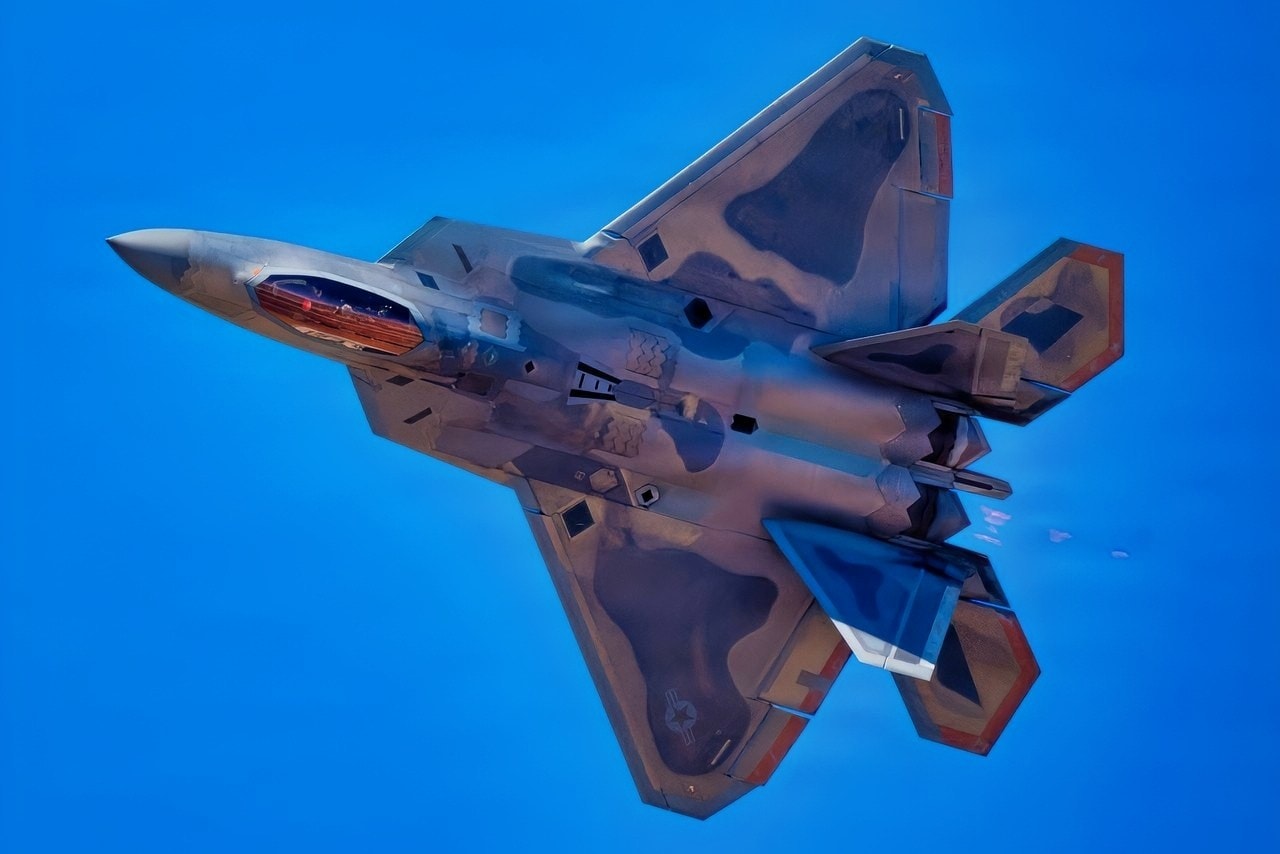
U.S. Air Force Capt. Samuel “RaZZ” Larson, F-22 Raptor Aerial Demonstration Team pilot and commander, performs during FIDAE 2024, Santiago, Chile, April 4th, 2024. The F-22 Raptor Aerial Demonstration showcases the unmatched maneuverability of the airframe by executing a series of combat maneuvers to inspire Americans and their allies, and deter foreign adversaries. (U.S. Air Force video by Staff Sgt. Michael Bowman)
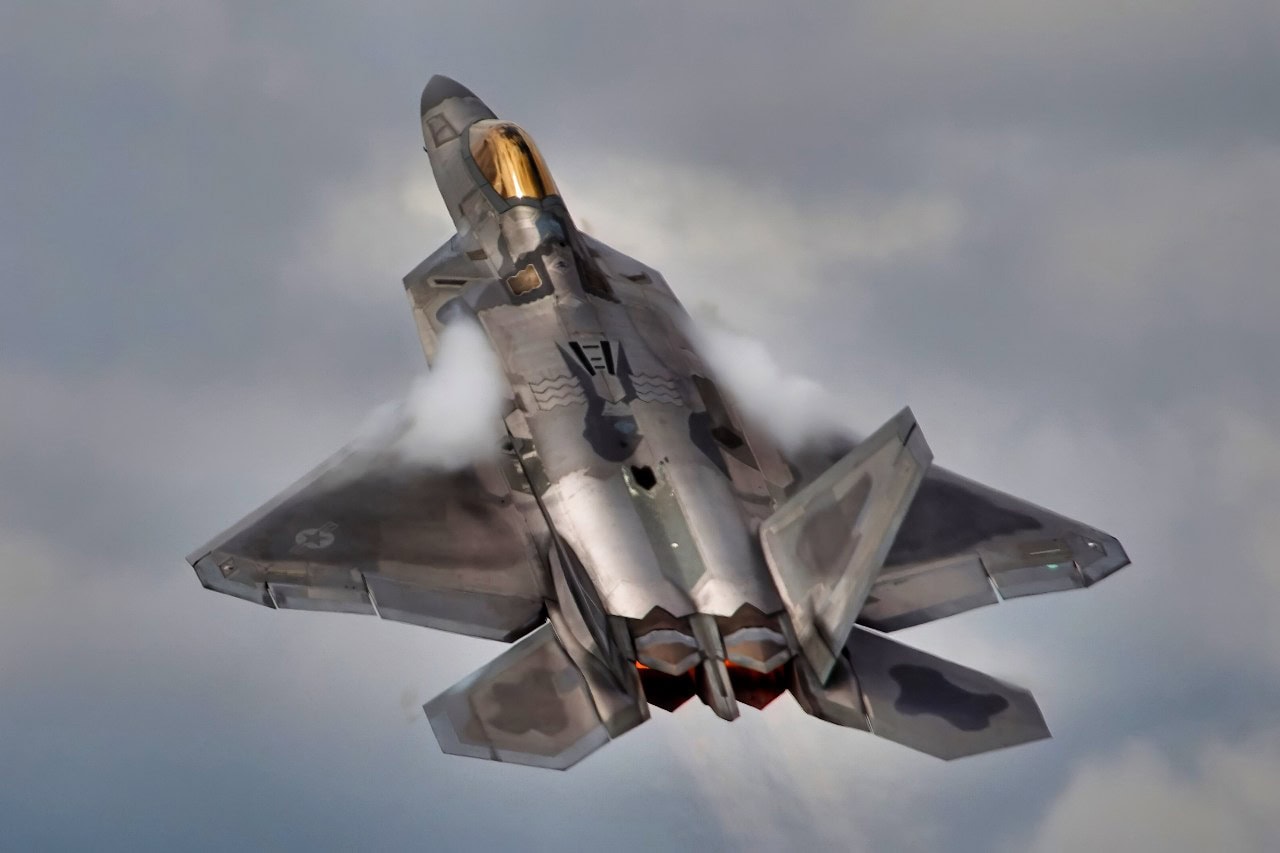
F-22 Raptor in Flight Back in 2017. Image Credit: Creative Commons.
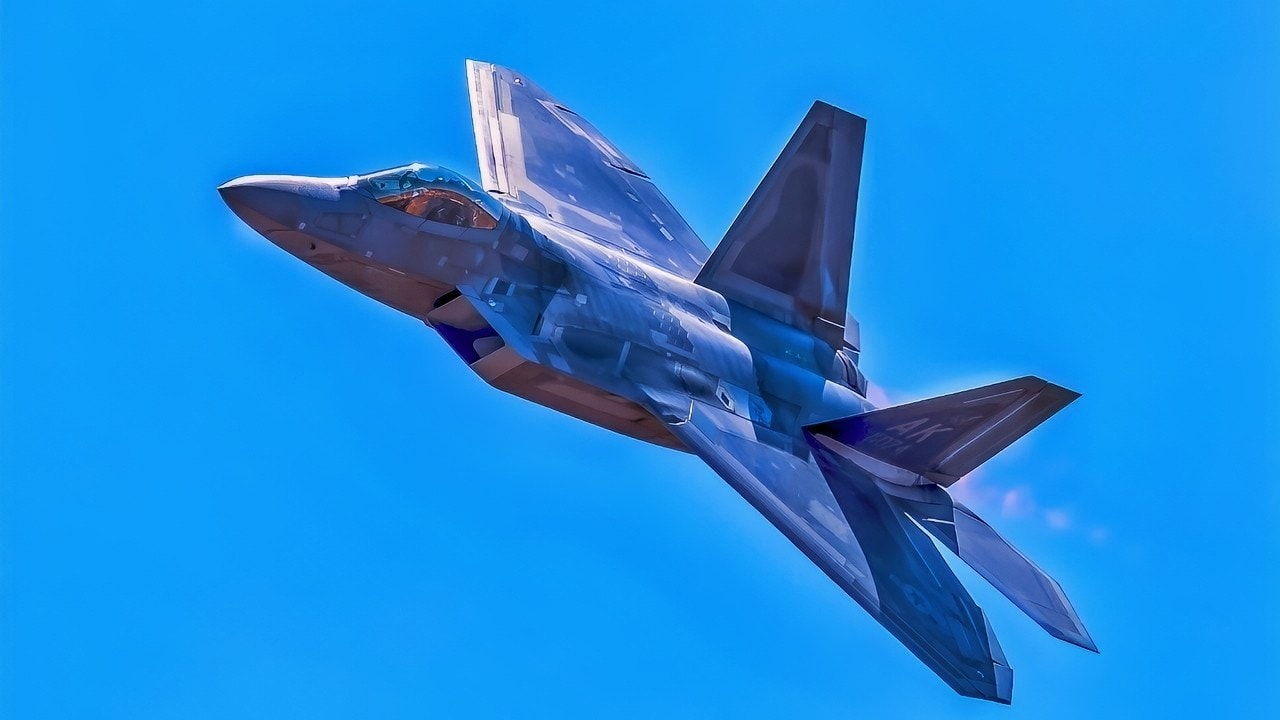
F-22 Raptor Fighter Flying High (1). Image Credit: Creative Commons.
When looking at the artist’s rendering depicted in the document, one can definitely see the resemblance to the Raptor—the lack of a tail notwithstanding.
Thrust vectoring would grant the kind of maneuverability that would overwhelm enemy fighter planes. The pilot could change the angle of thrust to control altitude, thus allowing the airplane to aggressively change directions, putting even the famed Russo-Ukrainian “cobra maneuver” to shame. For good measure, the warbird would have been blessed with lower drag. The tailless design would make instability a virtue rather than a vice.
An introductory page on that same publication adds: “Many have a misconception that X-vehicles have always explored the high-speed and high-altitude flight regimes – something popularized by Chuck Yeager in the original X-1 and the exploits of the twelve men that flew the X-15. Although these flight regimes have always been in the spotlight, many others have been explored by X-vehicles. The little Bensen X-25 [gyrocopter] never exceeded 85 mph, and others were limited to speeds of several hundred mph.”
Hypothetical Tech Specs and Vital Stats
The X-44 MANTA would have indeed been a Mach buster:
-Max Airspeed: Mach 1.95
-Powerplant: 2 x (side-by-side) Pratt & Whitney turbofan engines generating 35,000 lbs. of thrust
-Fuselage Length: 62 feet
-Service Ceiling: 49,000 feet
-Armament: internal weapons bays with potential for a full payload of AIM-9 Sidewinder infrared missiles; active radar-guided AIM-120 Advanced Medium Range Air-to-Air Missiles; laser-guided “smart bombs;” and a 20-mm internal cannon
So, What Went Wrong?
The authors of that 2003 NASA publication were cautiously optimistic about the MANTA’s prospects: “The X-44 is unlikely to fly before 2007, although the F-22 program will retire the first and second flying prototypes long before then. The X-44 technology, combined with fluidic nozzles and supersonic-cruise aerodynamics, could lead to a generation of high-performance, very stealthy aircraft, with exceptionally high aerodynamic efficiency.”
Nevertheless, all funding to the X-44 was cut in 2000—though it was not officially canceled.
The decision boiled down to five big reasons:
Technical Risk: “Safety is paramount,” as one military training mantra goes. As cutting-edge as the X-44 looked on paper, decision-makers did not want to risk money and reputation on a one-off demonstration that might crash on its maiden flight due to instability.
Overlapping Programs: The standard F-22 was still in its teething phase. Meanwhile another Skunk Works stealth fighter jet, the F-35 Lightning II, was consuming vast resources and political capital.
Lack of Sense of Urgency: Operational urgency, to be precise. The year after MANTA was defunded, 9/11 happened. Counterinsurgency warfare soon took priority over the near-peer adversaries stealth fighters were built to challenge. The F-22—which had its own production curtailed prematurely—was seen as adequate for air superiority needs.
The March of Time & Technology: By the time the 2010s arrived, even though the fifth-generation F-22 and F-35 had barely gone operational, sixth-generation warbirds had already entered the conversation.
Testing Costs: Like so many other promising military programs that died in their metaphorical wombs, the MANTA’s Achilles heel proved to be dollars and sense. As our esteemed editor, Harry Kazianis, eloquently put it, “Without an institutional champion, those costs become cliffs. The MANTA had admirers, not patrons.”
About the Author: Christian D. Orr, Defense Expert
Christian D. Orr is a Senior Defense Editor. He is a former Air Force Security Forces officer, Federal law enforcement officer, and private military contractor (with assignments worked in Iraq, the United Arab Emirates, Kosovo, Japan, Germany, and the Pentagon). Chris holds a B.A. in International Relations from the University of Southern California (USC) and an M.A. in Intelligence Studies (concentration in Terrorism Studies) from American Military University (AMU). He is also the author of the newly published book “Five Decades of a Fabulous Firearm: Celebrating the 50th Anniversary of the Beretta 92 Pistol Series.”