
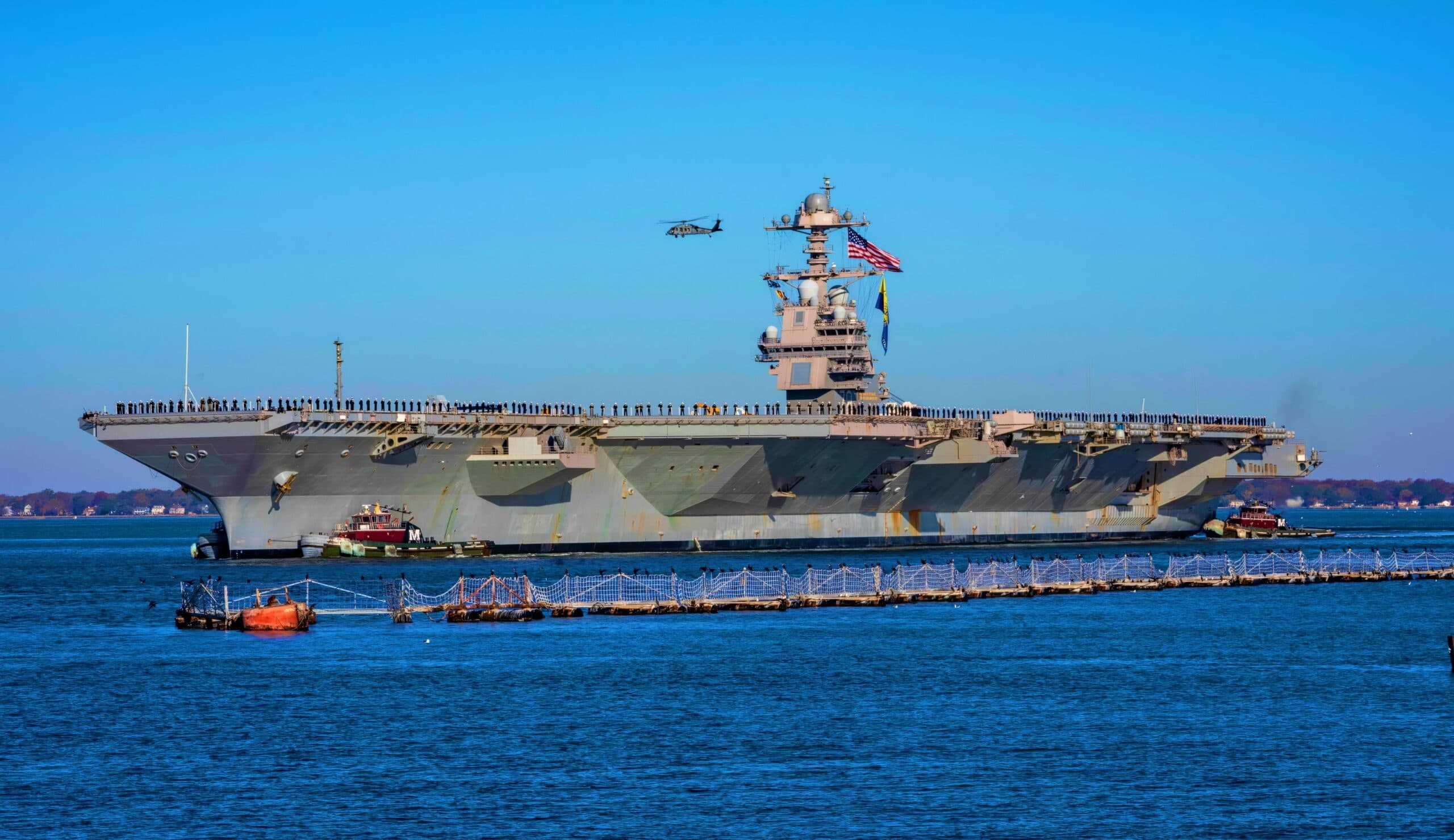
Summary and Key Points: USS Gerald R. Ford is extending its June 24, 2025, deployment and shifting to the Middle East amid rising tensions with Tehran—an extension that could push it past 300 days at sea and break the modern 294-day aircraft carrier record if it remains on station beyond mid-April.
-The move highlights how operational demand is colliding with fleet sustainability: delayed shipyard work, postponed testing for new systems, and mounting strain across the strike group.
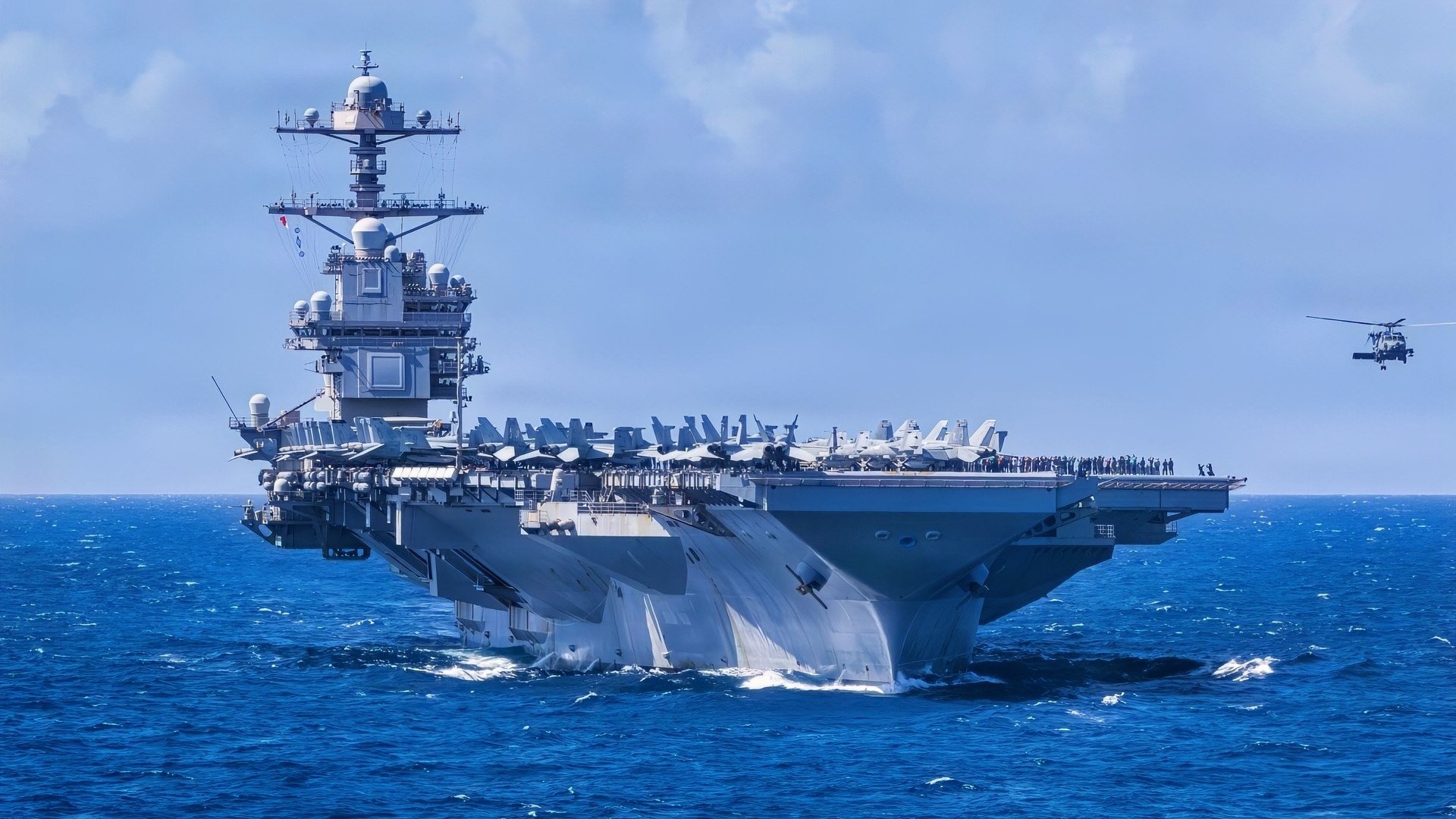
U.S. Navy Carrier Air Wing 8 aircraft fly in formation over the world’s largest aircraft carrier, Ford-class aircraft carrier USS Gerald R. Ford (CVN 78), during Carrier Air Wing 8’s aerial change of command ceremony while underway in the Caribbean Sea, Jan. 19, 2026. U.S. military forces are deployed to the Caribbean in support of the U.S. Southern Command mission, Department of War-directed operations, and the president’s priorities to disrupt illicit drug trafficking and protect the homeland. (U.S. Navy photo)
-Chief of Naval Operations Adm. Daryl Caudle signaled strong resistance to extensions, citing the human cost to sailors and the readiness penalties that follow when maintenance windows slip.
USS Gerald R. Ford’s Long Deployment Could Break Cold War Record for Aircraft Carrier Deployment
As of mid-February 2026, the USS Gerald R. Ford (CVN-78) is extending its deployment, heading to the Middle East, with projections suggesting it will break the 294-day post-Vietnam War record for carrier deployments if it remains on station past mid-April.
This follows an earlier 2024 deployment that lasted eight months.
Last week, President Trump ordered the USS Gerald R. Ford to deploy to the Middle East amid heightened tensions between Washington and Tehran.
It will take approximately a week for CVN-78 to reach the region, and it could be May before the warship returns to her homeport at Naval Station Norfolk, Virginia, after exceeding 300 days deployed.
Longest Navy Aircraft Carrier Deployment Since The War In Vietnam
The carrier is expected to exceed 300 days deployed, rivaling Vietnam-era lengths, as it supports operations in the Middle East.
Following operations in the Caribbean and Mediterranean, the Ford was redirected to the Middle East, with about 250 days on station by the time it arrived, according to The Maritime Executive.
These extended operations are expected to delay critical maintenance and testing of the ship’s new, advanced technologies.
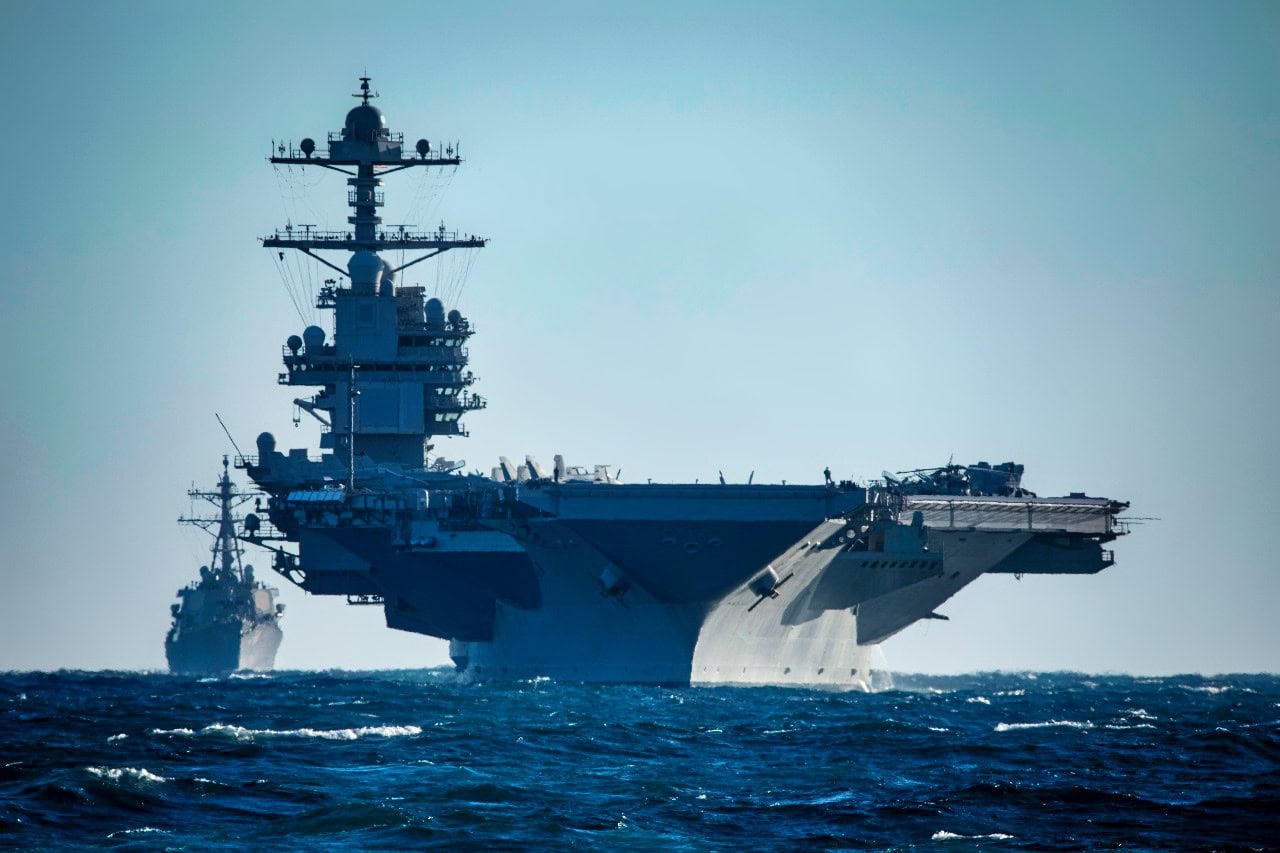
A view from the Ticonderoga-class guided missile cruiser USS Normandy (CG 60) of the first-in-class aircraft carrier USS Gerald R. Ford (CVN 78) and the Arleigh Burke-class guided missile destroyers USS Thomas Hudner (DDG 116), USS Ramage (DDG 61) and USS McFaul (DDG 74) as the ships steam in formation during a drill while underway as part of the Gerald R. Ford Carrier Strike Group March 5, 2023. Ford Carrier Strike Group is underway in the Atlantic Ocean executing its Composite Training Unit Exercise (COMPTUEX), an intense, multi-week exercise designed to fully integrate a carrier strike group as a cohesive, multi-mission fighting force and to test their ability to carry out sustained combat operations from the sea. As the first-in-class ship of Ford-class aircraft carriers, CVN 78 represents a generational leap in the U.S. Navy’s capacity to project power on a global scale. (U.S. Navy photo by Mass Communication Specialist 2nd Class Malachi Lakey)
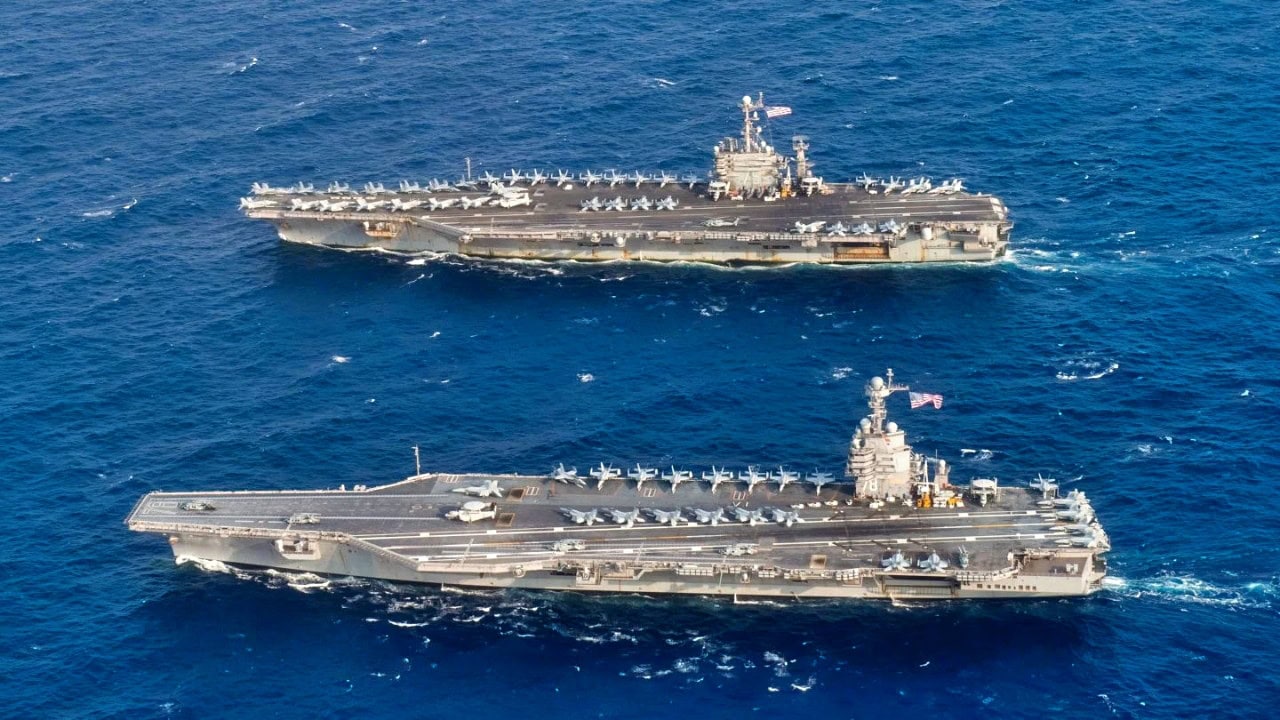
Ford-Class Aircraft Carrier U.S. Navy. Image Credit: Creative Commons.
The longest post-Cold War deployment for days at sea is currently held by the Nimitz-class aircraft carrier USS Abraham Lincoln (CVN-72), which spent 294 days deployed from April 2019 to January 2020. The USS Lincoln is currently on station in the Middle East.
The longest carrier deployment since 1964 was the USS Midway (CVA-41), which deployed for 332 days in 1972-73.
The carrier’s 2024 deployment included 33,444 flight deck moves and 16,351 aircraft fueling evolutions. The ongoing 2026 deployment underscores the strain of extended, high-intensity operations on the Navy’s fleet and the reliance on the Ford’s advanced capabilities, according to USNI News and Forbes.
America Promised Help To The Iranian People
After the protests in Iran resulted in the regime murdering thousands of its own people (some estimates run as high as 12,000-to-20,000 dead), President Trump told the Iranian people that help is on the way.
The Iranians responded with Iranian state TV on Wednesday, warning Trump against interfering with the country, saying “this time” the bullet “won’t miss” as it showed a picture of the president emerging from an assassination attempt at a Butler, Pennsylvania, campaign rally in July 2024.
However, the Navy’s top admiral said he was seeking to avoid extending the deployment of the USS Gerald R. Ford Carrier Strike Group (CSG), and sending it for any potential operation against the Iranian regime.
The Ford’s carrier strike group had been operating in the Caribbean, which is in the US Southern Command (SOUTHCOM) region, during the Operation Absolute Resolve mission to capture Venezuelan dictator Nicolás Maduro.
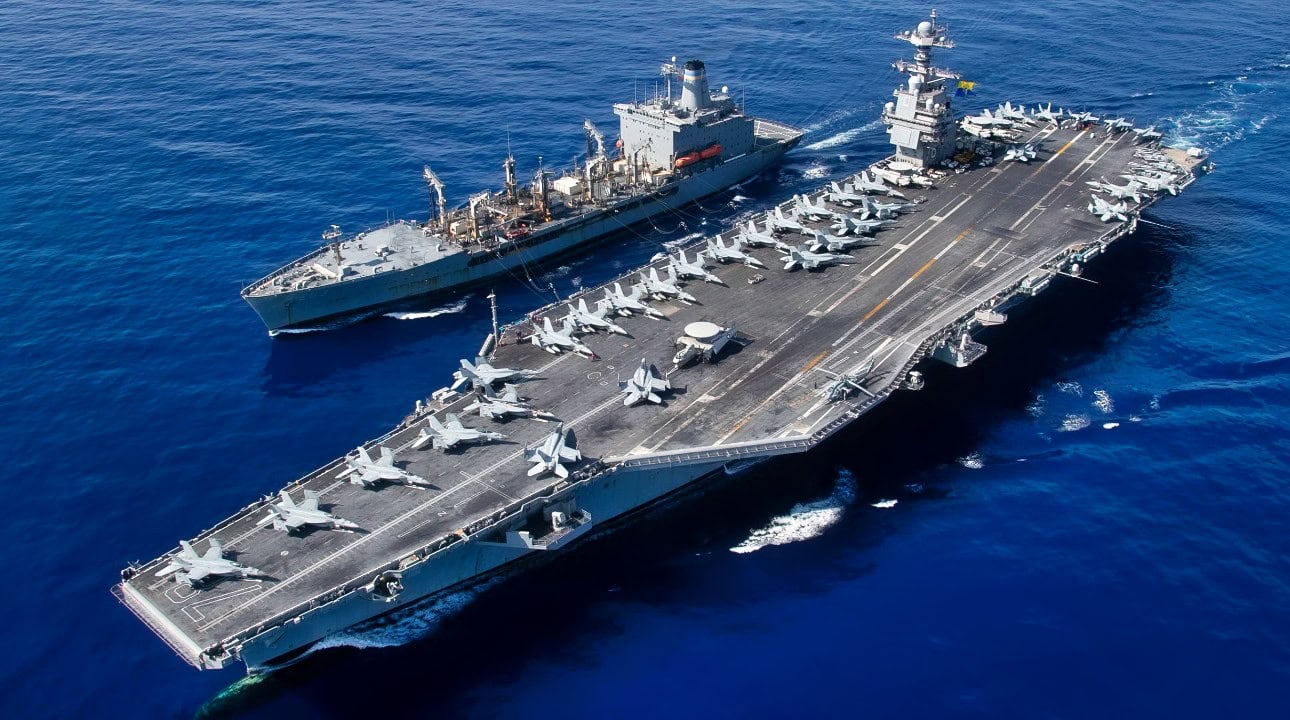
The world’s largest aircraft carrier USS Gerald R. Ford (CVN) 78 and the USNS Laramie (T-AO-203) conduct a refueling-at-sea in the Eastern Mediterranean Sea, Oct. 11, 2023. USS Gerald R. Ford is the Navy’s newest and most advanced aircraft carrier, representing a generational leap in the U.S. Navy’s capacity to project power on a global scale. The Gerald R. Ford Carrier Strike Group is currently operating in the Eastern Mediterranean Sea, at direction of the Secretary of Defense. The U.S. maintains forward deployed ready and postured forces to deter aggression and support security and stability around the world.(U.S. Navy photo by Mass Communication Specialist 2nd Class Jackson Adkins)
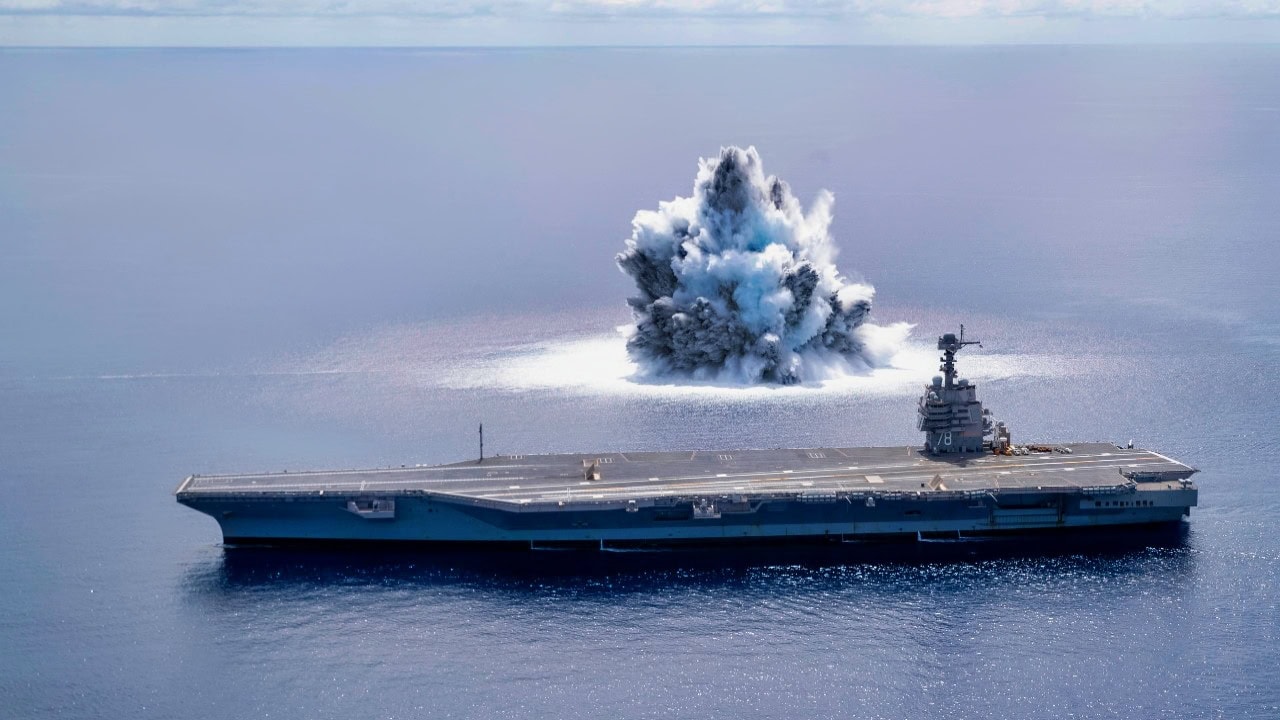
The aircraft carrier USS Gerald R. Ford (CVN 78) completes the first scheduled explosive event of Full Ship Shock Trials while underway in the Atlantic Ocean, June 18, 2021. The U.S. Navy conducts shock trials of new ship designs using live explosives to confirm that our warships can continue to meet demanding mission requirements under harsh conditions they might encounter in battle. (U.S. Navy photo by Mass Communication Specialist 3rd Class Riley B. McDowell)
The carrier strike group has been at sea since leaving its homeport of Norfolk on June 24, 2025. The Navy plans its force employment timelines and prioritizes current force demands while assessing its ability to meet future contingencies. It routinely deploys forces worldwide, including in response to the current situation in Iran.
The type of maintenance period the Ford and its carrier strike group is scheduled for after a typical six-to seven-month deployment would probably take four to six months in a shipyard. Delaying that maintenance by continually extending the carrier’s deployment often leads to spiraling costs.
Chief Of Naval Operations Sought an Alternative to the USS Ford Supercarrier
Adm. Daryl Caudle, the Chief of Naval Operations (CNO), addressed this situation at the Surface Navy Association’s annual symposium.
“I think the Ford, from its capability perspective, would be an invaluable option for any military thing the president wants to do,” Caudle said. “But if it requires an extension, it’s going to get some pushback from the CNO. And I will see if there is something else I can do.”
“I am a big non-fan of extensions, and because they do have a significant impact,” Caudle said to TWZ. “Number one, I’m a sailors-first CNO. People want to have some type of certainty that they’re going to do a seven-month deployment.”
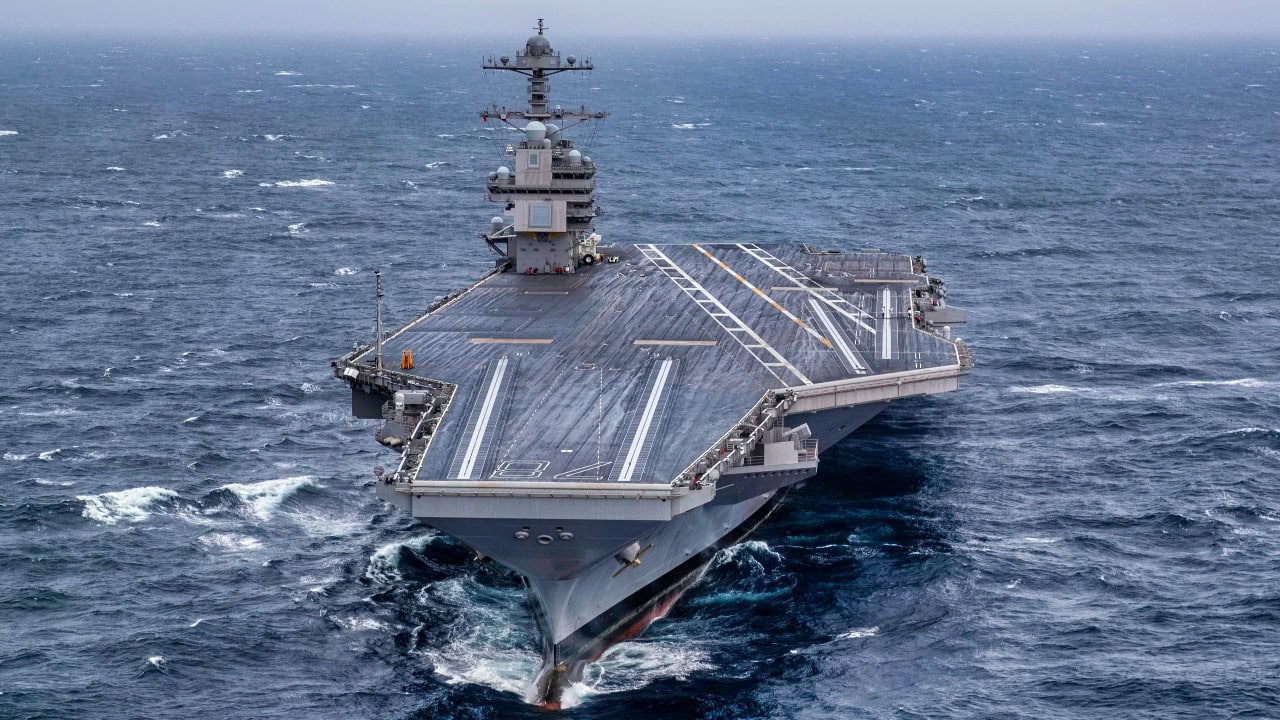
ATLANTIC OCEAN (Oct. 27, 2019) USS Gerald R. Ford (CVN 78) steams in the Atlantic Ocean for the first time since July 2018. Ford is conducting sea trials following its 15 month post-shakedown availability. (U.S. Navy photo by Mass Communication Specialist 3rd Class Connor Loessin)
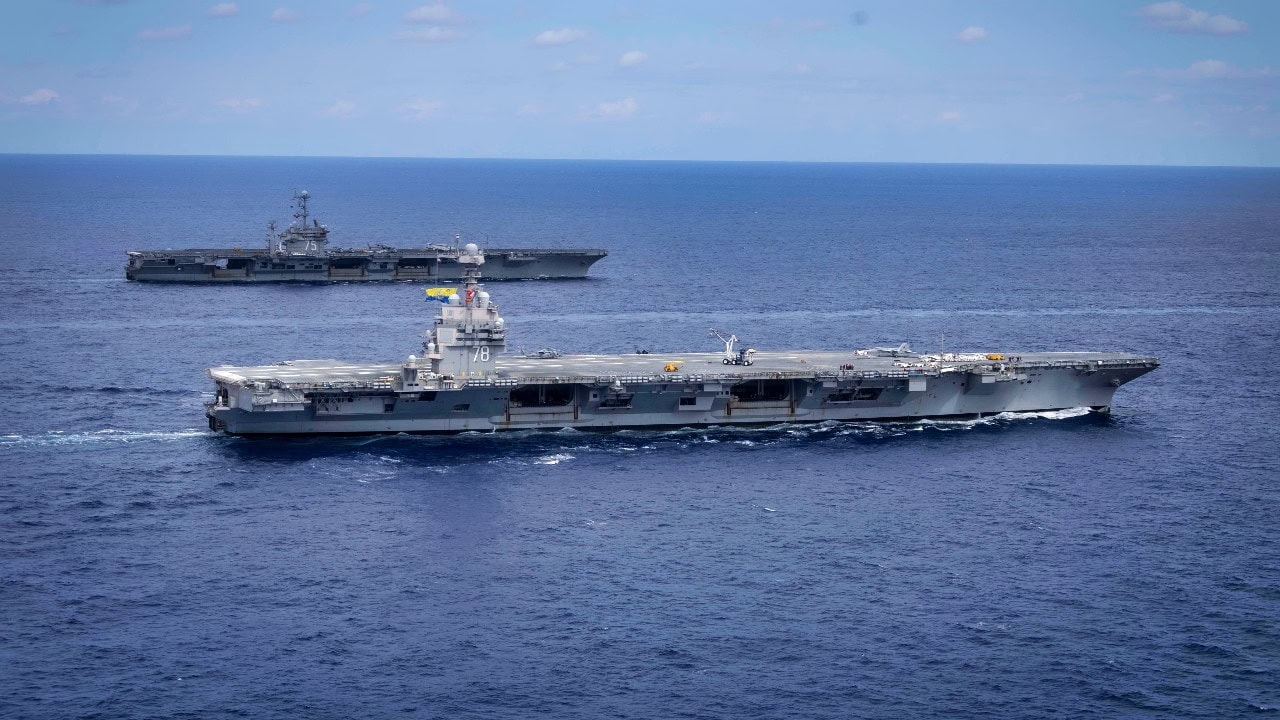
ATLANTIC OCEAN. (Aug. 24, 2024) The Nimitz-class aircraft carriers USS Harry S. Truman (CVN 75), back, and the world’s largest aircraft carrier, USS Gerald R. Ford (CVN 78), sail in formation in the Atlantic Ocean, Aug. 24, 2024. USS Gerald R. Ford is the flagship of the Gerald R. Ford Carrier Strike Group. The aircraft carrier is underway in the Atlantic Ocean to further develop core unit capabilities and skills such as fuels certification and ammunition on-load during its basic phase of the optimized fleet response plan. (U.S. Navy photo by Mass Communication Specialist 2nd Class Maxwell Orlosky).
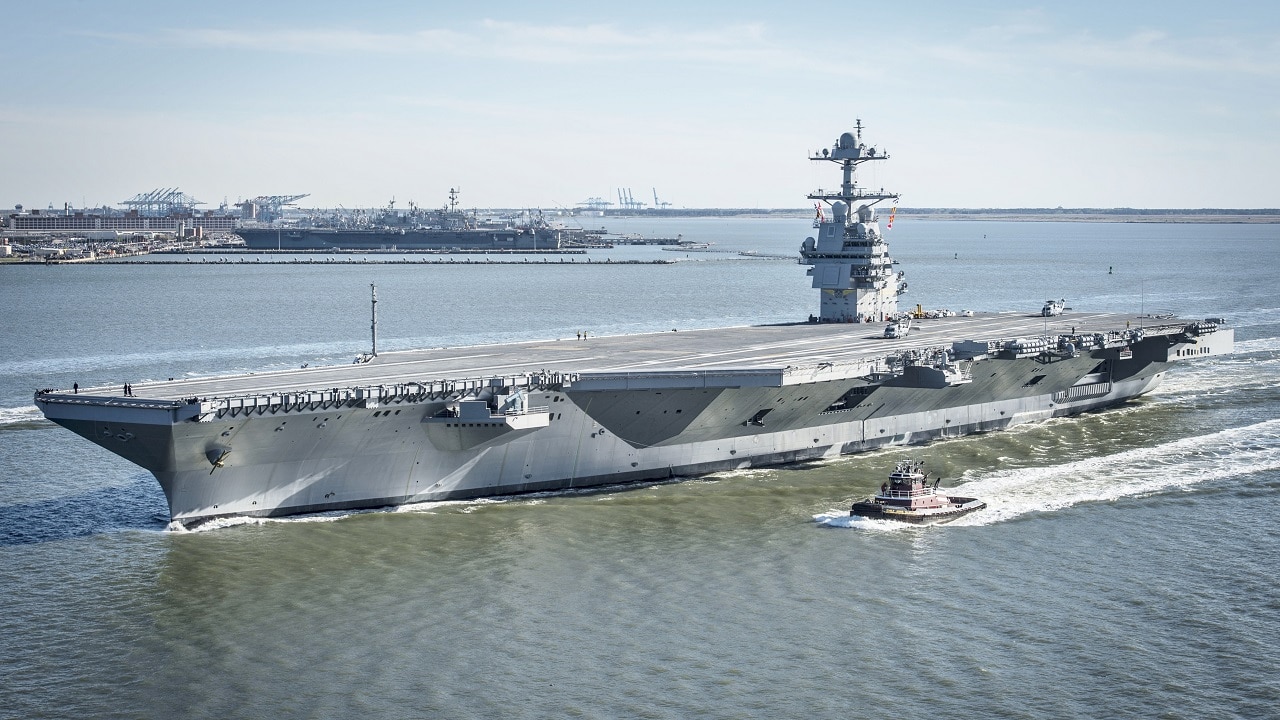
The U.S. Navy aircraft carrier USS Gerald R. Ford (CVN-78) underway under her own power for the first time while leaving Newport News Shipbuilding, Newport News, Virginia (USA), on 8 April 2017. The first-of-class ship – the first new U.S. aircraft carrier design in 40 years – spent several days conducting builder’s sea trials, a comprehensive test of many of the ship’s key systems and technologies. USS George Washington (CVN-73) and the amphibious assault ship USS Kearsarge (LHD-3) are visible in the background.
“When it goes past that, that disrupts lives,” Caudle added. “It disrupts things like funerals that were planned, marriages that were planned, okay, babies that were planned, you know, so the human element of extension, I’m not a big fan of obviously.”
Long Sea Deployments Hurt Readiness, Maintenance, And Morale:
Long naval deployments concern the Navy due to severe strain on sailor morale, retention, and well-being, increased material readiness issues (faster wear and tear, bigger maintenance backlogs), and significant disruption to meticulously planned ship maintenance schedules and workforce, creating a detrimental cycle of crisis and remediation that impacts overall fleet readiness.
Extended time away from family increases stress, which can impact mental health and potentially lead to lower retention rates.
Research shows longer deployments correlate with adverse health and mental health effects, as noted by the National Institutes of Health (NIH).
Pushing ships harder than planned stresses the maintenance workforce and disrupts the balance of available personnel.
USS Ford Has a Problem: Effects on Ships And Readiness
Long, extended deployments often accelerate wear and tear on operating systems and equipment. Operating ships outside their planned cycles accelerates deterioration and increases breakdown frequency.
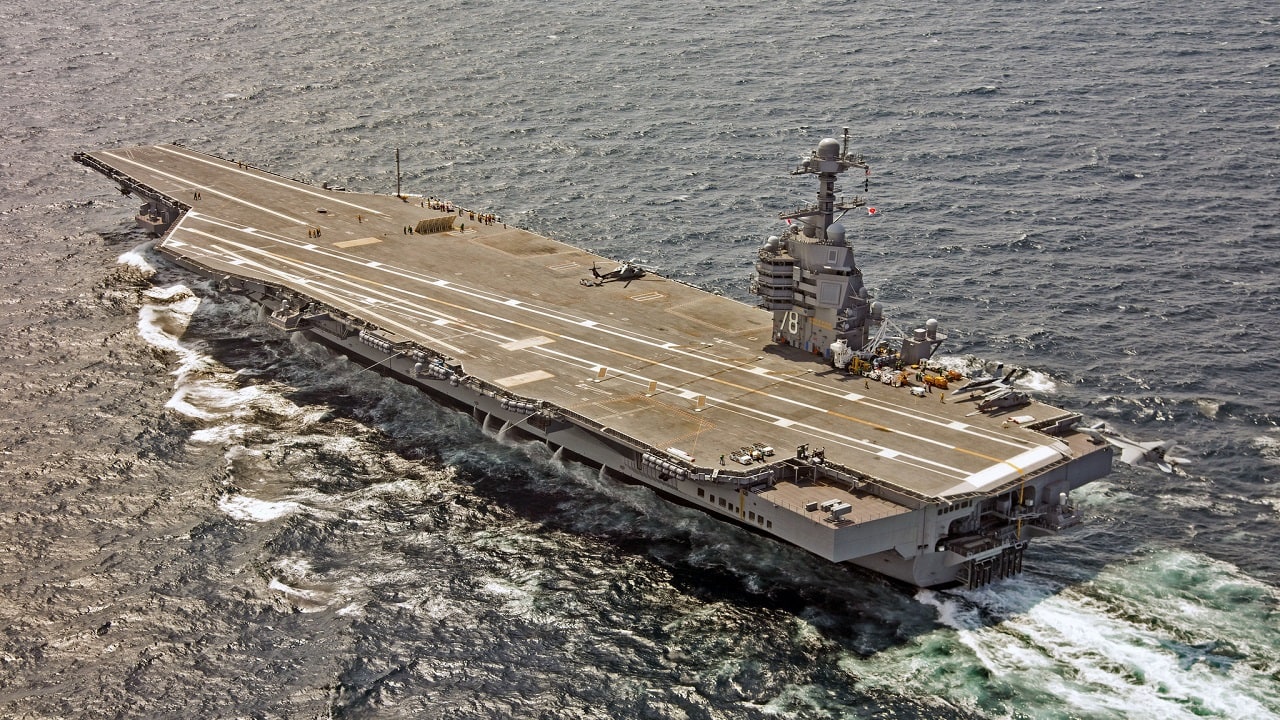
Ford-Class Aircraft Carrier Artist Rendering. Image Credit: Creative Commons.
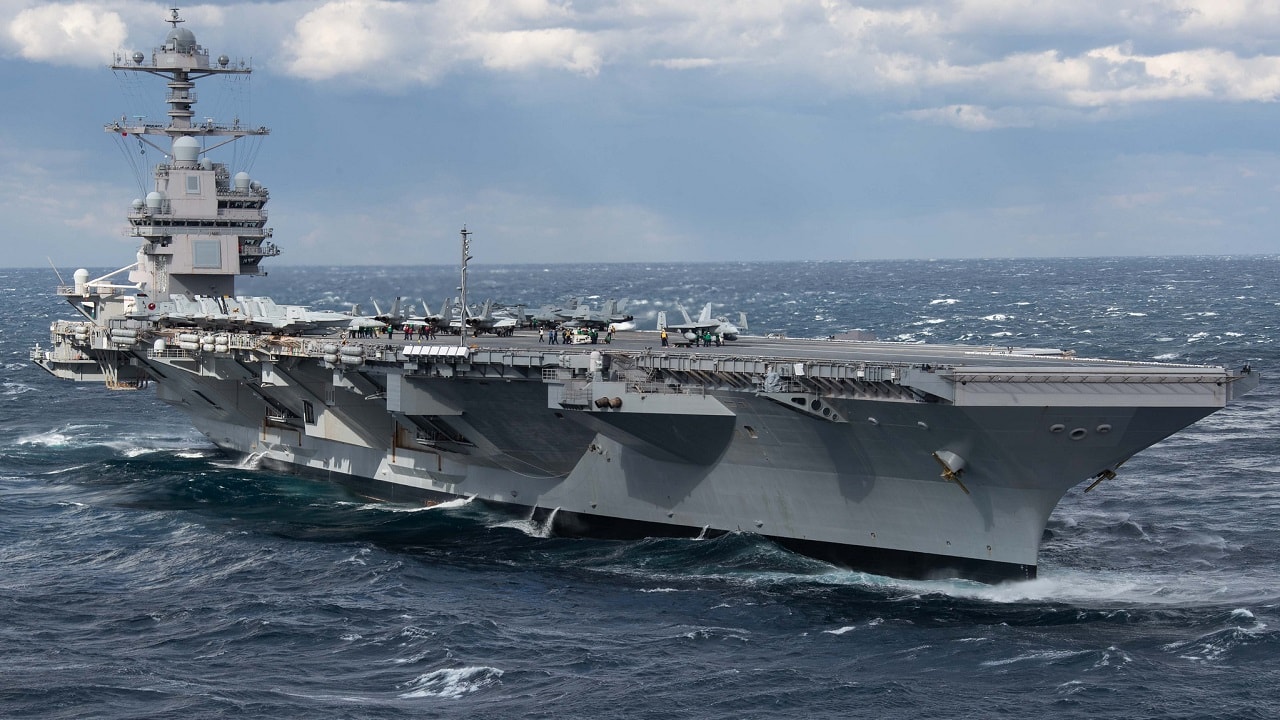
The aircraft carrier USS Gerald R. Ford (CVN 78) transits the Atlantic Ocean, March 26, 2022. Gerald R. Ford is underway in the Atlantic Ocean conducting flight deck certification and air wing carrier qualifications during the ship’s tailored basic phase before operational deployment.
Maintenance backlogs are frequently encountered. Extended deployments mean critical components that weren’t anticipated to require repair, which increases the maintenance workload and delays return-to-service dates due to reduced downtime.
Extended deployments disrupt planned maintenance periods (such as post-deployment availabilities), affecting the readiness of the entire fleet, not just the deployed ship. In the case of the USS Ford’s carrier strike group, all of the ships will suffer from the lack of maintenance downtime.
Strategic and Operational Concerns for Aircraft Carriers and Over-Deployment
One issue is that during extended deployments, additional wear and tear on systems and equipment can lengthen the maintenance period when the deployment ends.
Rand Corporation said, “Similar solutions with similar problems arise for nearly all elements of readiness, creating a spiral that becomes increasingly difficult to reverse. The impacts can rapidly cascade into persistent problems for force development, threatening the Navy’s ability to meet projected wartime surge needs.”
While necessary to meet global commitments, these disruptions challenge the Navy’s ability to maintain a sustainable forward presence and meet wartime surge requirements.
While operational needs demand extended deployments, the Navy faces a difficult trade-off between immediate mission demands and long-term fleet health, crew sustainability, and maintenance capacity, with serious consequences for overall readiness.
U.S. Navy Redirecting the USS Abraham Lincoln To The Gulf
The Pentagon has already redirected the USS Abraham Lincoln Carrier Strike Group from the South China Sea to the Middle East in a move driven by the accelerating internal unrest and protests within Iran, and the resultant killing by the regime of thousands of its people.
The USS Abraham Lincoln (CVN-72), the fifth Nimitz-class nuclear-powered supercarrier, had been operating in the South China Sea and last month conducted live-fire exercises and a replenishment-at-sea as part of its ongoing routine operations since its deployment began in November.
The Lincoln’s carrier strike group (CSG) includes the Arleigh Burke‑class guided‑missile destroyers USS Spruance (DDG 111), USS Michael Murphy (DDG-112), and USS Frank E. Petersen Jr. (DDG-121). A U.S. Navy fast-attack, nuclear-powered submarine typically operates with a CSG, but its identity usually is not disclosed for operational security.
It will be several more weeks before the USS George H.W. Bush (CVN-77) and the West Coast-based USS Theodore Roosevelt (CVN-71) begin their respective deployments, one of which could relieve the USS Ford in the region.
About the Author: Steve Balestrieri
Steve Balestrieri is a National Security Columnist. He served as a US Army Special Forces NCO and Warrant Officer. In addition to writing on defense, he covers the NFL for PatsFans.com and is a member of the Pro Football Writers of America (PFWA). His work was regularly featured in many military publications