

Synopsis: The U.S. Navy’s MQ-25 Stingray stealth drone tanker has successfully completed key low-speed taxi trials at MidAmerica Airport, marking a critical step toward active duty.
-Designed to counter China’s anti-access/area denial (A2/AD) capabilities, the Stingray carries 15,000 pounds of fuel to extend the combat radius of carrier-based jets like the F-35C by up to 500 miles, keeping the carrier itself out of missile range.
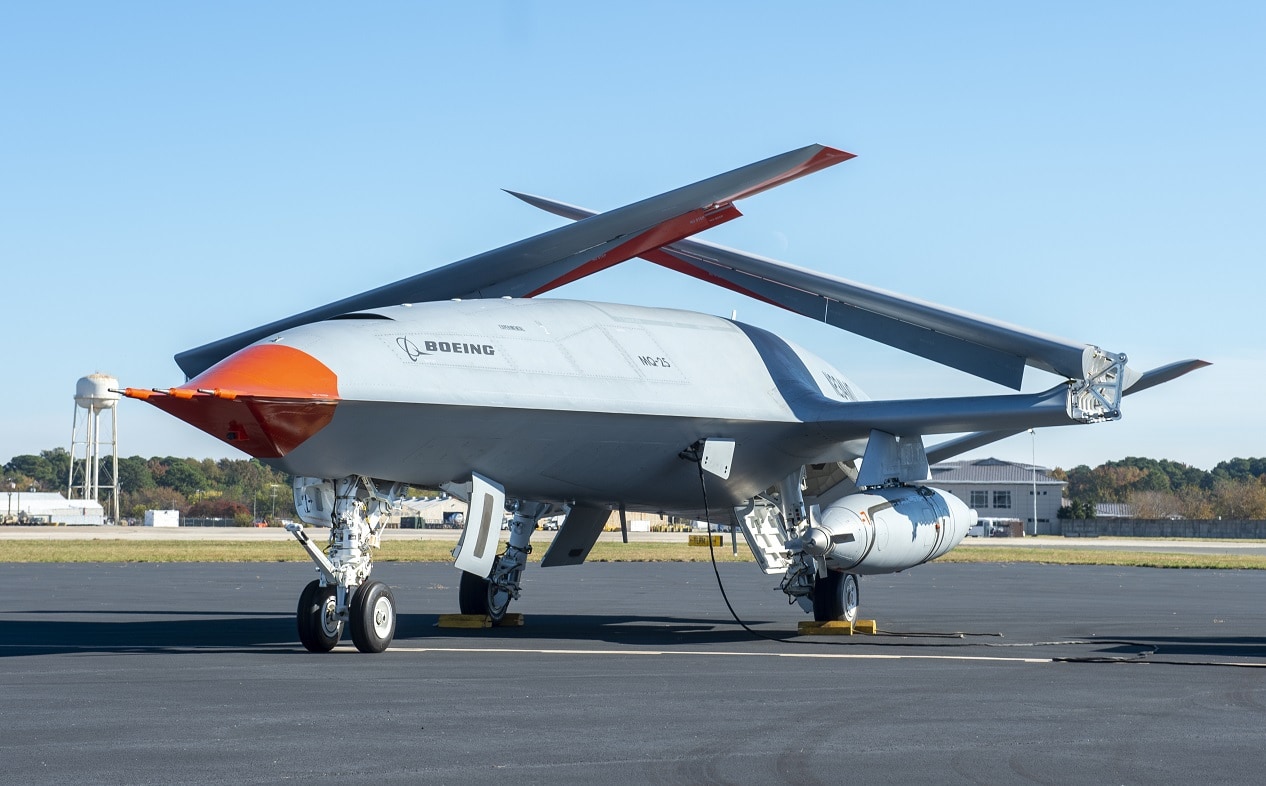
The U.S. Navy and Boeing conducted ground testing of the MQ-25 Stingray at Chambers Field onboard Naval Station Norfolk, Virginia. The MQ-25 Stingray is an unmanned aerial refueling aircraft. (U.S. Navy photo by Mass Communication Specialist 2nd Class Sam Jenkins)
-Such efforts could ensure U.S. Navy Supercarriers don’t become ‘obsolete battleships’ if a war with China ever breaks out.
The Navy’s “Genius” Drone: MQ-25 Stingray Hits Major Milestone
When I think of my favorite aircraft in the U.S. Navy, the F-35C Lightning II and F/A-18 E/F Super Hornet come to mind.
So does the high-flying P-8 Poseidon anti-submarine platform, joined by the sneaky-good EA-18G Growler electronic warfare airplane.
MQ-25 Stealthy Drone Tanker Is the Answer
But one new aircraft is not getting nearly enough credit: the MQ-25 Stingray stealthy drone tanker. This thing is a beauty, and it is going to solve many problems for U.S. carrier-based aviation.
Aerial refueling is more important than ever, given that potential future battlefields are covered by anti-access/area-denial capabilities. The Stingray can carry 15,000 pounds of fuel, extending the range of naval warplanes and helping win a missile fight against China or Russia.
Dual ISR Advantage
The Stingray can also perform intelligence, surveillance, and reconnaissance (ISR) missions after refueling an aircraft. This is a vital mission to protect carrier strike groups, and having an unmanned platform to execute it is a significant advantage.
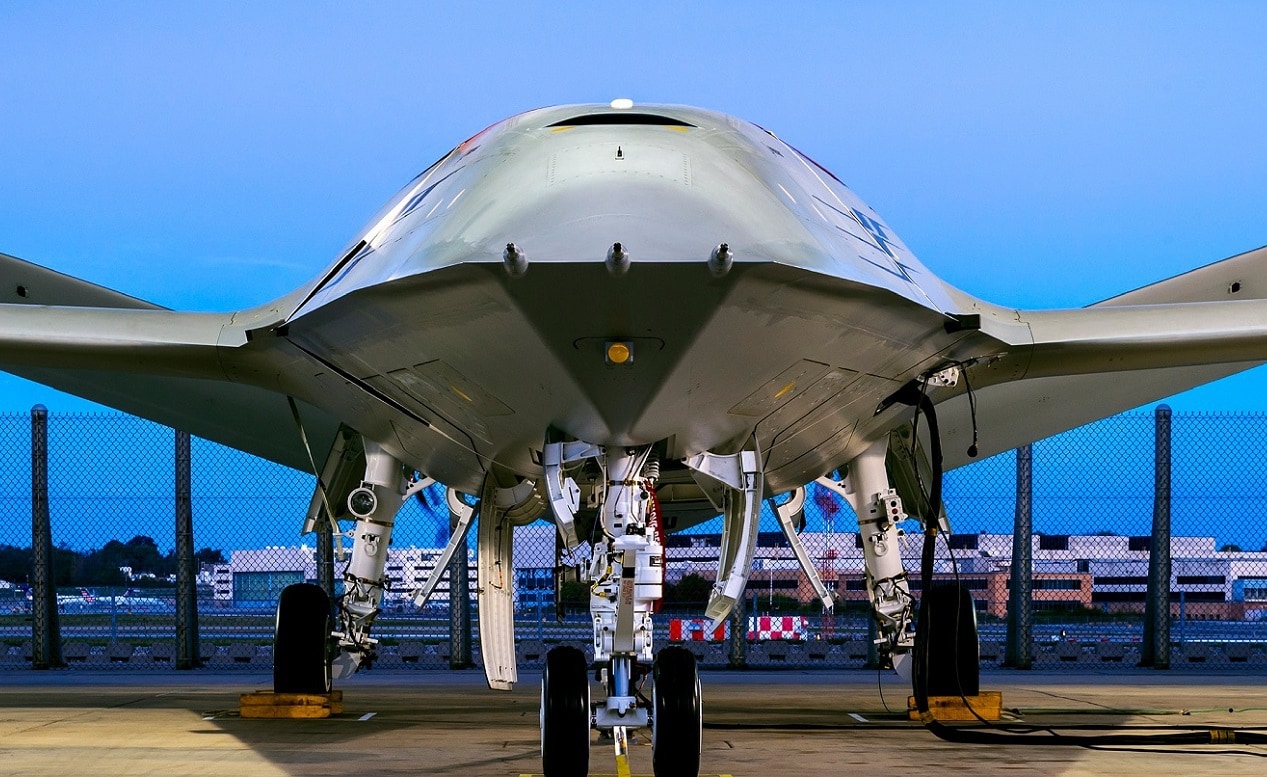
MQ-25. Image Credit – Creative Commons.
Ground Taxi Test Is Complete
The MQ-25 just reached an important milestone on its path toward full-time duty from aircraft carriers. On January 30, it conducted taxi trials at MidAmerica Airport near St. Louis, Missouri, near the Boeing plant that is producing the unmanned craft.
Boeing has already built nine Stingrays. The company said the tankers will “be put through static, fatigue and flight tests to ensure durability and airworthiness.”
The Navy wanted a successful taxi test by late last year, so there has been a slight schedule slip, but the program is mainly on-time and under-budget, which portends well for its future.
Defeating China’s Anti-Access/Area Denial Strategy
The step forward comes at a critical time. China has a growing list of hypersonic carrier-killing missiles. U.S. Navy aircraft carriers are always in danger in the western Pacific, and the airplanes onboard don’t have the combat radius needed to keep the carriers out of missile range.

MQ-25. Image: Creative Commons.
This “range game” is the concern on which a Pacific war could pivot. With the drone tanker, the Americans can extend the range of their aircraft—carriers thus will have greater ability to challenge the range of China’s missile systems. The Stingray is badly needed, and the service can’t wait to get the drones on active duty.
Look at What We Have Now
The U.S. Navy released a hype video of the Stingray on X: “One Step Closer to the Sky – The MQ-25A Stingray successfully completed its first low-speed taxi test. Under the control of #VX23, #UX24 pilots monitored the Stingray as it taxied from Boeing’s production facility to the taxiway at MidAmerica St. Louis.”
The Stingray taxied under its own power, which is an important milestone. “This is the first of nine Stingrays to be put through static, fatigue and flight tests to ensure durability and airworthiness,” Boeing said on X.
How Does the ISR Work?
The videos show the MQ-25’s electro-optical ball turret in the retracted position, which enables ISR collection. This is an ingenious addition to the aircraft, which can add eyes and ears for a CSG when it is not refueling another aircraft.
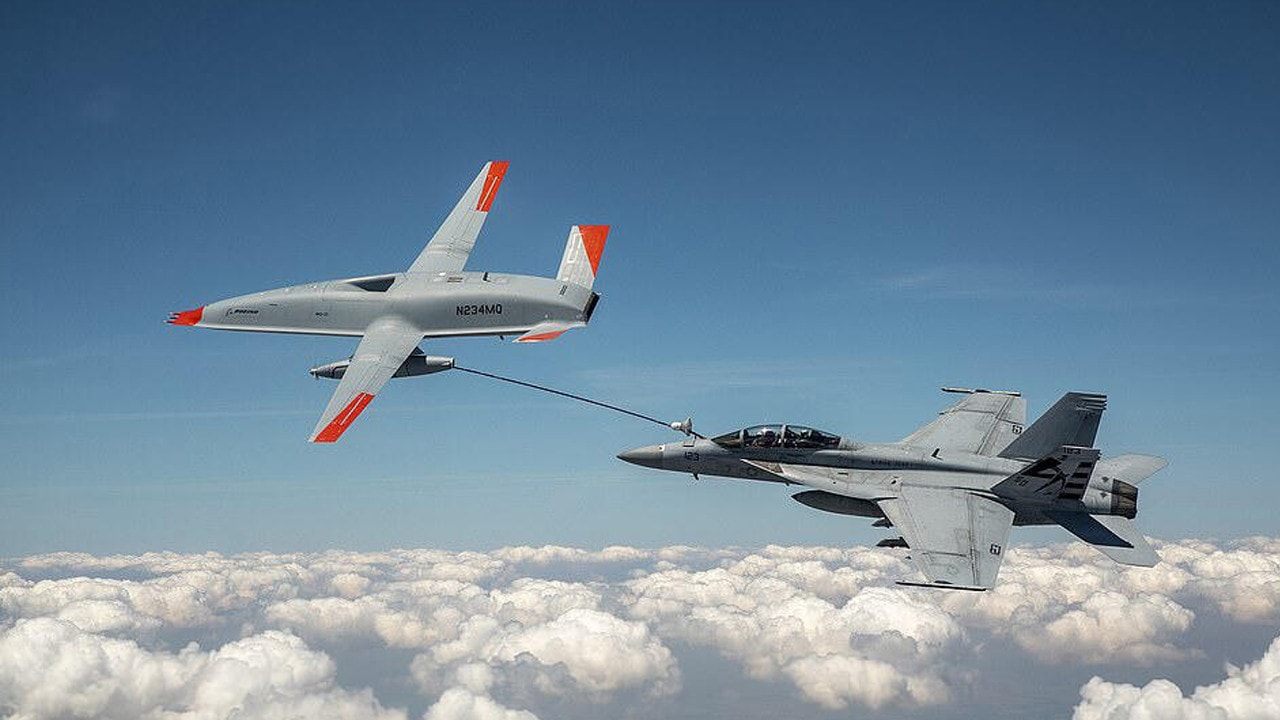
MQ-25. Image Credit: Boeing.
Eight-Year Journey
Boeing in 2018 was awarded the Carrier-Based Aerial-Refueling System (CBARS) project. The “T1” test model re-fueled an F-35C in-air in 2021. The program has grown by leaps and bounds since then.
This will be a momentous year for MQ-25s. The drone will need more ground and aerial tests before it can serve on carriers full-time.
MQ-25: I Like the Way the Navy Is Thinking
The Stingray has great potential as a refueler, but equipping it with ISR capabilities is a stroke of genius.
When fully deployed, these drones will be busy. Their missions will change China’s battle calculus, while American naval planners can breathe a little easier, thanks to the extended range of their carrier-based aircraft. The intervention of a Stingray could lengthen the combat radius of a naval fighter jet by as much as 500 miles.
If the F/A-XX can be approved and built, refueling operations between the two aircraft will be nearly fully stealth; the same is already true of refueling missions with the F-35C.
About the Author: Dr. Brent M. Eastwood
Author of now over 3,000 articles on defense issues, Brent M. Eastwood, PhD is the author of Don’t Turn Your Back On the World: a Conservative Foreign Policy and Humans, Machines, and Data: Future Trends in Warfare plus two other books. Brent was the founder and CEO of a tech firm that predicted world events using artificial intelligence. He served as a legislative fellow for US Senator Tim Scott and advised the senator on defense and foreign policy issues. He has taught at American University, George Washington University, and George Mason University. Brent is a former US Army Infantry officer. He can be followed on X @BMEastwood.