
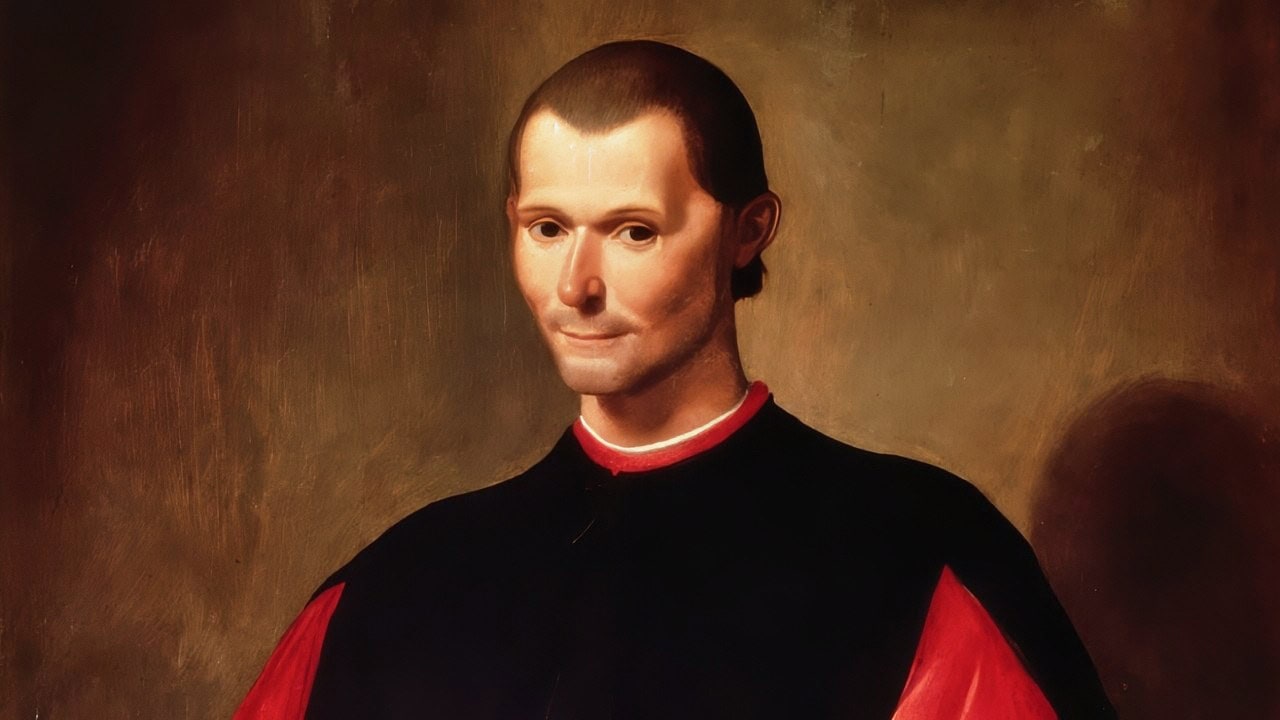
Synopsis: Machiavelli’s famous warning in The Prince argues that leaders are safest when feared, because love is fickle and obedience is paramount.
-Framed as a proto–national security strategist, Machiavelli fits the classical realist paradigm: power is the currency of politics, the international system is anarchic, and rulers must protect the state even when moral virtue falls short.
-The piece contrasts Machiavelli’s hard-edged “virtù” with Confucian moral leadership, emphasizing that stability often demands coercion and discipline.
-A brief biography tracks Machiavelli’s Florentine roles, diplomatic exposure to Cesare Borgia, militia experiments, exile, and enduring influence in politics and popular culture.
Machiavelli’s 1 Rule for Leaders: Feared Beats Loved When You Must Choose
“Here a question arises: whether it is better to be loved than feared, or the reverse. The answer is, of course, that it would be best to be both loved and feared. But since the two rarely come together, anyone compelled to choose will find greater security in being feared than in being loved.” -Niccolò Machiavelli.
The First National Security Advisor
The above quote comes from chapter 17 of Machiavelli’s famous 1517 work The Prince. When teaching international relations, I have described Machiavelli as history’s first “national security advisor” and The Prince as the first “National Security Strategy.”
A Classical Realist
Machiavelli fits into an important strain of international relations theory; he was one of the first classical realists. Machiavelli believed power is the currency of all sovereign states. States and their leaders always try to maximize power and remain in command by keeping their subjects from rebelling.
The Anti-Confucius
The Italian philosopher did not always believe that a leadership style should be based on morality and virtue, like Confucius believed. The pursuit of power in its most raw form was the best way to command an army, city-state, or nation. This practice convinced a ruler’s subjects to always adhere to the king’s will.
Anarchical System of Foreign Affairs
Machiavelli did not believe that city-states should be united under one powerful, over-arching government. The system is “anarchic” with no “international policeman” to enforce the will of a universal ruling body. States will always pursue their national interest. This sense of “rationality,” or the endless pursuit of power, explained a ruler’s behavior and how the supreme leaders would oversee an army or government.
“The ‘state’ is literally owned by whichever prince happens to have control of it. Moreover, the character of governance is determined by the personal qualities and traits of the ruler,” according to the Stanford Encyclopedia of Philosophy.
Evil Could Be Part of Power
These traits are what Machiavelli called “virtu” and reveal the power relationship among states. Individual leaders are sometimes evil as they pursue military necessity and invade other states to rule by fear. Machiavelli believed this power projection in service of the national interest is a natural state of affairs.
“Machiavelli’s argument is a logical extension of his assessments of human nature and virtue. In the first place, people will become disloyal if circumstances warrant. In the second, the prince’s ultimate goal is to maintain the state, which requires the obedience of the people. From these two points, it follows that between benevolence and cruelty, the latter is the more reliable,” according to Sparknotes.com.
A Brief Biography
Machiavelli was born in Florence, Italy, to lawyer Bernardo di Niccolò Machiavelli and his wife, Bartolomea di Stefano Nelli, in May 1469.
Aside from his parents, Machiavelli was influenced most greatly by his tutor, Paolo da Ronciglione, from whom he learned Latin and rhetoric. His ability to persuade would be important in the philosopher’s production of his famous book.
Machiavelli’s early career in government was greatly aided by his tutor’s lessons. Due to his written skills, he was assigned to handle the city-state’s official documents.
First Real Position of Influence
He then became secretary of the Dieci di Libertà e Pace, the Florentine council that conducted diplomacy and defense. This is when Machiavelli began to develop his ideas about power and prestige.
Machiavelli was influenced by the Pope at the time—and especially the Pope’s son, Cesare Borgia. Machiavelli noted how Borgia came down hard against rebellious papal advisors. He believed that Borgia always acted in self-interest to remain in power. The lesson struck a chord in Machiavelli.
The Power Behind the Pope
In 1500, Machiavelli was made a diplomat and served in the Holy See. This position taught him first-hand how to run a government and advise leaders. He began thinking about how leaders remained in office, or how they failed. This would form the basis of his famous book.
A General With a Mixed Record
The Italian sage wandered into military affairs, raising a militia in Florence and figuring out how defense forces can influence a ruler’s ability to stay in a leadership position. Machiavelli believed that citizen soldiers would serve in the armed forces better than mercenaries. He raised a small group of farmers as militia members. They took over the city of Pisa, but later lost to the Medici family, who were backed by Pope Julius II and expert Spanish troops. These fighters overwhelmed the Florentines at Prato.
Since he had tried to defeat the Medici family, Machiavelli was forced to remain in Florence. After a year, he went back to his estate at Sant’Andrea in Percussina. This is when he began ruminating about his future and writing down his beliefs about holding and losing power.
His Legacy Is Intact
Machiavelli’s life and his book are still taught at universities. The quote referenced above has been uttered in movies about the mafia. The pursuit of power that states and rulers conduct is an important part of international relations theory. Machiavelli would probably not be surprised at his influence. He had real political experience and the writing ability to produce a book on the topic that stood the test of time. He will continue to be influential to anyone who must lead and remain at the top.
About the Author: Brent M. Eastwood
Author of now over 3,000 articles on defense issues, Brent M. Eastwood, PhD is the author of Don’t Turn Your Back On the World: a Conservative Foreign Policy and Humans, Machines, and Data: Future Trends in Warfare plus two other books. Brent was the founder and CEO of a tech firm that predicted world events using artificial intelligence. He served as a legislative fellow for US Senator Tim Scott and advised the senator on defense and foreign policy issues. He has taught at American University, George Washington University, and George Mason University. Brent is a former US Army Infantry officer. He can be followed on X @BMEastwood.