Summary and Key Points: Satellite imagery from February 9, 2026, reveals that Russia has concentrated nearly its entire Su-57 “Felon” fleet—approximately 15 to 20 aircraft—at the Dzyomgi air base in the Far East.
-Located 280km from the Chinese border and adjacent to the Komsomolsk-na-Amure production plant, this move serves a dual purpose: protecting the limited 5th-generation assets from Ukrainian drone strikes (which damaged two airframes in 2024) and providing easy access to technical staff for ongoing flight trials.
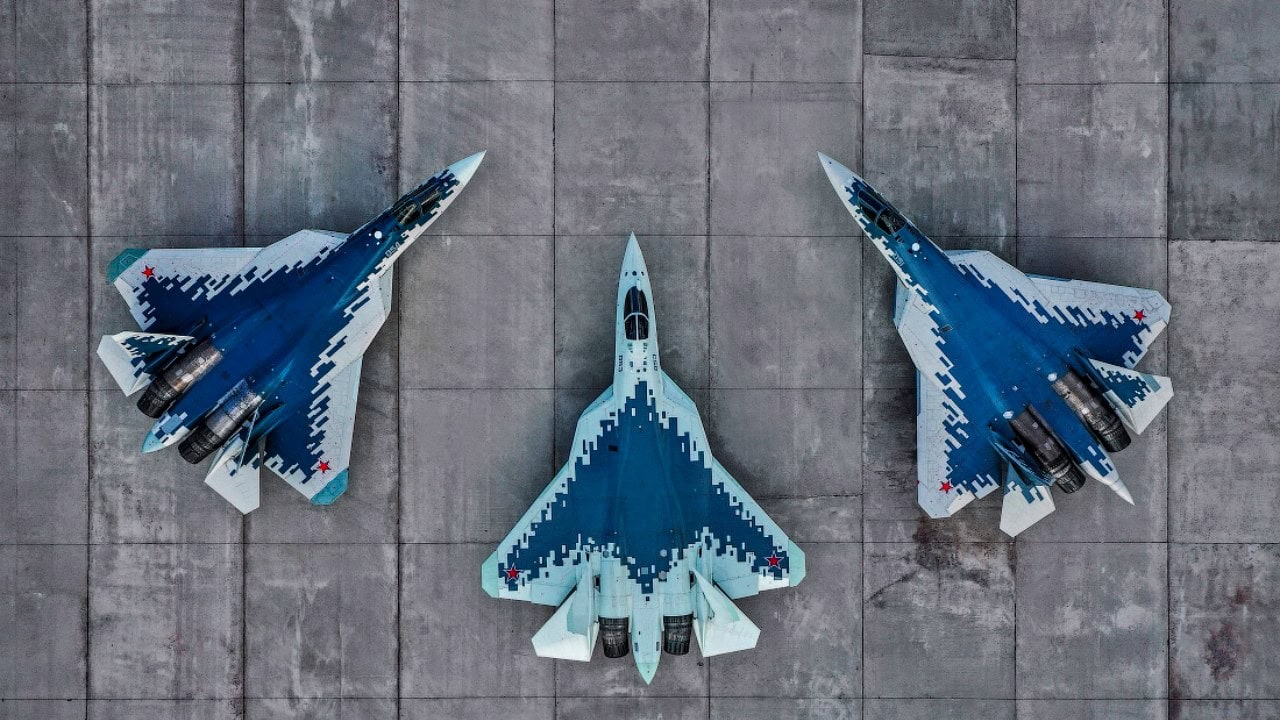
Su-57 Felon. Image Credit: Screengrab from X.
-Despite its “stealth” branding, the Su-57’s radar cross-section remains 1,000 to 10,000 times larger than the U.S. F-35, limiting its role to “low observable” operations.
Why Russia Just Moved Its Entire Su-57 Stealth Fleet 6,000 Miles Away from Ukraine
Russia has concentrated almost all of its fleet of Sukhoi Su-57 aircraft at the Dzyomgi air base in the Khabarovsk region—this, according to satellite images published by the AviVector project and reported by the Ukrainian outlet Militarnyi. This facility is about 280 kilometers from the border of the People’s Republic of China (PRC).
These aircraft were originally identified in satellite imagery dated February 9, which revealed at least 15 Su-57 aircraft parked out in the open at the airfield. The Su-57 is advertised as a 5th-generation design, with a blended-body design. But it remains to be seen how effective the Russian design team has been at making the aircraft a true stealth platform with a markedly reduced radar cross section (RCS).
Estimates of the aircraft’s signature have placed it in the range of 0.5 to 0.1m2 when measured in the frontal hemisphere. This would have the Su-57 classified as a “low observable” rather than a true stealth aircraft, as its radar signature is significantly larger than those of the US F-35 or F-22.
Other aspects of the aircraft’s design mean it is detected on radar at 6-10 times the range at which either of the US-made stealth aircraft would be detected. All told, the US fighters have a 1000 to 10000 times smaller RCS depending on which aspect or hemisphere of the aircraft is being measured.
In addition to these Su-57 aircraft, this base also hosts 18 Su-35S Super Flankers, multirole fighters. The Su-35S is frequently dispatched as an escort aircraft for missions flown by Tupolev Tu-95MS bombers assigned to the VKS Long-Range Aviation command. Typically, these are training flights conducted in the Far East and over international waters.
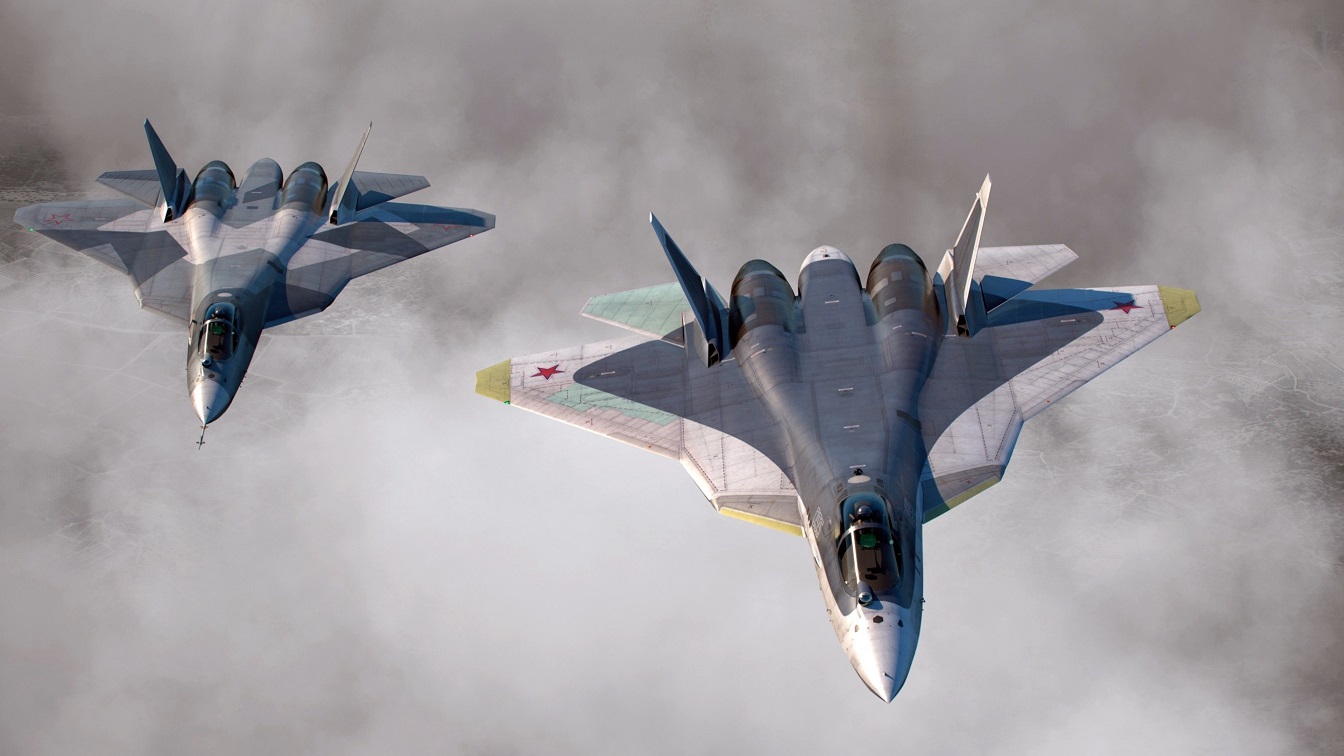
Su-57 stealth fighter. Image Credit: Artist Rendition.
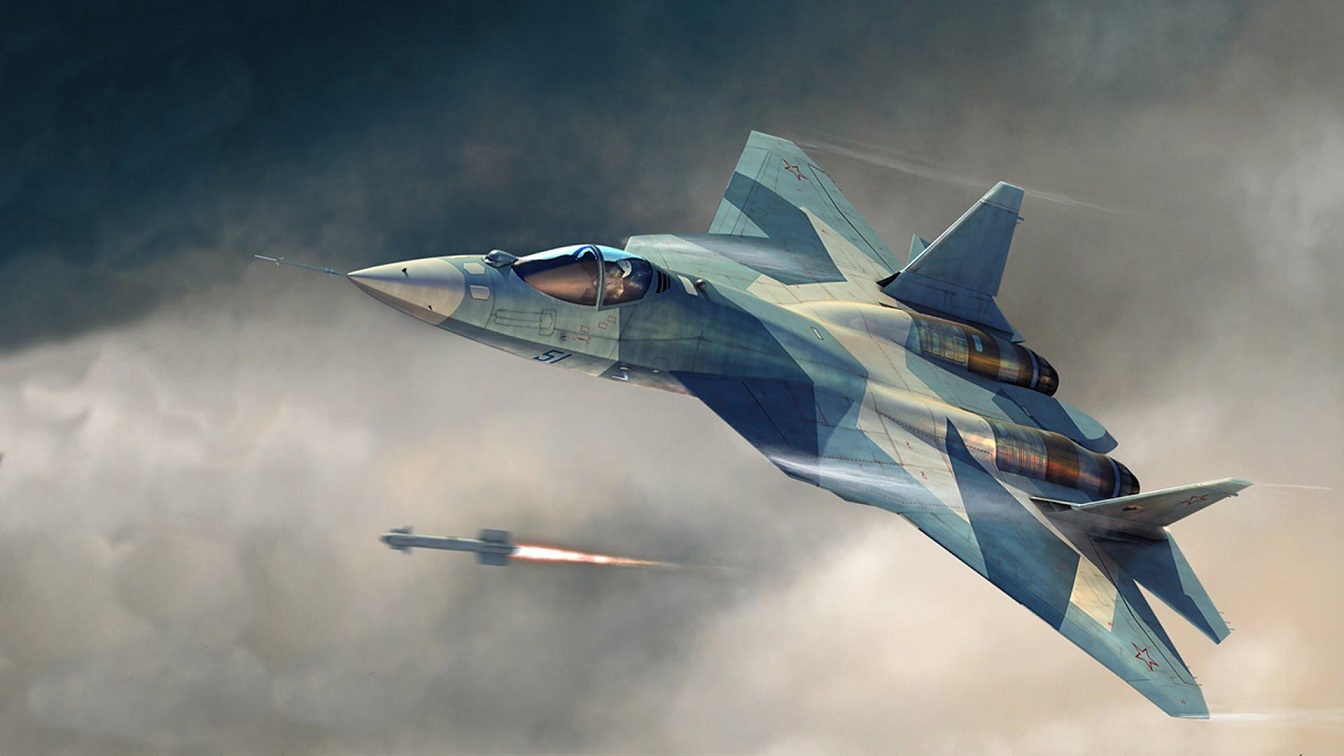
Su-57 artist rendering. Image Credit: Creative Commons.
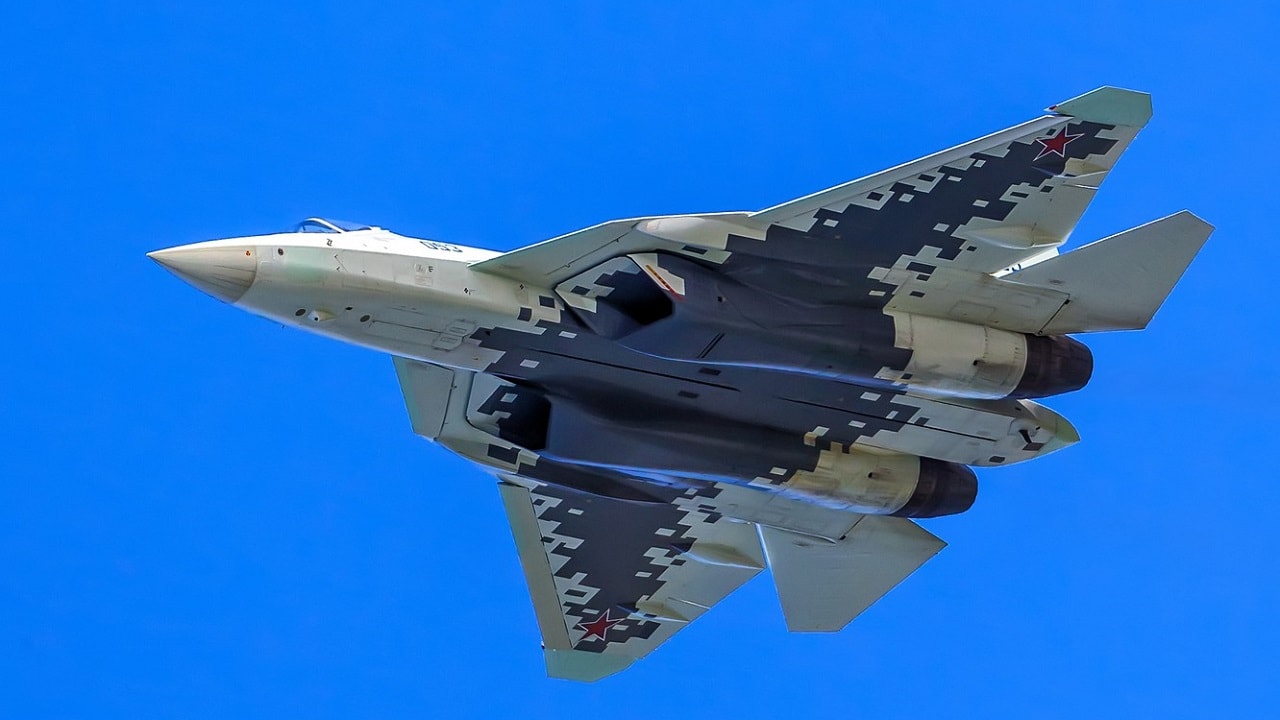
Su-57 stealth fighter. Image Credit: Creative Commons.
Why The Su-57 Deployment
There are also three Mikoyan MiG-31BM interceptors and two Mil Mi-8 helicopters assigned to the base, according to a report by the Ukrainian military news site. Militarnyi and other observers of Russian tactical air inventory levels have stated that the total number of operational Su-57 aircraft remains limited.
To date, there is confirmation of at least 16 completed airframes, excluding at least two aircraft recently delivered to the Russian Aerospace Forces (VKS). Including the newly delivered models, the original T-50 series prototypes, and the initial batch of early production units, the total Su-57 fleet is no more than 20 or 25 aircraft.
The Dzyomgi aerodrome is not the aircraft’s normal base of operations, as they are assigned to the 23rd Guards Fighter Aviation Regiment in the Far East. However, placing the aircraft at this aerodrome has a two-fold rationale.
One is that this facility is located very far from the Ukrainian border. The VKS command is very concerned about the vulnerability of these aircraft to drone strikes. Ukraine drones have already hit at least two Su-57 fighters, both of which were located on the Akhtubinsk airbase in Russia’s Astrakhan region, which is home to the VKS flight test center at Chkalov air base.
This particular incident occurred in June 2024, during which the aircraft in the parking area came under a Ukrainian drone attack.
One of the two aircraft was reported to have sustained extensive damage, to the point that there was some question whether it could be repaired and returned to flight status.
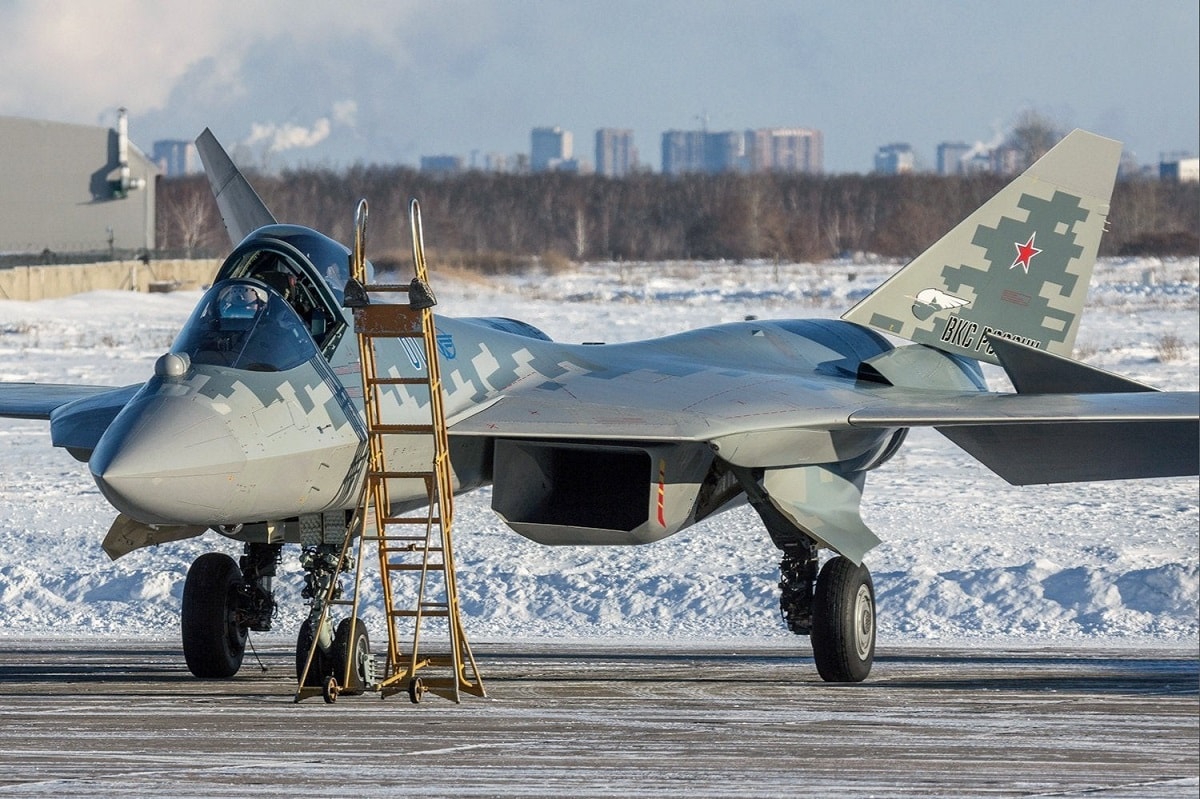
Su-57 Felon. Image Credit: Creative Commons.
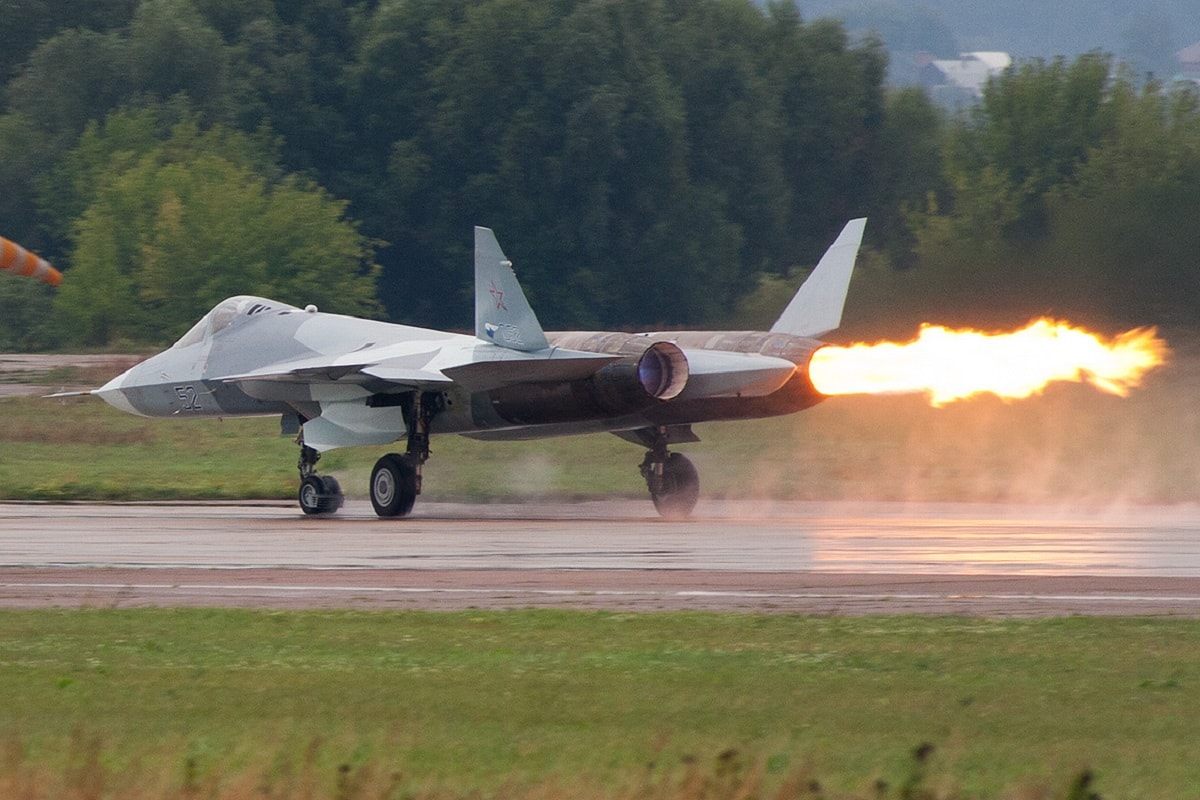
Image of Russia’s Su-57 fighter. Creative Commons.
There was no information about the condition of the second airframe, but the reports on the attack should be taken with a grain of salt.
The information released about this attack came from Russian propaganda outlets, which are well known for “being economical with the truth,” as one Ukrainian military official stated at the time.
Field Testing for the Felon Fighter
A second factor in moving the aircraft to this location is that, while it is considered a safe zone, the area is also close to the Komsomolsk-na-Amure production plant, where the Su-57 and Su-35s are both manufactured. Some of these aircraft are still in flight trials or require staged upgrades or the insertion of new hardware to enhance their combat performance.
This would require them to be within striking distance of the technical support staff and facilities located at the production plant.
The original plan for the Su-57 was to make it the tip of the spear of the VKS, but to date, the force has not been able to realize this objective. The production rate for the Su-57 has remained low due to a deteriorating financial environment within the aerospace sector, among other problems.
Su-57s have also proven to be difficult to build in large numbers due to numerous technological bottlenecks that emerged after the February 2022 Russian invasion of Ukraine. International sanctions imposed on Russia have also restricted imports of electronic components and other production inputs.
MORE – Why the U.S. Navy Has No Mach 7 Railguns
MORE – 32,000-ton ‘Super’ Battleship USS Texas Has a Message for the U.S. Navy
MORE – Mach 2 F-14 ‘Super’ Tomcat 21 Fighter Has a Message for the U.S. Navy
About the Author: Reuben F. Johnson
Reuben F. Johnson has thirty-six years of experience analyzing and reporting on foreign weapons systems, defense technologies, and international arms export policy. Johnson is the Director of Research at the Casimir Pulaski Foundation. He is also a survivor of the Russian invasion of Ukraine in February 2022. He worked for years in the American defense industry as a foreign technology analyst and later as a consultant for the U.S. Department of Defense, the Departments of the Navy and Air Force, and the governments of the United Kingdom and Australia. In 2022-2023, he won two awards in a row for his defense reporting. He holds a bachelor’s degree from DePauw University and a master’s degree from Miami University in Ohio, specializing in Soviet and Russian studies. He lives in Warsaw.