
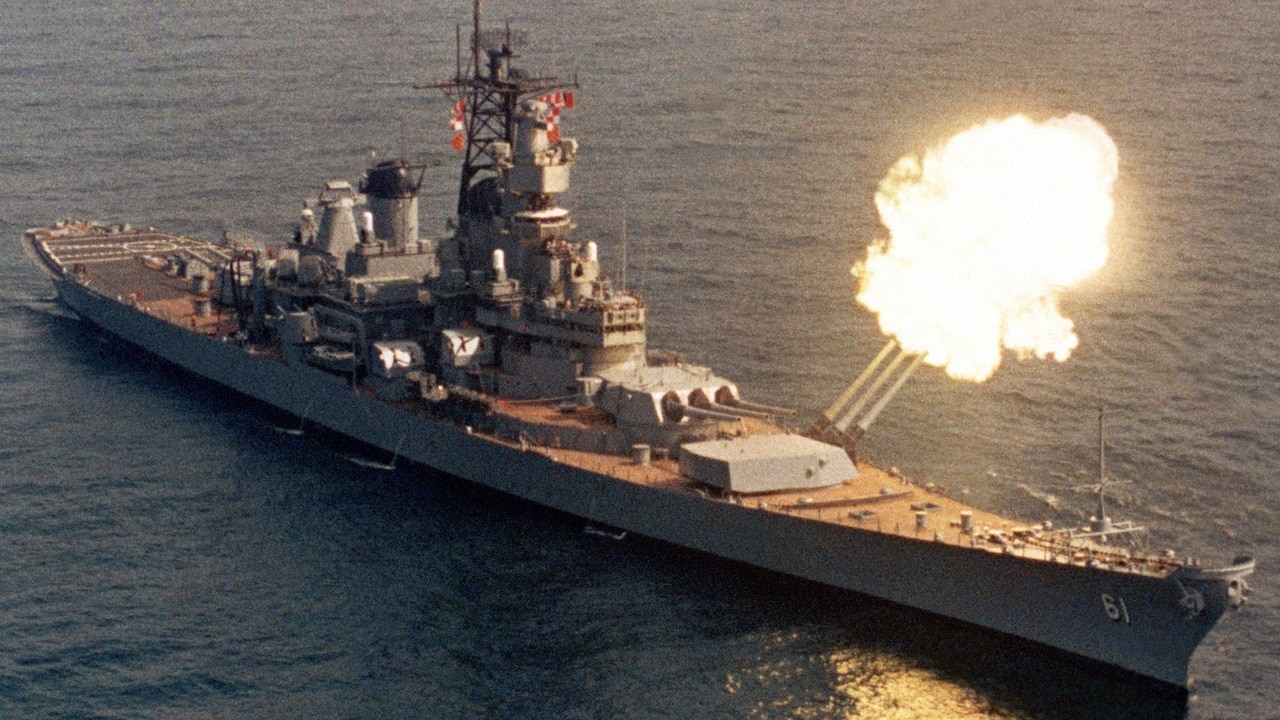
Synopsis: The Trump-class battleship BBG(X) is being pitched as a 21st-century command-and-control powerhouse, but analysts warn it may lack the military utility of the aircraft carriers it is often compared to.
-Unlike aircraft carriers, which project adaptable, off-board lethality through air wings, the BBG(X) concentrates its firepower on the hull itself.
-In 2026, this “fixed lethality” creates a high-value, low-flexibility target susceptible to saturation attacks from anti-ship ballistic missiles and drone swarms.
-While the lead ship, USS Defiant (BBG-1), boasts railguns and hypersonic tubes, its inability to adapt without radical redesign may render it a symbolic rather than decisive asset.
“BBG(X)” Gamble: Why the New Trump-Class Battleship Summed Up in 2 Words
Some observers are framing the proposed Trump-class battleship BBG(X) as a kind of presence platform—powerful to look at, politically resonant, but of questionable military utility.
Some have gone so far as to compare the BBG(X) to an aircraft carrier, which they believe will become increasingly vulnerable in modern conflicts against A2/AD defensive systems.
But the analogy fails. Not only are aircraft carriers still reliable under modern conditions, but the BBG(X) and aircraft carrier are fundamentally different platforms: the aircraft carrier facilitates adaptable, off-board power projection, which keeps the platform relevant; the BBG(X) does not.
The carrier analogy
When critics of the aircraft carrier argue that the BBG(X) might be another carrier, what the critics mean, presumably, is that the new BBG(X) is large, visible, and expensive, meaning it would make an attractive target that would earn lots of attention within a dense A2/AD envelope.
Accordingly, the vessel would struggle to survive and would be relegated to a more symbolic function, a symbol of power rather than a practice weapon, against near-peer rivals. Critics argue that the BBG(X) would be unable to operate near Chinese coastlines, rendering it irrelevant.
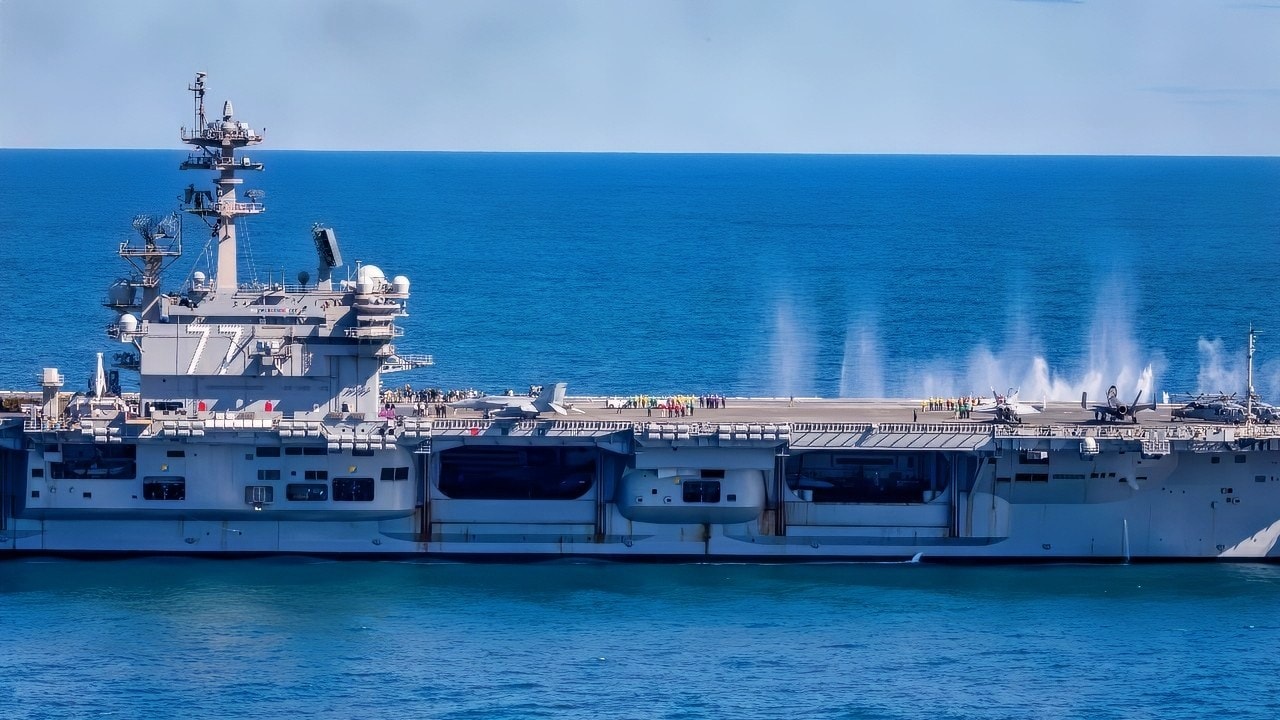
ATLANTIC OCEAN (Oct. 5, 2025) The Nimitz-class aircraft carrier USS George H.W. Bush (CVN 77) transits the Atlantic Ocean while an F/A-18E Super Hornet, attached to the “Pukin Dogs” of Strike Fighter Squadron (VFA) 143 fire rounds into ocean in support of the Titans of the Sea Presidential Review. The Titans of the Sea Presidential Review is one of many events taking place throughout the country to showcase maritime capabilities as part of the U.S Navy’s 250th birthday. America is a maritime nation. For 250 years, America’s Warfighting Navy has sailed the globe in defense of freedom. (U.S. Navy photo by Mass Communication Specialist 2nd Class Mitchell Mason)
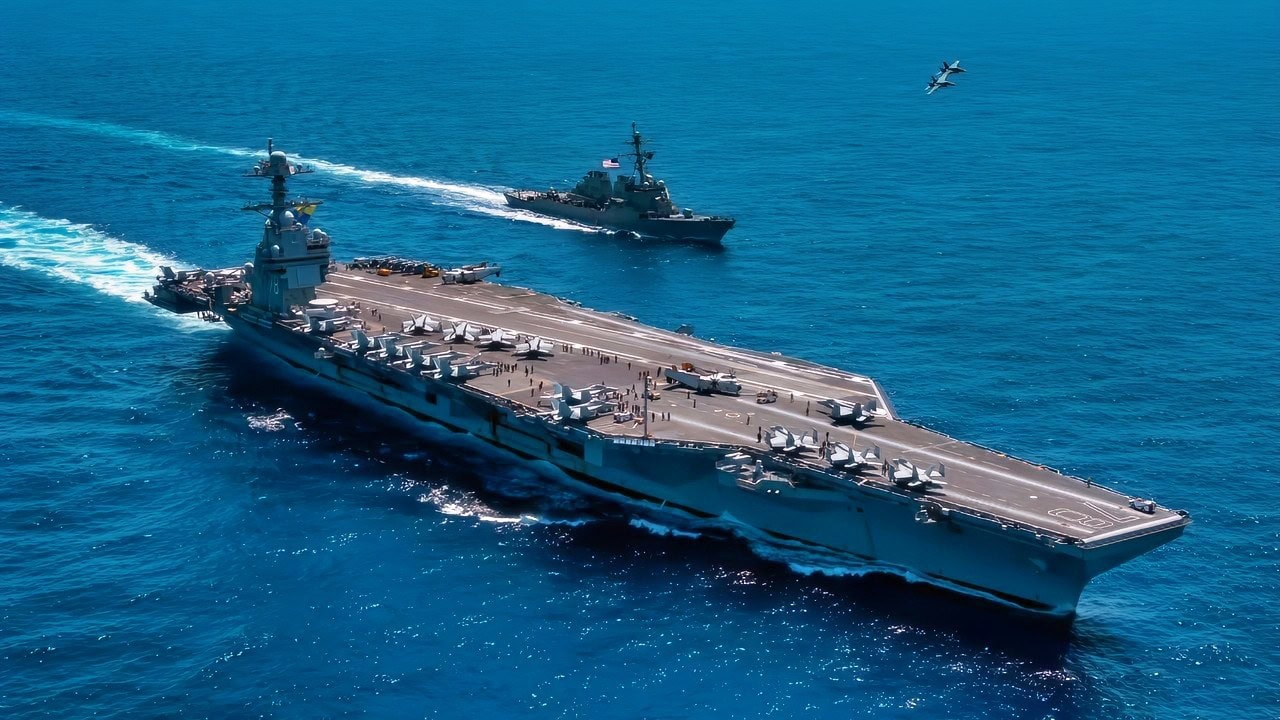
An F/A-18F Super Hornet, attached to the “Blacklions” of Strike Fighter Squadron (VFA) 213 and a F/A-18E Super Hornet, attached to the “Golden Warriors” of Strike Fighter Squadron (VFA) 87 fly over the world’s largest aircraft carrier, USS Gerald R. Ford (CVN 78), the Arleigh Burke-class guided-missile destroyer USS Mahan (DDG 72), April 11, 2025. The Gerald R. Ford Carrier Strike Group is underway in the Atlantic Ocean completing integrated naval warfighting training. Composite Training Unit Exercise. Image Credit: Creative Commons.
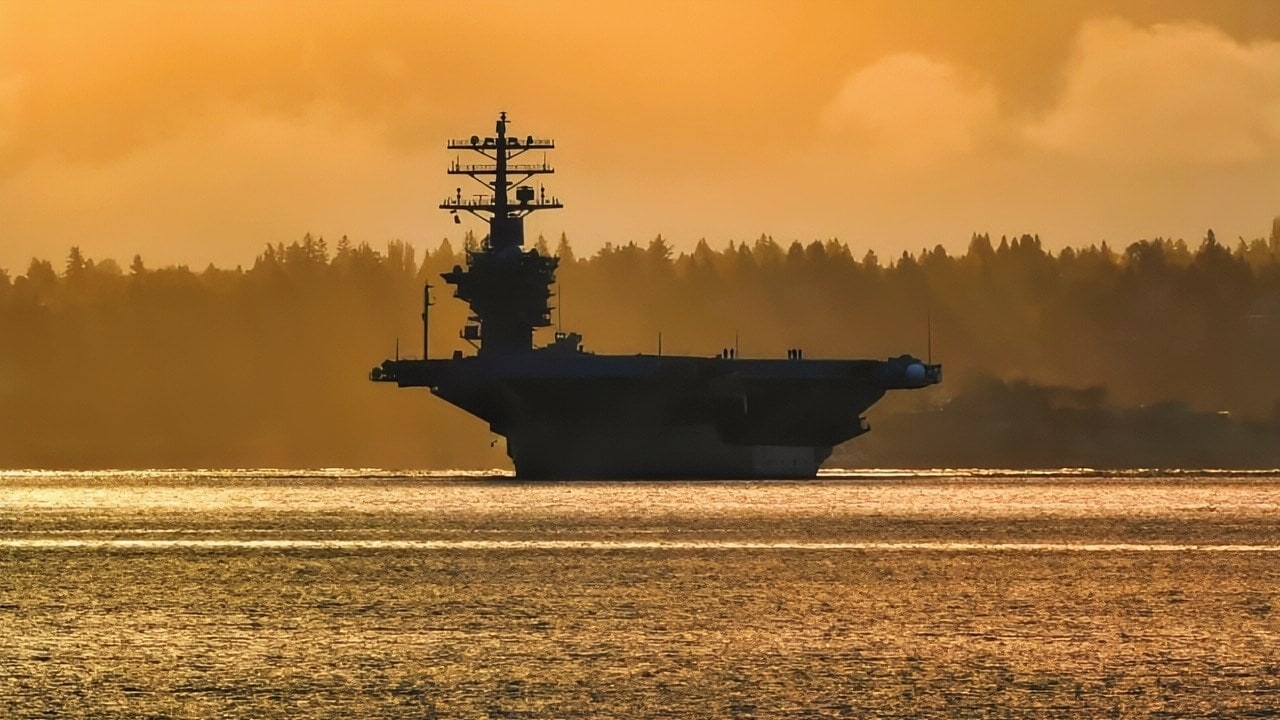
MANCHESTER, Wash. (April 28, 2017) USS Nimitz (CVN 68) transits Puget Sound, past the Seattle skyline enroute to its homeport, Naval Base Kitsap-Bremerton. The return to homeport marks the end of an underway along with its Carrier Strike Group 11, having successfully completed its final pre-deployment assessment, Composite Training Unit Exercise, April 21, and is now fully certified to deploy later this year. (U.S. Navy photo by Mass Communication Specialist 2nd Class Vaughan Dill/Released
There is merit to the concern, in general. However, the analogy still falls short, as carriers and battleships are vulnerable in different ways, and only the aircraft carrier can adapt to that vulnerability while still contributing to meaningful warfighting.
The battleship history
Battleships were designed as surface combatants to engage other ships, to provide naval gunfire support, and to generally control the sea lanes through direct firepower.
Battleship lethality was fixed to the hull, limited by gun range and line of sight, and dependent upon the ship’s armor and displacement. Battleships became obsolete once aircraft carrier technology matured.
Aircraft extended striking range far beyond naval guns.
Submarines and missiles undermined armor-centric survivability, thereby impairing battleships’ ability to strike deep inland and to adapt to new mission sets without radical redesign.
By the late 20th century, the battleship’s core function had not only been threatened but also replaced.
What the aircraft carrier is
Carriers are not surface combatants—they are mobile air bases. Their power comes from aircraft, not from the hull or the onboard guns. The carrier features changeable, adaptable air wings and networked operations. So, a carrier’s relevance depends on what it carries, not on how thick its steel is.
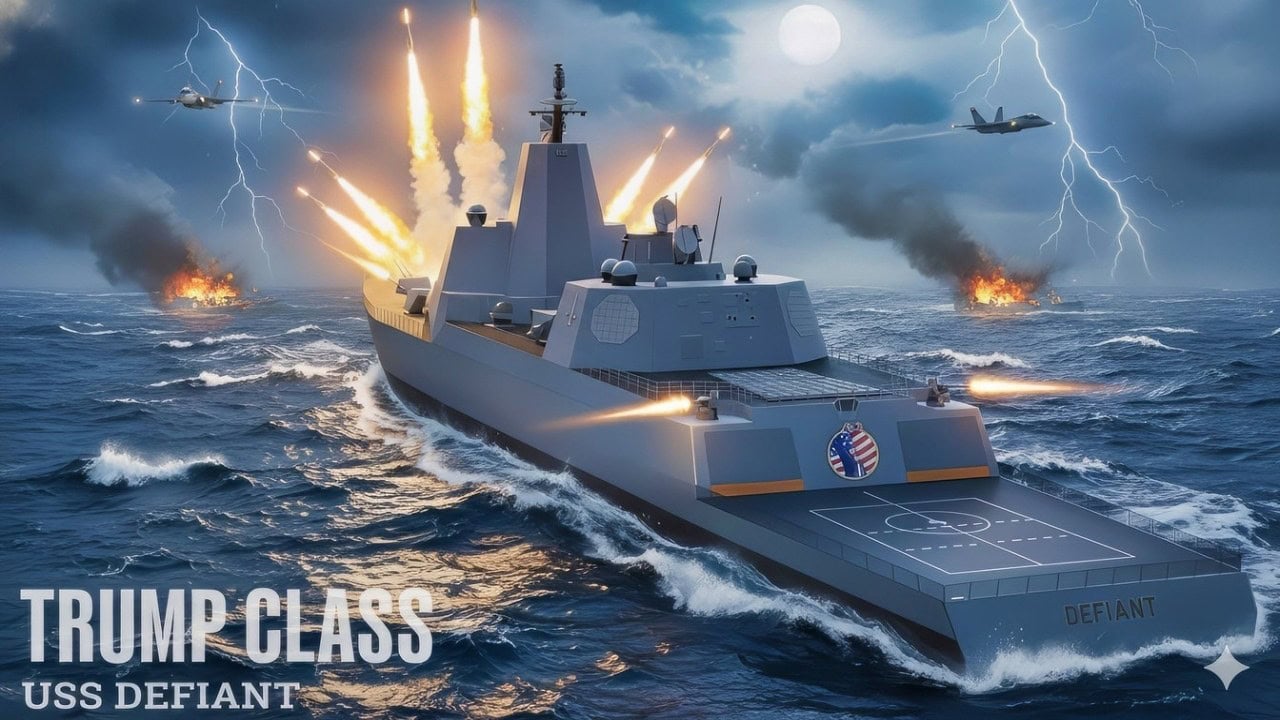
Trump-Class Battleship Image Mockup 16:9. Created Using Nano Banana.
Carriers are more likely to survive within an A2/AD envelope than battleships, because carriers do not need to sit off a coastline to matter. They project power via long-range aircraft, standoff weapons, and iSR and command-and-control. As threats evolve, carriers adapt by increasing air wing range, integrating unmanned systems, and operating as part of distributed maritime forces. The battleship cannot make these adaptations.
Downsides of the BBG(X)
The Trump-class BBG(X) would be large and detectable, lacking either stealth or standoff reach. It would concentrate firepower on the hull itself.
And unlike carriers, the BBG(X) would not be able to swap its weapons systems every decade, project power hundreds of miles inland, or adapt tactically without redesigning the entire ship.
The A2/AD environment would be more effective against the battleship than against the carrier. Near-peer A2/AD environments feature anti-ship ballistic missiles, cruise missile salvos, and swarming drones. Battleships have no inherent means of countering saturation attacks. Armor does not scale against modern precision weapons.
So a BBG(X) would be a high-value, low-flexibility target.
The Trump-class concept appears to emphasize visibility, political symbolism, and nostalgia for industrial-era power. Presence alone does not justify procurement.
The Navy already has carriers for presence and power, submarines for survivable strike, and destroyers for missile defense. The BBG(X) does not fit cleanly into that lineup.
Death of the battleship
Battleships died because their missions disappeared. Carriers persist because their missions (providing air power) remain decisive. Even critics concede that carriers are dangerous at range. And no one can really explain what a battleship would do better than existing aircraft, missiles, or submarines.
Battleships would not fight inside a near-peer coastline, survive sustained missile attack, or replace carriers, submarines, or destroyers.
At best, the new BBG(X) would cruise internationally, generate headlines, and absorb budget and shipyard capacity.
About the Author: Harrison Kass
Harrison Kass is an attorney and journalist covering national security, technology, and politics. Previously, he was a political staffer and candidate, and a US Air Force pilot selectee. He holds a JD from the University of Oregon and a master’s in global journalism and international relations from NYU.