Summary and Key Points: National Security Editor Brandon J. Weichert evaluates the U.S. Navy’s “dire strategic crisis” regarding undersea magazine depth. With the USS Ohio, Michigan, Florida, and Georgia slated for retirement between 2026 and 2028, the Navy loses its premier stealthy “missile trucks.” This report analyzes the 2026 shipbuilding bottlenecks and the potential for a Columbia-class SSGN conversion capable of carrying 200-300 Tomahawks. Weichert explores the Navy’s preference for distributed lethality and argues that Large Unmanned Undersea Vehicles (LUUVs) may offer a more cost-effective solution to counter China’s A2/AD defenses in a potential Taiwan contingency.
Columbia-Class SSGN Cruise Missile Submarine?

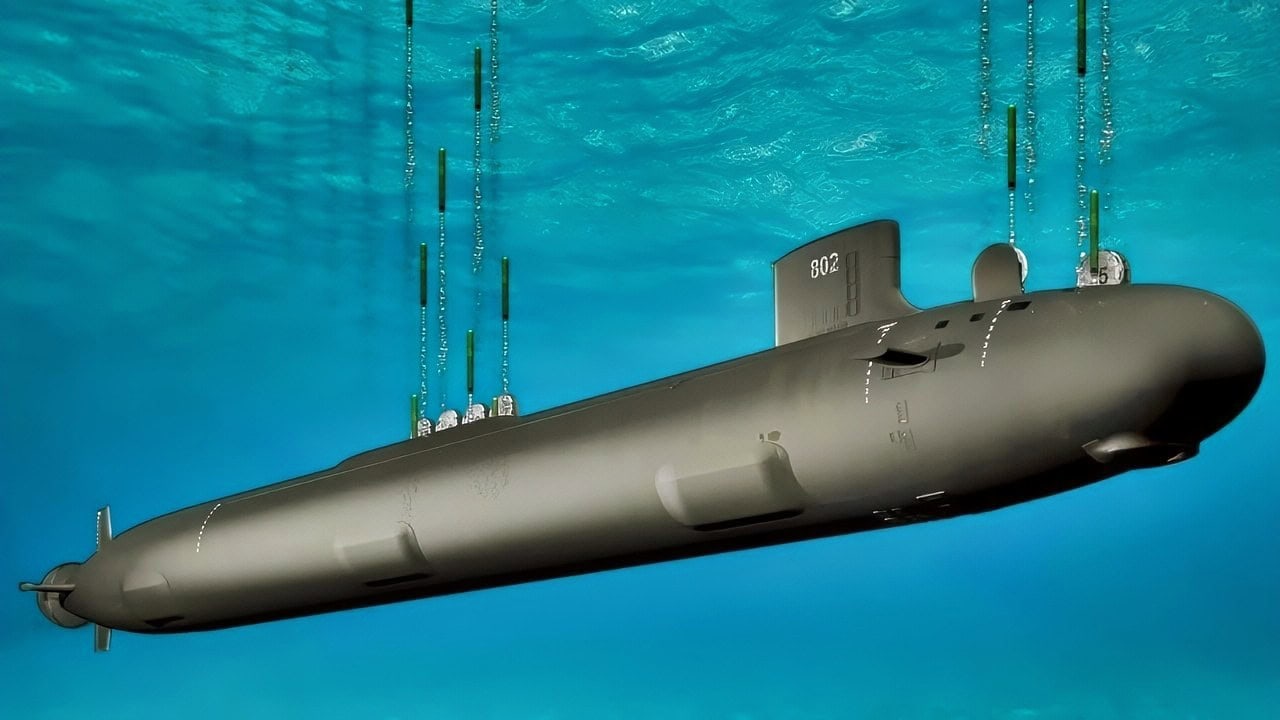
An artist rendering of the future U.S. Navy Columbia-class ballistic missile submarines. The 12 submarines of the Columbia-class will replace the Ohio-class submarines which are reaching their maximum extended service life. It is planned that the construction of USS Columbia (SSBN-826) will begin in in fiscal year 2021, with delivery in fiscal year 2028, and being on patrol in 2031.
The U.S. Navy is in a dire strategic crisis. The fleet is at the smallest it has been since the interwar years of the previous century. With chaos befalling the world, a reduced Navy is being pulled in many directions—far too many at once—that risk breaking the strategic back of the service. One thing that the Navy has struggled with has been shipbuilding—especially building a useful number of submarines.
Bottlenecks Galore
Bottlenecks in shipyard production are compounded by personnel shortages and far too many requirements. There are too few resources available to address those requirements in a timely manner, therefore, strategic gaps form. One of those gaps is in the production of guided-missile submarines (SSGNs). Currently, the Navy relies on Ohio-class SSGNs. These systems are key for supporting massive, conventional strikes.
Go back to the early 2000s. The Navy opted to convert four Ohio-class ballistic missile submarines (SSBNs) into guided-missile submarines—the USS Ohio (SSGN-726), USS Michigan (SSGN-727), USS Florida (SSGN-728), and USS Georgia (SSGN-729)—with each carrying roughly 154 Tomahawk cruise missiles, special operations forces, and advanced intelligence, surveillance, and reconnaissance capabilities.
The SSGNs were meant to be giant, stealthy, underwater missile arsenal ships.
They are now scheduled to retire between 2026–28—and there are no replacements planned.
Insufficient Capacity
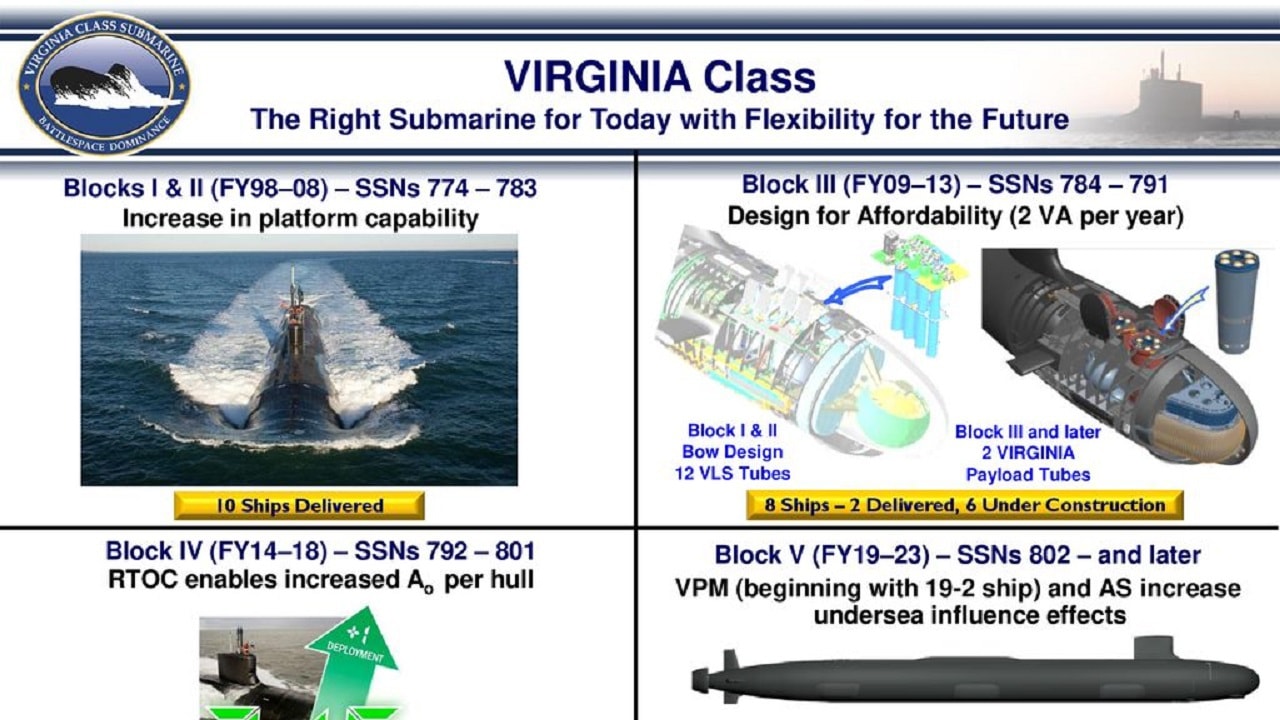
(FY98–08) – SSNs 774 – 783. Block III (FY09–13) – SSNs 784 – 791. Increase in platform capability. Design for Affordability (2 VA per year) Block I & II Bow Design. 12 VLS Tubes. Block III and later 2 VIRGINIA Payload Tubes. 10 Ships Delivered. 8 Ships – 2 Delivered, 6 Under Construction. Block IV (FY14–18) – SSNs 792 – 801. Block V (FY19–23) – SSNs 802 – and later. RTOC enables increased Ao per hull. VPM (beginning with 19-2 ship) and AS increase undersea influence effects. 10 Ships – 5 Under Construction, 5 Under Contract. In Design Phase, FY19 Construction Start. 16.
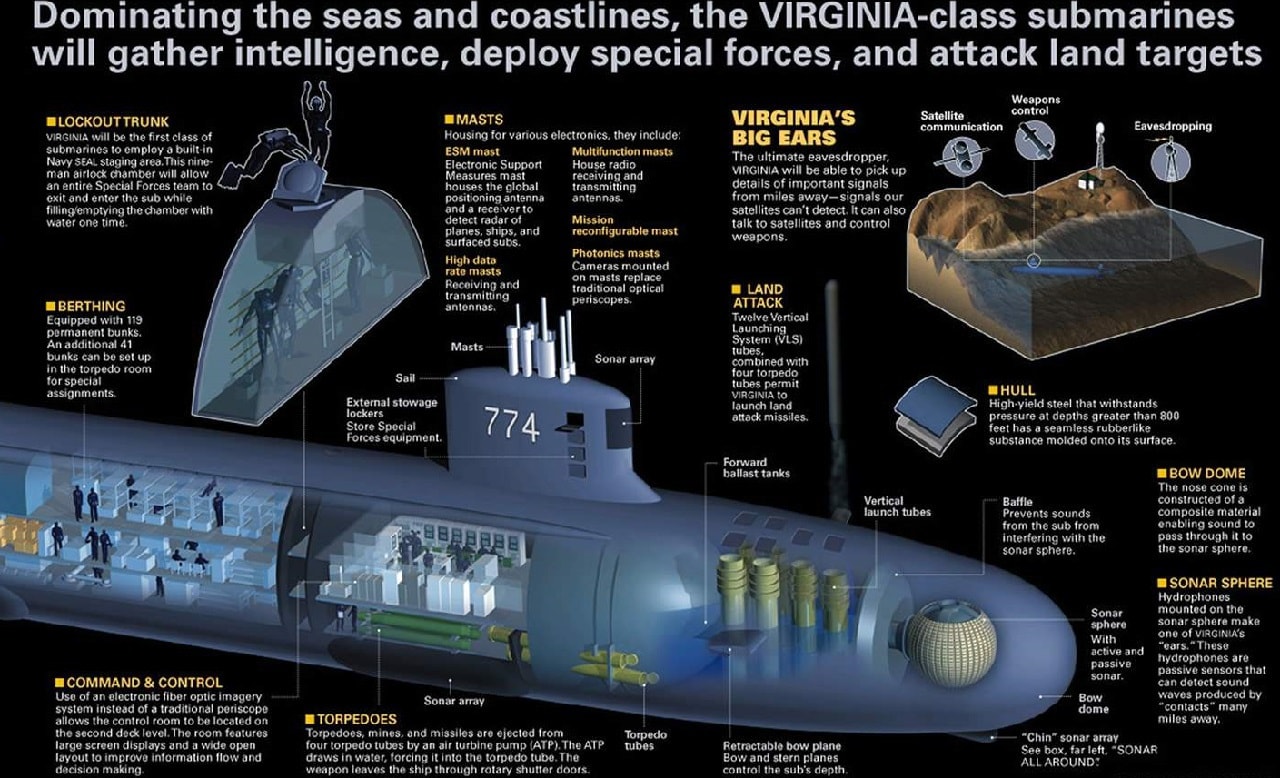
Image of Virginia-class Submarine features. Image Credit: Creative Commons.
The Navy’s current plan is to rely on the Virginia-class Block V submarines. Each of these submarines possess the Virginia Payload Module (VPM), which adds 28 additional Tomahawk cells to its payload. Yet the issue remains carrying capacity. The Virginia-class submarines, even with their VPMs, carry about 40 missiles, whereas the Ohio-class subs carry 154. That creates a 75 percent reduction in strike capacity per submarine.
Enter the Columbia-class, which is the Navy’s next-generation SSBN. But some are wondering if the United States could convert a handful of these boats into guided-missile submarines, the same way the Navy converted some of their Ohio-class SSBNs back in 2000.
The Columbia-class SSBNs have 16 missile tubes designed for Trident II ballistic missiles. If converted for SSGN use, those tubes could theoretically hold multiple Tomahawks per tube, similar to the Ohio conversion. These could allow for 200-300 cruise missiles, hypersonic strike weapons, unmanned underwater vehicles, and special forces modules. In other words, a Columbia-class SSGN could become the largest conventional strike submarine ever built.
Columbia-class SSGNs would be ideal counterweights to any country employing anti-access/area-denial (A2/AD) defenses.
Overcoming the Enemy
Think about it: Modern A2/AD functions threaten aircraft carriers. But a stealthy SSGN could operate inside enemy lines relatively undetected and ready to launch Tomahawks, hypersonic missiles, and anti-ship missiles.
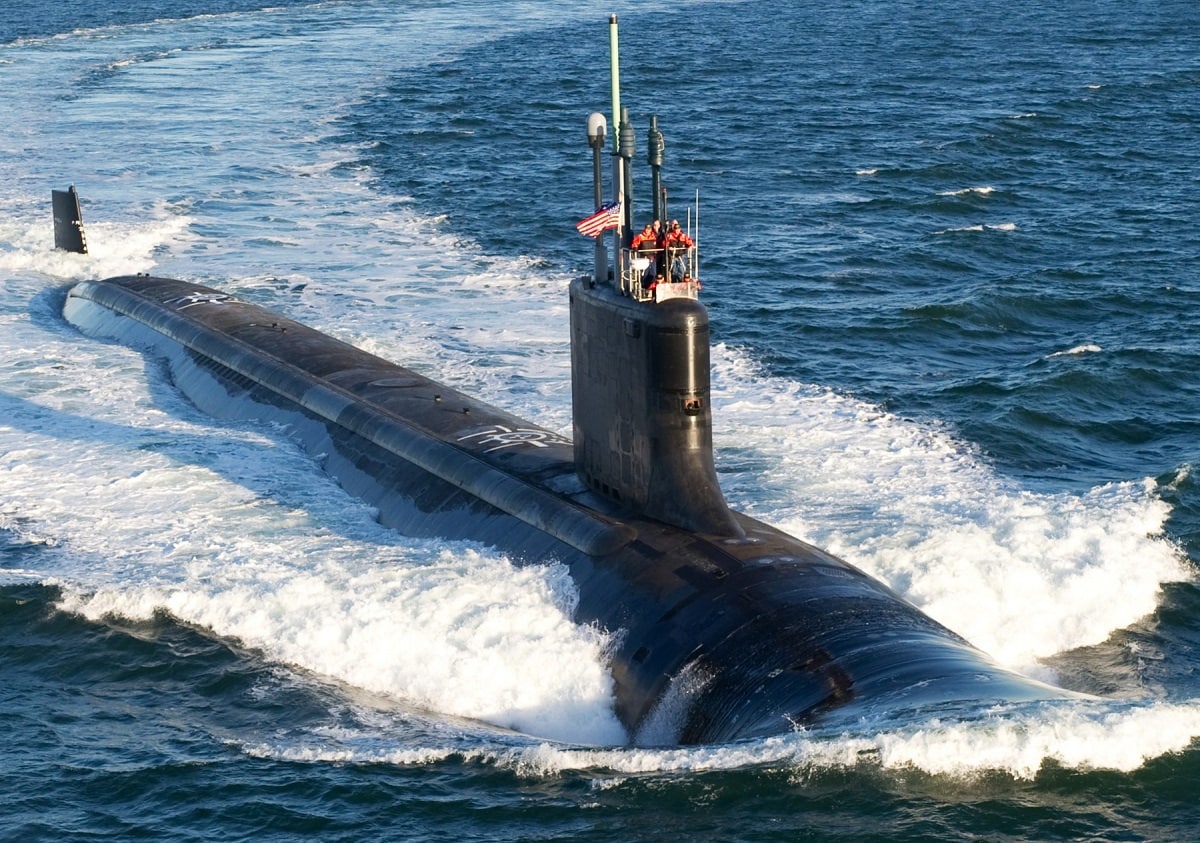
Virginia-Class. Image: US Navy.
This would make the Columbia-class a survivable first-night-of-war strike platform.
These submarines, by the way, are perfect for a Taiwan scenario. In that case, the United States would strike Chinese air bases, missile batteries, naval facilities, and command nodes. An SSGN with more than 200 missiles could deliver a massive opening salvo without exposing those vulnerable aircraft carriers.
Here’s the problem: the Columbia-class submarine is already expected to cost about $9–10 billion. Converting one into an SSGN would cost roughly that amount again. It’s not worth the cost. Meanwhile, the U.S. submarine industrial base is struggling to produce the Columbia SSBNs and the Virginia-class submarines—all as they prepare for the future SSN(X).
Further, the Navy prefers what’s known as distributed lethality. So, they want many platforms, smaller missile loads, and they want all these systems linked together in a vast, world-spanning network. Having a giant arsenal platform, such as a Columbia-class SSGN variant, would undermine that preferred approach to naval warfare.
A More Survivable Solution
Yet, the Navy might want to start seriously questioning these assumptions, especially considering the way in which drones have transformed the Ukraine War; the way missile and hypersonic forces have been used in Iran; and the massed-fires doctrine of China’s military.
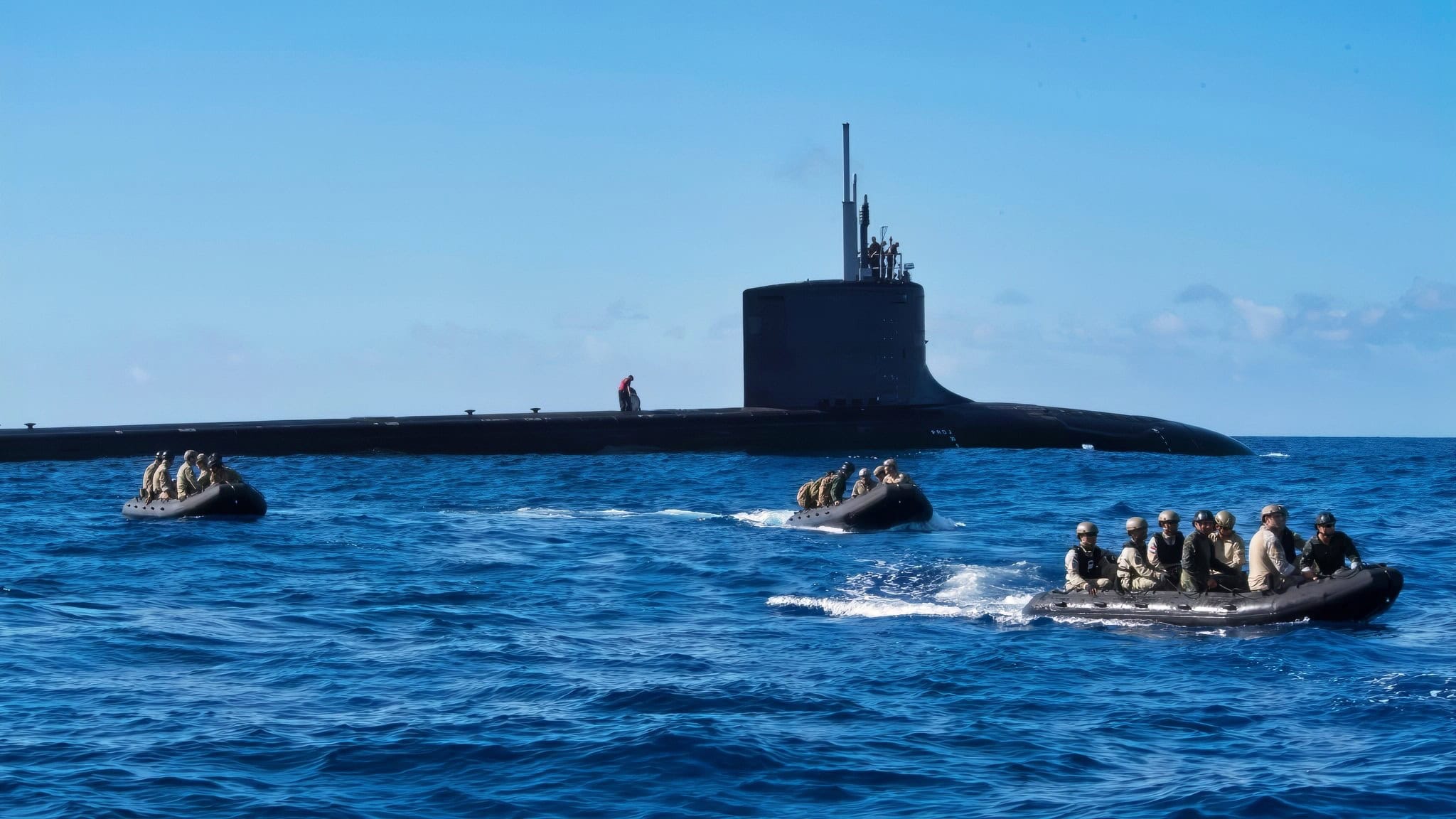
PEARL HARBOR (July 9, 2018) – Multi-national Special Operations Forces (SOF) participate in a submarine insertion exercise with the fast-attack submarine USS Hawaii (SSN 776) and combat rubber raiding craft off the coast of Oahu, Hawaii during Rim of the Pacific (RIMPAC) exercise, July 9. Twenty-five nations, 46 ships and five submarines, about 200 aircraft, and 25,000 personnel are participating in RIMPAC from June 27 to Aug. 2 in and around the Hawaiian Islands and Southern California. The world’s largest international maritime exercise, RIMPAC provides a unique training opportunity while fostering and sustaining cooperative relationships among participants critical to ensuring the safety of sea lanes and security of the world’s oceans. RIMPAC 2018 is the 26th exercise in the series that began in 1971. (U.S. Navy photo by Lt. j.g. Michelle Pelissero)
Perhaps a better solution—cheaper and accessible for the strained U.S. industrial base—would be to build a fleet of large unmanned undersea vehicles (UUVs) that could conduct massive cruise missile and drone attacks on distant targets, better protecting U.S. sailors who might be threatened by enemy retaliation and sparing platforms such as SSGNs from the risk of a catastrophic loss
If the Navy doesn’t figure this one out soon, the United States will no longer be able to fully project power globally. Maybe that’s a blessing in disguise, though.
About the Author: Brandon J. Weichert
Brandon J. Weichert is the Senior National Security Editor at 19FortyFive.com. Recently, Weichert became the editor of the “NatSec Guy” section at Emerald.TV. He was previously the senior national security editor at The National Interest. Weichert is the host of The National Security Hour on iHeartRadio, where he discusses national security policy every Wednesday at 8pm Eastern. He hosts a companion show on Rumble entitled “National Security Talk.” Weichert consults regularly with various government institutions and private organizations on geopolitical issues. His writings have appeared in numerous publications, among them Popular Mechanics, National Review, MSN, and The American Spectator. And his books include Winning Space: How America Remains a Superpower, Biohacked: China’s Race to Control Life, and The Shadow War: Iran’s Quest for Supremacy. Weichert’s newest book, A Disaster of Our Own Making: How the West Lost Ukraine, is available for purchase wherever books are sold. He can be followed via Twitter/X @WeTheBrandon.