
Downed American F-15E Prompts Risky, Partially Successful Combat Search and Rescue Effort
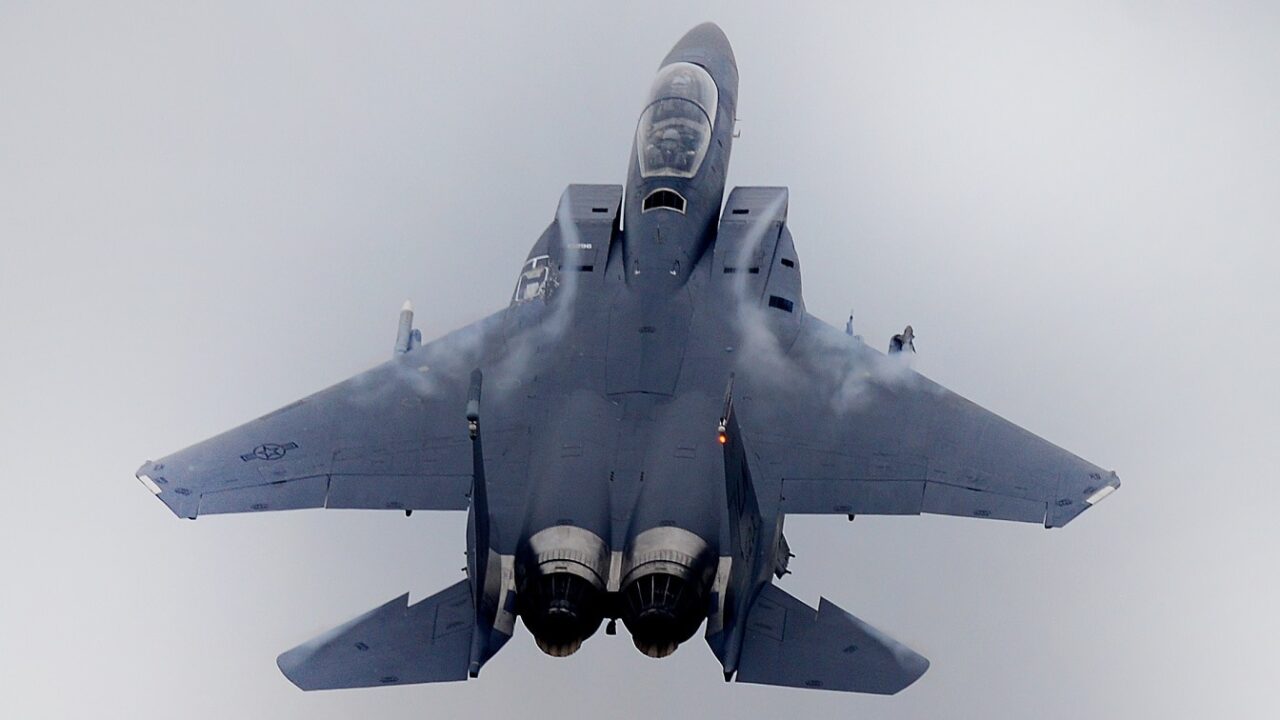
The U.S. Air Force has lost a two-seat F-15E Strike Eagle fighter-bomber in combat operations over southwestern Iran this morning—and is mounting a very risky combat search and rescue (CSAR) effort that has successfully extracted one of the ejected crew while efforts to extract a second crewmember remain ongoing.
It’s always wise to treat individual pieces of media issuing from warzones with cautious skepticism, but a mounting cascade of imagery of the wrecked jet and CSAR operation—followed by statements by U.S. officials—confirms the aircraft loss, rescue effort, and eventually, the successful extraction of one crewmember.
Iranian state media—at least initially—reported the Iranian Revolutionary Guard Corps had downed an F-35 stealth fighter. However, various images of wreckage that subsequently emerged clearly showed components of an F-15E Strike Eagle, eventually supported by U.S. sources. A red band on a piece of vertical tail stabilizer, moreover, shows the aircraft came from the 494th Fighter Squadron, a unit with its home base at RAF Lakenheath in the United Kingdom.
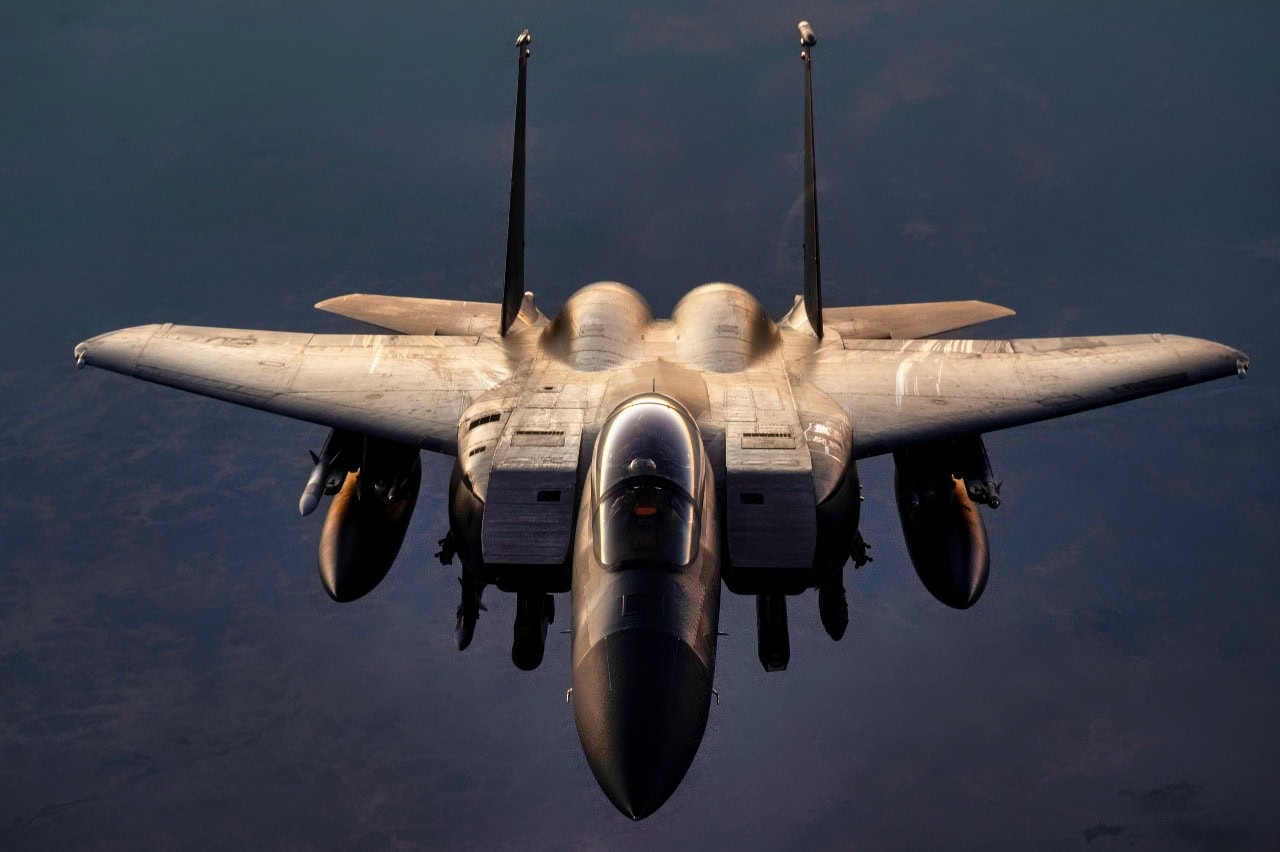
A U.S. Air Force F-15E Strike Eagle flies over the U.S. Central Command area of responsibility, Jan. 7, 2025. The F-15E’s superior maneuverability and acceleration are achieved through its high engine thrust-to-weight ratio and low-wing loading. (U.S. Air Force photo by Staff Sgt. William Rio Rosado)
Iran had earlier released footage of an F-15 being tracked by an optical sensor as it executed evasive maneuvers and released flares earlier that day, purportedly over Qeshm Island near the Strait of Hormuz. However, the footage doesn’t show an actual intercept, and the CSAR effort is taking place hundreds of miles northwest in Khuzestan, which borders Iraq.
The Pentagon promptly scrambled search-and-rescue aircraft, and Iranians on the ground began sharing images of U.S. HH-60G Pave Hawk rescue helicopters and HC-130J Combat King II aircraft refueling helicopters over Khuzestan. Iranian media circulated government messages offering a $60,000 reward to capture the F-15E crew alive and to fire upon CSAR aircraft.
The Pave Hawks are Blackhawk helicopters heavily refitted for CSAR missions inside enemy territory with added rescue winch/hoist, additional internal fuel tanks, retractable in-flight refueling capability, support for additional/heavier door machine guns, night-vision and infrared sensors, and multi-mode navigation systems.
Meanwhile, the Combat King II is a variant of the ubiquitous C-130J Super Hercules cargo plane designed to support air-to-air refueling of helicopters and Osprey tilt-rotor aircraft. Replacing older HC-130Ps, which had significantly shorter range and lower maximum speed, the J model introduced more advanced sensors to assist rescue efforts and detect threats, improved self-defense countermeasures, and a new ability to refuel itself from other aircraft to extend operations.
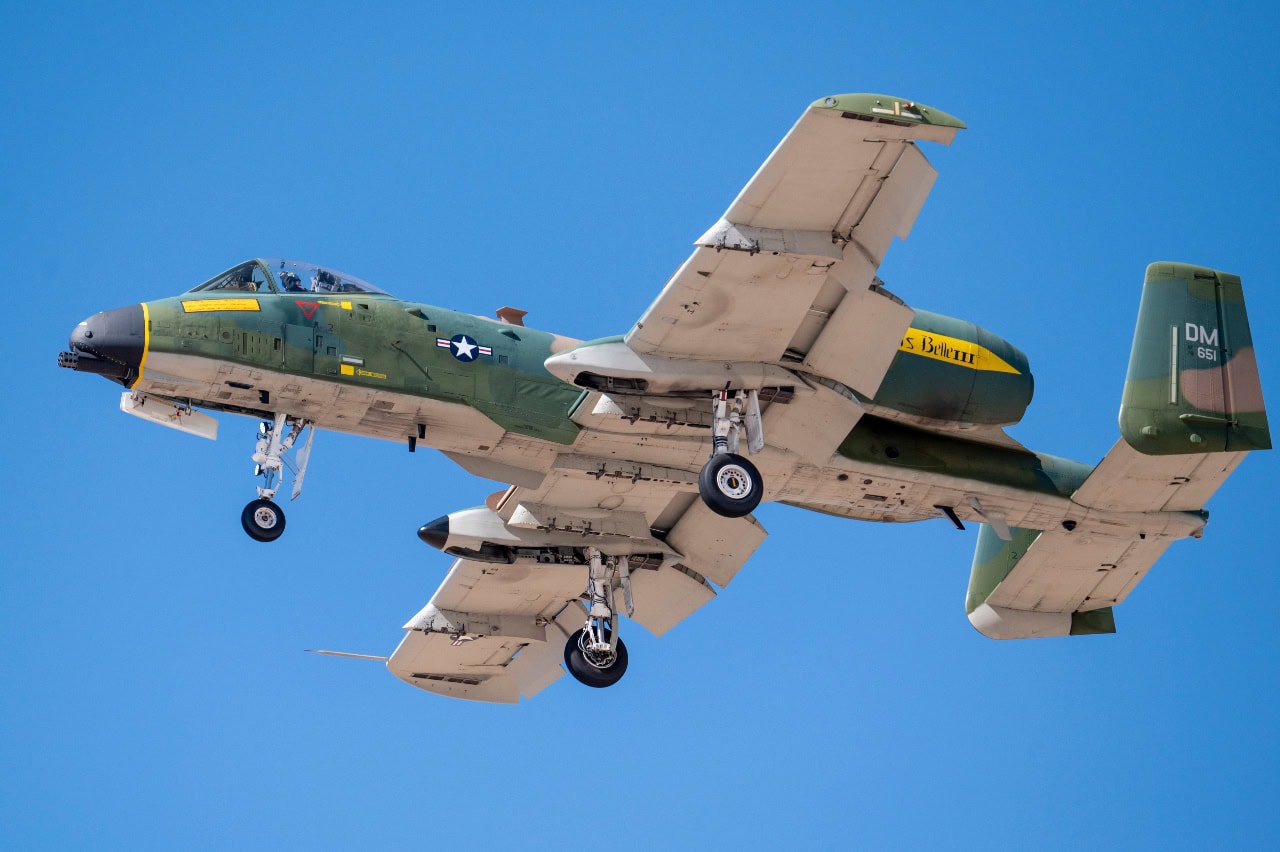
U.S. Air Force Maj. Lindsay “MAD” Johnson, A-10C Thunderbolt II Demonstration Team commander and pilot, signals to the audience from her A-10 aircraft during a Hawgsmoke 2024 practice demonstration at Davis-Monthan Air Force Base, Arizona, Sept. 12, 2024. The A-10’s ability to fly low and slow over the battlefield was one of the many attributes that made it an effective close air support airframe. (U.S. Air Force photo by Senior Airman Devlin Bishop)
One remarkable video from Iran today captured an HC-130J simultaneously refueling two Pave Hawks behind it over Iranian airspace. Helicopters have inherently shorter range and endurance than fixed-wing aircraft, so the HC-130J plays a key role in helping the HH-60s sustain their search-and-rescue efforts over hostile territory.
However, it’s worth noting that Pave Hawks and Hercules both operate at speeds and altitudes, leaving them highly vulnerable to anti-aircraft weaponry—despite being specially fortified with armor and self-defense systems against said threats, including directional infrared jammers (DIRCMs) that use flashing lights to disrupt optical/infrared-guided weapons, radar warning receivers, and chaff and flare dispensers.
The risks of ambush to these aircraft searching over a limited area for prolonged periods are quite considerable because if countermeasures fail, they lack the agility to outrun/maneuver most threats.
Of course, the CSAR aircraft are undoubtedly being covered by combat aircraft from above to surveil the surrounding ground and airspace with radar and optical sensors, and engage detected threats. Various Iranian videos suggest the overhead cover may include F-35A stealth fighters, beefy A-10 Warthogs, and MQ-9A Reaper combat drones.
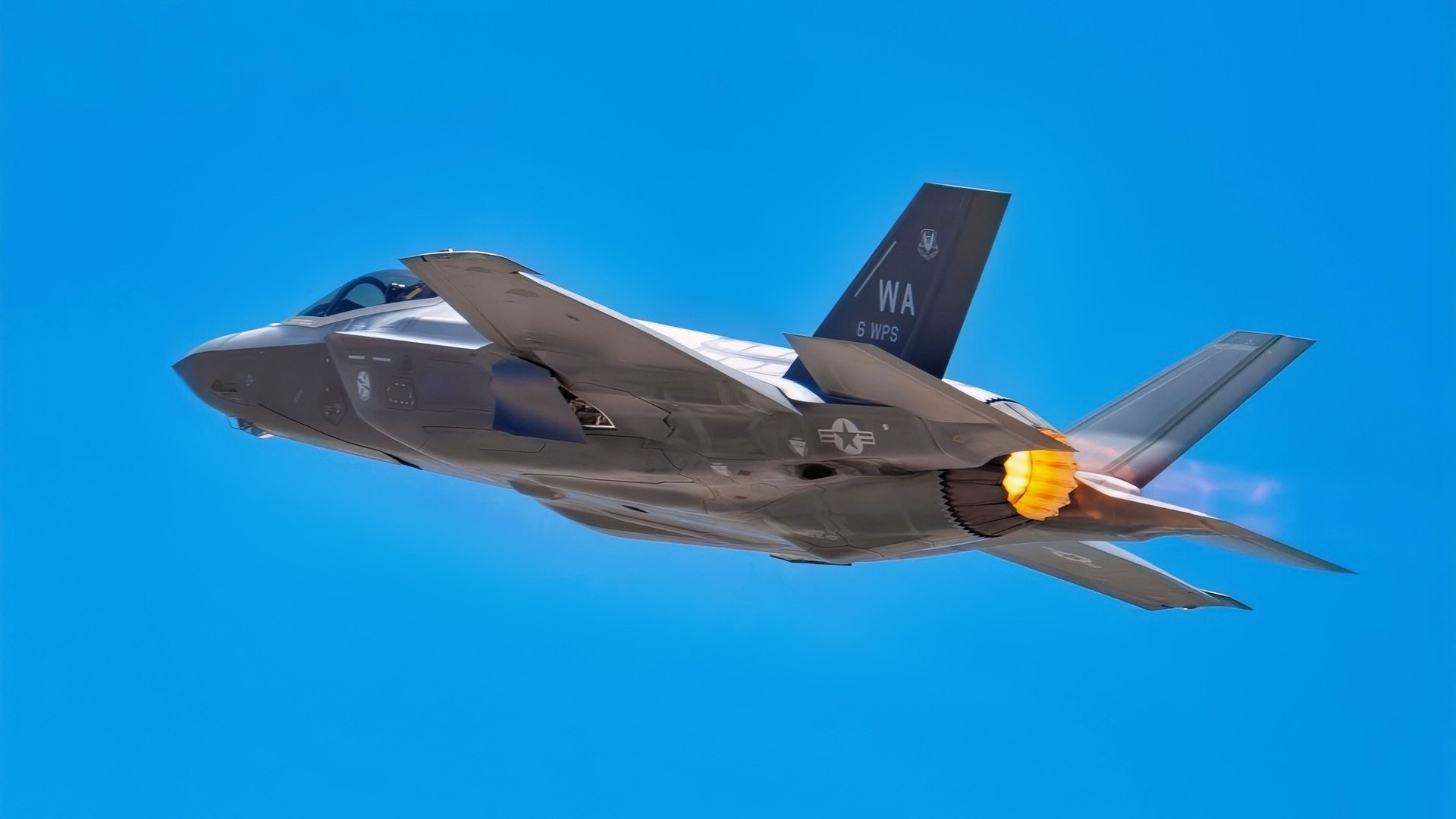
An F-35A Lightning II fighter jet, 6th Weapons Squadron (WPS), takes off from Nellis Air Force Base, Nev., July 18, 2019. The 6th WPS is the only squadron under the U.S. Air Force Weapons School exclusively training on the F-35A. (U.S. Air Force photo by Airman 1st Class Bryan Guthrie)
Still, CSAR operations during the Vietnam War sometimes lost multiple aircraft and personnel attempting to extract pilots from hostile territory. Iranian videos have also surfaced purporting to show small arms fire directed at CSAR helicopters. Another Iranian media source alleges a crew member has already been captured by Iranian forces, while insinuating the news is being suppressed to lure CSAR aircraft into an ambush.
Iran’s Air Defenses Stubbornly Refuse to Die
Between 2024 and March 2026, Israeli and U.S. strikes dealt a succession of punishing blows to Iran’s extensive air defense network, which has enabled both services to sustain weeks of airstrikes deep within Iran without losing a single manned warplane.
Yet despite repeatedly being pronounced neutralized, Iran’s air defenses have proven sufficiently numerous and diversified to pose an enduring threat to aircraft that assume greater risks by descending to lower altitude or entering optical detection range.
The thing is, to conserve expensive standoff-range weapons like JASSM or Tomahawk cruise missiles, which are available only in limited quantities, any air force must eventually assume greater risks by using less expensive weapons and non-stealth aircraft like the F-15E—ideally after having adequately suppressed air defenses.
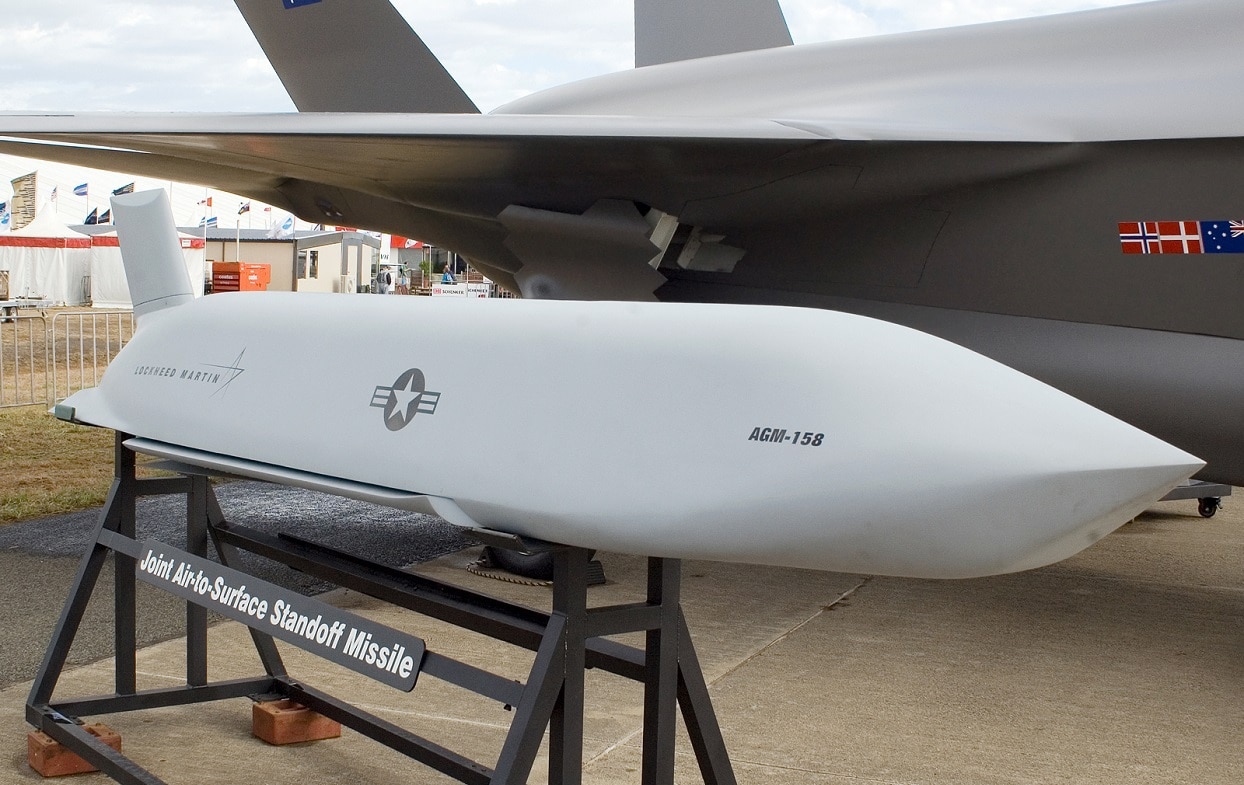
Image: Creative Commons.
And while Iran’s air defenses aren’t cutting-edge, Tehran has many of them in diverse configurations as both Iran’s regular armed forces and its more fanatical Revolutionary Guard Corps separately field multi-layer air defense apparatuses including with both radar and optical/infrared-guided missiles that can pose threats to stealth fighters—as testified by one that managed to damage an F-35 stealth fighter in March.
Another video captures a dangerously near miss of a Navy F/A-18E or F Super Hornet jet by an Iranian man-portable missile (allegedly an indigenous AD-08 Majid).
While far-seeing radars emit signals that are readily detected by enemy sensors and leave them vulnerable to counter-attack by anti-radiation missiles, optical/infrared sensors don’t, and thus have much better odds of surprising enemy aircraft that enter their admittedly limited fields of view. Thus, the only way to fully neutralize such systems is to pick them out using the same optical/infrared means—though ground-based defenses are able to conceal themselves amidst terrain while airborne sensors can’t.
Indeed, the enduring persistent threat posed by Iranian defenses has been reflected in the reported loss of at least 16 Air Force MQ-9A Reaper drones and at least 10 comparable Israeli Hermes 900s. While obviously more expendable than manned aircraft, such big drones aren’t cheap at roughly $15 million per airframe, with the Reaper furthermore out of production.
And as these aircraft provided useful long-endurance surveillance, target acquisition, and attack capabilities, it’s possible attrition to these combat drones created the conditions in which the F-15E was lost in April.
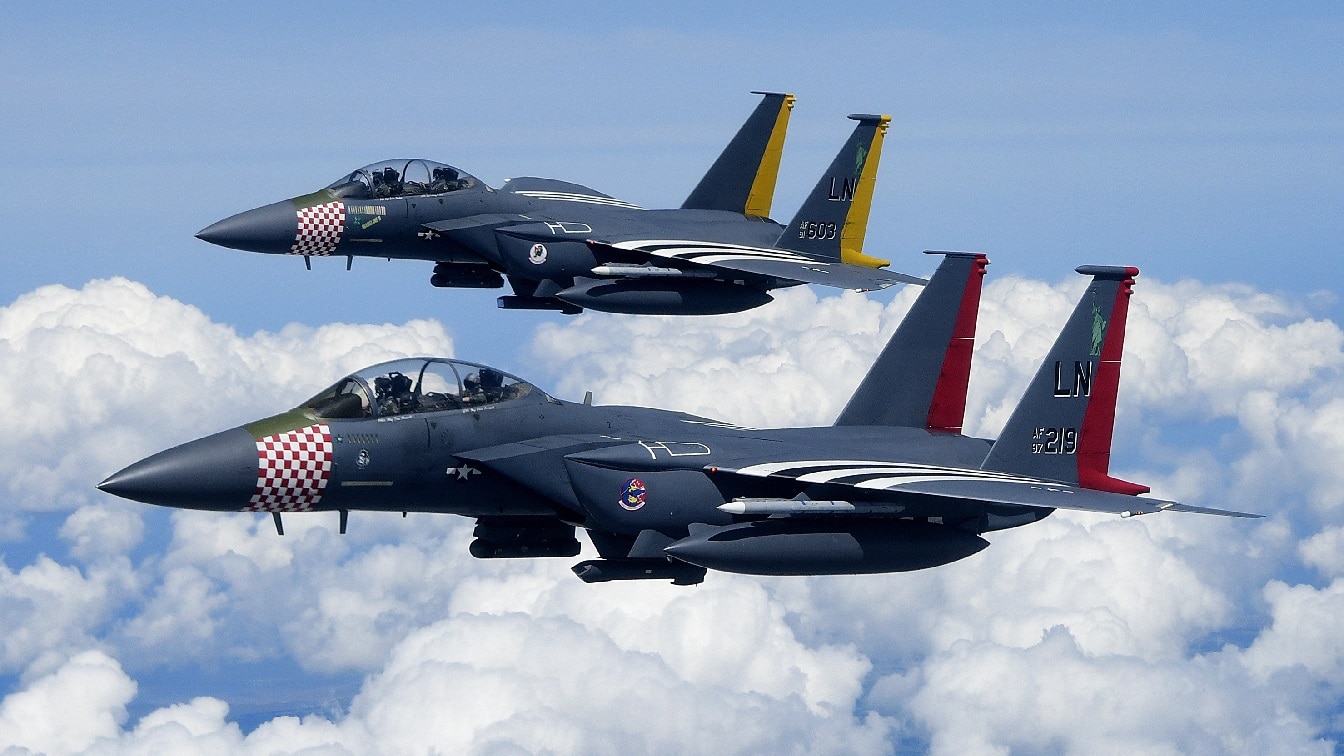
A pair of heritage painted F-15E Strike Eagles assigned to the 48th Fighter Wing conduct aerial maneuvers over southern England June 9, 2019. The Liberty Wing conducts routine training daily to ensure the 48th Fighter Wing brings unique air combat capabilities to the fight when called upon by United States Air Forces in Europe-Air Forces Africa. (U.S. Air Force photo/ Tech. Sgt. Matthew Plew)
To be fair, by traditional measures, losing just one manned aircraft to air defense fire after a month of intense air raids is still a remarkable performance—and doesn’t negate the remarkable extent to which U.S. and Israeli raids flout Iranian defenses.
However, wars are political events, and this first Iranian defeat of a manned U.S. warplane will invigorate Tehran’s morale and bring increasing pressure on the Trump administration, which has repeatedly claimed Iran ‘defeated’, to define the war’s nebulous objectives. It further highlights that sustained operations will gradually incur mounting losses rather than wiping out Iranian military capability entirely.
Additionally, the loss may compel Pentagon war planners to revisit the level of risk they are accepting with manned warplanes, curtail the use of non-stealth jets over Iranian airspace, and/or increase the use of more expensive, limited-supply standoff weapons. If such shifts occur, they could further increase the costs of the U.S. campaign and/or reduce its offensive output.
The Air Force’s Mud Hens’ Are Taking a Beating
This marks the fourth F-15E lost by the U.S. Air Force since it launched its air war against Iran, following a notorious incident on March 1st in which a lone supposedly allied Kuwaiti F/A-18 Hornet jet downed three F-15Es at short-range in rapid succession in an ostensible friendly fire incident.
A spinoff of the F-15 Eagle, initially designed strictly for air-to-air combat, the Strike Eagle is a very powerful and versatile supersonic warplane capable of carrying a ridiculous 12 tons of weapons at maximum payload. Less glamorously nicknamed ‘Mud Hens’, F-15Es are slightly chunkier in profile and generally painted darker than air-to-air F-15s to better conceal them from aircraft looking down from above on the premise that they’re generally operating at low altitude.
However, the F-15 airframe was never designed for stealth and has a greater radar cross-section even than peer fourth-generation warbirds like the F-16 and F/A-18. Thus, the Strike Eagle’s key tools for surviving enemy air defenses include flying fast at low altitude to conceal themselves from terrain and self-defense systems, as well as a powerful jammer, which, post-2022, was updated with an AN/ALQ-250 EPAWSS electronic warfare system.
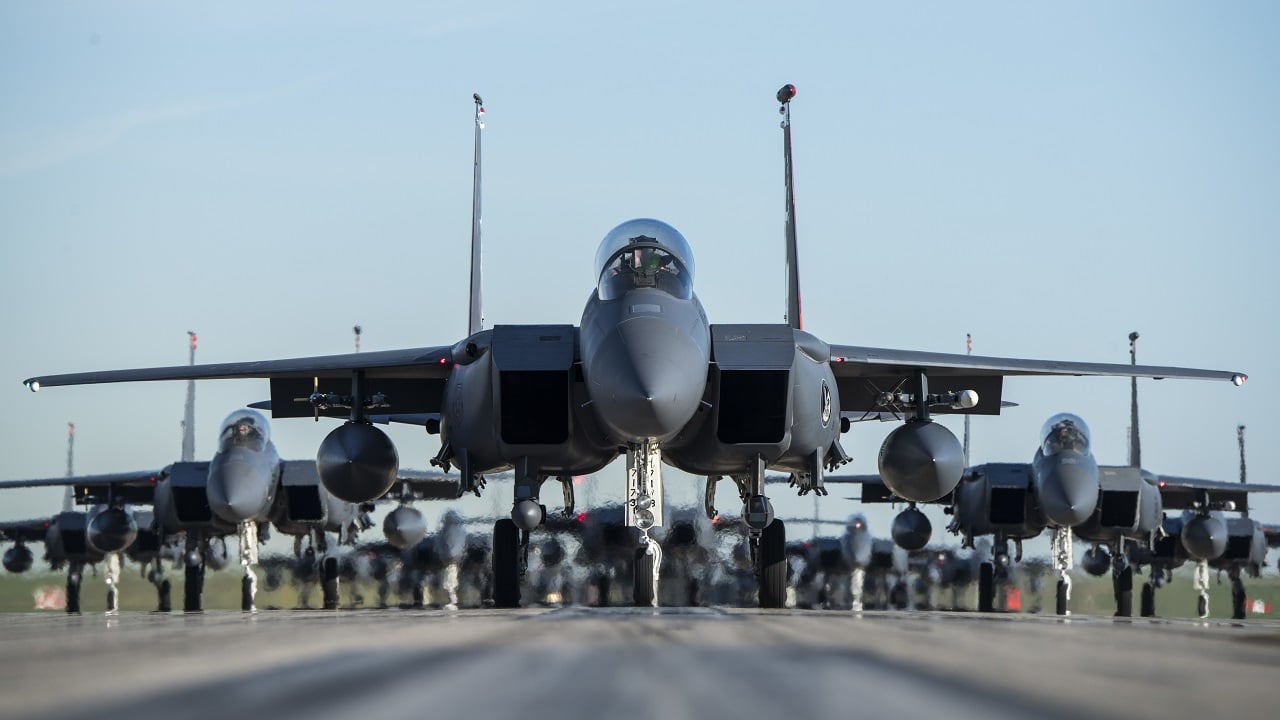
F-15E Strike Eagles taxi into formation June 12, 2019, at Mountain Home Air Force Base, Idaho. This was a rare opportunity to capture the Gunfighter family, including the 391st, 389th and 428th Fighter Squadrons, before a morning flight. (U.S. Air Force photo by Staff Sergeant Jeremy L. Mosier)
These capabilities are not a sure defense, particularly as low-altitude approach tactics involve a tradeoff: they increase exposure to short-range air defenses (guns and missiles typically using optical/infrared guidance) even as intervening terrain masks low-flying airplanes from radars used to guide long-range missiles.
Losses of manned warplanes are a risk in any sustained air war against a country with dense air defenses, as expenditures on pricy long-range weapons cannot be sustained for long, and long-range drones do not yet offer a substitute for the capabilities of manned warplanes. But while some losses are tolerable from a military standpoint (if not so much for families of the affected crew), this incident could have a disproportionate impact by deflating the exaggerated perceived invulnerability of U.S. airpower.
On the other hand, the success of the CSAR operation in extracting one of the downed airmen—using aircraft far more vulnerable to enemy fire than an F-35 or Strike Eagle—continues to reflect the exceptional operational capabilities of the U.S. Air Force and the bravery and skills of its Airmen.
MORE – The SR-71 Blackbird Required Titanium Manufacturing That Didn’t Exist
About the Author: Defense Expert Sebastian Roblin
Sebastien Roblin writes on the technical, historical, and political aspects of international security and conflict for publications including The National Interest, NBC News, Forbes.com, and War is Boring. He holds a Master’s degree from Georgetown University and served with the Peace Corps in China. Roblin is also a 19FortyFive.com Contributing Editor.