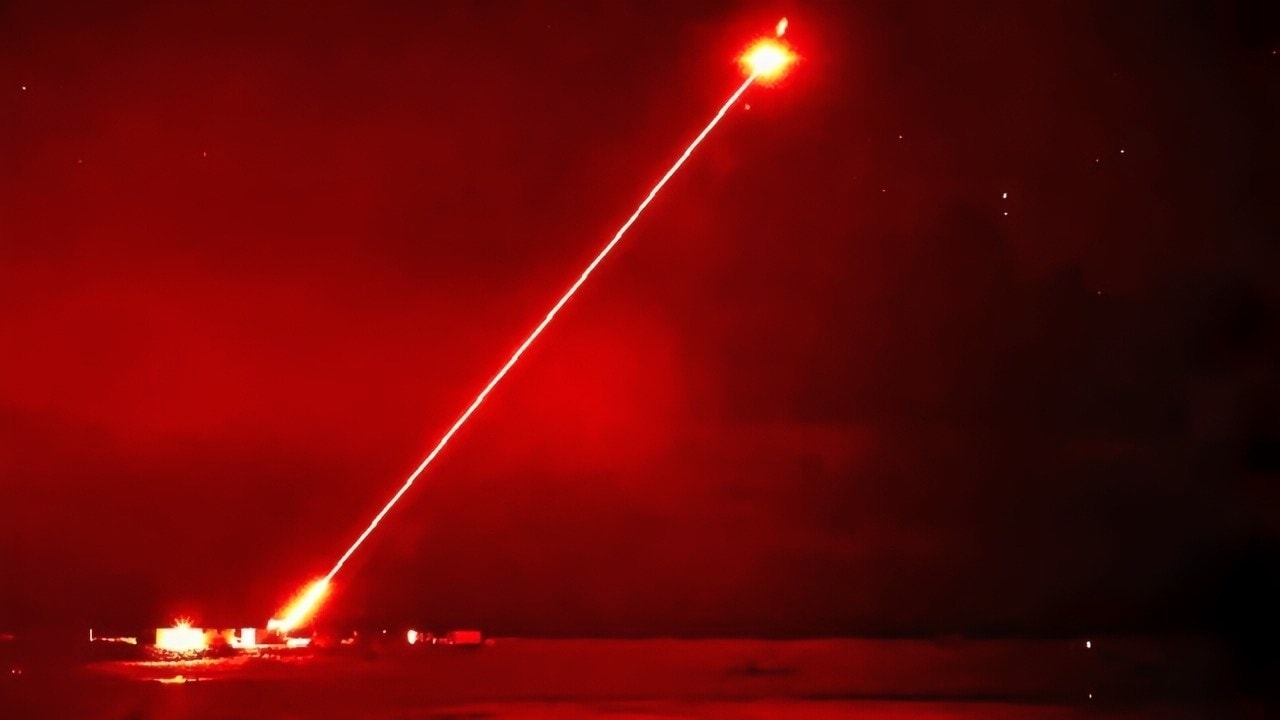
Though seemingly from a science fiction novel, militaries around the world are investing in laser weapon technology to better protect sensitive military and commercial sites, vehicles, and warships. In the United Kingdom, laser weapons are inching toward potential deployment on Royal Navy warships sometime next year, British parliamentarians confirmed in answers to questions posed to the Ministry of Defense. That’s right: DragonFire is coming soon.
DragonFire Is Coming
Luke Pollard, Minister for Defense Readiness and Industry, explained the timeline. “The DragonFire program [a laser weapon system] is being delivered through a new approach to procurement aimed at accelerating delivery timescales and providing the Royal Navy with novel capability sooner. This approach focuses on delivering a minimum deployable capability that can be further developed and enhanced over time.”
Based on a successful demonstrator trial, DragonFire was selected for accelerated service entry, leading to further trials to inform the design and development of a minimum deployable capability. We are on track to install this capability on a Royal Navy Type 45 destroyer in 2027.
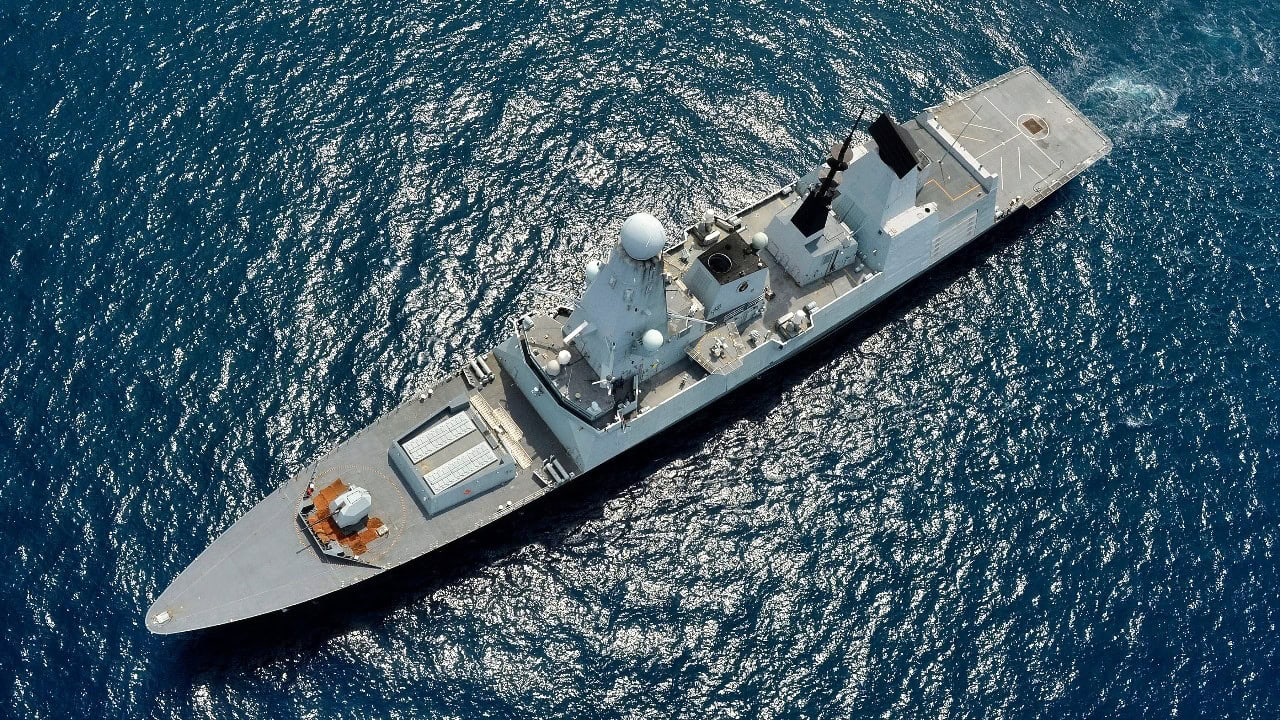
HMS Daring Type 45 Destroyer Royal Navy.
Beyond this, spiral development will allow for progressive improvement of the capability.”
Pollard’s comments are another confirmation of the Royal Navy’s DragonFire aspirations, following a multi-million-pound contract awarded to DragonFire’s parent, MBDA, several years ago.
That award, given two years ago, set the original 2027 timeline for laser weapon integration onto Royal Navy warships — a timeline mentioned by parliamentarians as far back as spring 2025. But the system has been in development for years.
“This high-power laser will see our Royal Navy at the leading edge of innovation in NATO, delivering a cutting-edge capability to help defend the UK and our allies in this new era of threat,” Luke Pollard, also a Member of the British Parliament, said following an MBDA contract award for the system. MBDA has developed the DragonFire laser.
Operation Epic Fury Proves Lasers are Needed
The ongoing war in the Middle East, part of a wider Israeli-American campaign, has laid bare what defense planners have long known: that despite air defense interceptors’ efficacy, their high per-shot cost and slow manufacture speed are serious hindrances to effective defense against the kinds of munitions launched by Iran at its neighbors throughout the region.

A Falcon Heavy rocket launches into the sky, surrounded by smoke and fire during takeoff.
Laser weapons could reverse that cost equation in favor of the defense.
The DragonFire laser system is far from the only directed-energy initiative today. Epirus, an American firm, combined with an Australian company with electronic warfare experience to build a counter-UAV system in 2023.
Israel’s Iron Beam laser system is in development, and should that initiative be successful, it will be used to engage and destroy mortar rounds and rockets as well as drones. In 2024, the British Ministry of Defense evaluated a vehicle-mounted laser that “successfully destroyed flying drones” by “directing an intense beam of infra-red light in the form of energy towards its target.”
Reporting from The Washington Post revealed that the United States has burned through 850 Tomahawk cruise missiles in the course of hostilities against Iran.
Both Israel and the Gulf countries are thought to have also expended hundreds of air defense interceptors fending off Iranian missiles and one-way attack drones.
The United States is believed to have fired off over 1,000 air defense interceptors from both Patriot and Terminal High Altitude Area Defense (THAAD) air defense batteries.
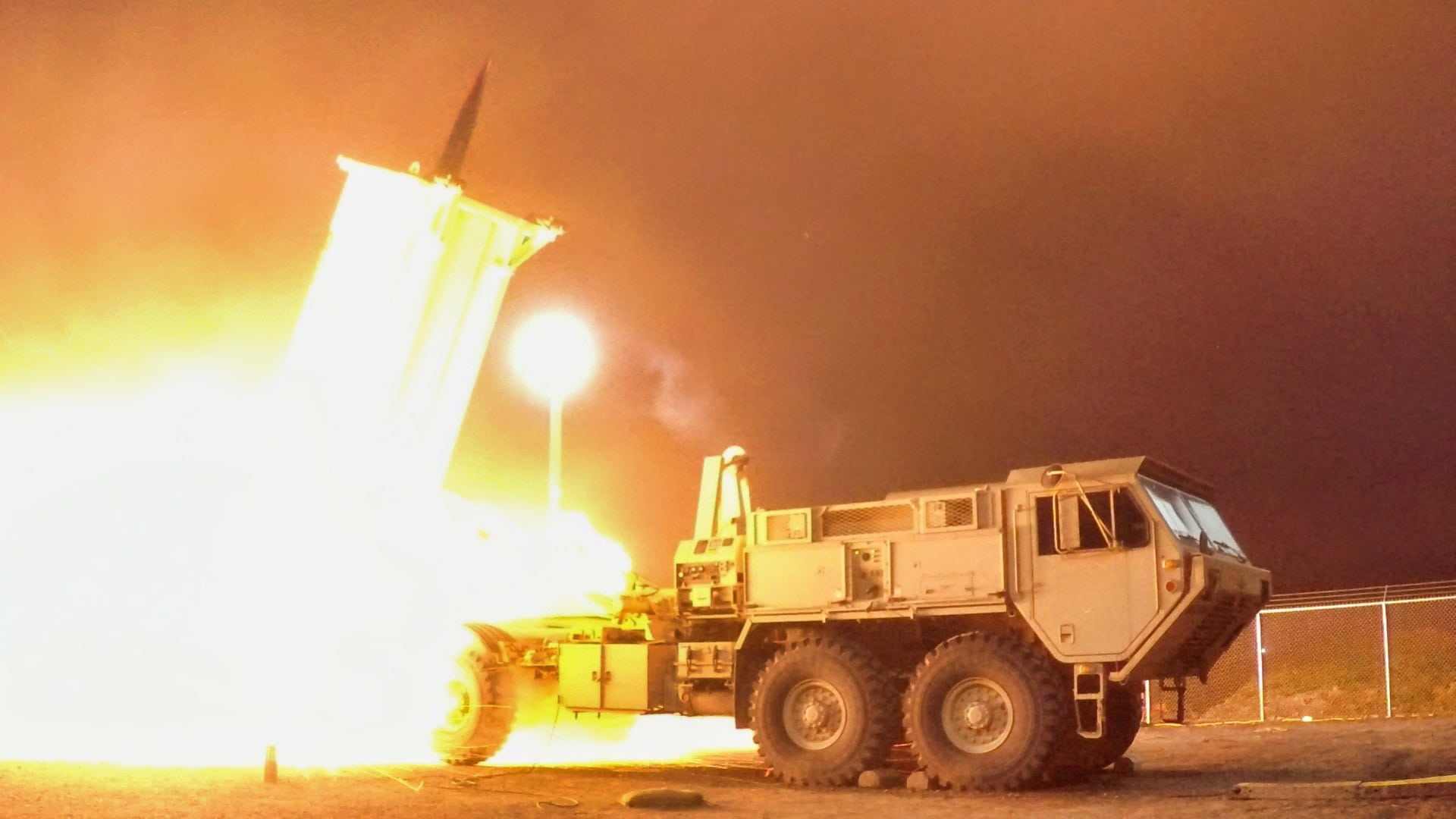
THAAD. Image Credit: Department of Defense.
Cost-benefit Analysis
Warships are a logical placement for directed-energy air defense systems.
Though cost-per-shot is very low, mere cents or dollars per shot, depending on the system, the amount of energy needed for an effective interception is significant.
Though large commercial generators could generate the energy needed to shoot down drones, missiles, or other incoming ordnance, warships are a more practical platform for energy-intensive defense.
The amount of electrical power warships can generate is significantly greater than, say, the amount of electricity a tank could generate.
The potential for nuclear-powered warships, like the United States Navy’s aircraft carriers — all of which are nuclear-powered — to defend themselves or their surrounding carrier strike groups is high, and a logical application.

Pre-Commissioning Unit John F. Kennedy (CVN 79) transits the James River as the ship departs for Builder’s Trials, Jan. 28, 2026. Builder’s Trials provide an opportunity to test ship systems and components at sea for the first time, and make required adjustments prior to additional underway testing. (U.S. Navy photo by Mass Communication Specialist Seaman Jayden Howard)
Their onboard reactors generate near-limitless amounts of energy, which can be applied to laser weaponry.
Blockade?
With the United States effectively blockading the Strait of Hormuz to secure that sea lane from Iran’s IRGC fleet of gun and missile-toting speedboats and sea mines, the need for reliable directed-energy weapons like the United Kingdom’s DragonFire laser weapons has never been greater.
French President Emmanuel Macron took to X, formerly Twitter, on Monday to announce the formation of a conference “with countries ready to contribute alongside us to a peaceful multinational mission aimed at restoring freedom of navigation in the strait,” an initiative that Paris said also includes the United Kingdom.
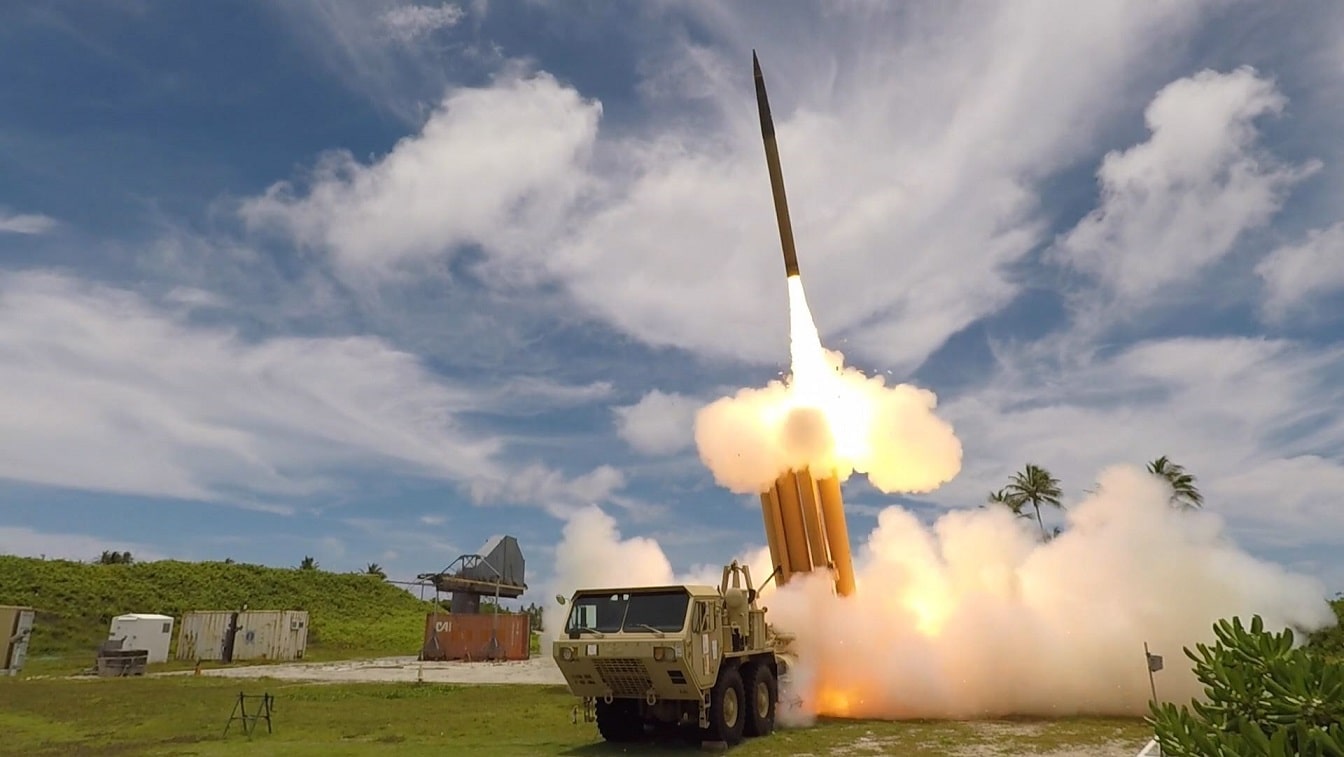
THAAD Missile Defense Battery Firing. Image Credit: Lockheed Martin.
“This strictly defensive mission,” Macron wrote, “distinct from the belligerents, will be deployed as soon as the situation allows.”
But when that date is remains to be seen. It is uncertain that British warships would be deployed to the Strait with DragonFire laser weapons — but the need for directed-energy weaponry has arguably never been greater.
About the Author: Caleb Larson
Caleb Larson is an American multiformat journalist based in Berlin, Germany. His work covers the intersection of conflict and society, focusing on American foreign policy and European security. He has reported from Germany, Russia, and the United States. Most recently, he covered the war in Ukraine, reporting extensively on the shifting battle lines in Donbas and writing about the war’s civilian and humanitarian toll. Previously, he worked as a Defense Reporter for POLITICO Europe. You can follow his latest work on X.