
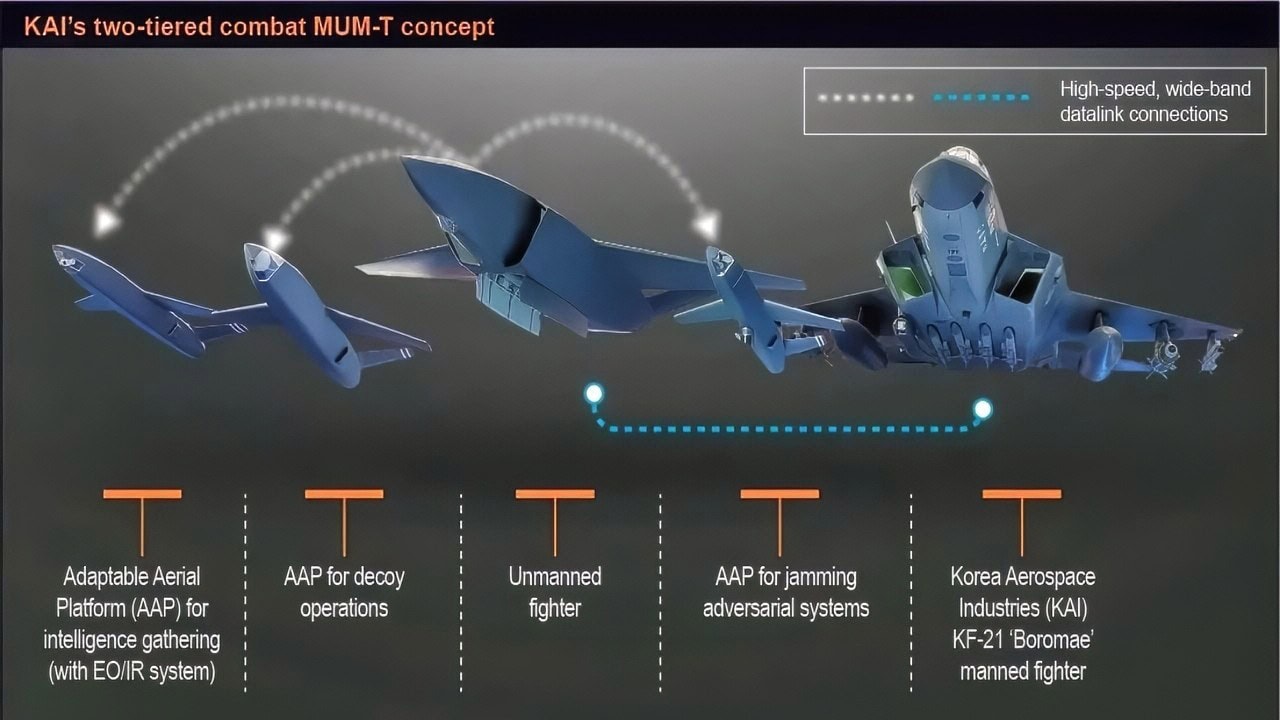
South Korea has crossed a threshold only a handful of nations ever reach: it has designed, built, and begun mass-producing its own supersonic fighter, the KF-21 Boramae, the first indigenous fighter in the country’s history. The more revealing story is the partnership behind it. Indonesia co-funded the jet, fell more than a billion dollars short of its pledge, saw its engineers accused of trying to copy classified program data, and is now both the recipient of the prototype and the aircraft’s prospective first export customer — a settlement that closes more than a decade of friction. The KF-21 is at once a milestone, marking the arrival of a new fighter-building power, and a cautionary tale about the perils of co-developing advanced weapons with a partner whose commitment wavered.
What The KF-21 Boramae Is, And Why It Matters
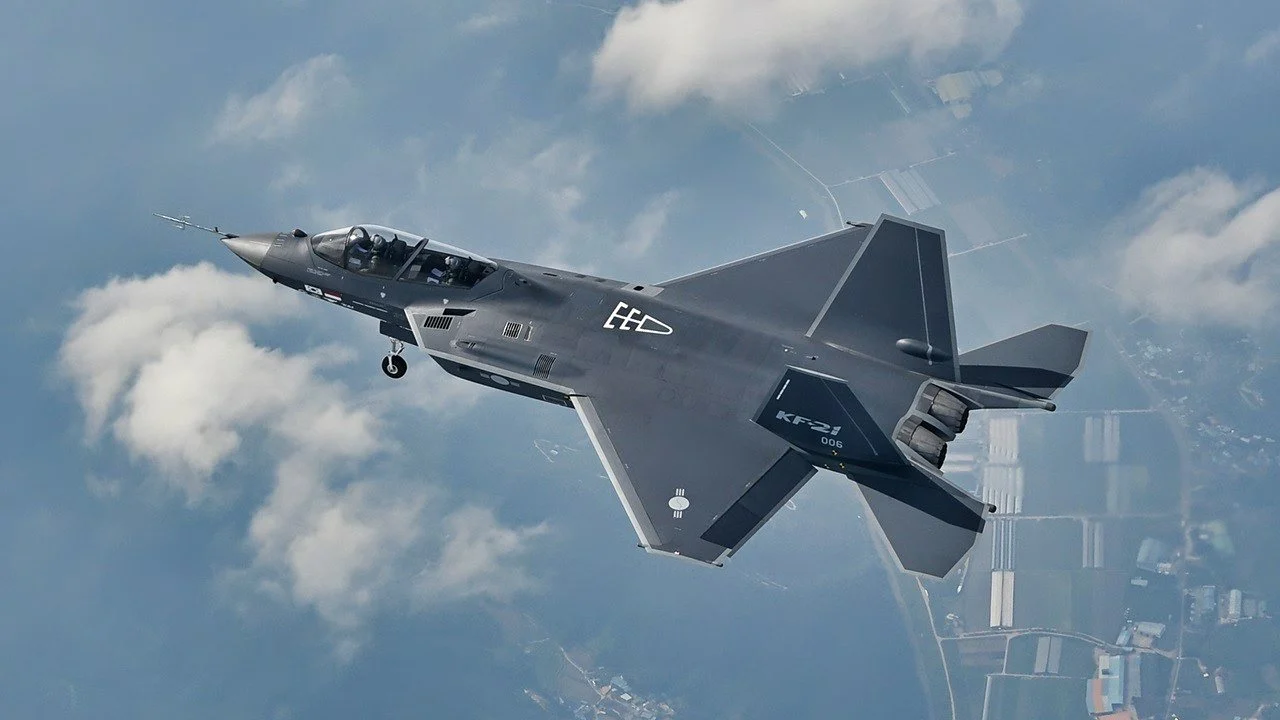
KF-21 Boramae. Image Credit: Creative Commons.
The Boramae is a twin-engine, 4.5-generation multirole fighter, and the precise wording of that classification matters. It is built with a reduced radar cross-section and advanced sensors, including an indigenously developed active electronically scanned array radar, but it is not a true stealth aircraft.
In its current Block I configuration, the jet carries its weapons externally, with internal weapons bays and fuller low-observable capability deferred to later production blocks. South Korea has marketed it accordingly — as a lower-cost alternative for air forces that want modern sensors, networked warfare, and supersonic performance without paying for a dedicated stealth fighter.
It is an advanced 4.5-generation aircraft on a path toward fifth-generation features, not a peer of the American F-35 or the Chinese J-20, and the honest framing is part of what makes it credible in the export market.
The program’s recent milestones are concrete and fast. South Korea’s Defense Acquisition Program Administration announced in January 2026 that the KF-21 had completed its flight-test program — two months ahead of schedule, after more than 1,600 test sorties without a single accident — and on March 25, 2026, the first series-production aircraft rolled out of Korea Aerospace Industries’ factory at Sacheon.
The rolled-out jet is a Block I variant configured primarily for air-to-air missions and is now in acceptance testing ahead of delivery to the Republic of Korea Air Force in the second half of 2026. Mass manufacturing formally launched in 2024, the ROKAF has committed to a fleet of 120 aircraft, and system development for the joint program was set to conclude in June 2026 after more than a decade of work.
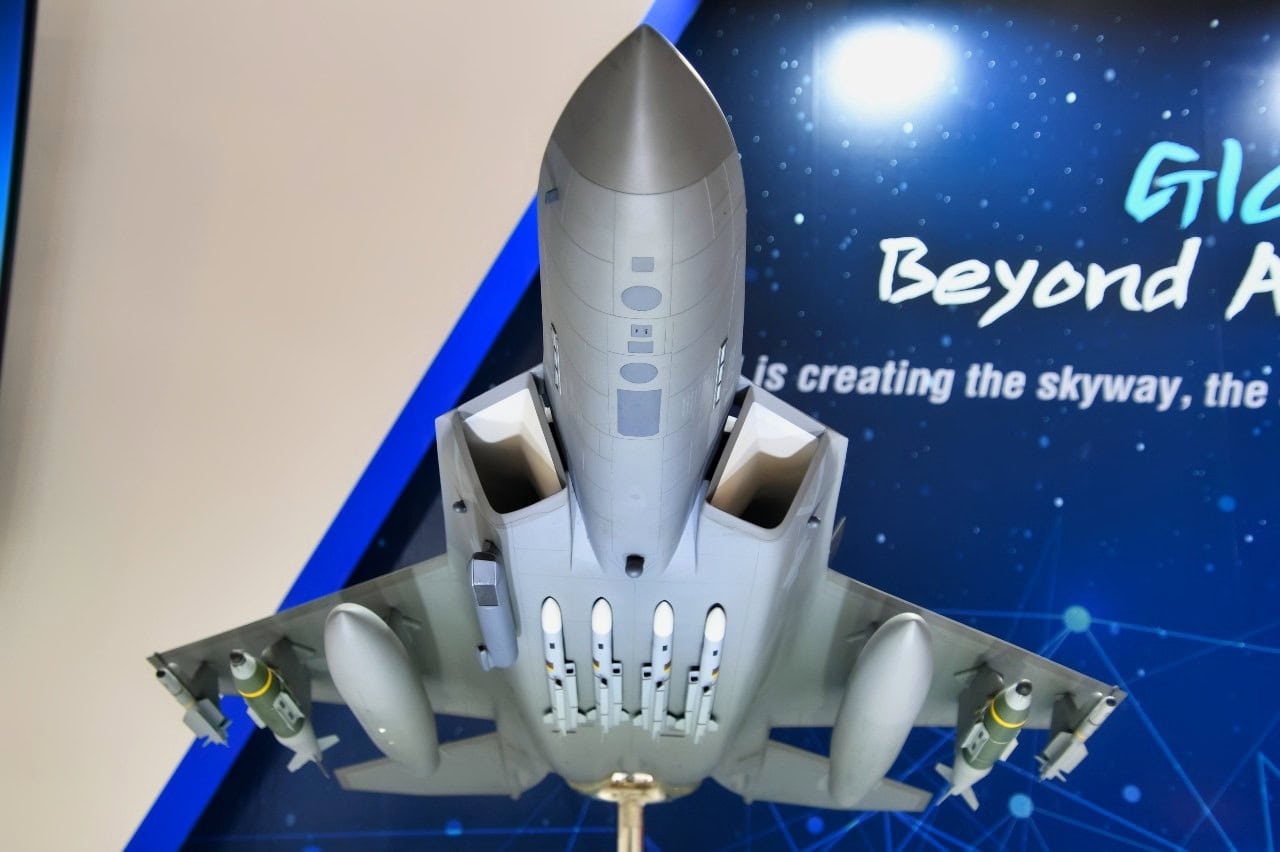
South Korea’s KF-21 Boramae is entering mass production, positioning KAI as a global defense leader. With Poland and other buyers interested, can it challenge the F-35 in export markets?
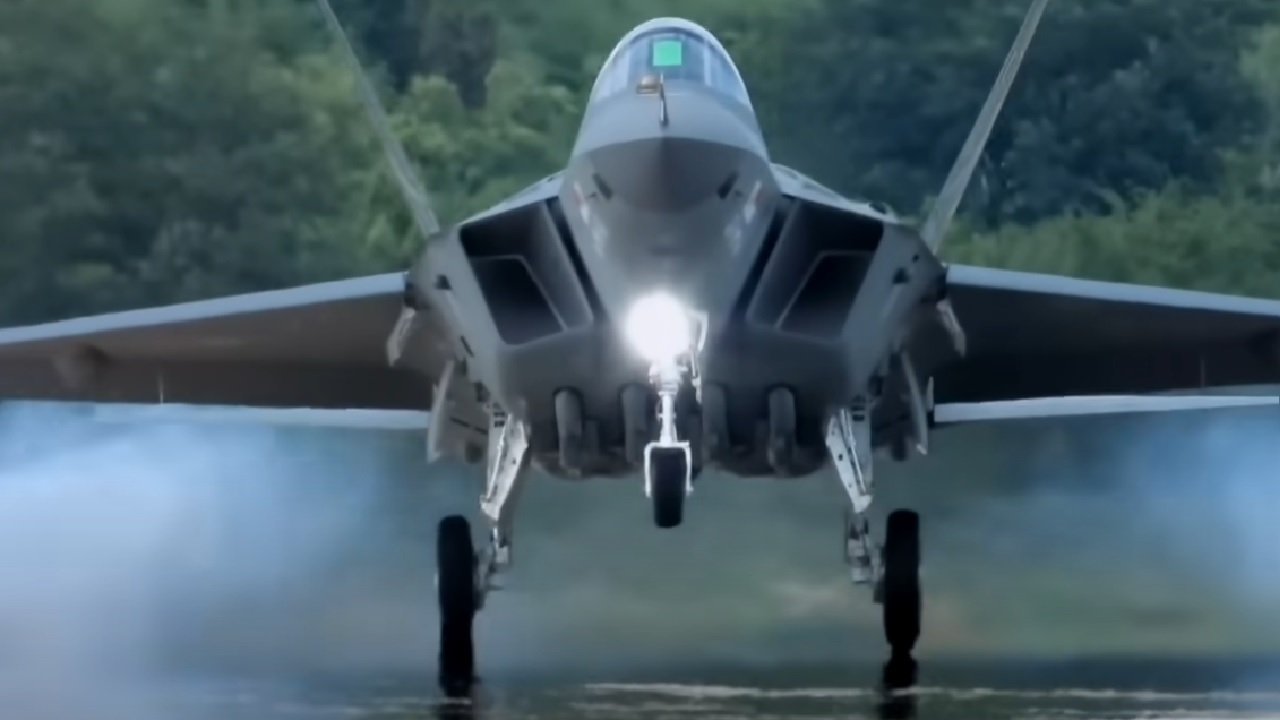
KF-21 screenshot from first flight. Image Credit: YouTube Screenshot.
This is, as defense analysts have noted, the first entirely new fighter program to reach series production in over a decade that is neither American nor Chinese, and it changes the calculus for air forces shopping for a modern combat aircraft.
The Partnership That Nearly Broke The KF-21 Program
The KF-21 was never meant to be a solo South Korean achievement. Indonesia joined the program in 2015 as a roughly 20 percent partner, committing to pay about 1.6 trillion won — on the order of $1 billion — toward the program’s total development cost of around 8.1 trillion won, in exchange for technology transfers, a prototype aircraft, and an Indonesian production variant once known as the IF-X.
The arrangement was supposed to give Jakarta a participatory route into advanced combat aviation and give Seoul a partner to share the financial load of a hugely expensive undertaking.
It did not work out as planned. Indonesia, citing domestic economic conditions, repeatedly fell behind on its payments, and its actual contribution came in far below the pledged figure, shifting the financial burden of the program onto South Korea.
By the time the partners renegotiated, Jakarta’s commitment had been reduced from the original 1.6 trillion won to 600 billion won, roughly $400 million — a fraction of what it had originally agreed to pay, with the value of what Indonesia would receive scaled down accordingly. The underpayment was a serious strain on a flagship program, and it set the terms of everything that followed: Indonesia would stay in the program, but on reduced terms, with fewer technology transfers as the price of having paid far less than it promised.
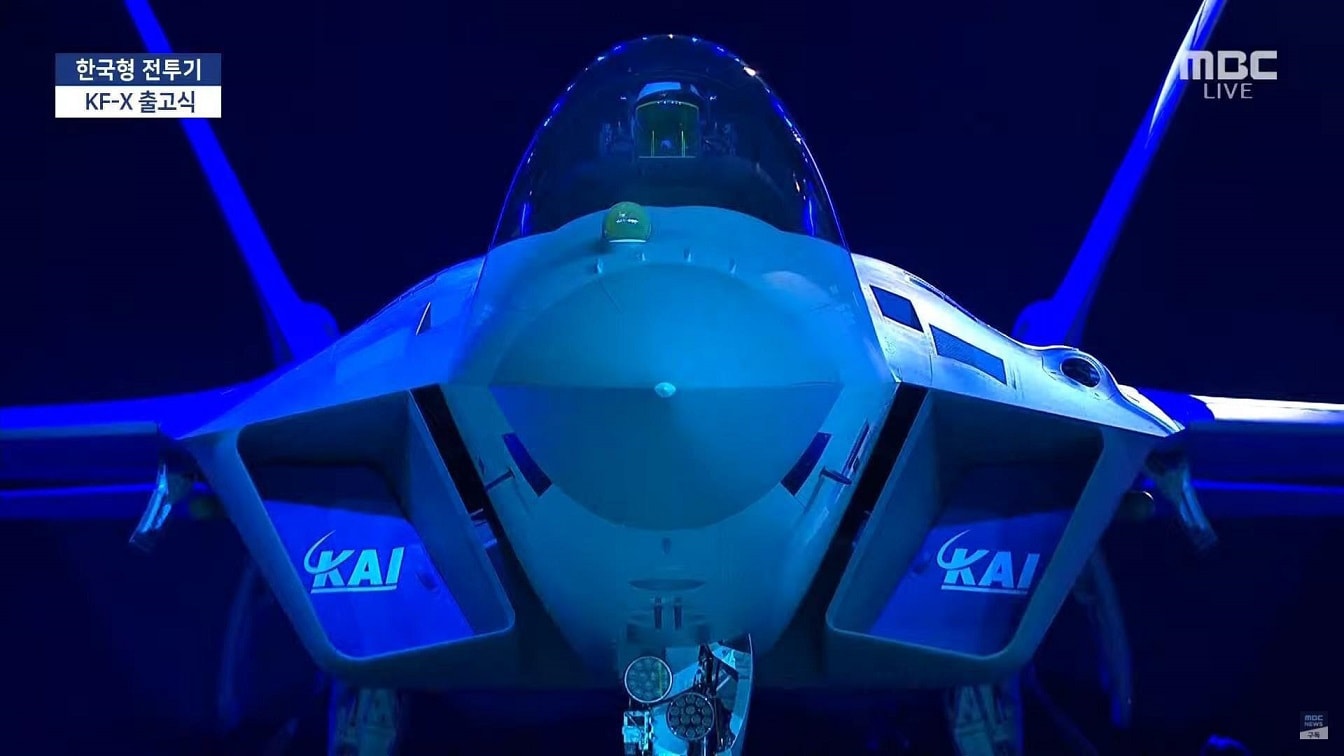
KF-21 Fighter. Image Credit: Screenshot.
The Data-Theft Allegation That Deepened The Friction
The financial dispute was not the only source of friction; the second was far more sensitive. In January 2024, South Korea’s Defense Acquisition Program Administration accused Indonesian engineers dispatched to KAI of attempting to store KF-21 development data on USB drives, triggering a joint investigation by DAPA, the National Intelligence Service, and the Defense Counterintelligence Command into whether classified technology had been compromised.
The data the engineers allegedly tried to remove reportedly included sensitive material on the fighter’s avionics, and some of it was subject to export agreements with the United States and European suppliers and therefore off-limits to Indonesia. South Korean authorities barred the engineers from leaving the country while the probe proceeded.
The matter escalated into a formal criminal inquiry. South Korean police raided KAI’s head office in March 2024 in connection with the Indonesian nationals accused of leaking technology related to the fighter, with the company saying it was actively cooperating to establish the facts.
Several points warrant care: this was an allegation that prompted an investigation rather than a proven conviction, the two governments handled it diplomatically with Indonesia’s foreign ministry stating it was gathering its own information, and even the basic facts were disputed — South Korean authorities and media referred to two engineers, an Indonesian foreign-ministry spokesman initially said one, and later reporting cited a larger number barred from departure.
The investigation remained a stumbling block, clouding Jakarta’s participation in the program well into 2025 and casting a lingering shadow over a partnership already strained by money. The accusation that a co-development partner’s personnel had tried to walk out with classified data is the kind of breach that can end an industrial relationship, and that it did not is part of what makes the resolution notable.
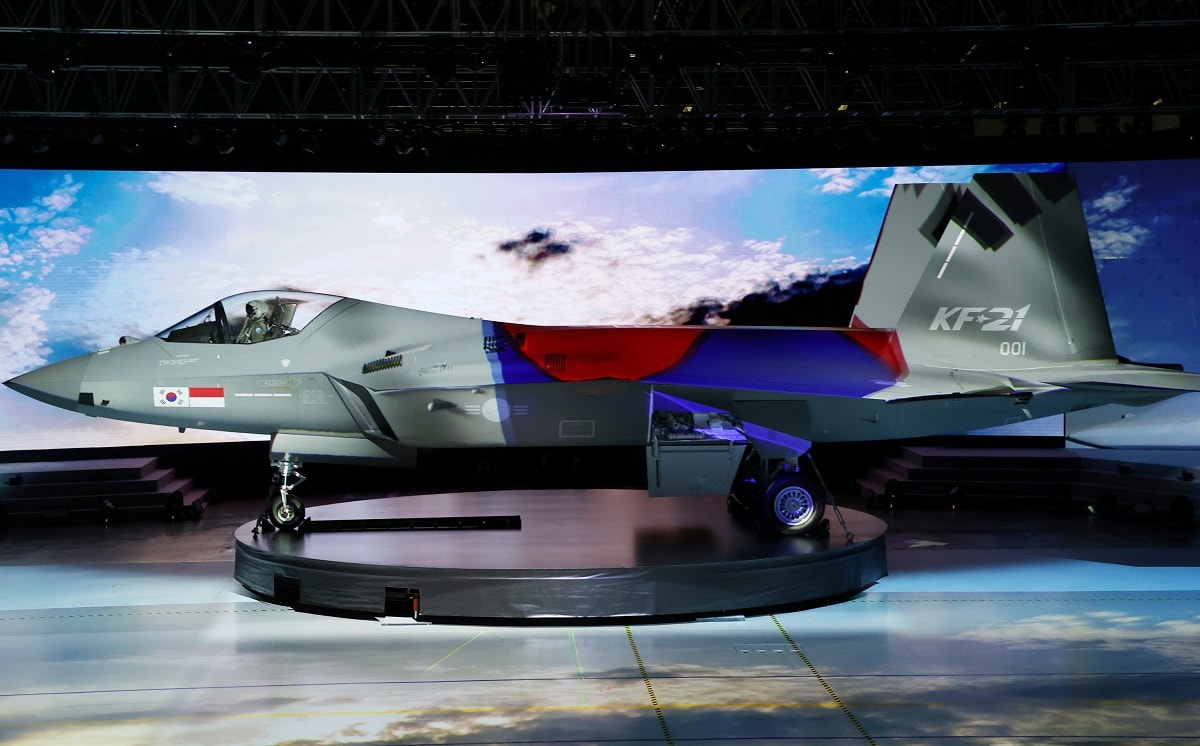
Image Credit: Media Handout.
The Settlement And The Export Breakthrough
The remarkable turn is that the friction became a deal. In February 2026, Seoul and Jakarta agreed on a revised settlement worth 600 billion won — about $406 million — centered on transferring the fifth of the six KF-21 prototypes to Indonesia, a single-seat aircraft previously used for avionics validation and aerial-refueling trials.
By the spring, Indonesia had paid 536 billion won of the agreed amount, with roughly $42 million remaining due by June 2026, and the physical handover of the prototype and its associated technical data was set to follow once that final balance was settled. As of early June 2026, Indonesian officials indicated that the contribution had been settled and that the prototype was ready for handover, with joint development formally concluding that month after more than a decade. The partner accused of trying to copy the plans is receiving an actual aircraft.
The larger prize is the export order, and here the tense matters. Indonesia is negotiating the purchase of 16 production KF-21s, a deal that would make it the program’s first export customer for a fighter South Korea designed and built itself — a first in the country’s history.
That order is not yet signed: no binding contract was concluded during Indonesian President Prabowo Subianto’s visit to Seoul in the spring; the contract value has not been disclosed; and financing is still under review, with both sides targeting completion as price negotiations continue. South Korea’s export credentials are real, built on a recent run of arms sales, including the K9 howitzer, the K2 tank, and the FA-50 light fighter and T-50 trainer. Beyond Indonesia, the Philippines, Malaysia, Poland, and the UAE have also been linked to potential interest in the Boramae.
But a prospective 16-jet order in talks is a different thing from a finalized sale, and the prototype transfer — not the production contract — is the settlement that has actually closed.
The Global Fighter Race, And Where The KF-21 Sits
The Boramae arrives in a crowded field of national fighter programs all moving at different speeds, and its progress stands out among the newer entrants. India’s Tejas Mk1A is entering squadron service after a long and troubled development; Turkey’s TF-X Kaan has flown but remains far from serial production; China fields the J-20 in numbers while its FC-31 matures.
Against that backdrop, South Korea is arguably the furthest along of the newer, non-great-power fighter programs — it has not only flown its aircraft but finished testing ahead of schedule and begun mass production, a stage several rival programs have yet to reach.
The placement should be kept in proportion. The KF-21 is a genuine achievement that vaults South Korea into a small club of nations capable of building a modern supersonic fighter from the ground up, and its 4.5-generation capability is strong, real, and competitively priced. It is not, however, a stealth fighter, and it does not change the top-tier balance dominated by American and Chinese fifth-generation aircraft.
What it changes is the market beneath that tier, where many air forces cannot afford or obtain an F-35 and are looking for exactly what the Boramae offers. KAI’s chief executive has pitched it bluntly to prospective buyers as delivering most of the capability of a Rafale or Typhoon at a substantially lower lifecycle cost, and that value proposition is the program’s real weapon in the export contest.
The Verdict: A Milestone And A Cautionary Tale At Once
The KF-21 is both things at once, and an honest assessment holds them together. South Korea has done something only a few countries have ever managed: designing and mass-producing an advanced indigenous fighter and positioning it for export, and it has outpaced most of the newer national programs it is measured against. That is a significant milestone for Asian airpower and the global defense market.
The accomplishment is not diminished by the caveat that the jet is a capable 4.5-generation aircraft rather than a stealth fighter, because that is precisely the niche South Korea aimed for and the niche where the export demand lives.
The partnership behind it is the cautionary tale, and it is just as instructive. Co-developing a frontline weapon with a partner whose payments faltered and whose engineers faced a data-theft investigation nearly broke the program, and the resolution — a reduced contribution, fewer technology transfers, a prototype handed over to settle the books — is the compromise that kept it alive at a cost to both sides.
MORE – The B-2 Spirit Stealth Bomber Crisis Is a Math Problem
MORE – MiG 1.44: Russia’s F-22 Raptor
MORE – China’s Aircraft Carriers Have an Escort Problem
Whether the KF-21 becomes a commercial success or an expensive lesson now rests on the export market it is chasing across Southeast Asia, the Middle East, and Europe.
The Boramae has proven it can fly, that South Korea can build it, and that even a badly strained partnership can be salvaged into a sale. Whether enough foreign buyers sign actual contracts, rather than entering talks, is the question that will decide if the first homegrown Korean fighter is remembered as a breakthrough or a money pit.
About the Author: Harry J. Kazianis
Harry J. Kazianis (@Grecianformula) was the former Senior Director of National Security Affairs at the Center for the National Interest (CFTNI), a foreign policy think tank founded by Richard Nixon based in Washington, DC. Harry has over a decade of experience in think tanks and national security publishing. His ideas have been published in the NY Times, The Washington Post, The Wall Street Journal, CNN, and many other outlets worldwide. He has held positions at CSIS, the Heritage Foundation, the University of Nottingham, and several other institutions related to national security research and studies. He is the former Executive Editor of the National Interest and the Diplomat. He holds a Master’s degree focusing on international affairs from Harvard University.

