
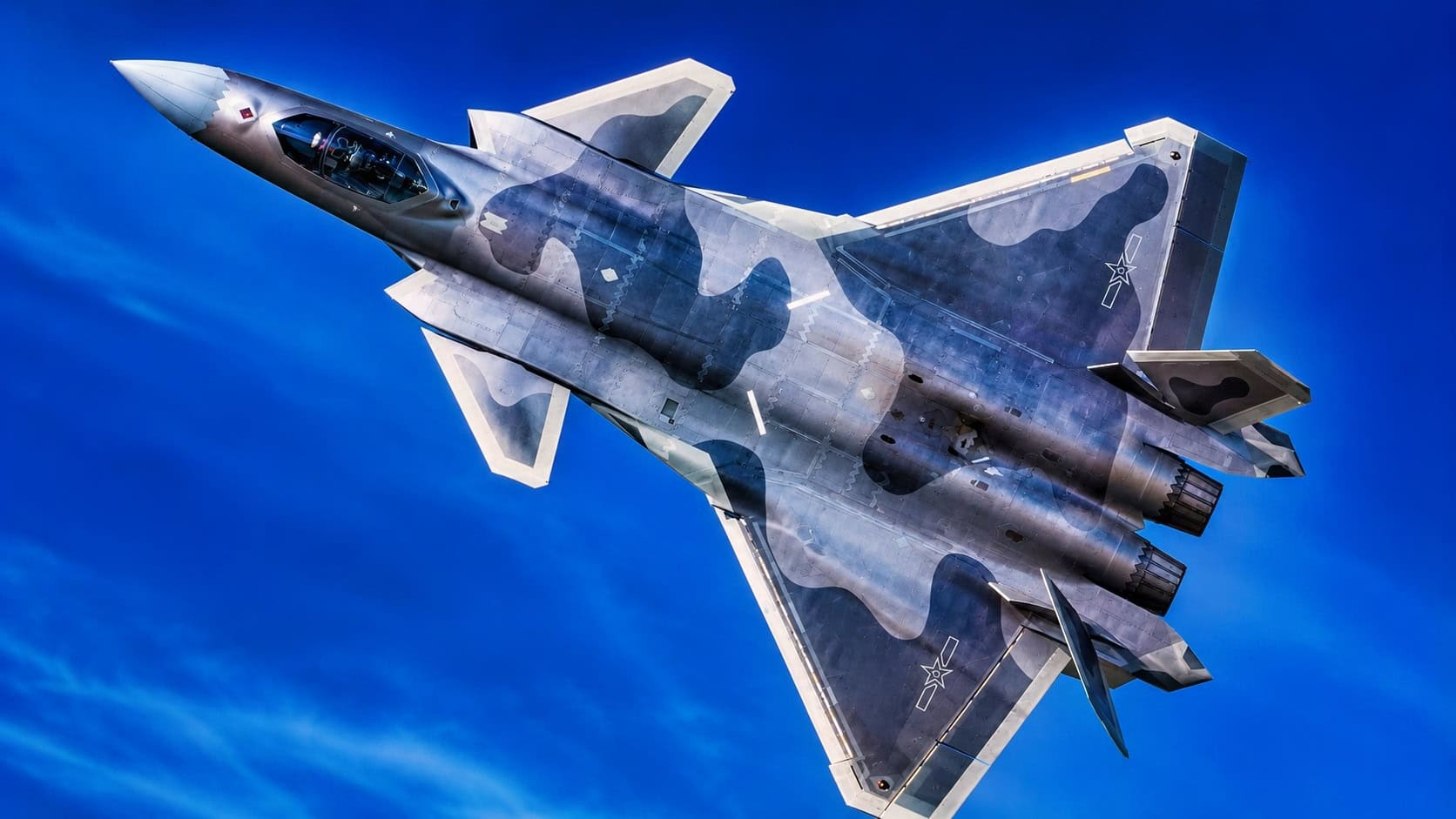
For years, discussion of China’s J-20 stealth fighter centered on whether the jet was a true peer to the American F-22 or F-35. But that debate may now be irrelevant, with production becoming the more important factor. Satellite imagery and intelligence assessments suggest China has expanded J-20 manufacturing to five active assembly lines—and may now be producing 100–120 aircraft annually.
With an operational fleet estimated at roughly 300–450 aircraft already, this number could approach 1,000 by 2030.
If that number is accurate, the strategic implications for the Indo-Pacific and China’s A2/AD network would be profound.
J-20 Mighty Dragon Means End of a Monopoly
Historically, the US has enjoyed a unique advantage: it possessed the world’s only large fleet of operational stealth fighters.
The F-22, the first ever fifth-generation fighter, represented the gold standard of air superiority. But while 700-plus F-22s were originally planned, only 187 were ever built, with the production line closing in 2009.
For 20 years, the US has been relying on an ever-dwindling fleet of F-22s, with the replacement, the F-47 NGAD fighter, still years away.
China, taking note, appears to be learning from the F-22’s production story and has opted for a different approach.
Beijing appears committed not merely to building a stealth fighter, but to mass-producing one. The result is the emergence of a fifth-generation fleet measured in hundreds rather than dozens.
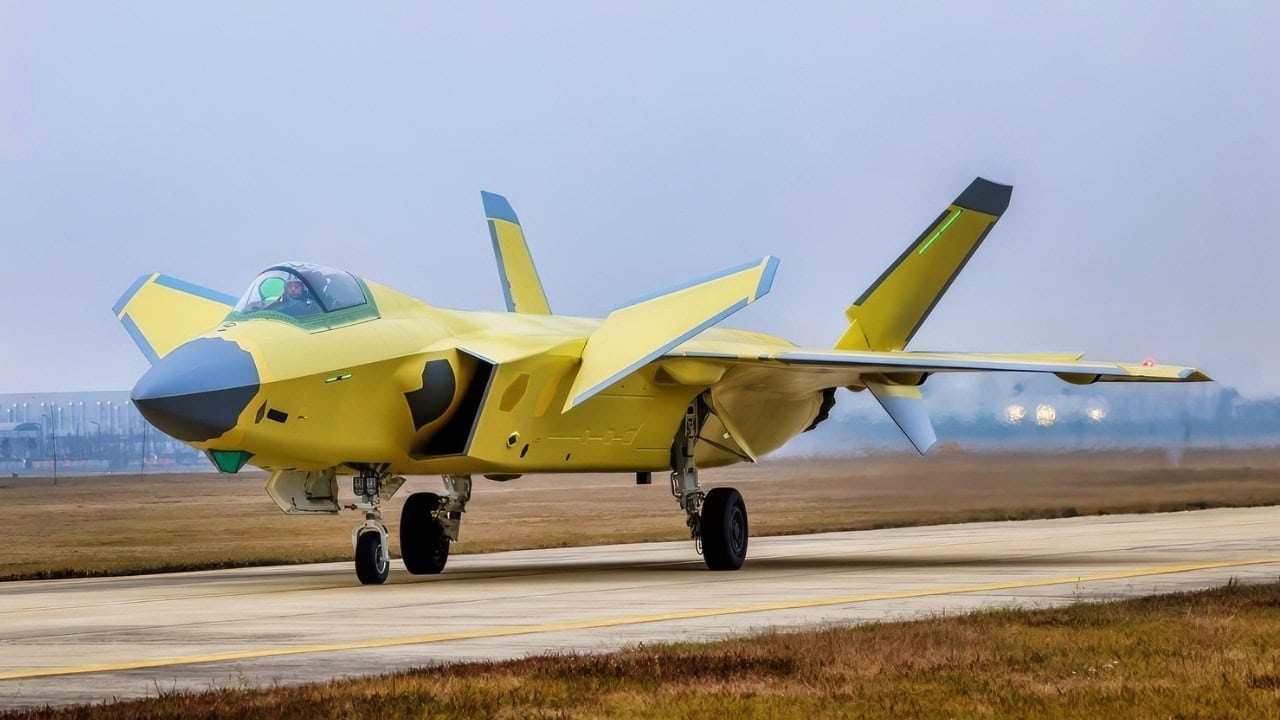
J-20 Fighter from China X Screenshot. Image Credit: Creative Commons.
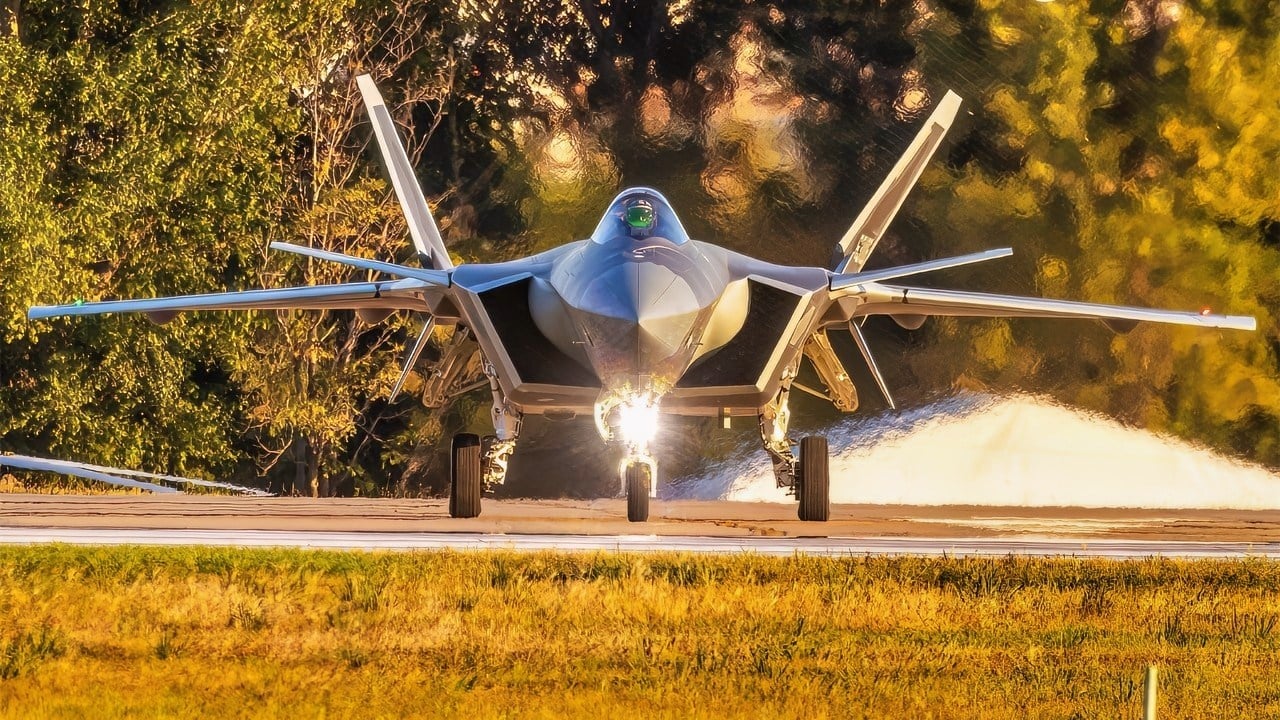
J-20 2026 New Image. Image Credit: PLAAF/Chinese Military.
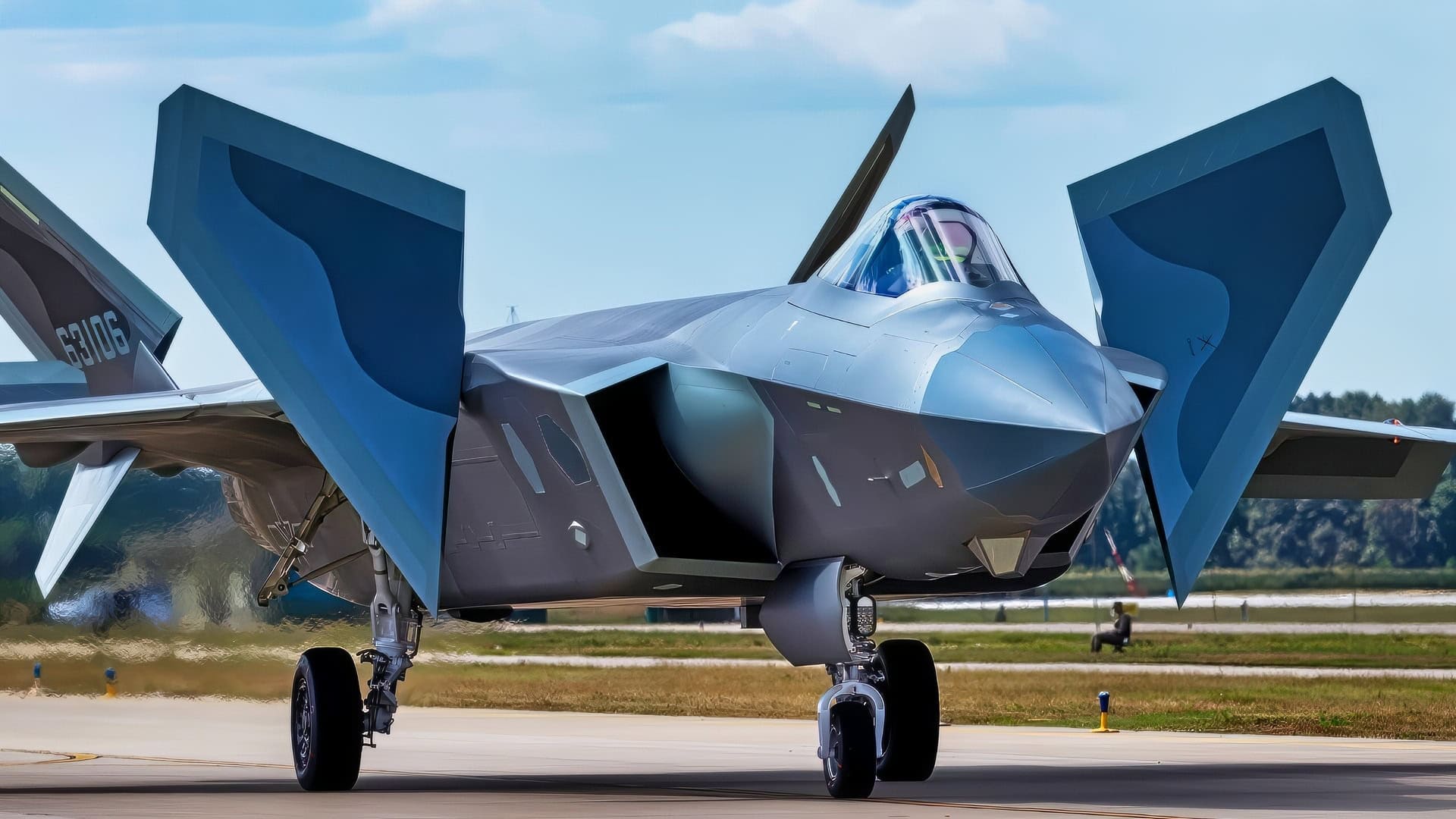
J-20 Fighter 2025 Photo. Image Credit: Creative Commons.
Accordingly, the analysis has shifted; the question isn’t about whether China can build a stealth aircraft but whether the US can maintain the numerical advantages it enjoyed for a generation.
J-20 Misconceptions
The J-20 is commonly misconceived as a dogfighter. Popular imagination pictures the J-20 dueling American fighters over Taiwan.
But China’s doctrine appears different; the J-20 may never be used to target frontline fighters.
Instead, the J-20 seems geared towards targeting support aircraft, such as tankers, AWACS, ISR aircraft, and airborne command nodes.
These aircraft, while often overlooked, are the ones that make American power projection possible—yet they are relatively easy targets compared to fifth-generation fighters.
And without tankers or AWACS, the utility of fighters decreases drastically. The Pacific geography is unforgiving. Distances are enormous.
US fighters depend heavily on aerial refueling. And air operations rely on extensive airborne surveillance networks. If China can kill the support aircraft, combat aircraft won’t be worth as much.
The PL-16 Factor
The J-20 isn’t the entire story.
The missile matters, too. Chinese reports increasingly reference the PL-16, which has an estimated range of 300 kilometers and is designed specifically for long-range engagements.
The purpose of the PL-16 isn’t necessarily to chase fighters but instead to threaten tankers, AWACS, and support aircraft that are operating further from the battlefield.
These long-range missiles threaten to degrade US operational reach.
The Two-Seater
Another interesting development is the emergence of the two-seat J-20S. Why add a second seat? Analysts increasingly believe the second crew member is intended to manage unmanned systems.
Much like the forthcoming NGAD system, which will feature manned-unmanned teaming, the J-20 could operate as a battlefield quarterback, controlling loyal wingman drones, recon assets, EW platforms, and autonomous strike systems.
This mirrors a broader trend, where the future air battle may be less about individual aircraft performance and more about network orchestration.
Lessons from Ukraine and Iran
China has watched both the conflicts in Ukraine and Iran closely.
The first takeaway is that volume matters. Ukraine demonstrated that attrition remains central to modern warfare.
Expensive systems eventually run into inventory limits, with China appearing determined to avoid that trap. The second takeaway is that industrial capacity directly equates to combat power.
The Iran conflict highlighted how quickly advanced munitions can be consumed, with America’s stores of Tomahawk, Patriot, and Standard Missiles dwindling fast.
Beijing’s response is to build at scale and avoid the pitfalls of exhausting magazine depth in weeks. The broader message is that military power increasingly depends on factories as much as platforms.
This appears to mark the return of industrial warfare. For decades, the West emphasized exquisite systems built in small numbers, with extreme sophistication, at very high cost.
MORE – The B-2 Spirit Stealth Bomber Crisis Is a Math Problem
MORE – MiG 1.44: Russia’s F-22 Raptor
MORE – China’s Aircraft Carriers Have an Escort Problem
This format has run into problems in recent conflicts against cheap, scale-built systems.
China appears to be pursuing a different formula, however, employing reasonably advanced systems and industrial mass production.
Now, the Pentagon will need to respond, assuming that in future conflicts, air superiority near China’s coastline will be contested.
About the Author: Harrison Kass
Harrison Kass is a writer and attorney focused on national security, technology, and political culture. His work has appeared in Tablet, City Journal, The Hill, The Spectator, and The Cipher Brief. He holds a JD from the University of Oregon and a master’s in Global & Joint Program Studies from NYU. More at harrisonkass.com.