
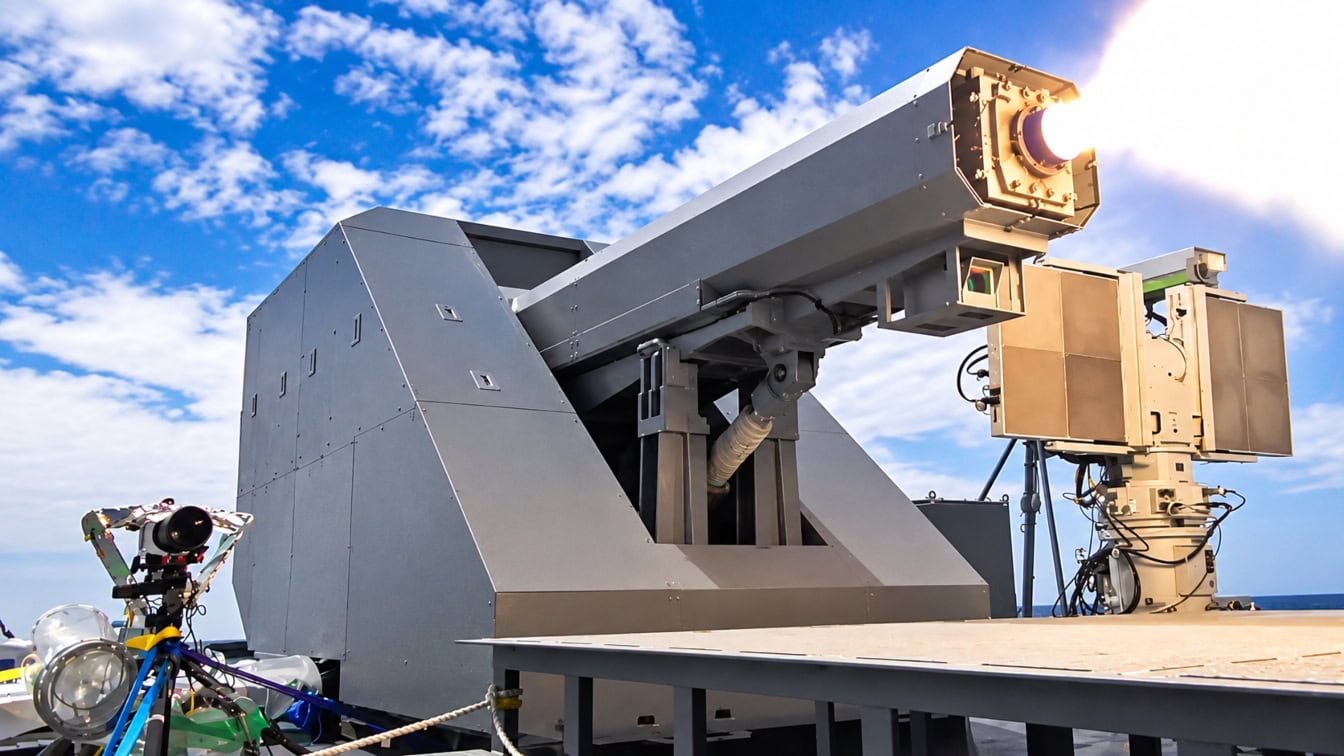
The U.S. Navy declared its electromagnetic railgun dead in 2021, after spending more than $500 million over roughly 15 years on a weapon it could not make work — beaten by barrels that wore out after a few dozen shots, power demands that exceeded what its ships could generate, and a decision to pour money into hypersonic missiles instead.
Five years later, the weapon is back in the conversation, and not for nostalgia. Three separate forces are reviving interest at once: the Iran war burned through missile interceptors faster than American industry can replace them, making the railgun’s cheap kinetic rounds suddenly attractive for missile defense; Japan just did at sea what the United States never managed, firing a ship-mounted railgun at a moving target; and President Donald Trump’s proposed new battleship is being designed around a railgun as a headline weapon.
The question is whether the physics that killed the program the first time has actually been solved — or whether this is a revival chasing an urgent need more than a genuine breakthrough.
Why The Navy Killed Its Railgun In 2021
The electromagnetic railgun was, on paper, one of the most appealing weapons the Navy had ever pursued. Instead of a chemical propellant, it uses a powerful electric current to accelerate a projectile along a pair of conductive rails to hypersonic speed, generating enough kinetic energy for an inert metal dart to destroy a target on impact without any explosive filler.
The promise was a weapon combining the reach of a missile with the deep magazine and low per-shot cost of a gun, firing rounds that cost only a tiny fraction of those of a guided missile. The prototype, built by BAE Systems, set records in testing, and the concept was once tied to the stealthy Zumwalt-class destroyers.
The physics that made it attractive also made it impractical. The same enormous electrical currents that launched the projectile caused severe rail erosion, with barrels degrading after only a few dozen shots — meaning no sustainable rate of fire without constant hardware replacement. A single shot could demand energy on the order of tens of megajoules delivered in an instant, exceeding the power-generation and management capacity of existing ship designs, and the supporting equipment was physically bulky.
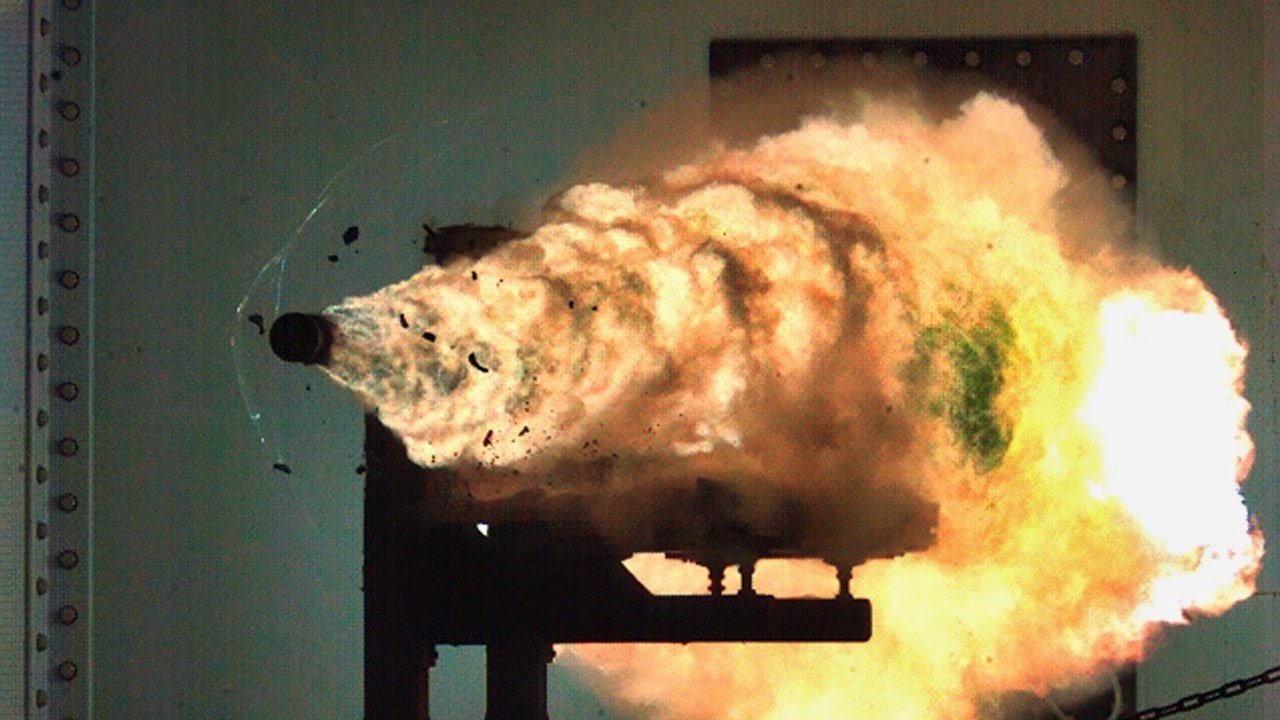
(Jan. 31, 2008) Photograph taken from a high-speed video camera during a record-setting firing of an electromagnetic railgun (EMRG) at Naval Surface Warfare Center, Dahlgren, Va., on January 31, 2008, firing at 10.64MJ (megajoules) with a muzzle velocity of 2520 meters per second. The Office of Naval Research’s EMRG program is part of the Department of the Navy’s Science and Technology investments, focused on developing new technologies to support Navy and Marine Corps war fighting needs. This photograph is a frame taken from a high-speed video camera. U.S. Navy Photograph (Released)
Combined with rising costs and a shift in priorities toward hypersonic missiles, electronic warfare, and directed-energy weapons, those obstacles led the Navy to shelve the program in 2021 and store the hardware.
The prototype, which had been moved from the Naval Surface Warfare Center’s Dahlgren site in Virginia to the White Sands Missile Range in New Mexico in 2019, never got its planned at-sea test.
The Quiet Revival: A Railgun As A Hypersonics Testbed
The Navy never entirely stopped, though what it has been doing is research rather than a weapon comeback. The detail surfaced only when it was referenced in a Naval Sea Systems Command warfare-centers year-in-review report: the White Sands Detachment of the Naval Surface Warfare Center Port Hueneme Division tested a railgun during a three-day campaign in February 2025, jointly with the Dahlgren division, to collect data on high-velocity firing for NAVSEA’s Joint Hypersonics Transition Office. The objectives were not disclosed.
What that campaign was not, by all available evidence, was the resurrection of the railgun as a weapon. The work supported the hypersonics office, which suggests the railgun is being used as a research tool — a relatively cheap way to launch payloads at extreme speed to study the thermal and structural stresses imposed by hypersonic flight on materials and electronics, feeding into the Navy’s hypersonic missile programs.
It is, in effect, a “flying rail” repurposed as a hypersonics testbed rather than a gun the Navy has recommitted to fielding. That distinction matters because it means the actual push to turn the railgun back into a weapon is coming from outside the program itself — from three external forces that have made the old idea suddenly relevant again.
Driver One: The Iran War And The Interceptor Crisis
The most powerful driver is cost, and it stems directly from the war with Iran. Sustained missile and drone attacks forced the United States to expend air-defense interceptors at a rate the industrial base cannot match, drawing down stocks of THAAD, Patriot, and Standard Missile interceptors far faster than factories can rebuild them — a magazine-depth problem that has run through every recent debate about American military readiness.
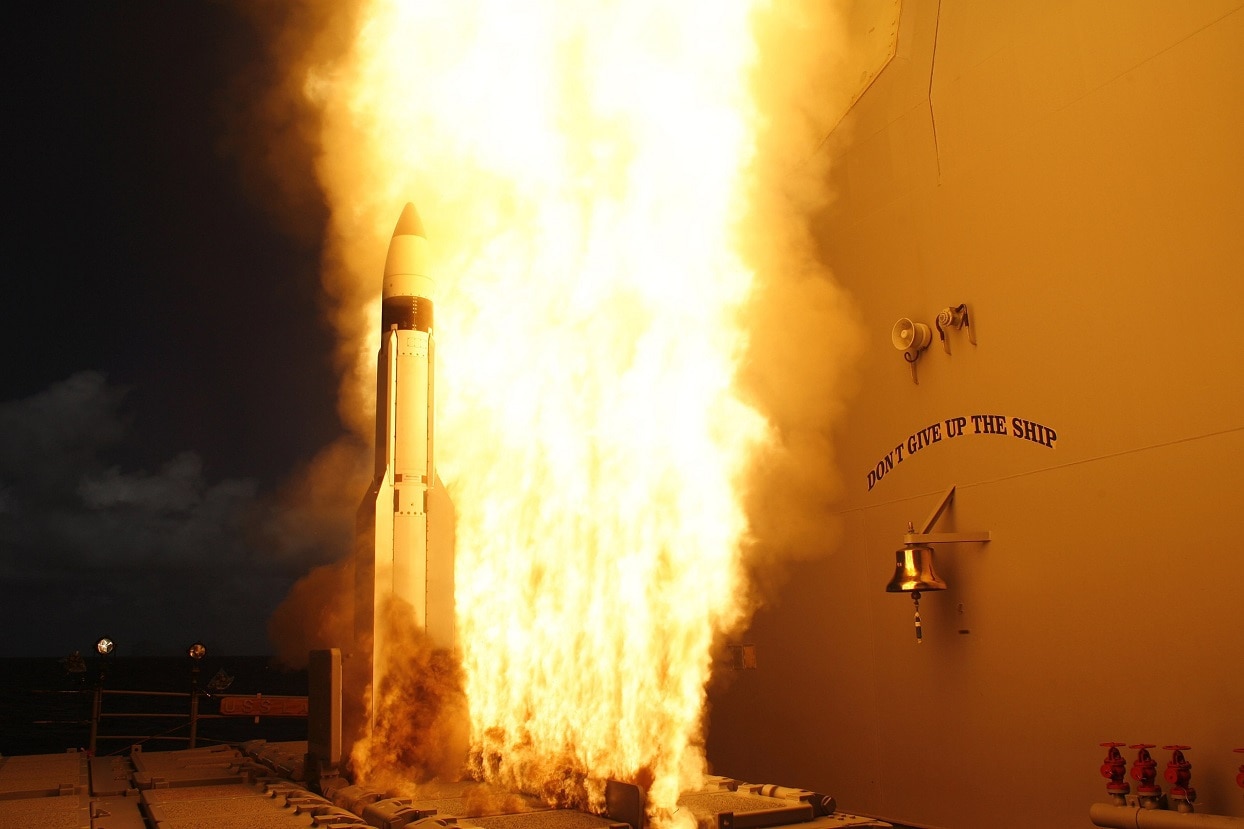
PACIFIC OCEAN (April 26, 2007) – A Standard Missile-3 (SM-3) is launched from the Aegis-class guided missile cruiser USS Lake Erie (CG 70), during a joint Missile Defense Agency, U.S. Navy ballistic missile flight test. Approximately three minutes later, the SM-3 intercepted a unitary (non-separating) ballistic missile threat target, launched from the Pacific Missile Range Facility, Barking Sands, Kauai, Hawaii. Within moments of this launch, the USS Lake Erie also launched a Standard Missile-2 (SM-2) against a hostile air target in order to defend herself. The test was the eighth intercept, in 10 program flight tests. The test was designed to show the capability of the ship and its crew to conduct ballistic missile defense and at the same time defend herself. This test also marks the 27th successful hit-to-kill intercept in tests since 2001. U.S. Navy photo (RELEASED)
The arithmetic is brutal: defending against cheap drones and mass missile salvos by firing interceptors that cost millions of dollars each is financially and operationally unsustainable, and adversaries know it.
That is precisely the gap the railgun is being pitched to fill. In October 2025, General Atomics Electromagnetic Systems renewed its push to field a family of railgun weapons as a terminal air-and-missile-defense layer, describing launcher classes from roughly 3 to 32 megajoules firing inert tungsten projectiles at around Mach 6. The head of the company’s weapons programs, Mike Rucker, told Naval News the weapon’s extreme muzzle velocity is the key to intercepting very fast targets, and that its tungsten-pellet rounds could offer a lower-cost effect per engagement than interceptor missiles.
General Atomics has pitched the system for the Pentagon’s Golden Dome homeland missile-defense initiative and to strengthen Guam’s layered defense, pairing deep magazines with simplified logistics by removing explosives and propellant from the supply chain. The appeal is the cost math: trading multi-million-dollar interceptors for cheap kinetic rounds is exactly what a saturation-attack environment demands — if the weapon can be made to work reliably, which the company’s own materials acknowledge still depends on solving barrel life, heat, and sustained rate of fire.
Driver Two: Japan Did What America Couldn’t
The second driver is the uncomfortable fact that a U.S. ally just achieved at sea what the U.S. Navy never did. Japan’s Acquisition, Technology & Logistics Agency, which has developed an electromagnetic railgun since the mid-2010s, mounted a prototype on the experimental warship JS Asuka and, in tests conducted between June and early July 2025, fired it at a moving target ship for the first time anywhere.
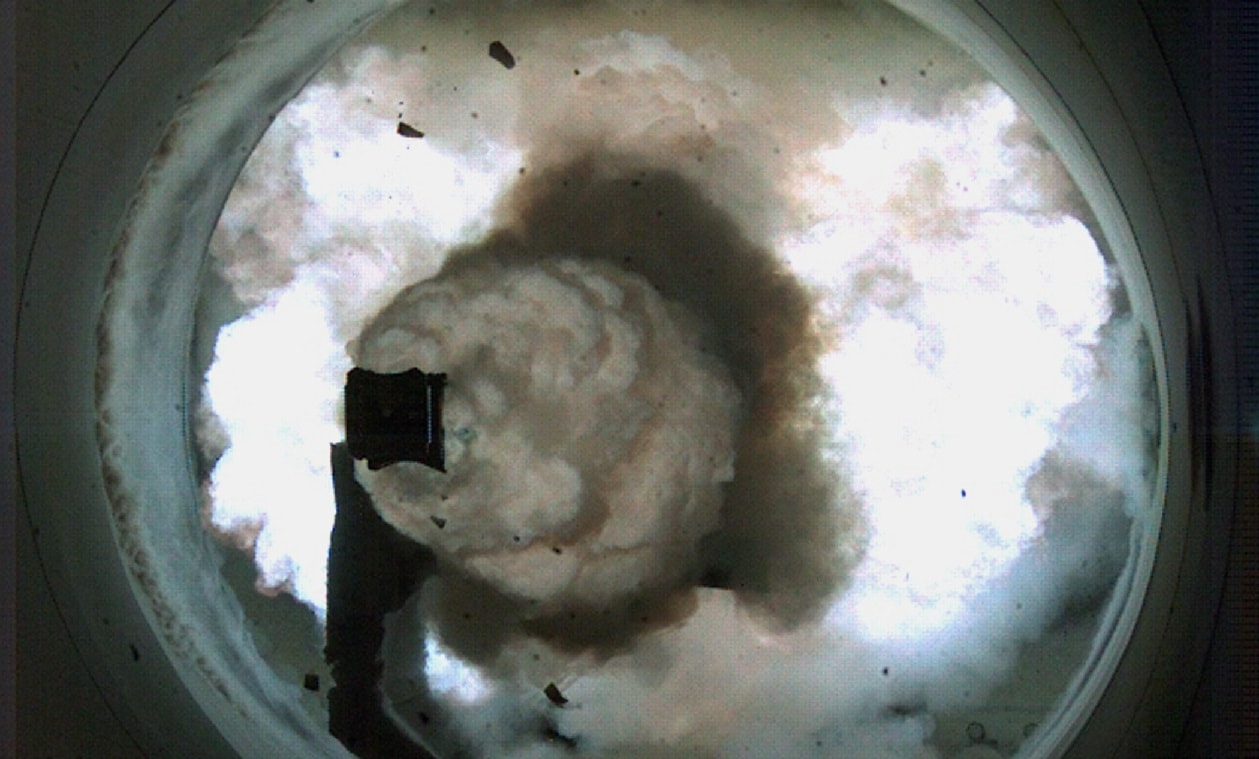
DAHLGREN, Va. (Dec. 10, 2010) High-speed camera image of the Office of Naval Research Electromagnetic Railgun located at the Naval Surface Warfare Center Dahlgren Division, firing a world-record setting 33 mega-joule shot, breaking the previous record established Jan. 31, 2008. The railgun is a long-range, high-energy gun launch system that uses electricity rather than gunpowder or rocket motors to launch projectiles capable of striking a target at a range of more than 200 nautical miles with Mach 7 velocity. A future tactical railgun will hit targets at ranges almost 20 times farther than conventional surface ship combat systems. (U.S. Navy photo/Released)
The target, a towed yard tug, was struck repeatedly, and the cross-shaped impact points showed the fin-stabilized projectiles flew stably. Japan had already conducted the world’s first shipboard railgun firing back in 2023; hitting an actual vessel at sea was a milestone the American program never reached before it was shelved.
The Japanese results speak directly to the problem that defeated the U.S. effort. Japan’s 40-millimeter railgun has reached muzzle velocities around Mach 6.5 to nearly Mach 7, and Japanese researchers reported roughly 120 stable firings in a durability test, addressing the barrel-erosion issue in part by replacing copper rails with more durable materials — meaningful progress on the exact wear problem that helped kill the American gun.
Tokyo frames the weapon explicitly as a low-cost kinetic response to hypersonic missiles and drones, the same logic that is driving the American revival. The progress is real, but so are the caveats: a senior ATLA official acknowledged at a 2025 defense exposition that the program is advancing but still faces “various challenges,” and the installation aboard JS Asuka required four shipping containers of supporting power and cooling equipment, a reminder that the bulk and power demands that troubled the U.S. effort have not vanished.
China is also developing naval railgun technology, reportedly mounting one on a landing ship for trials, though its maturity remains unclear. The combined effect is a don’t-fall-behind pressure on Washington: the technology the U.S. abandoned is being fielded by an ally and pursued by a rival.
Driver Three: The Trump-Class Battleship
The most concrete peg for the railgun’s return is the most contested. On December 22, 2025, President Trump announced plans for a new class of large surface combatant — designated BBG(X) in Navy documents, to be called the Trump class or Defiant class, with the lead ship named USS Defiant, and the Navy that day posted notices for two design contracts.
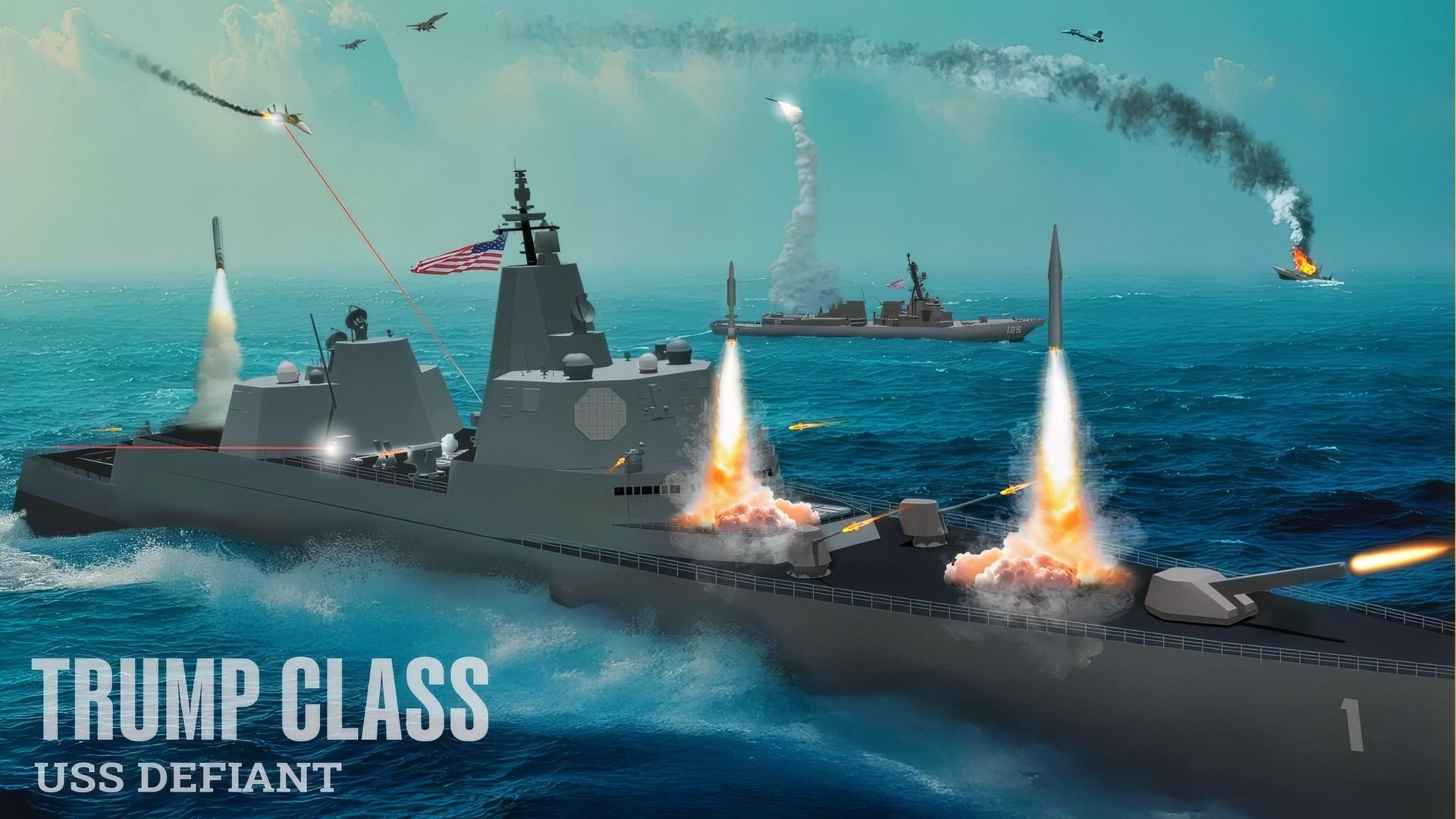
Trump-Class Battleship USS Defiant. Image Credit: Creative Commons.
The ships are envisioned as the largest U.S. surface combatants since World War II, roughly 840 to 888 feet long and displacing 35,000 to 41,000 tons, the high end of a planned “high-low” surface fleet and the centerpiece of what the administration calls the “Golden Fleet.” The Navy’s budget documents request about $1 billion in advance procurement in fiscal 2027 and roughly $16.5 billion for the first hull in fiscal 2028, with the lead ship’s gross cost estimated at about $17.5 billion and three ships at roughly $43.5 billion, and a keel-laying targeted for August 2028.
The railgun is a headline feature of the design. The planned armament pairs a main battery of nuclear-capable and conventional cruise missiles, hypersonic Conventional Prompt Strike weapons, and a 128-cell vertical launch system with a secondary battery that includes a 32-megajoule railgun, five-inch guns, and high-power lasers.
The logic connecting the battleship to the railgun is exactly the constraint that killed the gun on the smaller Zumwalt: a 35,000-ton warship with a large integrated power system and high-capacity energy storage could generate and manage the electricity a railgun demands, where today’s destroyers cannot. General Atomics said in January 2026 it was in discussions with the Navy about the “role of railguns” on the new ships. The big ship, in theory, finally solves the power problem.
The Honest Problem: The Physics Isn’t Solved And The Ship May Not Survive
The case for skepticism is strong on two fronts, and both deserve real weight. The first is that the physics underlying the railgun’s failure has not actually been solved. Japan’s durability progress is genuine, but power generation, thermal management, arcing, and sustained rate of fire under real operational conditions all remain hard, unfinished problems — General Atomics’ own pitch materials concede that program credibility still rests on quantified barrel and rail life and on managing heat under repeated firing.
A railgun cheap and reliable enough to serve as a missile-defense interceptor is still unproven, and the Congressional Research Service has pointedly framed the open question of whether the railgun and higher-power lasers can be made mature enough by the early 2030s to go aboard the new battleships at all.
The second problem is that the railgun’s most concrete platform may never be built. The Trump-class battleship has drawn sharp criticism, including from a Republican-controlled Congress increasingly unwilling to fund a costly ship built around technologies that may not work. The draft National Defense Authorization Act bars construction of the lead ship until the Navy certifies the technology has reached a sufficient maturity level, with lawmakers demanding the Navy prove the railgun, lasers, and hypersonics are not science fiction.
The House Armed Services Committee voted in June 2026 to require the Navy to submit a detailed acquisition plan by March 2027 and to address the program’s impact on aircraft-carrier construction, and CSIS analyst Mark Cancian concluded the ship “will never sail” as currently designed. Critics argue that the battleship contradicts the Navy’s own move toward distributed operations — concentrating enormous value in a single large target at exactly the moment when cheap drones and missiles have made big surface ships vulnerable — the lesson from the loss of the Russian cruiser Moskva in the Black Sea.
The Congressional Research Service does not expect the lead ship to be in service before around 2040. If the battleship is delayed, redesigned, or canceled, the railgun loses its highest-profile home.
The Verdict: A Weapon Revived By Need, Not By A Breakthrough
The railgun is back in the conversation, not because someone suddenly solved the engineering problem, but because the problem it was always meant to solve — cheap, deep-magazine defense against missiles and drones — has become urgent in a way it was not in 2021. The Iran war proved that interceptor-based defense bleeds magazines and money faster than industry can refill them; Japan proved a ship-mounted railgun can hit a moving target at sea; and the Trump-class battleship offers, on paper, a hull big enough to power the weapon that the Zumwalt never could. Each of those is a real development, and together they explain why a weapon the Navy buried is being quietly exhumed.
Whether it stays exhumed depends on two things that remain genuinely unsettled. The first is whether physics can be finished — whether barrel wear, heat, and power can be tamed enough to make a railgun a reliable weapon rather than a research curiosity, a problem decades of work have not closed. The second is whether the battleship that would carry it survives a Congress that is openly skeptical of paying carrier-level money for unproven technology.
The railgun’s comeback, in other words, is riding on solved physics it does not yet have and a ship that may not get built. The need is real and urgent. The weapon, for now, is still a promise — the same promise that cost $500 million the first time.
About the Author: Harry J. Kazianis
Harry J. Kazianis (@Grecianformula) was the former Senior Director of National Security Affairs at the Center for the National Interest (CFTNI), a foreign policy think tank founded by Richard Nixon based in Washington, DC. Harry has over a decade of experience in think tanks and national security publishing. His ideas have been published in the NY Times, The Washington Post, The Wall Street Journal, CNN, and many other outlets worldwide. He has held positions at CSIS, the Heritage Foundation, the University of Nottingham, and several other institutions related to national security research and studies. He is the former Executive Editor of the National Interest and the Diplomat. He holds a Master’s degree focusing on international affairs from Harvard University.