
Meet the Boeing X-36 – the forgotten aerospace wonder: The loudest design argument in military aviation right now concerns two small surfaces on an airplane that almost nobody has seen. The US Air Force’s official renderings of the Boeing F-47, the sixth-generation fighter meant to replace the F-22, show canards (if, of course, the mock-up photos we have from the U.S. military are inspired by the real thing no one has ever seen in public circles), small control fins ahead of the wing, on an airframe with its tail surfaces radically reduced. Chinese commentators have seized on them, arguing that canards compromise stealth and that Washington is borrowing a feature the West spent years criticizing on China’s own J-20, while Beijing’s two new sixth-generation prototypes, the Chengdu J-36 and Shenyang J-50, fly with no vertical tails and no canards at all.
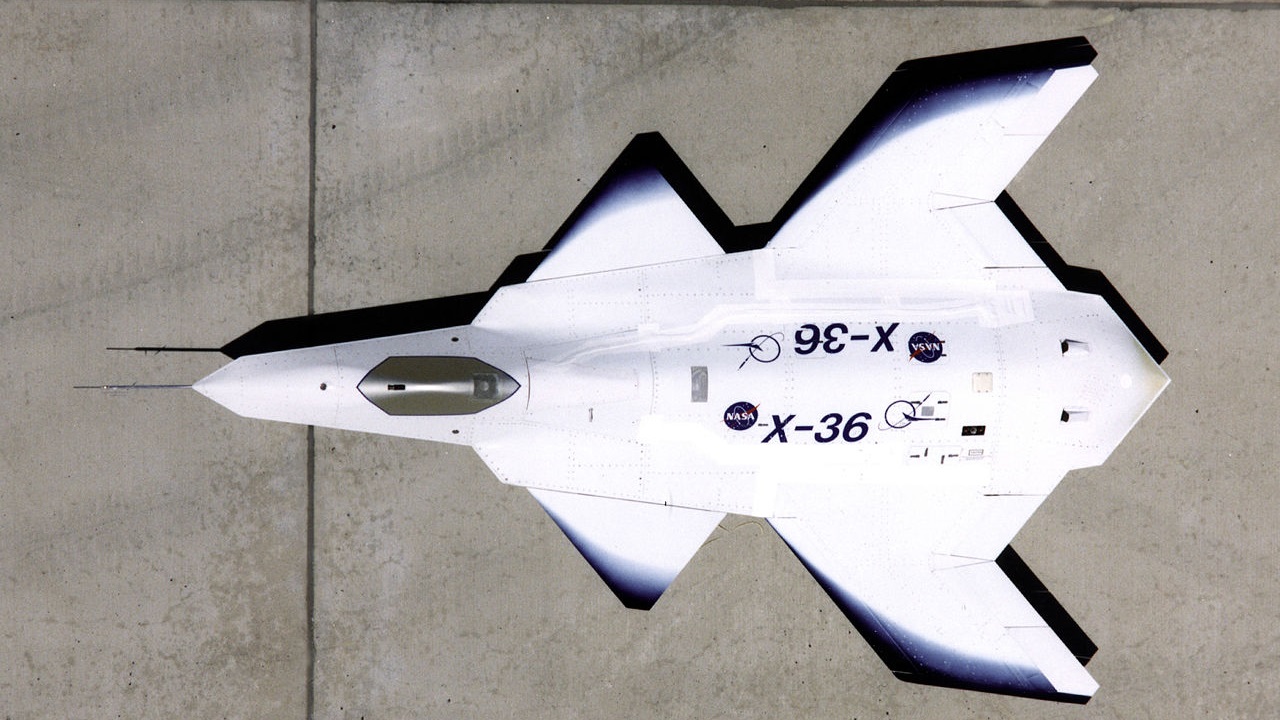
Missing from the entire debate is a small gray airplane hanging in a museum in Ohio. In 1997, a 28-percent-scale demonstrator called the X-36 flew 31 times over the California desert with no vertical tail, no horizontal tail, and a canard doing much of the work, and it flew beautifully. The program cost roughly $21 million, start to finish. It was built by McDonnell Douglas’s Phantom Works in St. Louis, the same organization, folded into Boeing mid-program, that is building the F-47 today.
X-36. 19FortyFive original image.
What the X-36 Was: A Fighter Configuration With No Tail at All
The X-36 existed to answer one question that had hung over fighter design since stealth arrived: tail surfaces are among the biggest radar reflectors on a fighter, so can you delete them entirely and still have an airplane agile enough to fight?
NASA‘s Ames Research Center and Phantom Works engineers began working on the technologies in 1989, and McDonnell Douglas proposed a flying demonstrator in 1993.
Under a roughly fifty-fifty cost-sharing agreement, the team used rapid prototyping to build two aircraft beginning in 1994, each a 28-percent-scale model of a notional future fighter: 19 feet long, a hair over 10 feet of wingspan, about 1,250 pounds fully fueled, powered by a Williams F112 turbofan of roughly 700 pounds of thrust, the same class of small engine that powers cruise missiles.
Deleting the tail meant deleting stability. The X-36 was unstable in both pitch and yaw, kept flying by a single-channel digital fly-by-wire system, built partly from commercial components to hold costs down, that commanded a canard ahead of the wing, split ailerons that opened like clamshells to act as drag rudders, and a thrust-vectoring nozzle. Every one of those choices was a bet that software and control surfaces in unconventional places could replace the fin and stabilizer that had steadied fighters since the beginning.
The other radical choice was where the pilot sat, which was nowhere near the airplane. A rated pilot flew the X-36 from a ground-station virtual cockpit, looking through a video camera in the nose at a display with a fighter-style head-up display and a moving map, with an onboard microphone piping back the engine sound for cueing.
NASA‘s own program summary states the reasoning plainly: putting a human in the loop eliminated the need for the expensive and complex autonomous flight-control systems of the day, and, with them, the risk of an autonomous system encountering a situation nobody had programmed for.
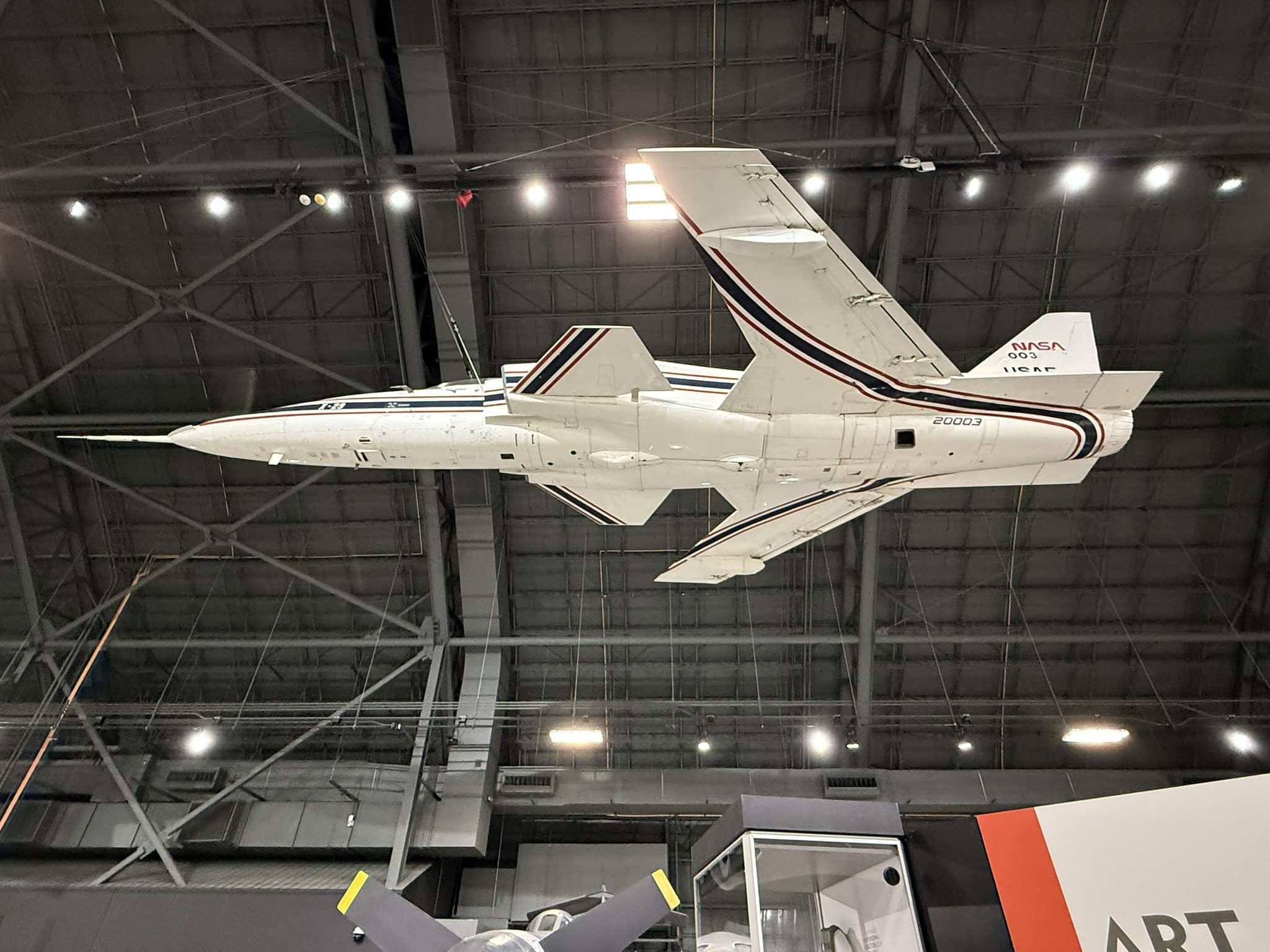
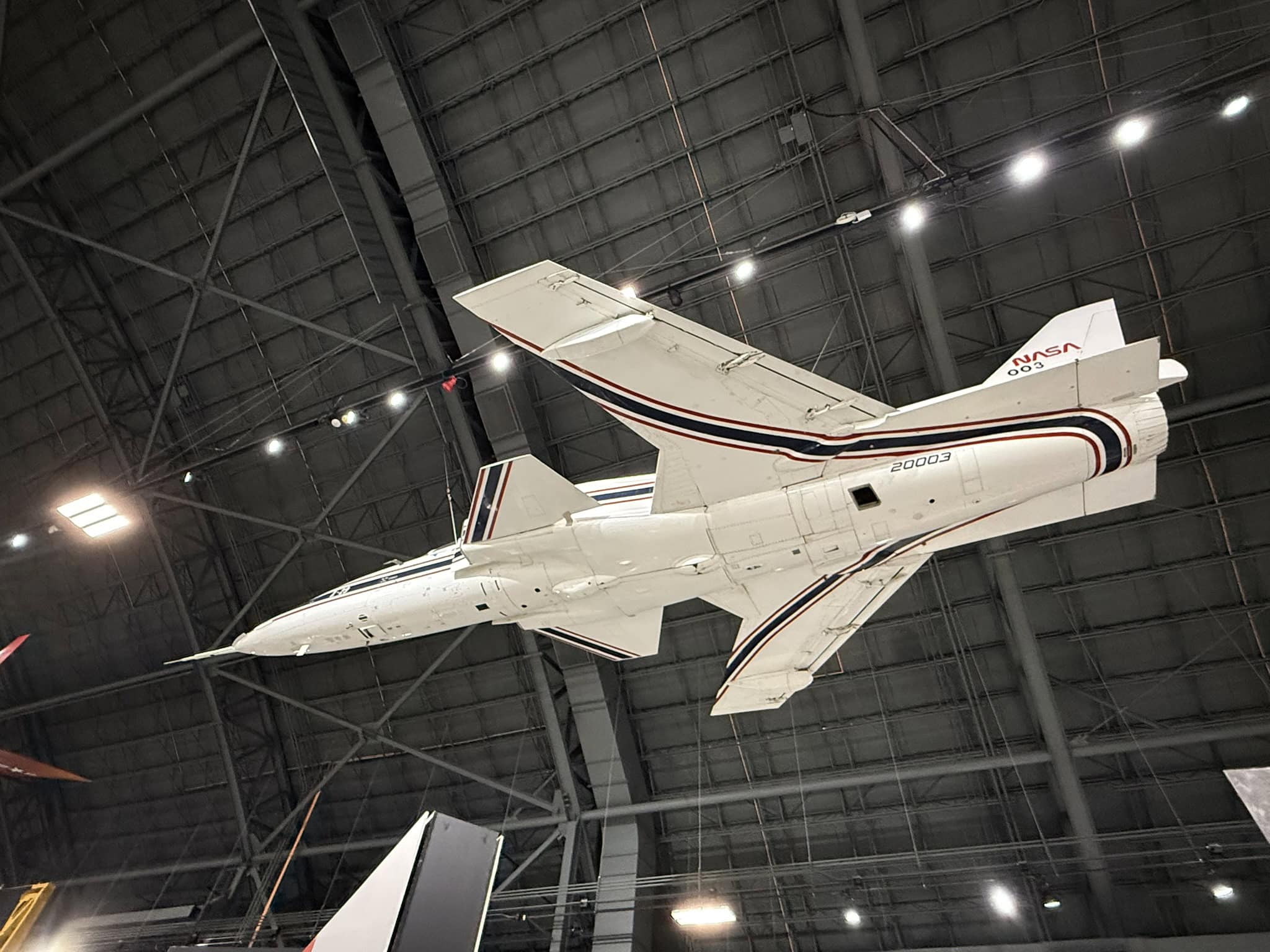
X-36 at the National Museum of the U.S. Air Force. Taken back in July of 2025 by Harry J. Kazianis.
In 1997, it was a cost-saving workaround. Read in 2026, it describes how the Air Force’s newest uncrewed fighters are being flight-tested.
31 Flights in 25 Weeks: How the Tailless Demonstrator Actually Performed
The X-36 lifted off Rogers Dry Lake at what was then NASA’s Dryden Flight Research Center on May 17, 1997, and flew its final program flight on November 12, 31 flights in 25 weeks, totaling 15 hours and 38 minutes in the air across four different versions of its flight-control software. The little aircraft reached 20,200 feet, touched 206 knots, and, most importantly for the question it was built to answer, flew at angles of attack up to 40 degrees, the slow, nose-high regime where a fighter with no tail should theoretically tumble out of control.
It did not tumble. The project team worked the envelope at both ends, high angle of attack at low speed and low angle at high speed, and NASA’s summary records that the aircraft was stable, maneuverable, handled very well, and that the program “met or exceeded all project goals.”
That result mattered because it was not obvious. A tailless airplane trades away the surfaces that damp every unwanted motion, and the X-36 demonstrated that the trade could be won with control laws, canards, and vectored thrust, at fighter-relevant agility, for the price of a couple of business jets. The data and the confidence it generated went into the databases that every subsequent American tailless design has drawn on.
RESTORE: A Neural Network Flew This Airplane in 1998
The X-36’s second act is the one almost nobody remembers, and in 2026, it may be the most relevant part. After the NASA Agility Program closed, the Air Force Research Laboratory at Wright-Patterson contracted Boeing to fly the aircraft again under a program called RESTORE, Reconfigurable Control for Tailless Fighter Aircraft.

The NASA/Boeing X-36 Tailless Fighter Agility Research Aircraft program successfully demonstrated the tailless fighter design using advanced technologies to improve the maneuverability and survivability of possible future fighter aircraft. The program met or exceeded all project goals. Image: Creative Commons.
In two flights in December 1998, the X-36 flew with an adaptive, neural-network-based software layer running alongside its proven control laws. The test team then deliberately introduced simulated failures of the aircraft’s control effectors in flight, the flaps, ailerons, and rudder equivalents, that a battle-damaged fighter might lose. Each time, per NASA’s account, the neural-net software correctly identified the degradation and adjusted the control laws accordingly, and the aircraft continued to fly safely.
Strip away the 1990s vocabulary, and what happened over Edwards in December 1998 was an artificial neural network exercising real-time authority over a real, unstable, tailless jet and passing its test. The Pentagon’s current push to put adaptive, learning software at the heart of combat aviation, from AI-flown test aircraft to the autonomy stacks inside the new collaborative combat drones, is usually told as a story that begins in the 2020s. Its first flight-proven ancestor was a 19-foot airplane with no tail, twenty-seven years ago.
The Ground Cockpit That Previewed the Loyal Wingman Era
The X-36’s third legacy is procedural rather than aerodynamic. In 1997, a qualified pilot flying a high-performance testbed through a camera and a ground cockpit was an economy measure. It has since become the standard operating pattern of the era for which the F-47 is being built. The Air Force’s Collaborative Combat Aircraft program is fielding uncrewed fighters designed to fly as armed teammates alongside crewed jets, and its first two increment-one aircraft are already flying: General Atomics’ YFQ-42A first flew last August, and Anduril’s YFQ-44A followed in October 2025. The manned-unmanned teaming they represent is one of the defining traits every sixth-generation program shares.
The X-36 did not invent that world, but it flew the working method, human judgment in the loop, airframe in the air, cockpit on the ground, before most of the engineers now building it had started their careers.
The Canard Irony: J-20, J-36, J-50, and the F-47 Renders
Which brings the story back to China’s argument over the F-47’s nose.
The mockery has a history. When China’s J-20 appeared with large canards, Western analysts spent years describing them as a stealth compromise, reflective surfaces ahead of the wing that a truly low-observable design would avoid. China’s sixth-generation answer took the criticism to its conclusion: the J-36 and J-50, flying since December 2024, deleted both the vertical tails and the canards, and Chinese commentators now ridicule the canards in the F-47 renderings as America adopting yesterday’s feature. Their own programs keep moving; observers reported what may be a third J-36 prototype by late 2025, flight testing has continued into 2026, and the aircraft was acknowledged among China’s sixth-generation fighters at Beijing’s September 2025 parade.
Two honest caveats belong in the middle of the argument. The first is that nobody outside the program knows what the F-47 looks like. The renderings have been officially released and are deliberately unrevealing, and Air Force Secretary Troy Meink has all but said they are designed to frustrate analysis: “Good luck trying to dig something out of there.”
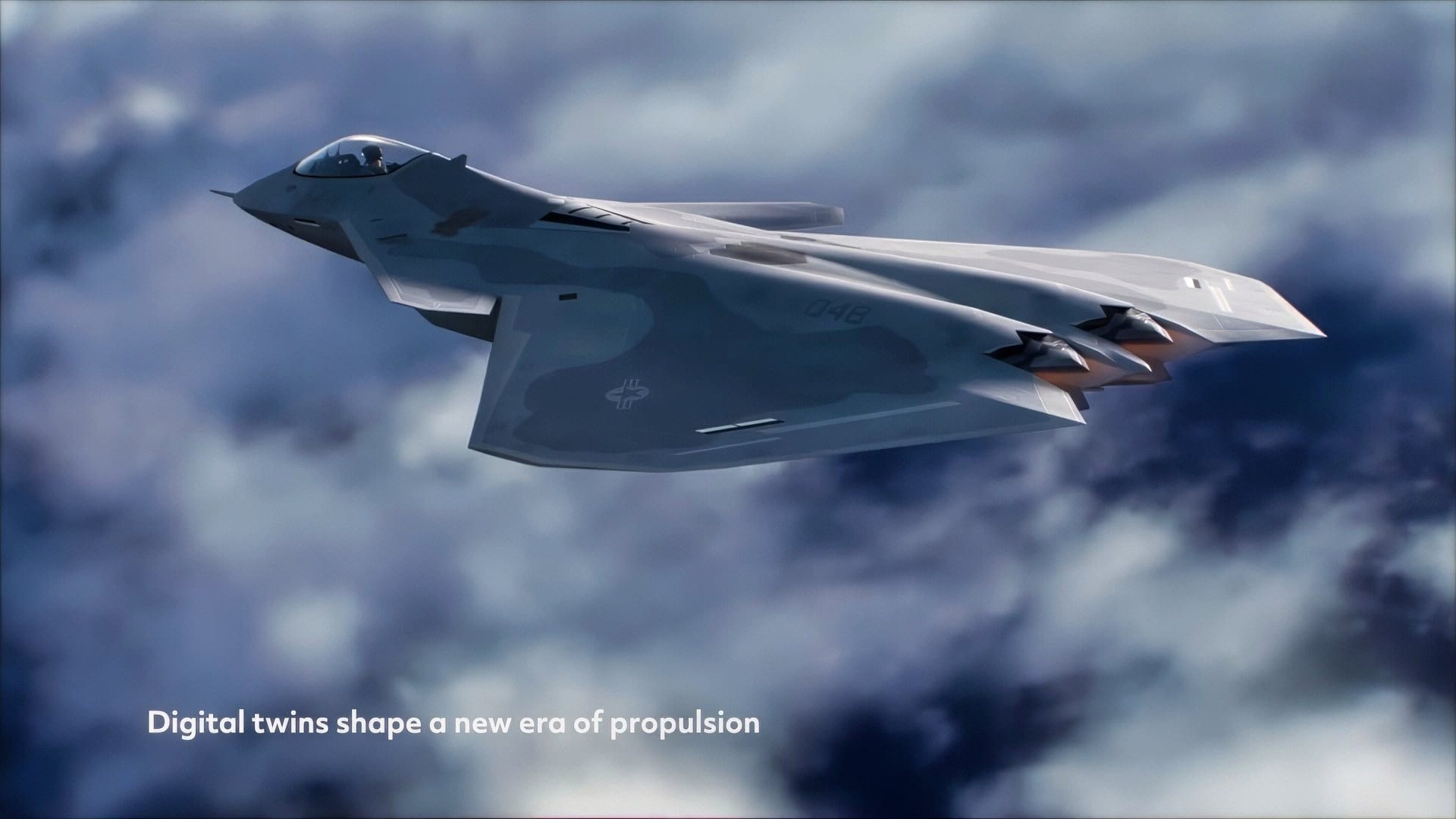
F-47 NGAD Fighter Possible Image. Image Credit: Screenshot.
The canards may be real, a misdirection, or transitional. The second is that the underlying trade is genuine. Removing tails cuts radar signature at a real cost in control authority and agility, which is why, as RUSI airpower analyst Justin Bronk and others have noted, tailless designs lean on advanced control systems and thrust vectoring to compensate, and why the British-Italian-Japanese GCAP program has kept large vertical tails on its concept entirely. Taillessness is a bet, not a settled consensus.
What the mockery misses is that the specific bet being argued over, a tailless fighter using canards among its replacement controls, is not an untested American improvisation. It is the configuration that the X-36 proved flyable in 1997, with the agility data to show for it, generated by the same St. Louis works whose name is on the F-47 contract. The claim is about legacy, not lineage: a 1,250-pound demonstrator from the Clinton administration did not design a sixth-generation fighter, and the F-47 will stand or fall on engineering three decades newer. But when the renderings show canards on a tail-reduced airframe, they show a shape American engineers have already flown, measured, and archived, at 28 percent scale, for $21 million.
Where the Two X-36s Sit Today: We Visited It
Both airframes survive. One is displayed at the National Museum of the US Air Force at Wright-Patterson Air Force Base outside Dayton, sharing gallery space with the Air Force’s other research one-offs; the second sits at the Air Force Flight Test Museum at Edwards, beside the lakebed it flew from.
Visitors walk past the Dayton airframe quickly because a 19-foot gray drone photographs poorly next to full-scale legends. I know this well; I almost did this last year when I visited the museum. The airframe sits right above the F-22 Raptor. Look just below.
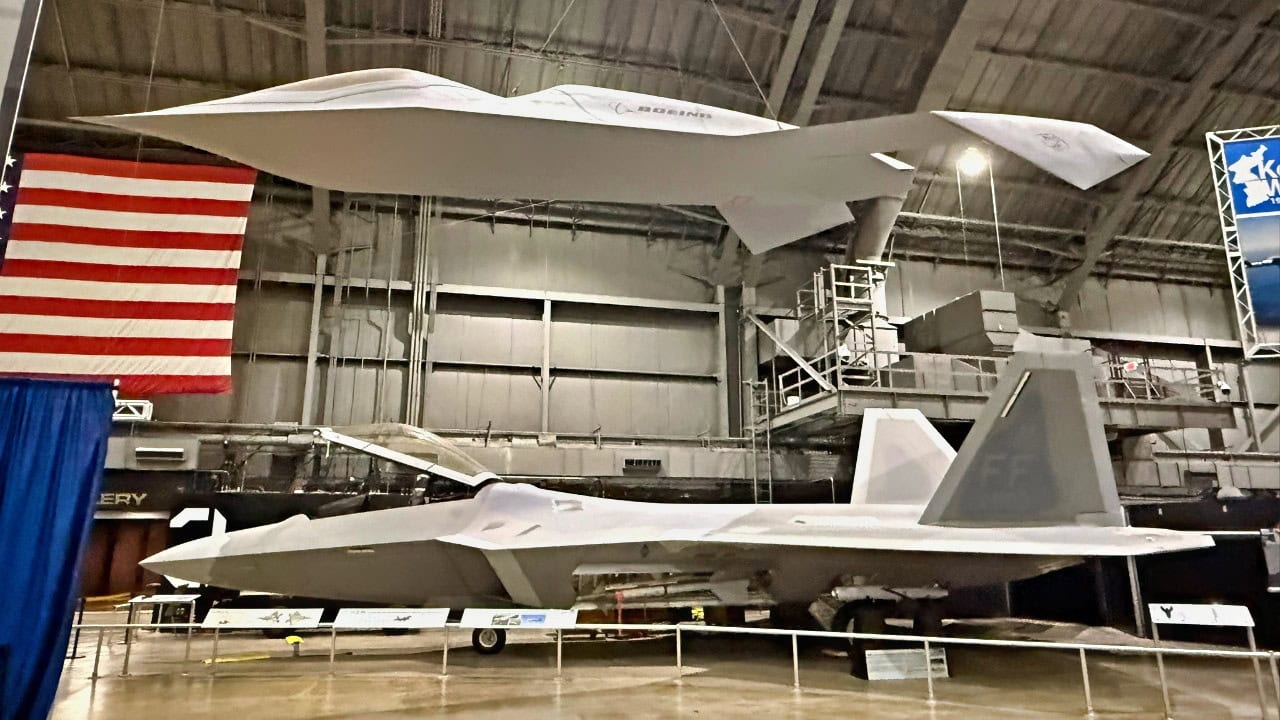
YF-118G. Image taken by Harry J. Kazianis for 19FortyFive.
Almost none of them know they are looking at the airplane that proved the shape now flying over Chengdu, fought over on Chinese social media, and rendered, perhaps truthfully, over St. Louis, or that the whole demonstration cost less than a single modern fighter. The tailless future everyone is now racing toward made its first takeoff on May 17, 1997, and the machine that made it is small enough to miss.
About the Author: Harry J. Kazianis
Harry J. Kazianis (@Grecianformula) was the former Senior Director of National Security Affairs at the Center for the National Interest (CFTNI), a foreign policy think tank founded by Richard Nixon based in Washington, DC. Harry has over a decade of experience in think tanks and national security publishing. His ideas have been published in the NY Times, The Washington Post, The Wall Street Journal, CNN, and many other outlets worldwide. He has held positions at CSIS, the Heritage Foundation, the University of Nottingham, and several other institutions related to national security research and studies. He is the former Executive Editor of The National Interest and The Diplomat. He holds a Master’s degree focusing on international affairs from Harvard University.

