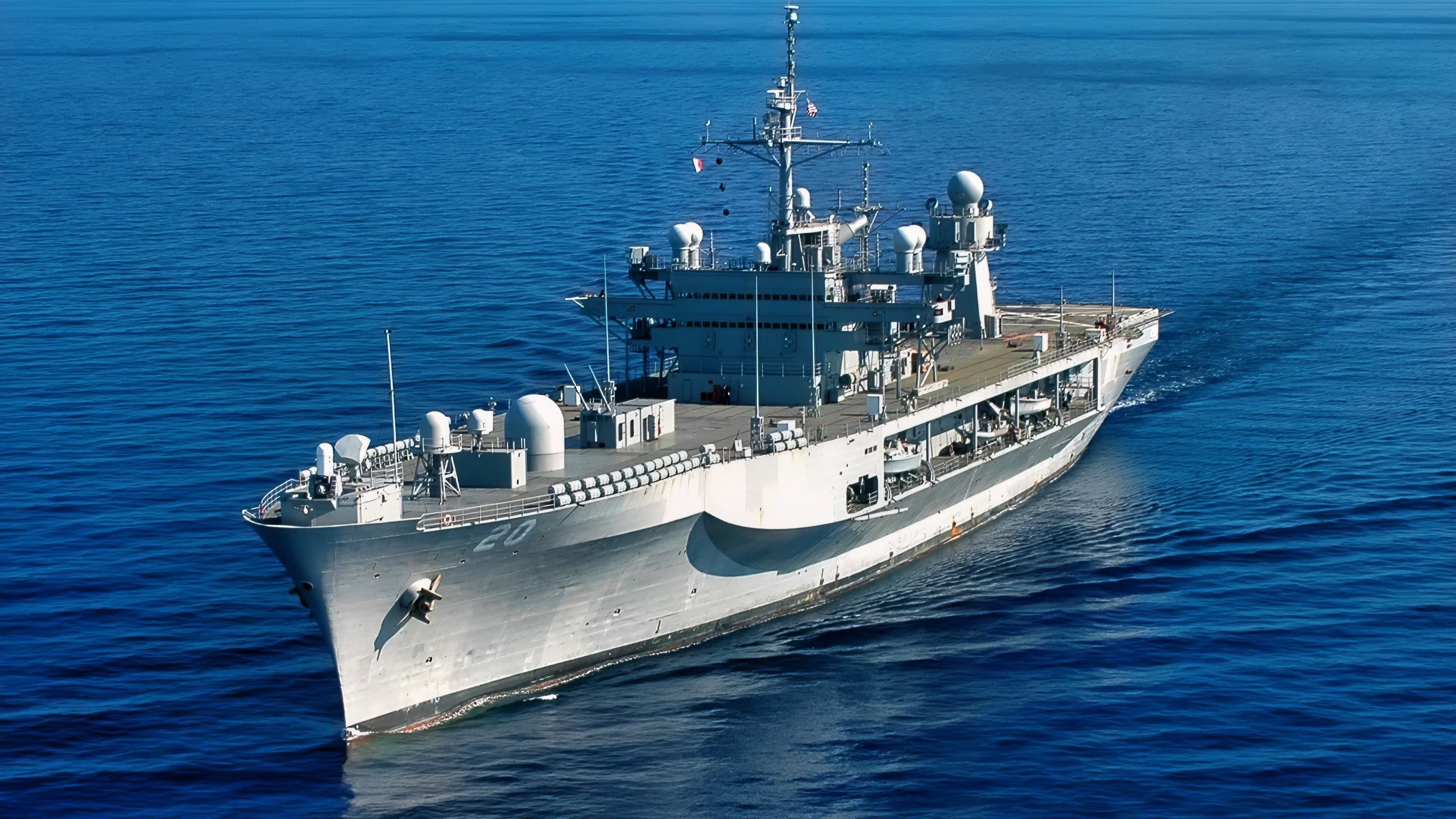
Summary and Key Points: Defense analyst Caleb Larson evaluates the Blue Ridge-class command ships, the USS Blue Ridge (LCC-19) and USS Mount Whitney (LCC-20).
-These vessels serve as the critical “nerve centers” for the U.S. Seventh and Sixth Fleets.
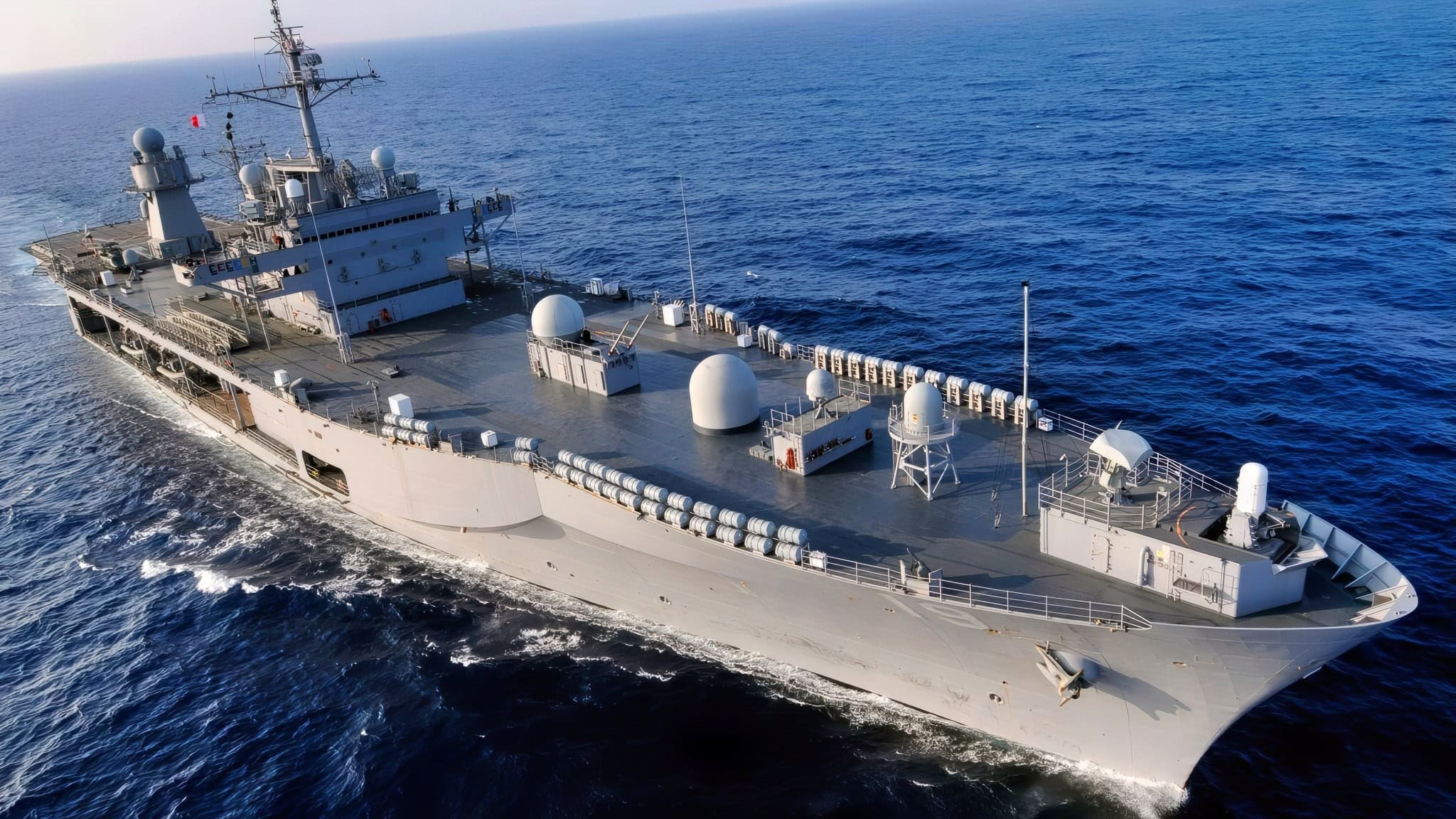
Blue Ridge-Class U.S. Navy. Image Credit: Creative Commons.
-This report analyzes the class’s origin in the Cold War, its sophisticated electronics suite—historically 30% larger than that of an aircraft carrier—and its role in Distributed Maritime Operations (DMO).
-Larson explores why the Navy extended their service life to 2039, concluding that their unique capacity to host hundreds of staff officers makes them currently irreplaceable.
Floating Nerve Centers: Why the US Navy is Keeping the 50-Year-Old Blue Ridge Ships Until 2039
The United States Navy’s Blue Ridge-class command ships are only two in number, but they play a critical role as dedicated command-and-control platforms for fleet commanders.
Rather than participating in naval warfare themselves, the ships serve as floating headquarters capable of directing large-scale naval operations.
The Blue Ridge-class is quite small, with just two ships: the USS Blue Ridge and the USS Mount Whitney, flagships of the United States Seventh Fleet in the Western Pacific and the United States Sixth Fleet in Europe and the Mediterranean, respectively.
The ships are the nerve centers of their fleet in two of the world’s most strategically significant bodies of water.
The Origin of the Blue Ridge-Class
The genesis of the Blue Ridge-class lay in the late 1960s, an answer to a particular Cold War command issue the U.S. Navy faced.
How would senior Navy leadership maintain command and remain in contact with fleets if headquarters on shore were destroyed or degraded?
To answer that conundrum, the Blue Ridge-class placed a premium on communications equipment and sensor suites.
The Blue Ridge-class also incorporated lessons learned during the Vietnam War, when senior Navy commanders running operations faced limitations due to makeshift command spaces on aircraft carriers or amphibious ships, but struggled to coordinate naval gunfire support, surveillance and interdiction missions, and coordination with South Vietnamese forces in addition to carrier strike operations.
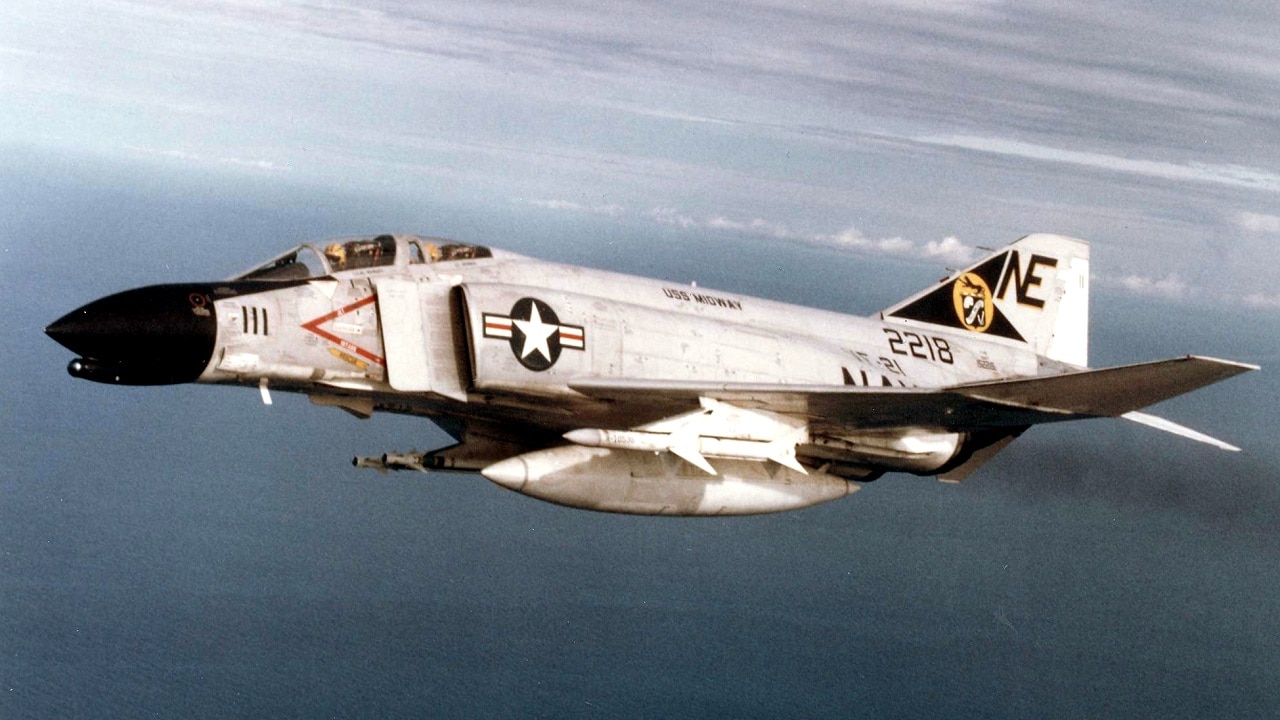
Vietnam War F-4 Phantom. Image Credit: Creative Commons.
The class is equipped with a massive communications suite, packed with antennas, satellite links, and secure communication systems, allowing navy commanders to coordinate forces in the air, at sea, underwater, and with disembarked troops on land simultaneously.
The ships are essentially a land-based operations center but afloat at sea and capable of hosting hundreds of officers, planners, intelligence personnel, and communications specialists, all of whom help to integrate forces across the services and across allied militaries, too, a crucial capability for multinational operations.
At the time of her commissioning, the USS Blue Ridge was one of the most electronically advanced vessels afloat.
As a U.S. Navy publication from around the time of her commissioning explained, “in becoming operational BLUE RIDGE assumes the distinction of carrying the world’s most sophisticated electronics complex to sea–a package some thirty percent larger than that of the attack carrier John F. Kennedy, which until the time of the BLUE RIDGE’s commissioning, held this record.”
_1971_file_05_of_10.jpg)
It added an explanation of what the USS Blue Ridge does, saying that the ship leverages “her “main battery” of computers, communications gear, and other electronic facilities to fulfill her mission as a “command ship for Amphibious Task Force and Landing Force Commanders during Amphibious Operations,” which includes the landing of troops, air and gunfire support, task force protection, and logistics support.”
Age is Just a Number for Blue Ridge-Class
Though the two Blue Ridge-class ships are more than fifty years old, they’ve managed to remain in service largely thanks to their primary mission of communications rather than combat. Over the decades, the U.S. Navy has modernized its ships’ computers and electronics, keeping their capabilities up to date with technology.
This strategy leverages the enormous internal volume the class dedicates to staff space and communications equipment.
The ship was designed from the outset — and from the keel up — as a command-and-control ship, and as such does not have an obvious replacement. The overwhelming majority of warships afloat place a premium on survivability, sensors, and weapons, not what could be characterized in the Blue Ridge-class as office space.
A warship like the Arleigh Burke-class destroyer, for example, boasts sophisticated combat systems but does not have anywhere near the space on board to host a fleet headquarters staff.
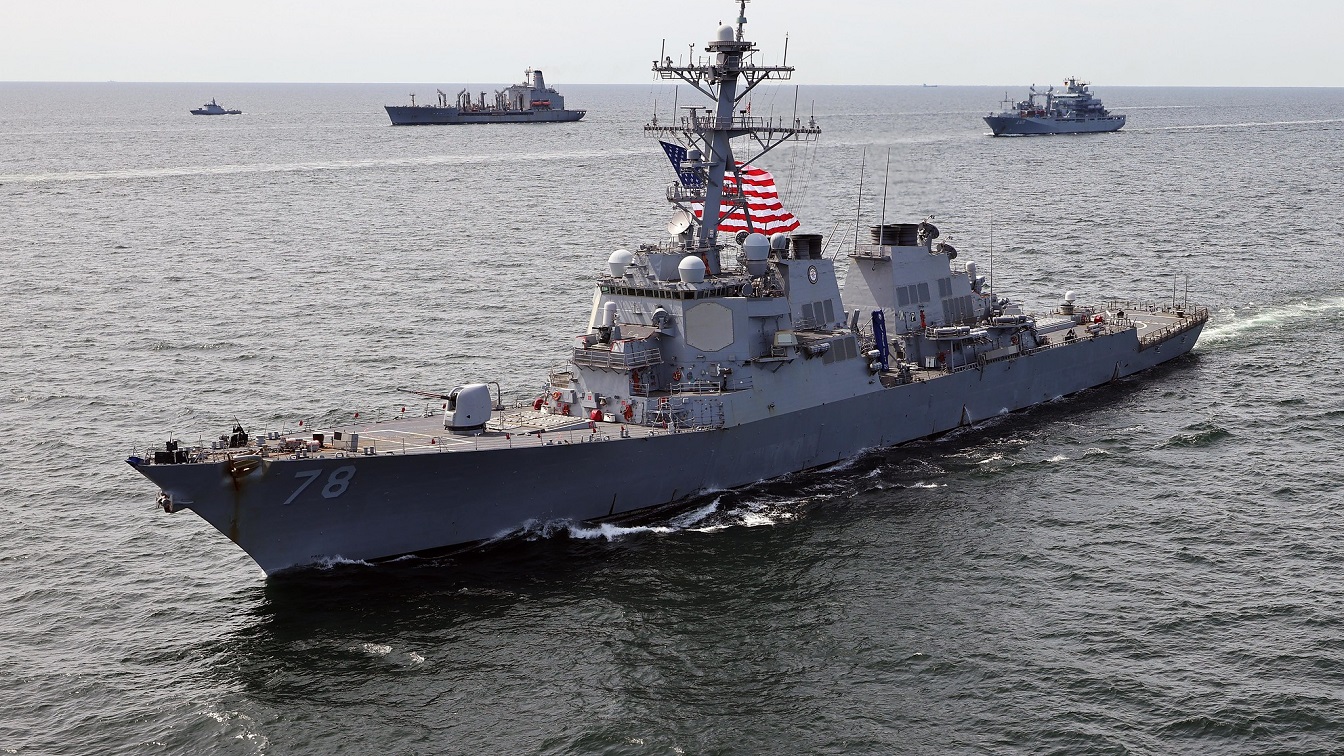
BALTIC SEA (June 6, 2022) The Arleigh Burke-class guided-missile destroyer USS Porter (DDG 78) sails in formation in the Baltic Sea, June 6, 2022, during exercise BALTOPS22. BALTOPS 22 is the premier maritime-focused exercise in the Baltic Region. The exercise, led by U.S. Naval Forces Europe-Africa, and executed by Naval Striking and Support Forces NATO, provides a unique training opportunity to strengthen combined response capabilities critical to preserving freedom of navigation and security in the Baltic Sea. (U.S. Navy photo) 220606-N-NO901-3008
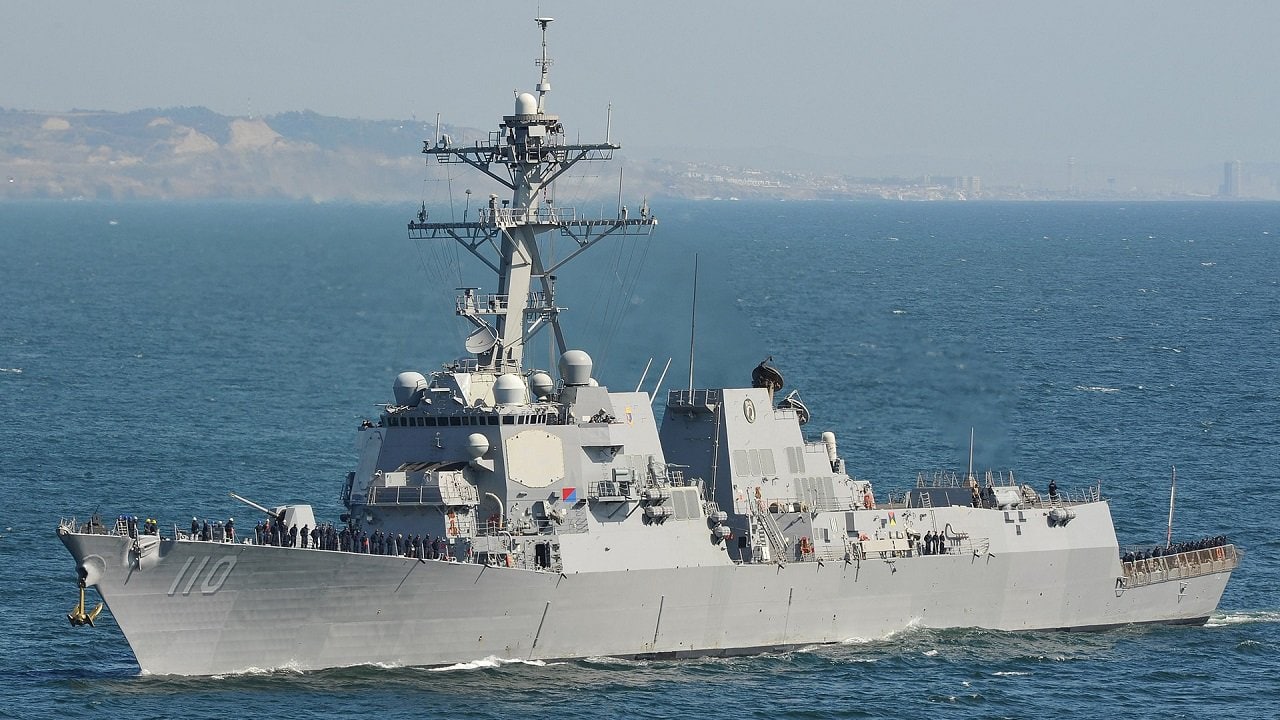
PACIFIC OCEAN (May 4, 2015) – The guided-missile destroyer USS William P. Lawrence (DDG 110) steams toward San Diego Harbor. (U.S. Navy photo by Mass Communication Specialist 3rd Class Nathan Burke/Released)
Distributed Command
Over the past several decades, the U.S. Navy has attempted to move away from large command ships and toward a distributed command-and-control network.
The strategy attempts to shift command across several platforms rather than a single flagship and is a hedge against the kind of knockout blow that the loss of a ship like the Blue Ridge-class would deliver to the Navy.
But despite their age, the U.S. Navy has extended the Blue Ridge-class’ service lives precisely because they lack a clear, single-platform alternative, even as the Navy shifts to distributed maritime operations.
Into the Future
The Congressional Research Service, a nonpartisan think tank that compiles reports for the United States Congress, explained that a crucial component of the Navy’s distributed maritime operations is the disaggregation of key Navy assets. “Spreading the Navy’s sensors and weapons across a wider array of ships and aircraft, to reduce the fraction of the Navy’s sensors and weapons that would be lost due to the destruction of any one Navy ship or aircraft,” will be key to future operations. But the class will remain in service until 2039, so the Blue Ridge-class has more than a decade of service life yet.
About the Author: Caleb Larson
Caleb Larson is an American multiformat journalist based in Berlin, Germany. His work covers the intersection of conflict and society, focusing on American foreign policy and European security. He has reported from Germany, Russia, and the United States. Most recently, he covered the war in Ukraine, reporting extensively on the war’s shifting battle lines from Donbas and writing on the war’s civilian and humanitarian toll. Previously, he worked as a Defense Reporter for POLITICO Europe. You can follow his latest work on X.