
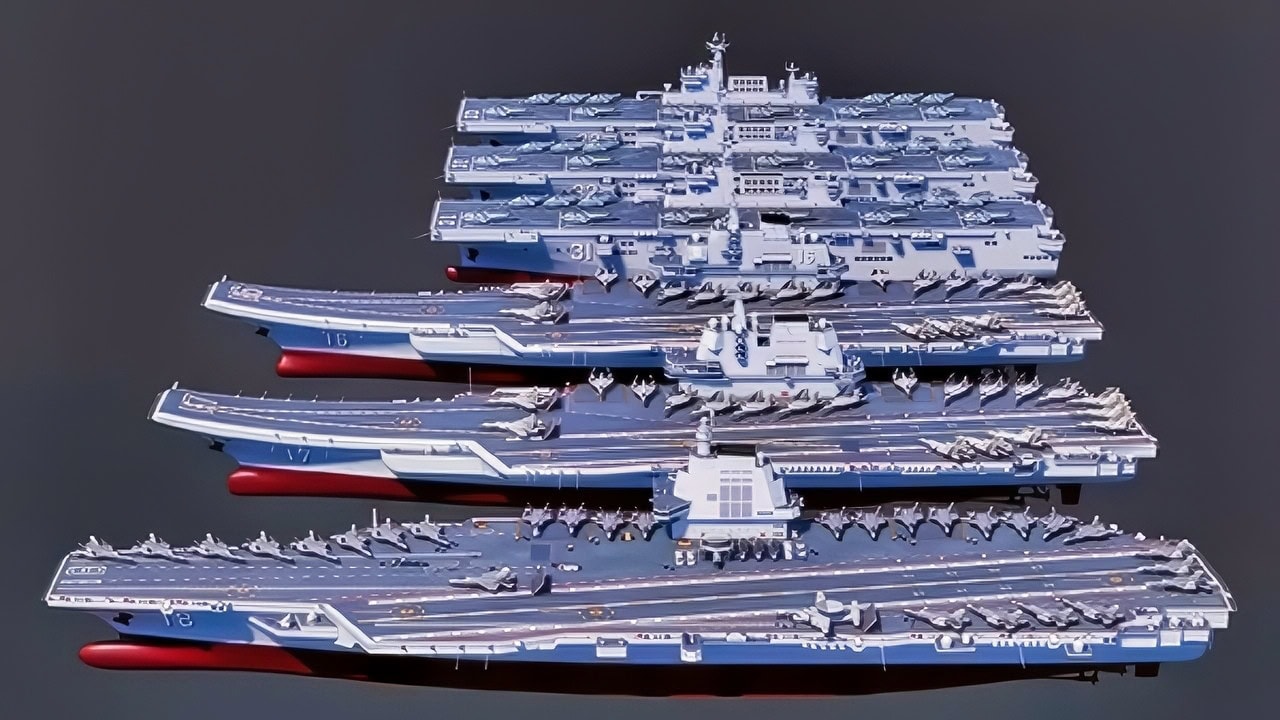
China is now on track to triple its aircraft carrier fleet to nine warships by 2035—averaging one new carrier every 20 months in the largest naval buildup in the Indo-Pacific since World War II. The fourth Chinese carrier, designated the Type 004, will likely be a 110,000–120,000-ton nuclear-powered supercarrier capable of operating more than 100 aircraft, exceeding the size of the U.S. Navy’s USS Gerald R. Ford.
China’s Aircraft Carrier Surge Is Real: Nuclear Supercarrier Coming Soon?
China continues to build naval vessels at an incredible rate and is well on its way to achieving its goal of a fleet of nine aircraft carriers by 2035.
China’s continued building spree of adding aircraft carriers flies in the face of many analysts who believe that the days of the aircraft carrier are increasingly numbered today because of the plethora of anti-ship missiles available.
However, the Chinese are firm believers in the aircraft carrier’s power-projection capability.
Beijing released a military propaganda video that they titled “Sailing Toward the Ocean,” which hinted that a fourth aircraft carrier—the third to be entirely built in China and the first that might be nuclear-powered.
The video featured a trio of officers whose names mirrored the PLAN’s three current operational carriers: the Type 001 CNS Liaoning, the Type 002 CNS Shandong, and the Type 003 CNS Fujian.
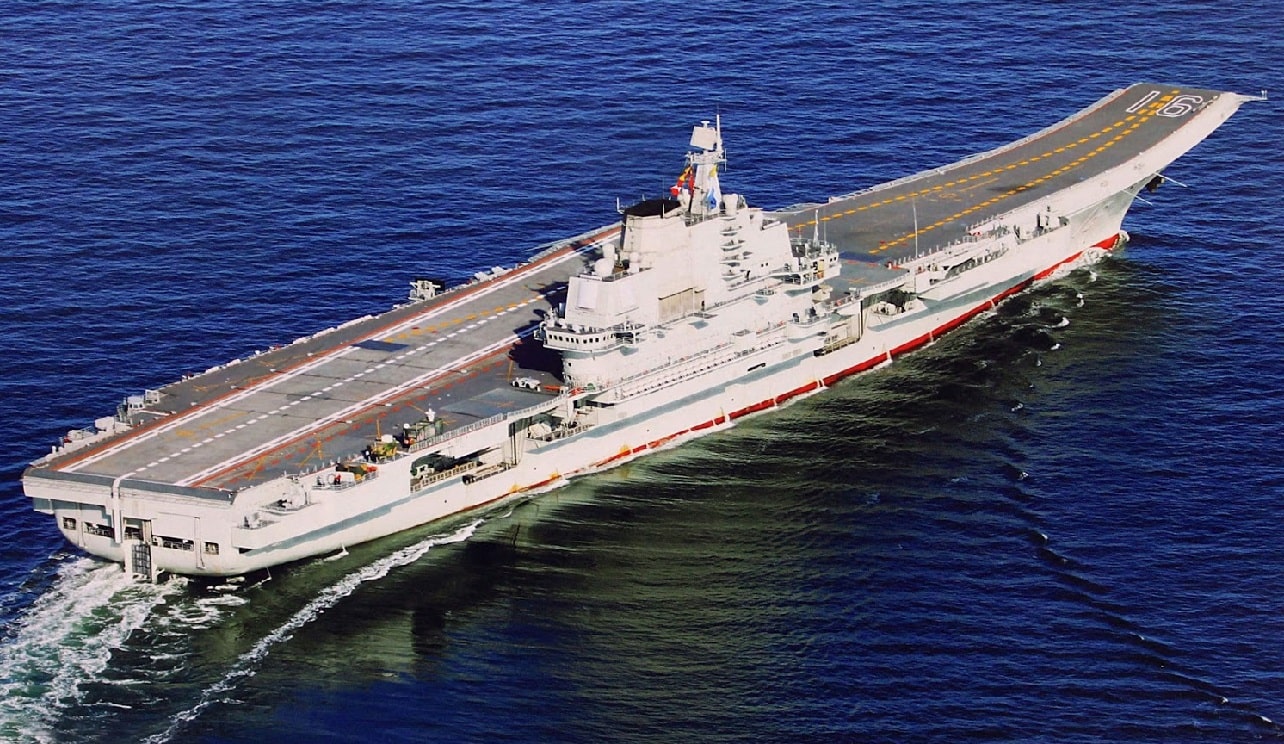
China’s first aircraft carrier. Image Credit: Creative Commons.
The three officers were joined by a fourth, named “He Jian”, which is Mandarin for “nuclear vessel.”
The Pentagon’s 2026 Report On Chinese Military Power:
The U.S. report says that the People’s Liberation Army Navy (PLAN) will embark on the largest carrier build-up effort in the Indo-Pacific since World War II, by tripling its carrier fleet’s size.
“The PLAN aims to produce six aircraft carriers by 2035 for a total of nine,” the Pentagon said (page 24).
This expansion, which averages one new carrier every 20 months, reflects a massive modernization effort aimed at securing maritime control and accelerating the People’s Liberation Army Navy’s (PLAN) capabilities.
China Building A Nuclear-Powered Carrier Bigger Than the USS Ford:
China’s fourth aircraft carrier, widely identified as the Type 004, is currently under construction at the Dalian Shipyard and is anticipated to be China’s first nuclear-powered aircraft carrier, operating twin reactors, according to Janes.
“However, the real challenge lies in designing a high-performance reactor that is suitable for use in the sea, resistant to shocks and swells, suitable for radiation protection, and easy to maintain. Approval, certification, and operational testing can take years.”
Image: Creative Commons.
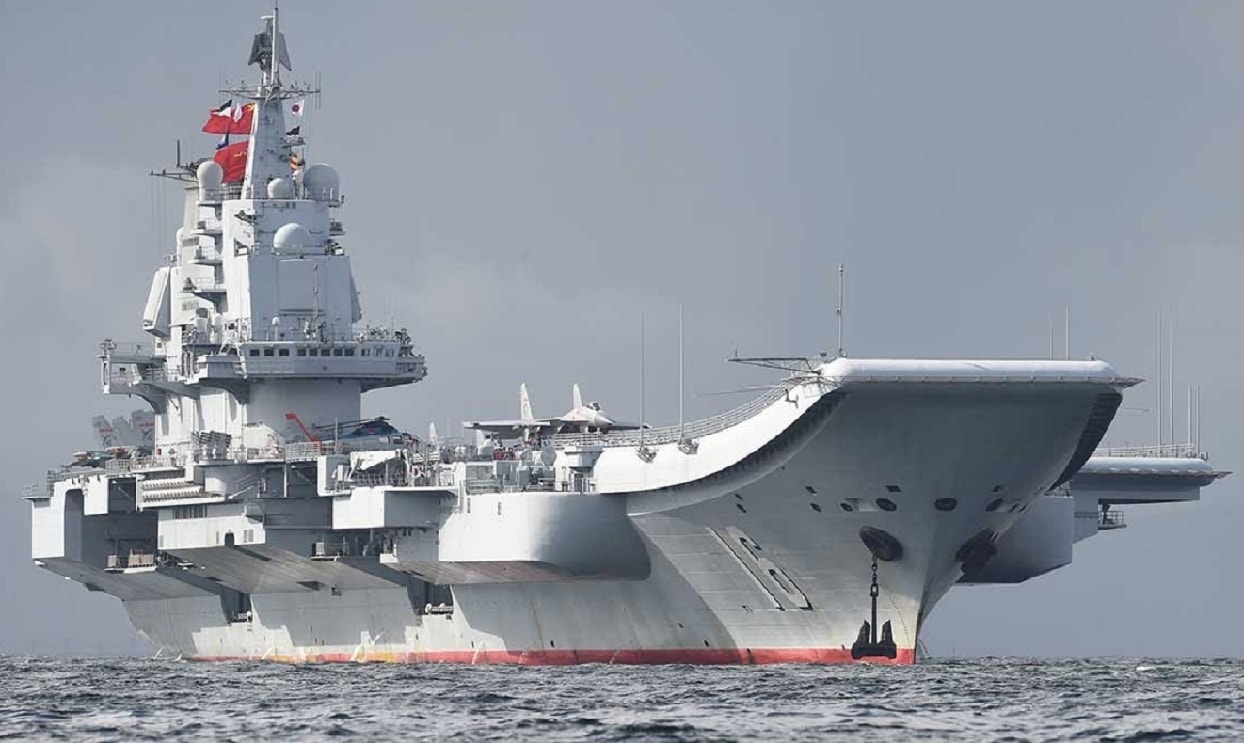
Image: Creative Commons.
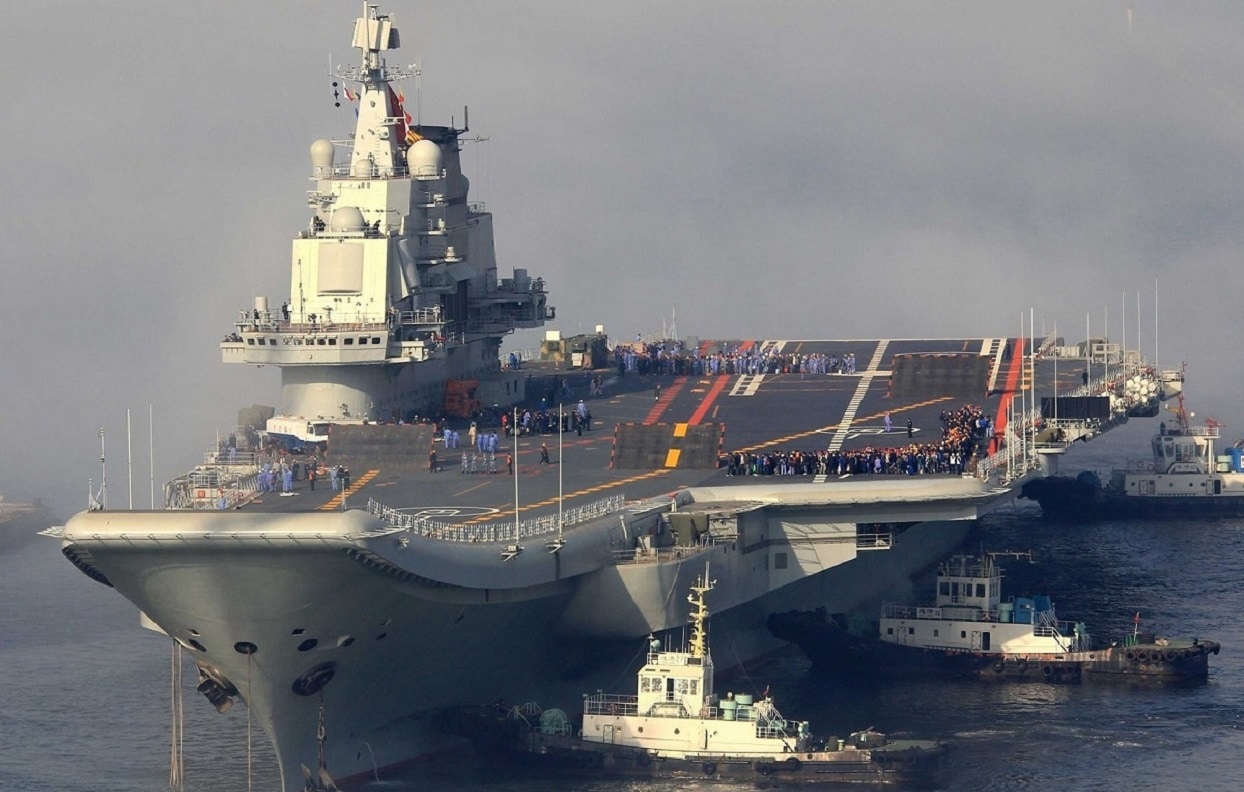
Chinese Aircraft Carrier. Image: Chinese Internet.
Expected to be a massive supercarrier with a displacement of 110,000–120,000 tons, it will feature electromagnetic catapults (EMALS) to support advanced aircraft like the J-35 and KJ-600, designed to perform a role similar to that of the E-2C/D Hawkeye launched from U.S. carriers.
This represents a significant jump in naval capability. For comparison, the Ford operates 90 aircraft; the type 004 will reportedly operate more than 100 aircraft.
China’s Three Conventionally Powered Carriers Have Limited Range:
They currently have three carriers, but two are older models. One was the former Soviet-built and retrofitted Liaoning, which carries 24 fighters, and the indigenously built Shandong, another ski-jump-type carrier that is slightly larger and carries eight additional aircraft.
Their third carrier is the much more modern Fujian, which operates with a flat deck and a Ford-class-like electromagnetic catapult. It is the largest non-nuclear warship in the world. It is China’s first carrier to use a CATOBAR system.
The Fujian Design Issues Hurt Its Capabilities:
Fujian has issues, however, with its flight deck layout and the location of its island, which bottlenecks aircraft on the flight deck and lowers the sortie rate. It has only about 60 percent of the operational capability of the Nimitz-class. This design flaw means the carrier can’t launch and recover aircraft simultaneously, a prerequisite for carriers of this size.
The Fujian carries about 40 fighters but is conventionally powered, so its range without refueling is more limited. The PLAN’s oiler fleet is limited and would constitute vulnerable targets for U.S. forces.
However, in June of last year, China, for the first time, operated two aircraft carriers together off the First Island Chain, conducting hundreds of carrier launches and landings.
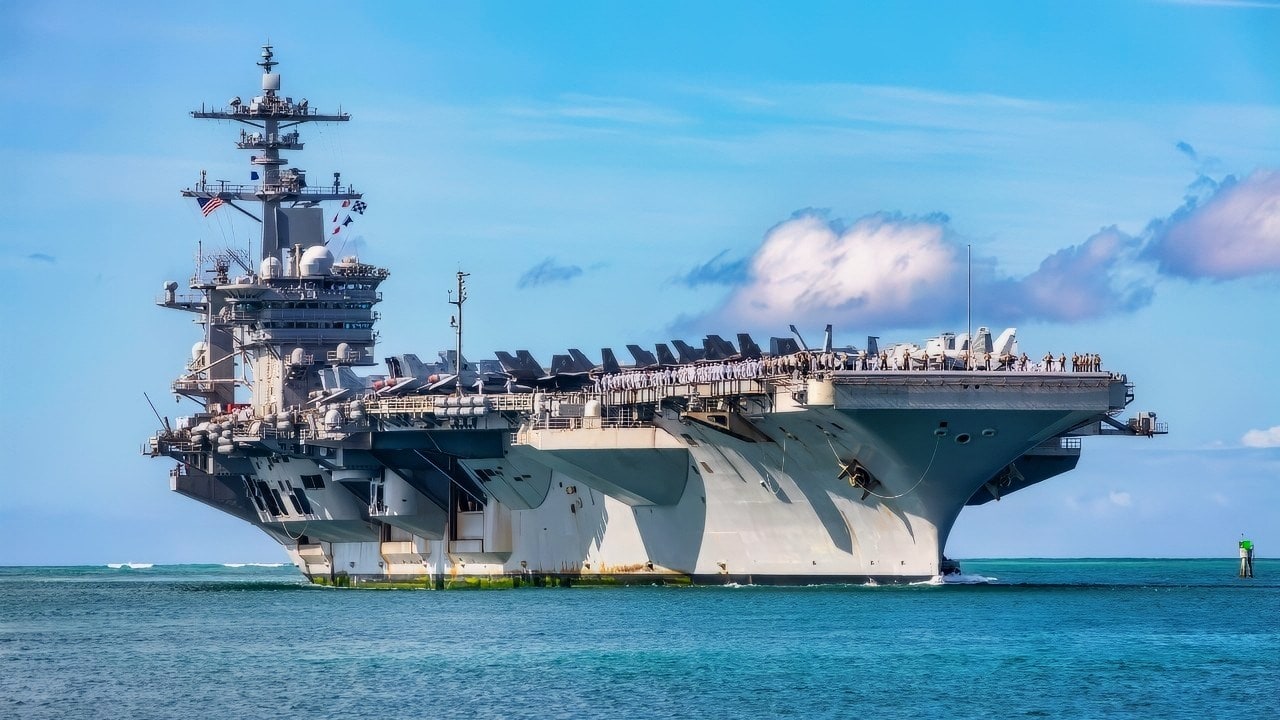
Supercarrier Nimitz-Class U.S. Navy. Image Credit: Creative Commons.

USS Nimitz in November 2025. Image Credit: Creative Commons.
“Only 15 or so countries in the world operate aircraft carriers,” Australian naval analyst Jennifer Parker said. Parker served as a principal warfare officer in her more than 20 years in the Royal Australian Navy, including roles in force design, strategic planning and various operational roles.
“Very few of them would be able to operate two with associated escorts concurrently. While the carriers themselves are not the most capable, it demonstrates China’s increasing blue water expeditionary capability that is not constrained to their near seas.”
China’s Carrier Strike Groups Lack Of Stealth Fighters:
Chinese air wings currently don’t have enough fifth-generation fighters for their carrier force. The fifth-generation J-20 stealth fighter is too large and too heavy for carrier operations.
Their most prevalent carrier fighter is the fourth-generation J-15T. The more modern, fifth-generation J-35 stealth fighter is currently in production, but the PLAN has only about 57 of them.
The plan is to produce enough to have 200 to 300 J-35s by 2030. Designed as a carrier-borne strike platform for the Fujian (CV-18), the J-35 provides the People’s Liberation Army Navy (PLAN) with a fifth-generation, twin-engine capability to challenge the U.S. F-35 Lightning II.
“The J-35A has a different design than China’s first stealth fighter jet, the J-20. The J-20, with a canard wing configuration, is a heavy fighter jet with a focus on air superiority missions comparable with the US’ F-22, while the medium-sized J-35A uses a tailplane wing configuration similar to the US’ F-35 that also has strong surface attack capabilities,” The Global Times said.
China may also incorporate the massive, three-engine J-36 stealth fighter prototype into its carrier wings.
China’s Carriers Are Still Gaining Operational Experience:
The Chinese aircraft carriers still have a long way to go to match the U.S. Navy, primarily due to a significant gap in operational experience, crew training, and military doctrine.
While China is rapidly advancing technologically, it faces significant challenges in areas such as sustained 24-hour air operations, anti-submarine warfare, and sea-based logistics that can only be developed over time and with experience.
The PLAN lacks the decades of real-world experience the U.S. has in conducting complex, sustained carrier operations and projecting power.
Aircraft and systems integration are behind the US. While China’s new carriers can launch jets with electromagnetic catapults, the U.S. has more advanced landing software and battle-tested systems.
Continuous Air Operations Still A Work In Progress:
Last April, I posted that the Chinese carriers were still operating close to their shores and under the protection of their A2/AD. And in many instances, Chinese pilots took off or landed from Chinese airfields, rather than from the carriers. However, that is beginning to change as they conduct more carrier deployments.
The IISS recently analyzed the joint carrier operation conducted by the Liaoning and Shandong carriers, along with their respective escort groups. It showed a leap in Chinese naval capability, which was typically crowed about in the state-run media. They portrayed the operation in much the same way the U.S. Navy does, as a projection of regional power.
Does China have an actual capability to conduct complex multi-carrier operations? The U.S. Navy has been doing this for more than 80 years. The Chinese have demonstrated their intent to conduct such operations, but mastering this skill takes time.
Night operations and operations in adverse weather conditions are staples of American carrier operations, as are continuous flight operations, which the Chinese have yet to master.
“The continuous operation of its carriers sits at the very core of what makes the U.S. military absolutely preeminent,” said a Singapore-based defense analyst
Protective Screening And Missile Defense Needs Improvement:
China has a significant amount of “carrier killer” missiles, which it can muster against US aircraft carriers, but because of their design, China’s carriers are more vulnerable to US anti-ship missiles than American carriers are to theirs.
Some experts say China’s carriers would be vulnerable to missile and submarine attacks, noting that the People’s Liberation Army Navy has not perfected protective screening operations, particularly antisubmarine warfare.
“Unlike other parts of their military modernization, there is something politically theatrical about their carrier deployments so far,” said Trevor Hollingsbee, a former British naval intelligence analyst.
“Carrier operations are a very complicated game, and China’s got to figure this out all by itself. It still has a long, long way to go.”
Chinese carriers are just beginning to operate with early-warning aircraft, relying mostly on land-based aircraft. This is not conducive to operating anywhere but near their shores. A new aircraft, the KJ-600, designed to perform a similar role to the E-2C/D Hawkeye launched from U.S. carriers, is still in testing, according to the Pentagon’s latest annual report on China’s military.
China’s Carriers Are Meant To Operate Close To Its Shores:
China’s aircraft carriers have limited anti-missile defenses because they are designed to operate under the protection of land-based missile networks, rather than to possess comprehensive on-board defenses like U.S. carriers.
This strategy relies on land-based missile systems to create an anti-access bubble, a stark contrast to U.S. carriers, which are built to be self-sufficient and operate as “roaming nerve centers” for a wider network.
Because of this, China’s naval strategy emphasizes asymmetric warfare, using long-range anti-ship missiles to threaten enemy carriers from a distance. In contrast, their own carriers remain relatively vulnerable to direct attack.
This means that China is far from having carrier strike groups that project power from anywhere other than close to its own shores. They are still far from that. So, Beijing is hinting that it is building a nuclear carrier, but hasn’t yet announced it publicly. Stay tuned…
About the Author: Steve Balestrieri
Steve Balestrieri is a National Security Columnist. He served as a US Army Special Forces NCO and Warrant Officer. In addition to writing on defense, he covers the NFL for PatsFans.com and is a member of the Pro Football Writers of America (PFWA). His work was regularly featured in many military publications.